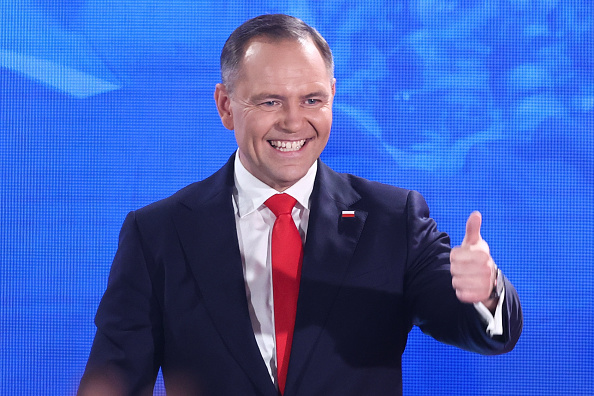
Polish President-elect Karol Nawrocki has expressed alarm at growing threats to Poland’s cultural heritage and historical memory under the government of Prime Minister Donald Tusk.
In a live broadcast on Telewizja Trwam and Radio Maryja, Nawrocki thanked his supporters and promised to stand as a firm counterweight to ideological pressure on Polish institutions, while also warning of growing dangers to national sovereignty.
“I am concerned about what is happening in Polish institutions and museums under Donald Tusk’s government,” Nawrocki said. “Historical pressure remains a crucial front in the defense of our sovereignty as a state.”
He strongly criticized recent developments at the Pilecki Institute and the Museum of the Second World War, accusing them of erasing Polish heroes and attempting to rewrite historical truth. In particular, he condemned the controversial description of Poles conscripted into the Wehrmacht as “our boys,” calling it a disgraceful distortion. In contrast, he praised the Museum of Poles Saving Jews as an example of proper remembrance.
“I will not allow Polish cultural heritage to be forgotten,” Nawrocki declared. “I will be a counterweight to many of the things that outrage public opinion, including in the context of artistic life and historical memory. A reinterpretation of historical truth is emerging, and I will safeguard Polish culture and national memory.”
As reported by wPolityce, Nawrocki also reaffirmed the president’s role as a guardian of the national community and Poland’s cultural legacy, which he said had been built over centuries and is now under ideological pressure. “Without our language and our cultural heritage, we would not exist as a nation,” he said.
In response to questions from viewers and listeners, including Poles living abroad, he thanked them for their prayers and support. “I am glad that Poles abroad feel responsibility for their homeland,” he said. “Thank you for praying for the filling of the Holy Spirit.”
He further promised to address the mounting problems faced by Polish farmers, who have been hit hard by rising costs, foreign competition, and European Union environmental regulations. “We need a broad package of solutions for Polish farmers, who are under pressure from the Green Deal,” Nawrocki said. “My office will review all agricultural-related legislation.”
The rhetoric cements concerns expressed by Tusk that his liberal coalition government will face stiff opposition from the presidency, which has considerable power in Poland to veto legislation that can only be overturned by a super parliamentary majority, a majority Tusk does not have.
Beyond cultural and agricultural issues, Nawrocki pointed to a growing concern among ordinary Poles: mass illegal immigration, increasingly spilling over from Western Europe. In recent months, local citizens’ initiatives have sprung up along Poland’s western border with Germany. These self-organized groups are now patrolling border areas, claiming to act in defense of national security and cultural identity amid a perceived vacuum of state response.
The Tusk government has responded with hostility, accusing the volunteers of promoting extremism and warning of legal consequences. Some officials have even suggested these groups could face prosecution. However, supporters of the patrols argue they are filling a critical gap, as Poland becomes increasingly exposed to the consequences of what they describe as Western Europe’s failed migration model.
Critics warn that the Tusk administration’s failure to act — and its apparent crackdown on citizen-led responses — signals a broader erosion of national sovereignty.
Ostatnie szlify nowej kancelarii 🇵🇱 pic.twitter.com/EyAxdEtWGO
— Karol Nawrocki (@NawrockiKn) July 14, 2025Nawrocki did not mention the patrols directly but spoke to the broader sense of civic responsibility among his supporters. “Thank you for being with me, for supporting me during the campaign. Thank you again for your prayers, your votes, and for the issues you raised during nearly 400 campaign meetings,” he said. “Be with your president on Aug. 6, if you can — and throughout the next five years as I serve Poland and the Polish people.”