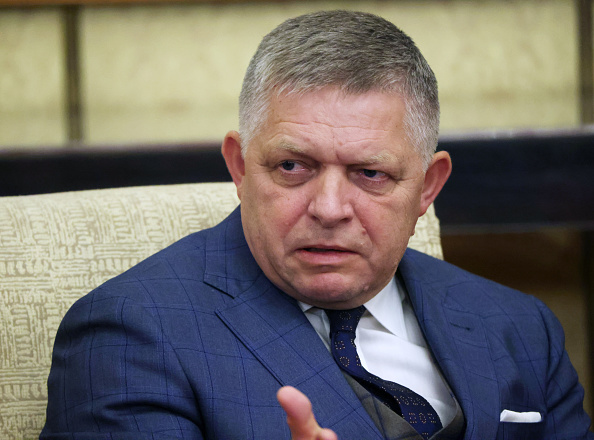
Slovak Prime Minister Robert Fico used a party event in Nitra on Monday evening to call for reform of Slovakia’s political system, arguing that the current party landscape undermines stable governance.
Speaking at a gathering titled “November 17 – Day of Respect for Other Opinions,” he said the country could not be effectively governed with dozens of parties competing in elections and governments formed through “broad coalitions” that ultimately see policies outlined in manifestos significantly watered down.
“Thirty-one parties cannot run, and we cannot form a government based on broad coalitions that are unable to function. This form of democracy is harmful to the Slovak Republic,” Fico told the audience at the Agrokomplex. Democracy, he said, should be “a democratic competition between the best for the best ideas,” but in Slovakia it had become “a sea for a ship of fools,” TASR reported.
Nov. 17 is marked in Slovakia as the anniversary of the 1989 Velvet Revolution, a national day commemorating the fall of communist rule and the restoration of democratic freedoms. Against that backdrop, Fico warned that the country had strayed from the principles secured after 1989, urging Slovaks not to forget life before the transition. He claimed that “people worked, created values, and then someone privatized and stole them.” He insisted that his Smer-SD party had “never adopted a law against democracy or restricting human rights” while in power. “We have not abused power, we have not used the police, we have not interfered in the affairs of other countries,” he added.
Veronika Remišová of the opposition For the People party sharply rejected his remarks, accusing Fico of misusing an anniversary devoted to democracy and freedom. “While all of Slovakia celebrated democracy and freedom yesterday, Robert Fico decided to commemorate the legacy of November ’89 in a way that only he knows how — by spreading conspiracy delusions and contemplating how to solidify his own power, while openly calling for a limit on the number of political parties,” she said, as cited by Pravda. Remišová urged the prime minister to stop undermining democratic norms. “If you are disturbed by the competition of many political parties and if you consider totalitarian regimes to be a model of perfect governance of the country, leave public life as soon as possible,” she said.
Deputy National Council chairman Tibor Gašpar echoed Fico’s message, arguing that opposition parties and activists do not respect democracy. He said many of the hopes of the Velvet Revolution had not been met and that societal tensions had worsened. Gašpar pointed to the shooting of the prime minister in May of last year as “the culmination of the hatred that prevails in society,” saying it targeted “first of all the person Robert Fico for having a different opinion, for having dared to say what values he professes.”
He called on the opposition to accept the results of the 2023 election. “I ask myself, what are you protesting against? In 2023, there were free elections, which resulted in a government headed by Robert Fico. Respect these results,” he said.
Even President Peter Pellegrini intervened, warning that Fico’s hardened political style was heightening tensions. “I do not think that the tough style of politics that he has been demonstrating in recent months is the right policy and the right type of politics that Slovakia needs,” he said. “On the contrary, it seems to me that the tension in society is becoming even more pronounced, and the prime minister must also realize that he is not just the prime minister of his party’s voters. He is the prime minister of the Slovak Republic.”