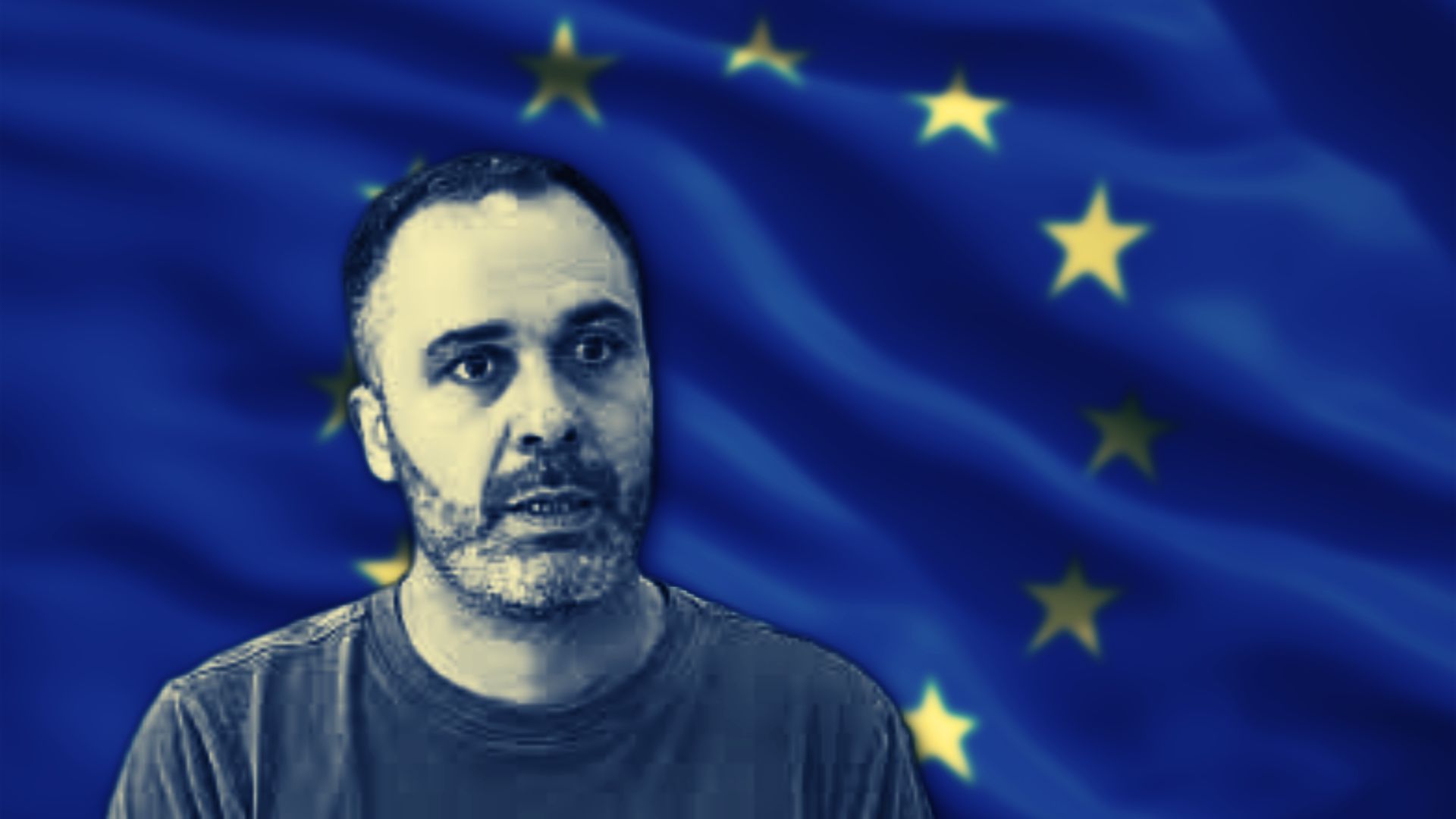
The Frankfurt am Main District Court in Germany has recently upheld a German bank’s decision to maintain the suspension of accounts belonging to Berlin-based journalist Hüseyin Doğru, who is known for his pro-Palestinian news coverage. The ruling rejected an urgent application by the journalist, who is currently facing the threat of homelessness due to EU sanctions. The court’s decision means Dogru remains without the necessary funds for rent or basic daily needs.
The legal battle surrounding Hüseyin Doğru has sparked intense political debate in Germany, with critics describing the case as a “socio-economic death sentence” and a dangerous precedent for press freedom. Certainly, these EU sanctions, which can freeze bank accounts, can be used to effectively target dissident journalists across the EU in the coming years.
According to the German court order, there was no right that would entitle Doğru, who has a Turkish background but also has German citizenship, to continue using his bank account while under sanctions. Berliner Zeitung reported that the judge determined that the situation lacked the “prerequisite for intervention in the urgent procedure” because “Doğru has no enforceable right to have the bank release the transfers it has requested.”
The impact of this ruling on Doğru’s personal life is severe. Expressing his concern for his family’s future, Doğru stated, “The risk of ending up on the streets with three children is a concrete threat.”
The paper notes that his “authorized €506 per month makes it impossible to support a family of five. Moreover, he cannot freely dispose of even that amount. The situation could become existential.”
While German law technically allows for a monthly subsistence allowance — cited in late 2025 as €506 — Doğru’s lawyers have had to repeatedly sue banks just to gain access to this minimum amount. His attorney, Alexander Gorski, described these tactics as a “war of attrition” designed to make social and economic participation “factually impossible.”
He also noted the extreme difficulty of maintaining a normal life under these conditions, remarking that “paying bills is practically impossible for me.”
Doğru has been on an EU sanctions list since May 2025, with Brussels arguing that his pro-Palestinian journalistic work incites “ethnic, political, and religious discord” and therefore, he allegedly supports “destabilizing activities by Russia.” Notably, he filmed a number of the occupations of Berlin universities by pro-Palestinian activists.
Doğru has denied these allegations, pointing out that he ended his previous employment with a Russian-funded outlet following the invasion of Ukraine and has publicly criticized the conflict.
Remix News already covered developments in this story at the end of January of this year.
At the time, Doğru, a left-wing journalist, said: “Not only I, but also my wife and my three children are effectively being sanctioned.”
“The sanctions themselves stipulate that I am entitled to access to essential funds. The fact that my bank is nevertheless blocking these funds violates applicable law in my view,” he continued.
The basis for the sanctions was his alleged connections to Russia, but the Berliner Zeitung indicated that so far, no proof has been presented to confirm this accusation, and more importantly, there was no trial or evidence provided to support this accusation.
“Brussels justifies the measures by saying that he is using his pro-Palestinian journalistic work to stir up ‘ethnic, political and religious discord’ and thus allegedly ‘destabilizing activities that support Russia.’ The EU has not yet publicly provided any concrete evidence of a connection to Moscow,” wrote the paper at the time.
There are now fears that the extraordinary case may be a sign of where the future is headed, where an authoritarian EU can censor and financially ruin dissidents and journalists with no oversight or judicial review. Notably, similar sanctions could also be deployed against others, such as Roger Köppel, the Swiss editor-in-chief of the weekly Die Weltwoche.
In a formal inquiry from the newspaper Junge Welt, the German Ministry of Economic Affairs clarified the severity of the “provision ban.” They stated that a sanctioned individual may receive “no economic benefit whatsoever,” including wages. This interpretation effectively bars any German company from hiring Doğru, as paying him would constitute a criminal offense.
An MP of the left-wing Social Democrats (SPD) Macit Karaahmetoğlu, defended the government’s position in the case and the sanctions, noting it was established to target those undermining “the security, stability, independence and integrity” of the EU. He emphasized that the German government “actively worked to establish and strengthen” this specific regime to counter hybrid threats.
Legal experts and journalists, however, have compared Doğru’s situation to “internal exile.” Since he is a German citizen, he cannot be deported, but the sanctions have stripped him of his identity card and barred him from all forms of employment.
Even friends and family who would like to donate money to Doğru could be targeted with criminal charges.
As Remix News previously reported, the sanctions had a devastating effect on Doğru and illustrate how they could be used to silence nearly any journalist, whether on the left or the right.
“I’m not allowed to pay my lawyer. I’m not allowed to buy water. I’m not allowed to provide my child with food. I’m not allowed to work. I’m not allowed to buy medicine. Every single monetary transaction with me is forbidden. Technically, you’re not even allowed to give me a basket of food because I could turn that technically into money. And this is forbidden.
And if I violate or you do, I don’t know about you, but if I were to violate one of these things, I could face like five years of prison time by avoiding sanctions technically, but they went further. I’m sanctioned, I’m on that list, but they also technically sanctioned my wife and our unborn twins because they froze older accounts. She is not allowed to receive her salary right now.
So in this moment, we technically have no money that we can access to go and buy something. There is also the problem because a lot of activists, journalists, colleagues, politicians and family members even said, ‘Should we send you money?’ We said, ‘Don’t do that. Don’t do that because you would be maybe categorized as avoiding sanctions.’ And this is the problem here. Sanction, as the European Union describes on their website, is a tool that is aligned with humanitarian law, which is not deemed to punish, but rather to change your behavior.”
For more information about the case, including the history of the sanctions, how they are being deployed, and the threat they represent, read more here.