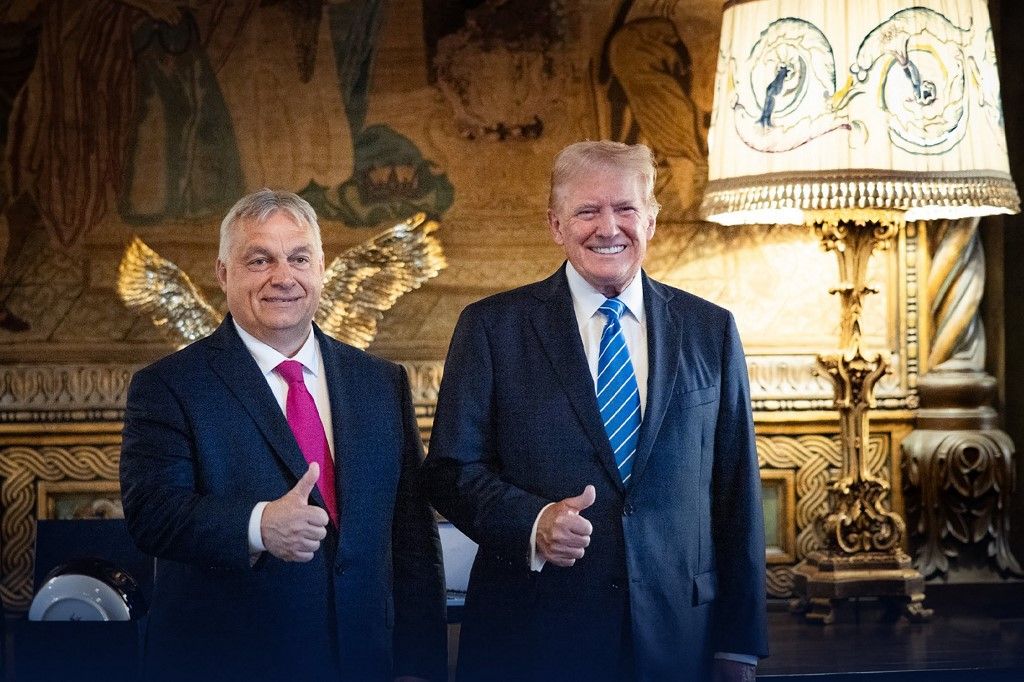
Following a phone call between Hungarian Prime Minister Viktor Orbán and U.S. President Donald Trump, the Hungarian government discussed some of the topics covered, including the ongoing war in Ukraine and Hungarian energy policy.
“The relationship is ongoing: Viktor Orbán and Donald Trump discussed the state of the war, the processes of the world economy, and the issue of Central European energy supply on the phone,” wrote Hungarian commentator Daniel Deak on Instagram.
Hungarian Foreign Minister Péter Szijjártó stated in New York that the Hungarian government is also in constant contact with the American leadership.
“We are also in constant contact with the American government. The prime minister also spoke with President Donald Trump recently, and several matters were discussed, the state of the war, the possibility of peace, the processes of the world economy, the situation arising from customs duties, and of course the issue of Central European energy supply. This happened a few hours ago,” Szijjártó said.
When asked, Hungarian Gergely Gulyás, the head of the Prime Minister’s Office, said that Trump clearly understood the Hungarian viewpoint on energy. Gulyás said the EU has been trying to force a divestment from Russian energy sources for years, and this same position has also been reflected in American rhetoric in recent weeks, he added.
“A government calculation was made in 2022 about the separation from Russian energy sources, and it was already obvious then that the cost reduction could not be maintained without Russian energy sources,” said Gulyás.
He also said that this government has done everything to ensure that the country can obtain energy from as many sources as possible. The main question is how much could be obtained now, both in quantity and price. However, he warned that it is certain that this would definitely be more expensive than today’s price from Russia.
Regarding the massive EU free trade deal with South America, known as the Mercosur agreement, the Hungarian government does not yet have a position. In response to another question, Gulyás said that there are currently two positions in the cabinet regarding the Mercosur agreement. The EU is currently trying to push through the deal, which will harm European farmers and flood Europe with cheap and unregulated farm goods from South America. It is also expected to drive down the price of produce and meat for Europeans, at least in the short term. So far, Hungary remains on the fence over the deal.