
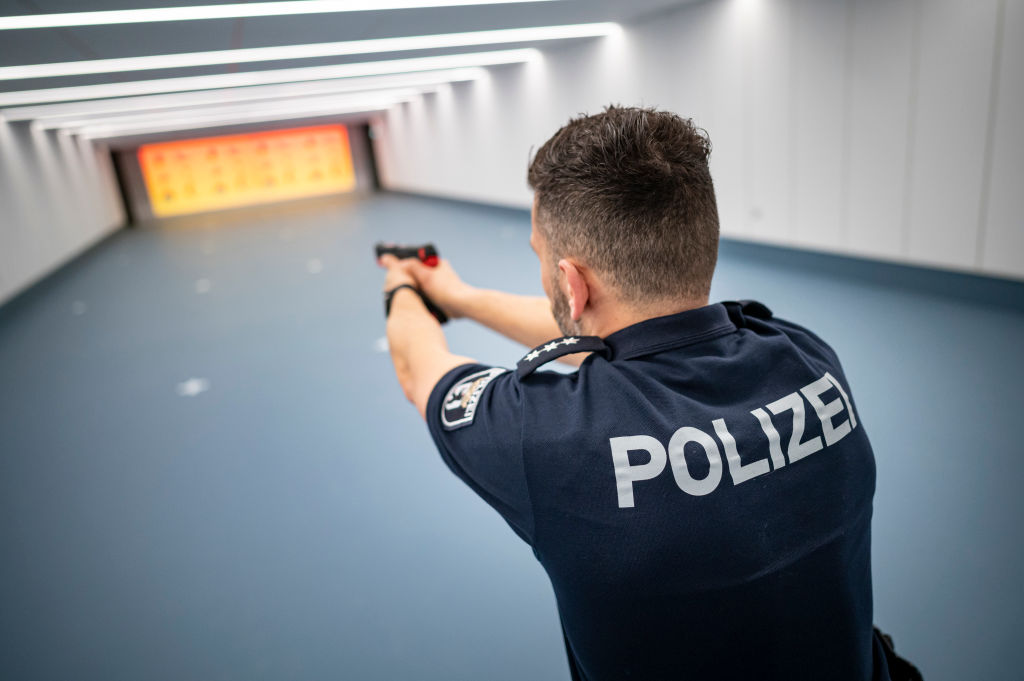
Gunfire has become a near-nightly fixture on Berlin’s streets, fueled by crime from migrants and those with a foreign background. For weeks, gang-related shootings have rattled the capital, and those police tasked with responding to them are increasingly frustrated — not just with the criminals, but with the politicians who are supposed to back them up.
The latest incident came Monday night in Schöneberg, where a 38-year-old man was gunned down. The suspects fled and remain at large. It was not an isolated case. Officers have been responding to shooting after shooting, and within the German Police Union — known by its German abbreviation GdP — patience is gone.
Spokesman Benjamin Jendro took to X to voice what many in the force are thinking: “It would be nice if politicians finally did something.”
Last year, Berlin saw a record number of shootings. The figures are striking. According to Berlin’s 2025 police crime statistics, firearms-related offenses — cases where a gun was either threatened or actually fired — surged to 1,119 cases, a jump of 68 percent compared to the previous year. Of those, guns were actually fired in 515 cases, up from 363 in 2024. Berlin is also the state that sees the most gun violence in all of Germany.
Interior Senator Iris Spranger of the SPD insists the city is taking action, according to German publication BZ.
“I do not tolerate armed conflicts in our city,” she said, invoking “zero tolerance for illegal possession of weapons.”
Jendro’s response to such assurances? “Too little is happening,” he said.
FDP state chairman Christoph Meyer, 50, offered perhaps the bluntest summary: “When shots are fired in Berlin almost every night, the state has a massive enforcement problem — that is not a feeling, that is reality.”
The GdP is pushing for expanded CCTV coverage and AI-assisted surveillance tools as the most effective way to get ahead of gang activity. But according to Jendro, the money simply isn’t there.
“Corresponding expenditures are not even included in the state budget,” he points out. Investigations are piling up faster than officers can process them. “We can’t keep up,” he said.
A recently overhauled law offered some hope, but without the money to implement it, Jendro dismisses it as “an empty shell.” His overall verdict on the political response is withering: “There is no uniform political strategy — often, it remains phrases.”
Berlin’s growing clan violence
To understand what is happening on Berlin’s streets, it helps to look back. Berlin’s crime gangs of Arab origin have long earned infamy with violence and brazen robberies. Often referred to as clans, their founders mostly arrived as refugees from war-torn Lebanon in the 1980s and other Middle Eastern states. They control the illegal drug trade, gambling, street prostitution, and protection rackets.
Now, that established criminal ecosystem has acquired a dangerous new dimension. Police say a new criminal network known as the “Daltons” — a group with roots in Turkey — has begun establishing itself in Berlin, with prosecutors currently pursuing around 200 investigations linked to the group and similar criminal enterprises. Authorities say the gang primarily targets Kurdish asylum seekers for recruitment, allegedly drawing them in through promises of money and status, with some recruits first approached in asylum centers.
The timing is significant. Authorities believe the Berlin underworld has become even more volatile following the death in January of Mehmet K., a prominent organized crime figure nicknamed “Kurdish Mehmet,” whose funeral required around 500 police officers to maintain order. “All hell is breaking loose in Berlin now,” one associate told German broadcaster RBB. “Everyone wants to make a name for themselves. I think things will get worse from now on, because Mehmet Abi is gone, and he was the one who made sure everything here went smoothly.
Other politicians weigh in
The CDU’s Burkard Dregger disputes that characterisation. He argues the criticism directed at the Senate is “completely unjustified” and cites the special unit Ferrum — up and running since November — as tangible proof of progress. The unit has opened 260 investigations, secured 13 arrest warrants, and taken 18 firearms off the streets. The coalition, he adds, has also “provided funds to acquire the necessary technology.”
Other parties have been more candid about the scale of the problem. SPD politician Martin Matz wants illegal weapons possession upgraded from a misdemeanor to a full criminal offense, though he acknowledges the decision lies beyond Berlin’s reach:
“This is only possible at the federal level in criminal law.” Green politician Vasili Franco, 33, did not shy away from the obvious: “It is a sad fact that the successes in combating organized crime are manageable.”
Transnational gang structures fuel crisis
What makes the situation particularly difficult is the nature of the criminal structures involved. Berlin’s clan crime report recorded 246 cases of bodily harm, three murders, 48 cases of serious bodily harm, 81 cases against personal freedom, 21 weapons and explosives violations, and 21 robbery cases in a single year — with the scene operating through legitimate businesses, including shisha bars, jewelry shops, and car rental companies used to launder money.
Berlin police warn that the Daltons’ international connections mean the problem cannot be solved locally, with the gang’s alleged leader believed to be operating outside Germany entirely. It is a reminder that what plays out on Berlin’s streets is not merely a local policing challenge — it is part of a transnational criminal infrastructure that has been building in the city for decades, and which successive administrations have struggled, and largely failed, to dismantle.