

Putin’s summer offensive was supposed to have given Moscow the upper hand, especially going into negotiations with U.S. President Trump, but this was far from the case, as highlighted by a recent piece in Die Welt.
Noting the muddy winter months to come, “a period of greater immobility” dreaded by soldiers, Schoker says Putin has failed to set up the desired “security zone” announced in May, and Russian forces are nowhere near capturing the capital of the Ukrainian border region of Sumy.
“The advance in the region has not even reached 10 kilometers into Ukrainian territory. And it is no longer an advance at all, but rather a rearguard action,” he writes, citing data from the Institute for the Study of War (ISW) that Ukrainian forces have meanwhile advanced in the northern part of the region.
ISW has a record of being pro-Ukrainian, but many in the West rely on its analysis and map information, and even Russian bloggers and experts closely track what the institute writes about the war.
Putin has also supposedly been fed misinformation as to the extent of Russian victories on this particular frontline, with ISW further claiming that Russian military bloggers are actively calling out Russian Chief of the General Staff Army General Valery Gerasimov’s report a “very big exaggeration.”
Russia has taken 3,500 square kilometers of Ukrainian territory and 149 settlements since March 2025? ISW says this is more like 2,346 square kilometers and 130 settlements, and again, nowhere near the primary objective of Sumy City.
And Schocker says the same is true along the entire front. “What’s happening in the Sumy region reflects the situation along the entire front: It’s a back-and-forth battle, with Russia suffering heavy losses. And even when Putin’s army manages to gain ground, it’s mostly fields, rows of trees, or small villages.”
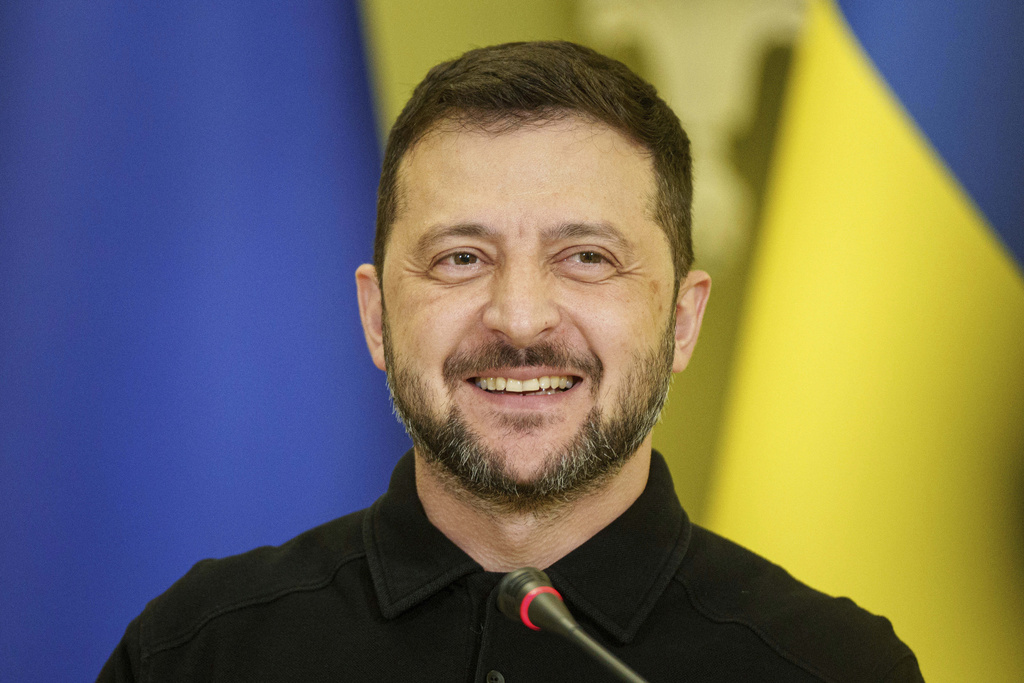
Meanwhile, Zelensky is celebrating various comebacks, most importantly in Dobropillya, where the Ukrainian leader just last week announced that forces had recaptured some 160 square kilometers and seven villages.
Kyiv has engineered a successful counteroffensive, protected the key city of Kramatorsk, taken 100 Russian soldiers prisoner, and even taken out a Russian supply convoy and Moscow’s comms in the region.
In addition, around 100 Russian soldiers were captured. He estimated Russian losses at 2,500 soldiers, including 1,300 dead.
None of Zelensky’s claims have been verified, and fighting continues in what is still contested territory. What is clear is that Moscow has made little headway.
However, Die Welt points out a perhaps far more important reality: “Ukraine is far less dependent on Western arms deliveries than it was a year ago.”
Citing a report out of Reuters, the piece notes Zelensky as saying that some 60 percent of its weapons will be manufactured domestically. This apparently includes the involvement of “Western partners in Ukraine,” i.e., Western arms manufacturers who have taken up production there.
“Ukraine is now even producing its own bunker-busting long-range weapons and is no longer just asking for weapons, but is also soliciting investment in its defense industry,” according to Reuters.
As a matter of fact, Ukraine expects to have a surplus of weapons from its newly burgeoning weapons business, so much so that Zelensky also announced last week “a controlled arms export program” to fund further drone production.
No word on whether Kyiv will be paid for training up allies on counter-drone warfare, but they are “lining up” to learn from Ukraine’s in-the-field expertise, with Poland already signing an agreement to do just this. Given the repeated incursions of Russian drones into Polish airspace, their need is evident.
Kyiv is also making advances elsewhere, namely, directly in Russia by way of repeated attacks on Russian oil refineries and pipelines. And Ukraine is also active over enemy territory.
According to Die Welt, Moscow’s oil revenues this year have plummeted 25 percent. The outlook for Russia’s finances is not good. “Added to this were low world market prices in the first half of the year and a stronger ruble. Revenue from oil and gas sales accounts for about a quarter of the Russian state budget. Moscow is now even discussing spending cuts and tax increases.”
In terms of perception, Moscow is also falling behind, according to Schoker. Countries such as Hungary and Slovakia may be calling out Ukraine for threatening their energy supply and heating for their citizens as winter nears. But Russia appears to have escalated bombings and drone attacks that lack any precision ordinances, which has increased civilian casualties.
“While Ukraine attacks the Russian oil industry, Putin’s army continues its attacks on civilian targets: Zelensky announced online that three people were killed and dozens more injured in heavy airstrikes on Saturday night. Russia fired 40 missiles and approximately 580 drones.”