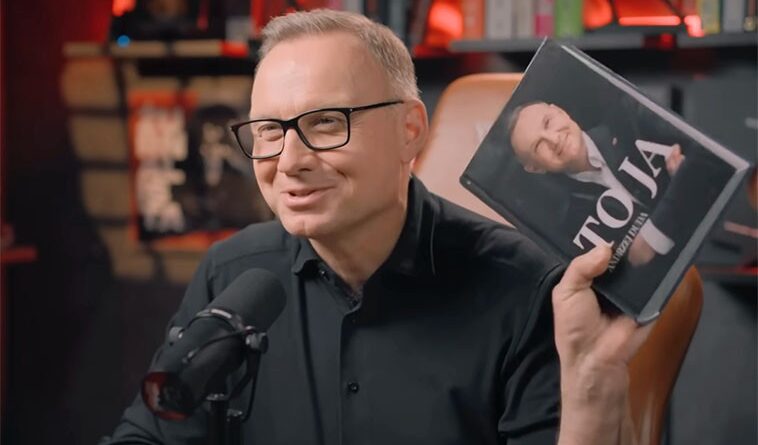
Former president Andrzej Duda has released a wide-ranging memoir that offers new details on his decade in office, including a striking claim that Ukrainian president Volodymyr Zelensky told him he learned about the Volhynia massacres only after assuming the presidency.
The 630-page book, “It’s Me,” spans 28 chapters and contains accounts of political disputes, foreign-policy negotiations, and personal experiences from his time in office.
He writes that he pressed the Ukrainian leader on the lack of marked mass graves and unresolved exhumation issues, telling him, “This is unacceptable to us. The sites of the mass graves remain unmarked to this day.” Zelensky, according to Duda, responded, “Believe it or not, I didn’t know about Volhynia for most of my life. In fact, I only heard about these crimes as president. It’s just that here in the east, they weren’t talked about at all; they weren’t taught in Soviet schools. A significant portion of Ukrainians have no idea what it’s all about.”
As reviewed by wPolityce, Duda also writes extensively about his relationship with the late president Lech Kaczyński, whom he describes as a political mentor. He says he viewed his own presidency as a continuation of Kaczyński’s vision and recalls their final conversations as decisive in his choice to run for office.
“We spent many evening hours in his office, while he explained various matters to me. He made a huge impression as a politician and visionary. When he died, I understood that my political master had passed away. I felt obliged to continue his ideas,” Duda wrote.
The memoir also outlines long-standing tensions with the Law and Justice (PiS) leadership. Duda writes that difficulties began immediately after his election and continued throughout his term, including disputes over staffing decisions and his veto of judicial reforms. He says that despite a decade marked by disagreements, he regarded PiS chairman Jarosław Kaczyński as a decisive political figure.
Duda devotes significant space to the role of the First Lady, Agata Kornhauser-Duda, describing her work over 10 years as unpaid, wide-ranging, and frequently overlooked. He writes that she carried out social and charitable activities while facing repeated criticism, particularly due to her refusal to give media interviews.
Foreign policy makes up a major section of the book. The former president describes extensive contacts with the United States during his term, including regular meetings with President Trump. He writes about negotiations over the U.S. missile-defense base in Redzikowo and says he repeatedly raised concerns about the Nord Stream 2 pipeline with former German Chancellor Angela Merkel. According to Duda, Merkel responded that she had no influence over the project.
The book highlights several strategic initiatives pursued during his presidency, including the Three Seas Initiative, the Baltic Pipe, and domestic energy and infrastructure projects. Duda writes that the Three Seas Initiative grew from an early concept focused on energy independence into a broader regional framework supported by the United States.
Duda writes that although his presidency has ended, he intends to remain active in public life.