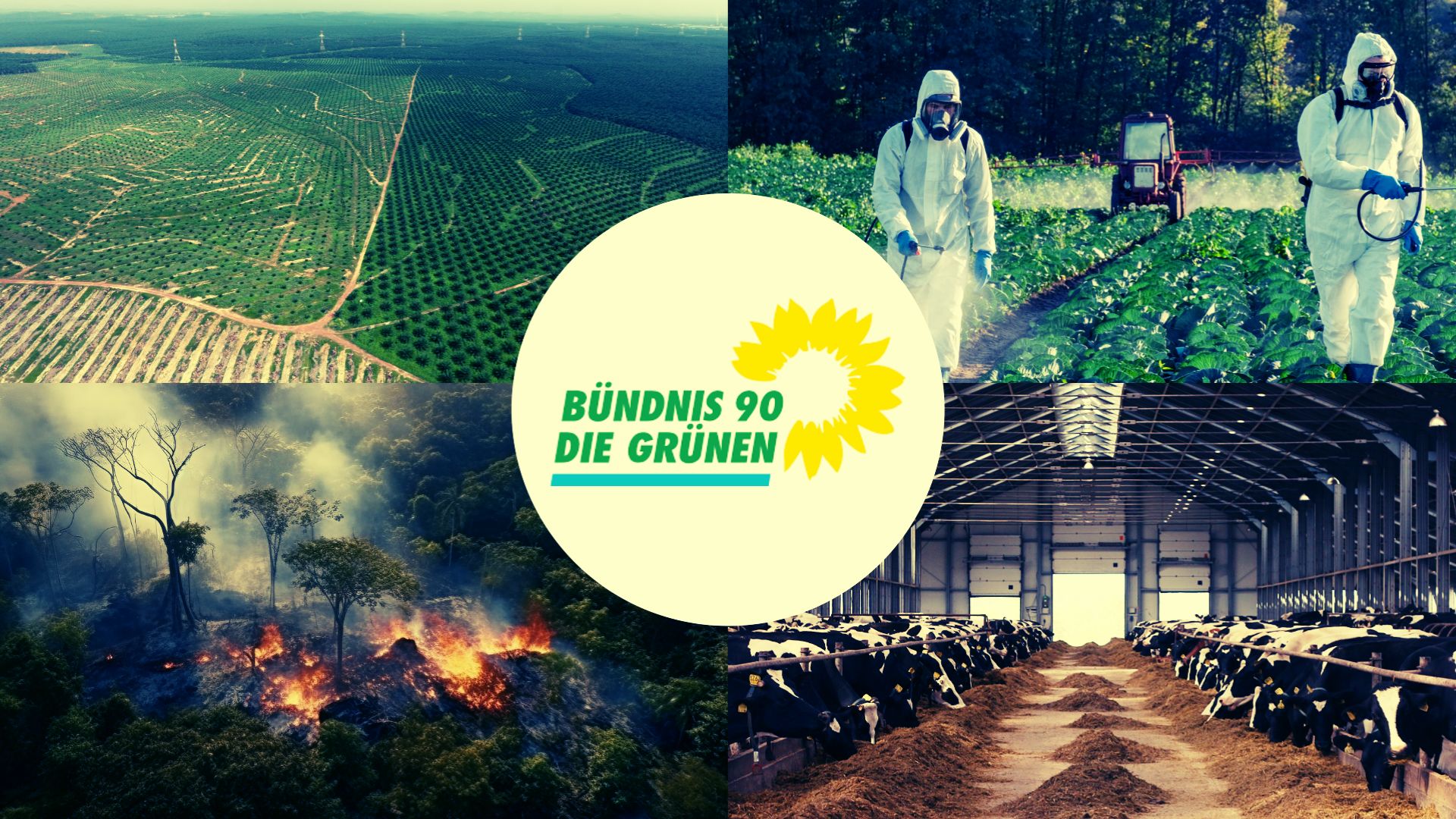
While the German Green Party frequently parade themselves as climate protectors who support organic food and eating local, their recent maneuvering over the Mercosur trade agreement has exposed a staggering level of environmental hypocrisy. Despite a platform built on reducing carbon footprints and protecting biodiversity, the party is fracturing over a deal that would facilitate shipping food halfway across the globe, flood European markets with products grown with high pesticide loads, and further incentivize the destruction of the South American rainforest.
The Green delegation in the European Parliament recently voted to delay the agreement by referring it to the European Court of Justice (ECJ). While they frame this as a “legal review,” critics see a party that is happy to champion environmental standards at home while entertaining a trade deal that lacks binding controls for violations in the Amazon rain forest, along with plenty of other vulnerable environments in Argentina, Brazil, Paraguay, and Uruguay.
🇫🇷🇪🇺 26-year-old French organic farmer, Anaïs Foulquier, says that the EU's new Mercosur free trade deal with South America will destroy her farm.
"We are young organic farmers. We rear our own goats, dairy cows and laying hens. We respect everything, the standards, the… pic.twitter.com/UyJjN0cWY8
— Remix News & Views (@RMXnews) January 20, 2026This internal rift in the Greens has sparked public infighting. German Green Party leader Felix Banaszak is attempting to balance the party’s “firewall against the right” with the reality that his own MEPs effectively voted with many right-wing parties in the EU parliament. The vote means that the Mercosur agreement could be delayed by up to 18 months.
The Greens are notorious for betraying their party roots, including their previous anti-war stance that the party was founded on. However, their latest positioning on the Mercosur agreement is truly astounding, as nearly every aspect of the free trade agreement violates their core tenets.
Rainforest destruction
Studies and government analyses cited by critics estimate that the agreement could increase deforestation in the Mercosur region by at least 5 percent per year over a period of six years. One study suggested up to 700,000 hectares of forests could be destroyed in the first year alone due to increased beef exports, according to a Veblen Institute study.
According to Earth.org. “Globally, 80 percent of the land cleared for cattle grazing and animal feed monocultures is used for meat production. In Brazil, the world’s largest beef exporter, cattle farming is the single largest driver of Amazonian deforestation and conversion of native vegetation to areas of pasture. Here, the rate of deforestation increased by 60 percent between 2016 and 2020, with approximately 580,000 hectares (5,800 square kilometers) of forest cut down in one year to create pastures.”
Pesticides
Any Green Party voters are notorious for being opposed to pesticides, which have been linked to a threat to human health, environmental destruction, and the ongoing eradication of insect populations.
In fact, former German Minister of Agriculture Cem Özdemir, who is now locked in an election battle to lead Baden-Württemberg, has now turned on his own colleagues for their “lack of pragmatism.”
“Apparently, too many still don’t understand the seriousness of the situation. European sovereignty must prove itself in concrete action, the time for cheap lip service is over,” Özdemir posted on X.
Incredibly, he wants to bypass the EU parliament, the only real democrtically elected body in Brussels, and explicitly encourage EU Commission President Ursula von der Leyen to bring the agreement into force provisionally. In other words, he wants no delay to Mercosur and believes von der Leyen should bypass the parliament’s vote.
There is big business at stake for Europe, after all. Germany accounts for 16 percent of the sales of pesticides to Mercosur, while France accounts for 37 percent, according to Greenpeace. Brazil is the largest consumer of pesticides in the entire world, and much of that pesticide use is being deployed on former rainforest, which has been burned and clear-cut to make room for massive monoculture crops and cattle farming. Greenpeace further writes:
“Brazil‘s agriculture model is based mainly on large-scale monoculture systems producing agriculture commodities. This agriculture business model is dominated by large corporations and is closely linked to the destruction of natural ecosystems such as forests. It requires large amounts of natural resources, emits greenhouse gases and is especially dependent on the use of pesticides that pose great risks to humans and the nature.According to the Food and Agriculture Organization (FAO) 20, around 380,000 tonnes of toxic substances ended up on Brazil‘s farmland in 2017 (around 634,000 square kilometers at that time 21). To meet the high demand for pesticides, Brazil imports large quantities of pesticide active ingredients, which are subsequently further processed in the country.”
Remarkably, Özdemir has previously been a central figure in efforts to restrict and ban various pesticides, both within Germany and at the European Union level. As the former federal minister of food and agriculture, he has championed several key initiatives aimed at reducing chemical pesticide use.
Özdemir was a vocal supporter of the EU’s Sustainable Use Regulation (SUR), which aimed to cut chemical pesticide use by 50 percent across the EU by 2030.
Now, his promotion of Mercosur would flood Europe with the same chemicals he was previously trying to ban or greatly reduce. Özdemir is, in short, a remarkable hypocrite.
The deal would create one of the world’s largest free trade zones, yet it offers little to address the “boomerang pesticides” that are banned in the EU but used in Mercosur states. The lack of enforceable safeguards means that while the Greens talk about “EU standards,” they are implicitly backing a system where environmental protections are compromised for market access.
After all, the deal is labeled the “cows-for-cars” trade deal for a reason. German companies, including automobile manufacturers and chemical companies, want access to South America, and for the Greens in Germany, business interests, lobbyists, and mega agricultural corporations now come first. The Mercosur agreement will tighten the screws on organic farmers, who will find it even harder to compete against cheap and substandard South American food.
The left turns its back on climate change
Özdemir is far from the only high-ranking German Green Party official slamming the Greens who voted against the deal. Current MP and former Minister for the Environment, Nature Conservation and Nuclear Safety Jürgen Trittin criticized the EU parliament voting bloc as being “without a compass.” He even went so far as to say that the Green MEPs contributed “to the right-wing farmers’ lobby and anti-Europeans blocking a step towards greater EU sovereignty by a 10-vote majority.”
Ohne Kompass: 8 deutsche #Grüne und 3 deutsche #Linke haben dazu beigetragen, dass rechte Bauernlobby und Anti-Europäer mit 10 Stimmen Mehrheit einen Schritt zu mehr Souveränität der #EU blockieren konnten #Mercosurhttps://t.co/hRH5k6QeSB
— Jürgen Trittin (@JTrittin) January 21, 2026While the Greens often attack Chancellor Friedrich Merz for accepting AfD votes in the Bundestag, Banaszak found himself making excuses for the same behavior in Brussels. He argued that „The situation is complex,“ and tried to distance the Greens’ coordination from Merz’s past actions: „What Friedrich Merz did in the German Bundestag last year: He knew he would ultimately have a majority with the AfD. And he accepted that.“
Banaszak admitted he was “not happy“ with the optics, stating: „I deeply regret that such a vote has now been held and that this result has been achieved. But one must acknowledge that the situation in the European Parliament is different.“
It is not just the Greens either. Other left-wing parties that claim that climate change is at the top of their agenda, such as the Social Democrats (SPD), are slamming the move to temporarily block the Mercosur deal.
“The fact that some Greens, together with AfD and Left Party, are delaying the entry into force of the Mercosur agreement in the current political situation is politically stupid and instinctless,” stated Dirk Wiese, the first parliamentary secretary of the SPD.
On a broader scale, the fact that much of the left in Europe voted for Mercosur should bury the idea once and for all that any of these people care about the rainforest, local food production, the environment, or climate change.
Remarkably, it is now the European right that played the decisive role in stopping the Mercosur agreement.
Do we now live in a world where the right cares more about climate change and farmers’ rights than the Greens? Looking at this monumental vote against Mercosur, it certainly looks like it.