

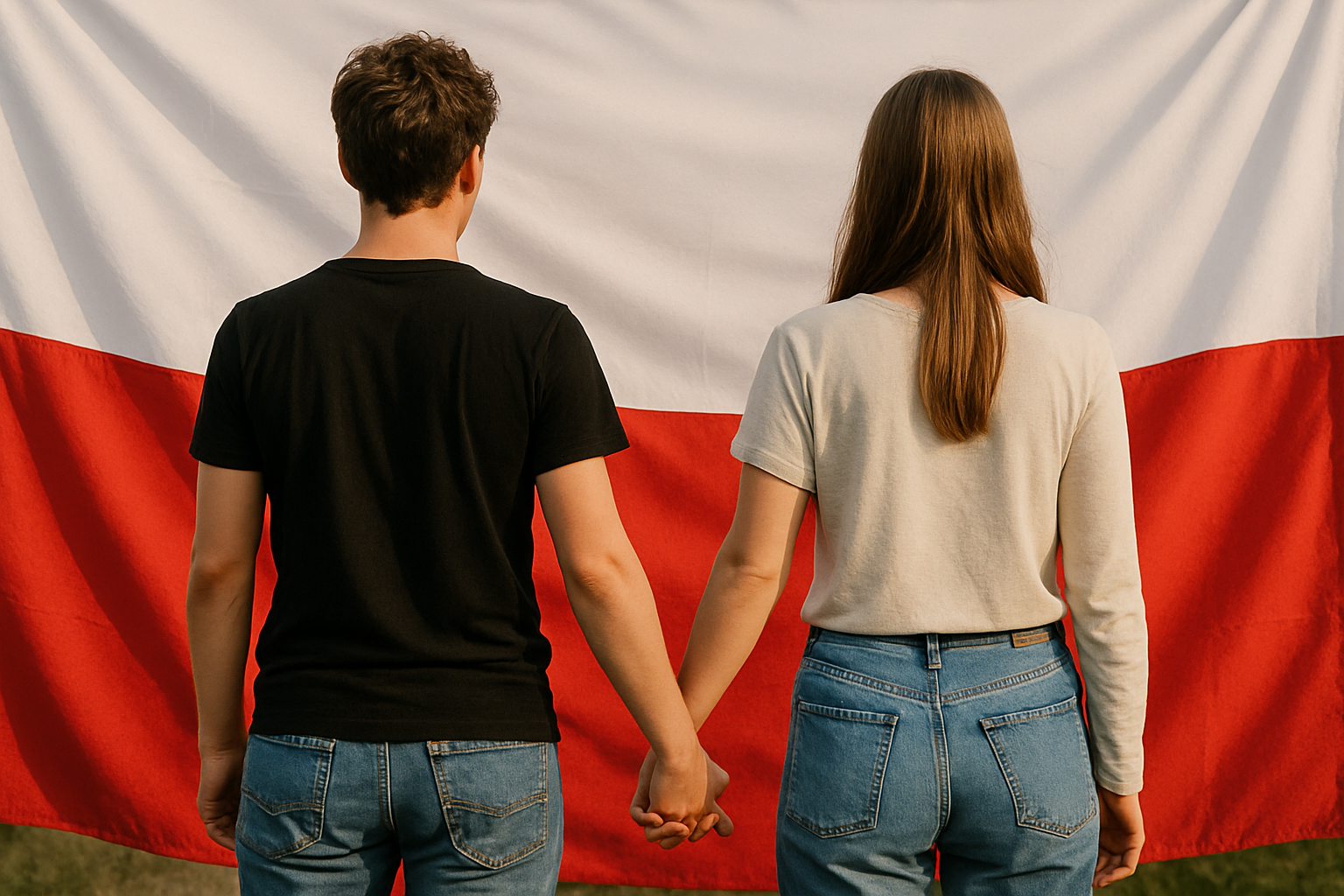
As Poland seeks solutions to its demographic collapse, Poles need to consider why people are not getting married, says Polish demographer Mateusz Łakomy, author of “Demography is the Future.”
His analysis may apply to countries around the developed world, which are seeing a birth collapse at a time when owning a house and steady employment seem like distant and unattainable goals for the vast majority. Lakomy also gives his assessment at a time when Poland is generally considered to be the worst country in terms of fertility in Europe.
In an interview with KAI, cited by the Do Rzeczy news portal, Łakomy notes that the decline in birth rates is a global phenomenon that seriously prevents the proper formation and growth of societies—economic development, productivity, innovation, and even a certain level of state functioning.
“The demographic collapse isn’t just a Polish problem. It’s a challenge facing many developed countries today, while a decline in birth rates compared to 100 or even 50 years ago can be observed worldwide, including in countries where fertility rates are still very high,’ he said.
Łakomy sees little prospect of the current downtrend changing. The demographer points out, people today, unlike for most of human history, are in nearly complete control of their procreation process.
“Today, we largely decide whether, when, and how many we will have, although, of course, there are times when, for various reasons, we can’t have children,” he points out.
According to Łakomy, the vast majority of people want children, though perhaps not necessarily many children. He also emphasizes that people who are in relationships and raise children are the least likely to experience the loneliness that plagues modern societies.
The reason, the demographer explains, that young adults in Poland are failing to bear children is that they face difficulty in forming relationships. In the 18-29 age group, almost 45 percent do not even have a boyfriend or girlfriend and are not dating, let alone a husband or wife. Only 12 percent of Poles in this age group are married.
Łakomy says there are three main reasons for this: the educational imbalance between women and men, the difficult experiences young people have in their own families, and the rise of smartphones.
Once a relationship is formed, further barriers to fertility emerge for these young Poles, the primary ones being the lack of stable employment and not having their own apartment or home.
Those who are more religious do still have more children. However, the once-common belief that less educated people have more children is a myth, says Łakomy. In developed countries today, the exact opposite is true: educated people have more children because they often find it easier to overcome the challenges of forming (and maintaining) relationships and securing stable employment—and having their own living space.
Should the state or the Church get involved? Łakomy emphasizes it is crucial to reach out to young people, creating spaces for them that are not only pastoral and formative, but also social.
🇵🇱🇺🇸Poland is much safer than the US, says Polish-American supermodel Joanna Krupa.
She directly refers to the murder of Ukrainian refugee Iryna Zarutska, who was killed by a career criminal with 14 convictions.
"I certainly feel more secure in Poland than in the States."… pic.twitter.com/eCGIieS5nG
— Remix News & Views (@RMXnews) September 23, 2025He also highlights the importance of pre-marriage courses, which are often the only space where young people today can learn a little about the dynamics of relationships, ask themselves difficult questions, work through certain difficulties, and learn that one does not remain in the initial phase of falling in love for the rest of their lives, notes Do Rzezcy.
As to the Church, Łakomy is blunt: “If we want our children to have a better chance of having a happy family in the future and would like to have grandchildren, it’s worth raising these children with some contact with faith and a religious environment.”