
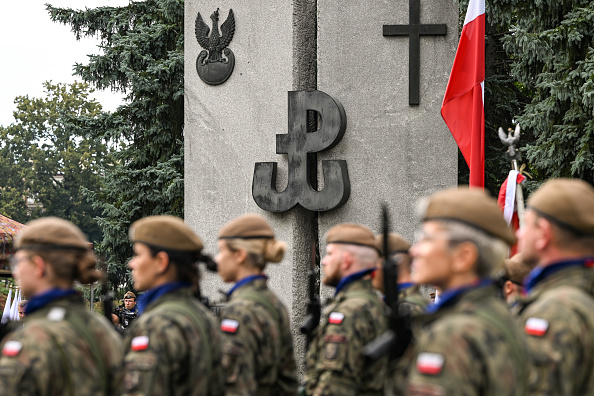
Poland commemorated the 81st anniversary of the Warsaw Uprising on Friday with solemn tributes, public gatherings, and official ceremonies honoring the tens of thousands who died in the 1944 revolt against German occupation.
Ceremonies began at the monument to the Polish Underground State and the Home Army, near the Sejm in Warsaw. Senate Speaker Małgorzata Kidawa-Błońska was among those laying wreaths.
President Andrzej Duda and President-elect Karol Nawrocki visited Warsaw’s Wola district to honor victims of the Wola Massacre, where Nazi forces carried out one of the war’s most horrific atrocities, killing tens of thousands of civilians in the first days of the uprising.
“Even in conditions of German cruelty and barbarity, we were ready for a military uprising, a social uprising. We were ready for deep sacrifice, to give our lives for a free and independent Poland,” said Nawrocki.
He emphasized that the uprising was rooted in a long Polish tradition of resistance, adding, “It was an arch-Polish uprising because that is who we are.”
Trwa Marsz Mokotowa w rocznicę #PowstanieWarszawskie pic.twitter.com/iCWFgE99PF
— Paweł Rybicki (@Rybitzky) August 1, 2025The uprising began at 5:00 p.m. on Aug. 1, 1944, with sirens ringing out across the city. Some 40,000 to 50,000 Polish resistance fighters rose up, expecting to hold out for only a few days. Instead, the fighting lasted 63 days, claiming the lives of approximately 18,000 insurgents and 180,000 civilians. The vast majority of Warsaw’s population was expelled, and the city was left in ruins by German forces who slaughtered Poles at will in an attempt to quash the rebellion.
President Duda, speaking alongside Nawrocki, described the massacre as “the most horrific event in the history of what we call the Wola Massacre,” and accused Nazi leaders of deliberately ordering the extermination of the city’s population in response to the uprising.
Powstanie Warszawskie było arcypolskim powstaniem. My tacy jesteśmy – że nawet w warunkach niemieckiego okrucieństwa i barbarzyństwa gotowi byliśmy do głębokich poświęceń, do oddania swojego życia za to, aby Polska była wolna i niepodległa. pic.twitter.com/Dbh0F7eVrP
— Karol Nawrocki (@NawrockiKn) August 1, 2025Public commemorations include the annual minute of silence at 5:00 p.m., when the entire city comes to a halt. Sirens wail and church bells ring out as pedestrians, cars, and public transport pause. In Castle Square, residents form the iconic Fighting Poland symbol and light candles at the Mały Powstaniec (Little Insurrectionist) monument, remembering the child soldiers who fought and died in the atrocity.
🇵🇱 1 sierpnia, 81 lat temu wybuchło Powstanie Warszawskie. 🇵🇱
Armia Krajowa ruszyła do walki z niemiecką armią, a warszawiacy włączyli się do pomocy Powstańcom. 🇵🇱 Była to Bitwa o Polskę, bo chcieli być wolni – i tę wolność wywalczyć sami. Dzisiaj oddajmy im hołd. 𝐖… pic.twitter.com/UKtjNNBuIt
— MuzeumPowstania1944 (@1944pl) August 1, 2025The Polish and Warsaw Aeroclubs mark the occasion by drawing the emblem of Fighting Poland in white smoke over the city skyline. A banner reading “We Remember 1944” is flown along the Vistula River.
A flotilla of boats, including city ferries and waterworks vessels, sails up the river in a symbolic reenactment. A wreath is cast into the water near the Poniatowski Bridge, recalling the site where the ship “Bajka” was sunk during the uprising.
Later in the day, a traditional march organized by nationalist groups will proceed from Dmowski Roundabout to Krasiński Square, and residents gathering in Piłsudski Square for a concert of songs forbidden under Nazi occupation.
Jarosław Kaczyński, president of the Law and Justice (PiS) party, also took part in official events and reflected on the political and moral legacy of the uprising.
“It was the largest armed operation of the underground in the entire Second World War,” he said, while also acknowledging the longstanding debate over whether the uprising should have been launched at all. He questioned how it was able to last so long, and what lessons it might hold for today.
“Because Poland is once again under threat,” Kaczyński added.
The German Embassy in Warsaw also issued a statement acknowledging the atrocities committed by German forces. “We commemorate the victims of German barbarity. We honor the heroism of the Warsaw Uprising fighters. Flags flown at half-mast are a symbol of our mourning and shame,” the statement read.