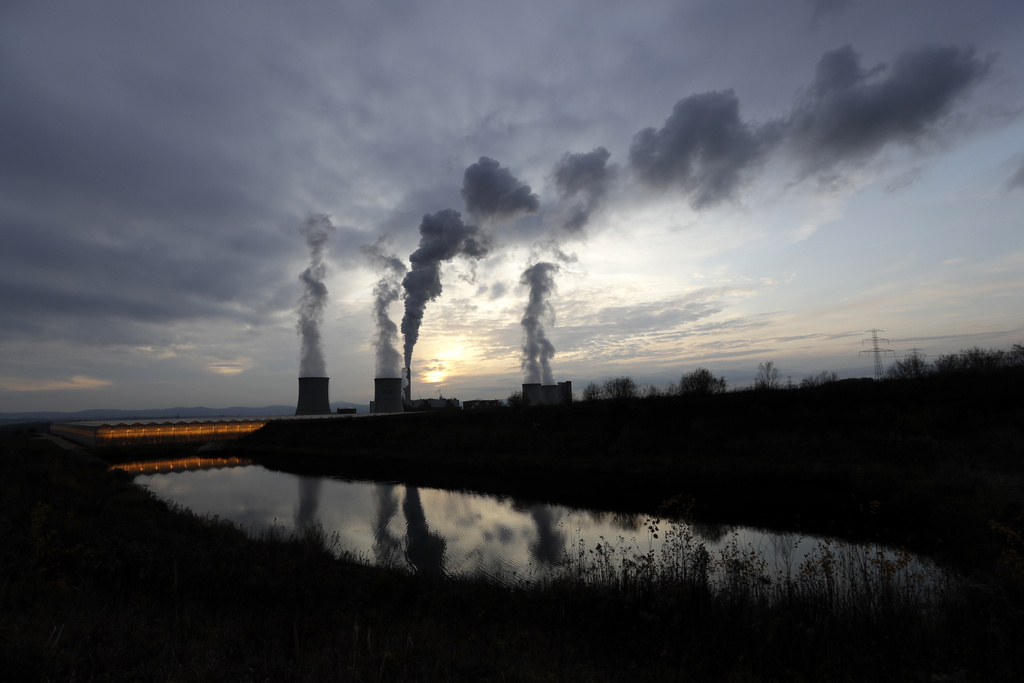
Polish President Karol Nawrocki is prioritizing nuclear power in the Polish energy mix, avoiding the transitional inclusion of gas, with the government focused on building the first nuclear power plant in Lubiatów-Kopalin.
Before his trip to Davos, Nawrocki had met with entrepreneurs to discuss Poland’s accession to the G20. In his speech, he presented his vision for Poland’s future energy mix. At the beginning of the year, the Sejm (lower house of parliament) almost unanimously passed a law to support the construction of the first nuclear power plant in Lubiatów-Kopalin, Pomerania, with over PLN 60 billion (€14 billion).
Negotiations on the contract for the construction of Poland’s first nuclear power plant (EPC) are expected to be completed by mid-year. Preliminary work on the plant’s construction site and the preparation of associated infrastructure are also scheduled for this year. Furthermore, in the first quarter, PEJ will soon submit an application to the National Atomic Energy Agency for a permit to build a nuclear power facility, Deputy Minister of Energy Wojciech Wrochna told Business Insider.
Experts confirm the long-term energy efficiency of nuclear power compared to other sources, such as renewables or coal.
Marcin Izdebski, an expert at the Center for Development Strategies, told the portal: “Renewable energy installations operate for 15-25 years. Nuclear power has a much longer lifespan, lasting 60-80 years. Furthermore, nuclear power doesn’t require balancing like renewable energy, which increases its economic efficiency. It’s most justified to build nuclear power plants where coal-fired units currently operate. Otherwise, these locations face economic collapse.”
“The government has a very rational and pragmatic approach to energy. We are by no means ideological about any source—neither coal, renewable energy, nor nuclear power. We are pursuing a policy aimed at achieving three goals: energy security, reducing CO2 emissions, and economic competitiveness. We view Poland’s future energy mix solely through the prism of these three issues,” Wrochna explained.
Construction of the first reactor of the Lubiatowo-Kopalino nuclear power plant is set to begin in 2028, while the plant is scheduled to become operational in 2036.
One source close to President Nawrocki also told Business Insider that he hopes to avoid natural gas altogether. “The president’s goal is for us not to make a hasty transition by replacing coal with gas, but to immediately switch from coal to nuclear power. For the head of state, stability is paramount, as it is not just an economic issue but also a component of national security.”
Wojciech Dąbrowski, former president of the Polish Energy Group under PiS, pointed to the risks of gas reliance. “Some point to gas, but it’s a fuel highly susceptible to various geopolitical turmoils. This must not be forgotten, as we don’t have sufficient gas resources of our own and must import about 80 percent of it. Therefore, gas can only be a useful supplement.”