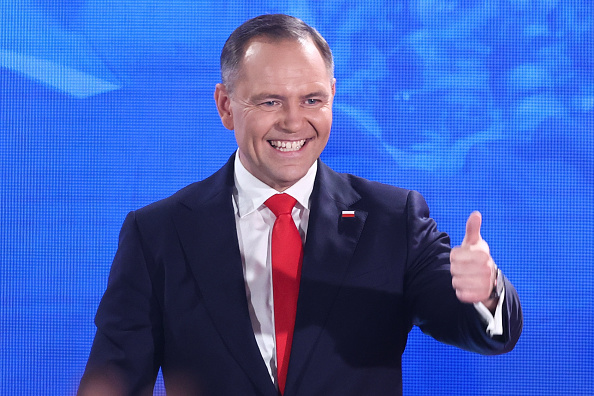
Loránt Sümeghi, a senior analyst at Budapest’s Századvég Public Knowledge Center Foundation, says the Polish right wing is on track for victory in 2027 in his op-ed for Magyar Nemzet.
When the right-wing candidate Karol Nawrocki won a decisive victory in the second round of the Polish presidential election in June, the local press, as well as the European press, devoted considerable attention to the future of Poland’s domestic politics and its relationship with the EU. The conservative reporting, which was already considered to be too loud at the time, has once again stirred up a lot of controversy across Poland now that Nawrocki has taken the oath of office a few days ago.
The reason for this is primarily that it is clear from numerous articles that, despite the statements of Prime Minister Donald Tusk, who leads the left-wing government coalition, trivializing the presidential election results, the impact of Nawrocki’s victory cannot be interpreted as a mere symbolic defeat suffered by the left. This is because the victory of the Polish right this year should not be interpreted in the light of the victory of the left-wing government coalition in the parliamentary elections two years ago.
After all, Nawrocki’s rise to power was not the culmination of a voter protest against a fundamentally stable left-wing government, but quite the opposite.
🇵🇱🔥 Polish President @NawrockiKn's inauguration speech in the Polish Sejm. ⬇️
"This election was a message to the political class that they cannot continue to govern like they have been.
My plan is clear:
🔴 NO to illegal migration
🟢 Yes to the złoty
🔴 NO to the euro!" pic.twitter.com/UIYb0rzFGg
— Remix News & Views (@RMXnews) August 6, 2025The victory of the right wing was nothing more than a sign of the revival of the conservative camp, which has remained numerically the same since the 2023 elections, and is preparing for a confident victory in the parliamentary elections due in 2027.
How accurate this statement actually paints a picture of the collapsing state of the Polish left – in connection with which Tusk’s circle has so far been unable to produce anything substantial other than crisis communication – is well illustrated by several public developments in recent weeks.
It is worth noting for the first time that although it may have seemed like a forward-thinking idea on the part of Tusk’s government in terms of communication to immediately request a vote of confidence against themselves in the weeks following their defeat in the presidential election, the relief resulting from the subsequent authorization did not generate as much political momentum as the government had expected.
This is also supported by the large-scale attempt at internal political transformation that became public within a few weeks of the vote of confidence. As part of this, Tusk implemented not only drastic structural but also radical personnel changes, as a result of which ministries were abolished, and he slimmed down the previously 26-member cabinet to 21 members. The list of those leaving included names such as Justice Minister and Prosecutor General Adam Bodnar, who was responsible for overseeing the politically motivated purges; but the previous Interior Minister Tomasz Siemoniak was also transferred, whose name was often associated with the overly assertive actions of the law enforcement forces during right-wing opposition demonstrations.
But the crisis symptoms of the governing coalition were not only revealed by the sudden and large-scale attempt at internal transformation, but also by the wave of demonstrations that unfolded across the country, which, appealing to the results of the presidential election, demanded the resignation of the puppet government from Brussels.
This was the first mass demonstration since the right-wing victory in June, where protesters specifically criticized the left-wing government’s pro-immigration migration policy and Tusk’s servility to Brussels’ dictates. As one of the organizers of the movement, Krzysztof Bosak (Confederation), the deputy speaker of the lower house, said at the demonstration, “Enough is enough of the mass immigration policy imposed by the EU and supported by Donald Tusk’s government. We will not allow a repeat of what is happening in Western Europe: crime, chaos, and the loss of national identity.”
In light of recent events, which clearly show that the left-wing government coalition, which is not free from internal divisions, is in the process of being repaired, it is perhaps not so surprising that Donald Tusk is still trying tooth and nail to stay in power.
This is also supported by the prime minister’s disturbing words, which he articulated following Nawrocki’s inauguration as head of state, after the new president drew attention to the importance of restoring the rule of law.
As Tusk said in response, “the arrogant and confrontational desire to possess the powers that the prime minister and the government have in the Polish political system is very palpable […] if necessary, we will stand firm in defending the constitution.”
What mandate does the Tusk government, which has become famous throughout Europe for trampling on the rule of law and democracy, and which has organized political persecutions based on revenge, forcing some right-wing former government members to seek asylum in some neighboring countries – including our country – have in the matter of protecting the Polish constitution, is a good question.
If we look at the data of a recent opinion poll, which shows that every second Polish voter demands the immediate resignation of Prime Minister Donald Tusk, then we can say without any exaggeration that it has absolutely nothing.