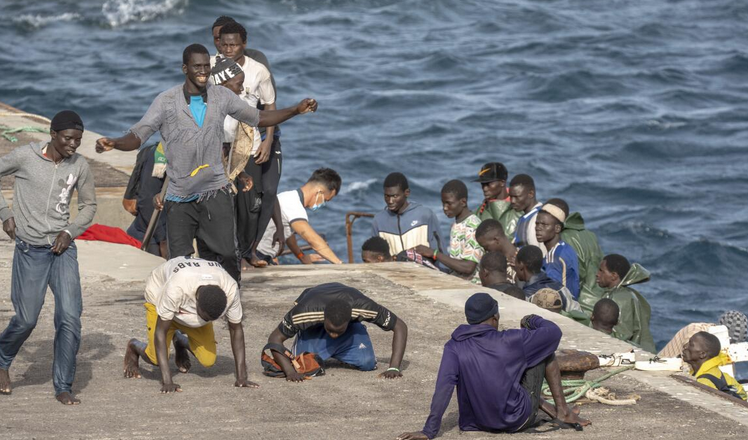
The Spanish government has asked the European Commission to help facilitate the redistribution of migrants arriving in the Canary Islands to other parts of Europe as part of a broader package of measures aimed at easing the demands placed on the archipelago.
Economy, Trade and Business Minister Carlos Cuerpo outlined the proposals in Spain’s Congress of Deputies on Wednesday during a question session with Canary Coalition deputy Cristina Valido, who raised concerns about pressures facing the islands.
Cuerpo said Madrid had submitted a package of initiatives to Brussels designed to reinforce economic and social stability in the region, adding the government was willing to examine “all proposals” aimed at guaranteeing the archipelago’s “territorial cohesion.”
🚨 The Spanish government says it has asked the European Commission to transfer the illegal immigrants who arrive in the Canary Islands to the other EU countries.
The mafias must be loving it… pic.twitter.com/CKSBepVcNM
— Canario Today (@CanarioToday) February 12, 2026Cuerpo said the government is seeking mechanisms to allow redistribution of unaccompanied migrant minors and transfer migrants arriving in outermost regions to other European territories to prevent what he described as an “overconcentration” of migrants in areas such as the Canary Islands.
The Spanish government is effectively asking Brussels to take immigrants off its hands and move them to other countries that have strengthened their borders, despite only last month announcing a mass amnesty for over half a million illegal immigrants, which Spanish conservatives have said is creating a pull factor for new arrivals, predominantly from the African mainland.
Spain’s population has meanwhile reached record levels. Data from the National Institute of Statistics, published on Thursday and cited by La Gaceta, shows the immigrant population surpassed 10 million for the first time, rising by roughly 540,000 in the past year and by about 2.5 million over four years.
The country’s total population reached 49,570,725 inhabitants as of Jan. 1, 2026, after growing by 81,520 people during the final quarter of 2025. Colombians, Venezuelans, and Moroccans were the largest nationality groups arriving in Spain during the last quarter of 2025, according to official data.
Soon, member states will be obligated under the controversial EU Migration and Asylum Pact, due to fully enter into force in June 2026, to accept relocated migrants or contribute financially if they refuse participation in relocation schemes.
Several governments in Central and Eastern Europe have signaled opposition to mandatory redistribution policies, including Hungary, Poland, Czechia, Slovakia, Austria, and even in the Balkans, where Latvian Foreign Minister Baiba Braže recently told parliament that her country’s position remained firm against illegal migration, stating border protection had been strengthened and rejecting forced migration policies from Brussels.
Migration pressures continue in Spanish territories beyond the Canary Islands, including the North African enclaves of Ceuta and Melilla. While migrants arriving now are not eligible under the current regularization program, critics argue that such measures create expectations of future leniency.
Spain’s right-wing Vox party has strongly condemned the government’s policy. Party leader Santiago Abascal said, “500,000 illegals! The tyrant Sánchez hates the Spanish people. He wants to replace them. That’s why he’s promoting the pull factor to accelerate the invasion. We must stop him. Repatriations, deportations, and remigration.”
In Aragón’s regional elections earlier this month, the first public test since the amnesty announcement, Vox significantly increased its vote share to double its seats, while support for Prime Minister Pedro Sánchez’s Socialist Party plummeted.