
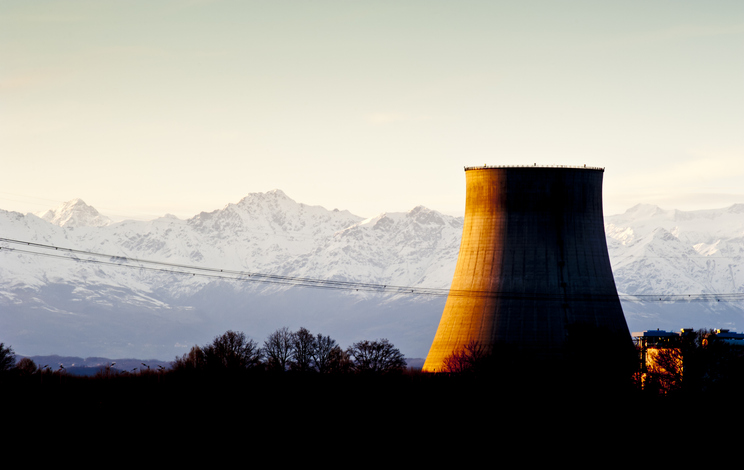
The Italian government is preparing to relaunch nuclear power after more than three decades of absence, in what ministers have called a “historic turning point” for the country’s energy policy.
On Thursday, the Council of Ministers is set to approve an enabling bill that paves the way for a National Program for the Development of Sustainable Nuclear Energy, with a final ruling expected in Parliament in the coming months.
Environment and Energy Security Minister Gilberto Pichetto, who is spearheading the initiative, said the aim was to guarantee national energy security while meeting climate commitments. “I respect all ideological positions, but I hope the debate focuses on the content, the science, and the national interest,” he said.
“We need to explain what new nuclear energy is, which is not the atomic bomb, and what needs to be done to provide the country with security and a regulatory framework for future generations, given the expected explosion in energy demand.”
As reported by Il Giornale, the bill sets out a legislative framework for the construction of new-generation reactors, the management of nuclear waste, training of technical staff, and reorganization of oversight responsibilities. It introduces faster approval procedures, declaring nuclear projects of public utility and national interest, thereby limiting the possibility of local resistance or bureaucratic delays.
The new law also allows for public-private partnerships, replacing earlier rules that placed the financial burden exclusively on private operators.
Waste management, long cited as a barrier to nuclear development in Italy, is also addressed in detail, with provisions for both temporary storage and permanent disposal. Safety and radiation protection will be required to meet international standards.
The government has stressed that this program represents a break from past nuclear projects, which were abandoned after two national referendums in 1987 and 2011. Instead, Rome is focusing on advanced technologies such as Small Modular Reactors (SMRs), microreactors, and fourth-generation fission. Investments in nuclear fusion are also included, signaling a long-term commitment to innovation.
According to government projections, nuclear energy could provide between 11 and 22 percent of Italy’s electricity supply by 2050, reducing reliance on fossil fuels and cutting decarbonisation costs by as much as €17 billion by mid-century.
Pichetto has previously stated that he is convinced Italy will have nuclear power back on the grid by 2030.
The initiative aligns Italy with several other European countries that have maintained or expanded nuclear energy programs, including France, Poland, Hungary, Czechia, Slovakia, and Sweden.
In contrast, Germany abandoned nuclear energy under the previous SPD-led government, officially closing its last nuclear power plants in April 2023 following an elongated phase-out.
Ironically, Europe’s largest economy was forced to import huge volumes of nuclear-generated electricity from France at the beginning of the year due to a shortage, just weeks before the federal elections.