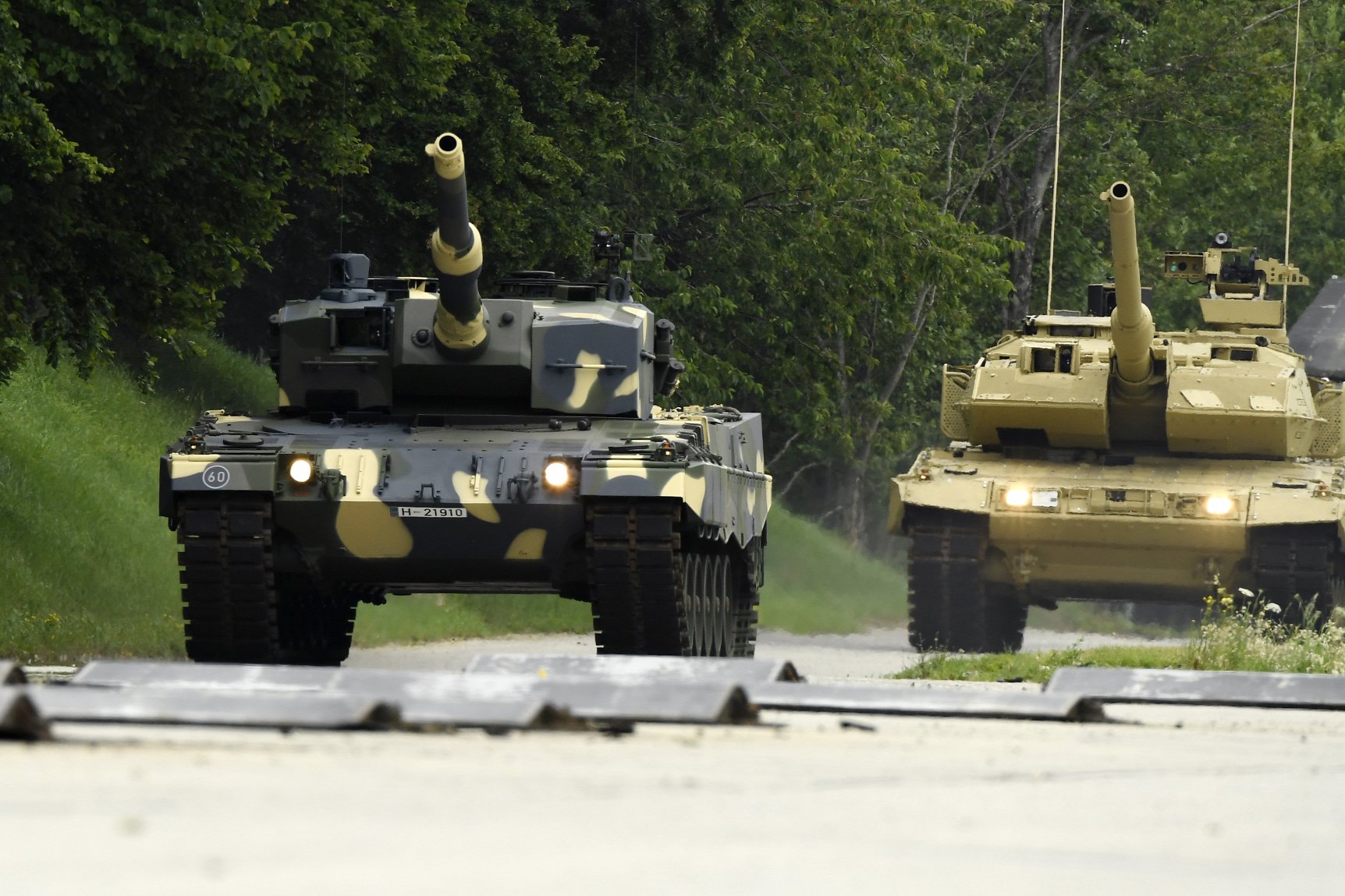
Hungary has announced the addition to its military arsenal of the Leopard 2 A7HU, “one of the most modern tanks in the world,” but some are asking about the future of tanks on the battlefield, given that so many have been taken out by drones on both the Russian and Ukrainian side.
Bálint Somkuti, a military historian and security policy expert, spoke to Mandiner about the usefulness of tanks in today’s warfare, especially with the emergence of drones.
“When aircraft carriers appeared, many declared that battleships were the end of the world, but in comparison, they were still in service in the United States Navy 40 years later. And when nuclear-powered submarines appeared, aircraft carriers were buried, but in comparison, they are fine, and are still considered the most advanced assets of the fleets,” he explained.
It should be noted that many believe traditional battleships are in need of a major overhaul to incorporate drone technology as well.
Nevertheless, Somkuti stresses that this new Leopard has “an active protection system, which will significantly increase the tank’s survivability.”
“Drone technology has not actually changed war primarily because they can destroy tanks with them, but because reconnaissance drones have made it impossible to conduct a deep breakthrough, a kind of ‘blitzkrieg’ warfare, the essence of which is to break through the weakest part of the front line quickly and unexpectedly. There are so many reconnaissance assets in the air and in space that this is no longer feasible. And it is relatively easy to strike at detected tank formations with either artillery or anti-tank weapons,” the expert told Mandiner.
Also, with effective drone jamming tech, tanks can operate as usual, he noted.
“If tanks were an obsolete tool, like biplanes are, no one would make them. In comparison, tank production is thriving, alive and well in Russia and China, as well as in the United States – where a new type of tank was recently designed and then abandoned – and next-generation tanks are also being designed in Europe.”
“The kind of mobile firepower that a tank has is simply still unavoidable. Today, not necessarily fighting directly alongside the infantry, but from a kilometer or two behind the front line, it can effectively support the infantry’s fight with direct fire, which is still essential,” he said.
“It is still impossible to imagine breakthroughs and deep-space operations without tanks. In the Russian-Ukrainian war, the question arises as to whether tanks still have a right to exist, as the number of tanks destroyed in the conflict has increased significantly due to drones and other means. However, most videos showing tanks being destroyed by drones show stationary, damaged, immobile vehicles.”
“Information has been received from several places that both the Ukrainians and the Russians use 50-60 drones to destroy a single tank,” Somkuti noted.
“A tank must first be immobilized before it can be destroyed by drones. In many cases, you see abandoned tanks being destroyed because the vehicle’s hatches are open,” he added.