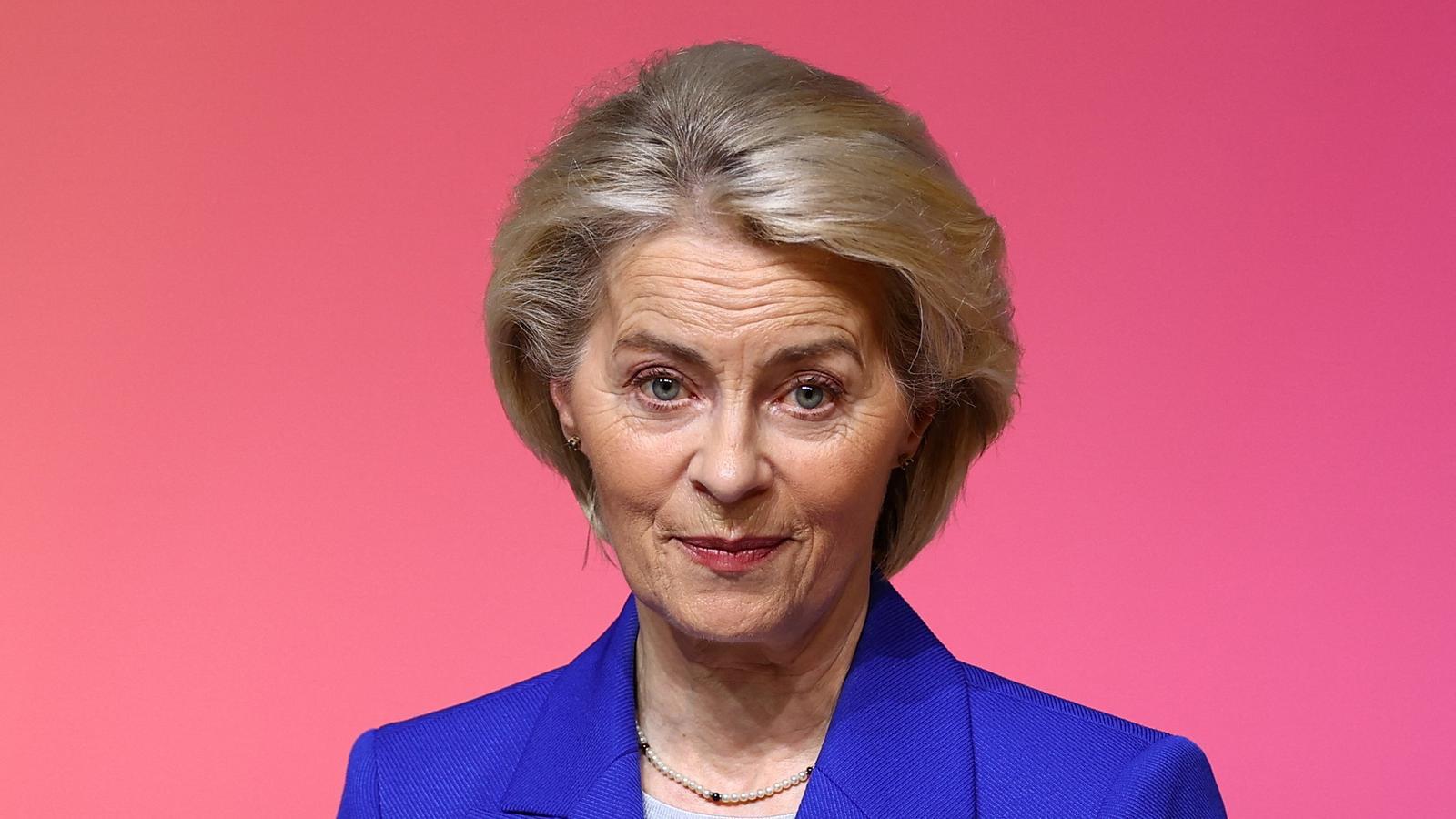
European Commission President Ursula von der Leyen has called for Europe to lead a revival of nuclear power, despite having personally supported the decision to phase out Germany’s nuclear energy sector while serving in Angela Merkel’s government.
Speaking on Tuesday at the Nuclear Energy Summit in Paris, von der Leyen argued that nuclear energy must become a central pillar of Europe’s energy system alongside renewables, warning that high electricity prices threaten the continent’s industrial competitiveness.
“Europe’s electricity prices are structurally too high. This matters enormously,” von der Leyen said. “Affordable electricity is not only important for our citizens’ cost of living, but it is also decisive for our industrial competitiveness.”
She argued that Europe faces a structural disadvantage because it relies on imported fossil fuels, adding that nuclear and renewable energy together could provide the “joint guarantors of independence, security of supply, and competitiveness.”
Von der Leyen also said Europe had made a “strategic mistake” by allowing nuclear energy to decline over the past three decades.
“While in 1990 one-third of Europe’s electricity came from nuclear, today it is only close to 15 percent,” she said. “This reduction in the share of nuclear was a choice. I believe that it was a strategic mistake for Europe to turn its back on a reliable, affordable source of low-emissions power.”
The Commission president outlined plans to revive the sector through support for next-generation reactors and small modular reactors (SMRs), including a proposed €200 million EU guarantee scheme aimed at attracting private investment into innovative nuclear technologies. The EU is also preparing a strategy designed to make SMR technology operational across Europe in the early 2030s.
Yet, von der Leyen’s remarks stand in contrast to her own role in the decision that dismantled Germany’s nuclear energy supply.
Following the Fukushima nuclear disaster in March 2011, Merkel’s government abruptly reversed Germany’s earlier pro-nuclear policy and pushed through legislation to phase out the country’s reactors. On June 30, 2011, the German Bundestag voted overwhelmingly to end nuclear power by 2022, passing the measure by 513 votes to 79.
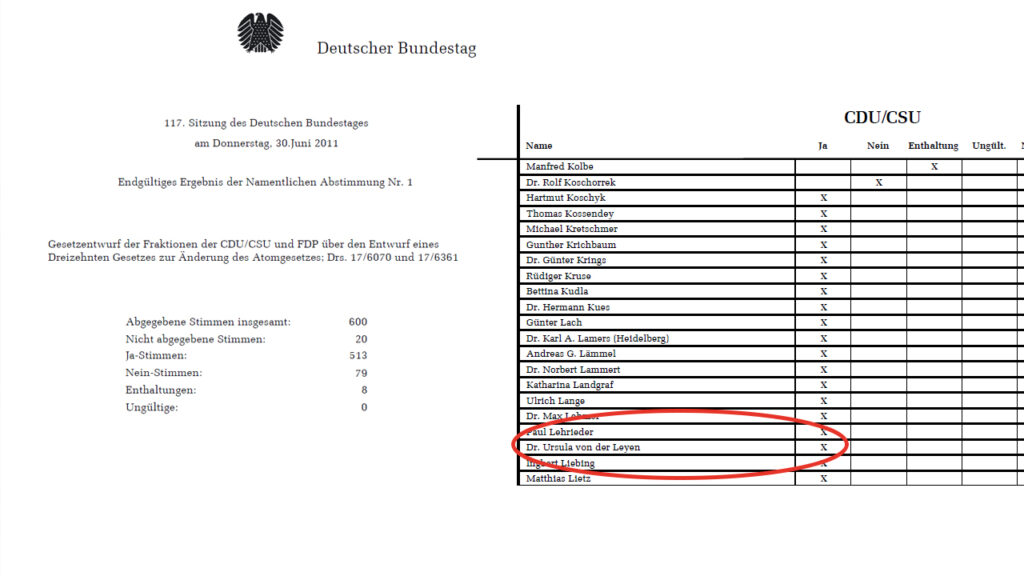
At the time, von der Leyen was both a CDU member of the Bundestag and serving as Germany’s federal labour minister in Merkel’s cabinet. She voted in favor of the phase-out.
The policy, known as the Energiewende, ultimately led to the closure of Germany’s final nuclear power plants in April 2023.
The decision contributed enormously to Europe’s broader energy crisis, forcing Germany — Europe’s largest economy — to rely increasingly on electricity imports, including nuclear-generated power from neighboring countries, driving up energy prices for families and businesses.
During periods of weak wind and solar generation, Germany has repeatedly had to import large volumes of electricity from France, where reactors operated by Électricité de France continue to supply nuclear power to the grid.
While Germany phased out its nuclear power with the implicit support of the European Commission, other countries were not so short-sighted. France erred on the side of caution by keeping its plants operational, while many countries across Central and Eastern Europe, including Poland and Hungary, ramped up their nuclear energy production.
Last year, energy economist Manuel Frondel of the RWI – Leibniz Institute for Economic Research warned that Germany’s energy policy had left it exposed.
“By phasing out nuclear power and coal, we have become heavily dependent on foreign countries and accepted higher supply risks,” Frondel said.
Von der Leyen, a proponent of the Merkel government’s decision to self-harm, now argues that Europe still has the capacity to regain global leadership in nuclear technology.
“The nuclear tech race is on, but we know that Europe has everything it needs to lead,” she claimed.