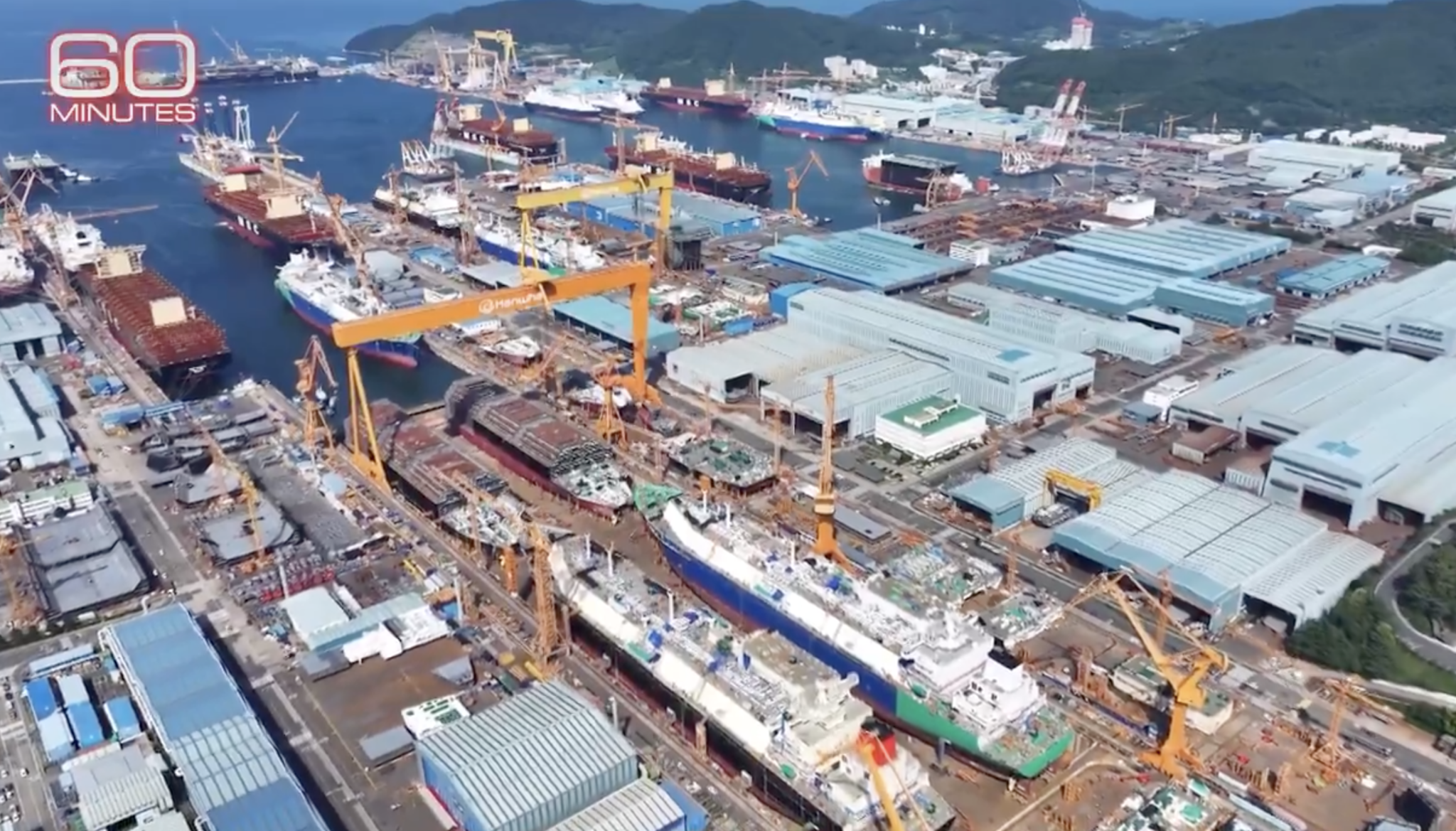
South Korea’s shipyards are racing past American shipyards — all without mass immigration. This is the fifth installment in the series known as the “big immigration lie,” which explores the soaring innovation and economic success of Asian countries that have closed the door on mass immigration (part 1, part 2, part 3, part 4).
In a new 60 Minutes news clip, the hosts marvel at the achievements seen in South Korea’s ship building industry. The program shows how South Korea is utilizing automation and robotics to fuel its manufacturing sector with virtually zero immigration.
🇰🇷🇺🇸South Korea's shipyards are racing past American shipyards — all without mass immigration.
In the 60 Minutes video below, the program shows how South Korea is utilizing automation and robotics to fuel its manufacturing sector with nearly zero immigration.
"He showed us how… https://t.co/v90DSqC267
— Remix News & Views (@RMXnews) March 25, 2026“He showed us how far ahead they are technologically. Rows and rows of robots,” exclaims the host, with the video panning to masses of robots welding and assembling ships.
Despite a rapidly dwindling population, South Korea has chosen to employ its own ethnic workforce and supplement it with high-tech robotics and automation. This automation and success has actually led to an employment boom in shipbuilding.
South Korea’s shipbuilding industry is experiencing significant siuccess as of early 2026, characterized by high-tech advancements and soaring profits. Major shipbuilders like HD Hyundai and Hanwha Ocean have secured large orders, including LNG carriers, and reported substantial 2025 sales growth, holding roughly 20-22 percent of the global market share.
More broadly speaking, South Korea frequently leads the world in innovation, often ranking higher than the U.S. and Germany in R&D intensity, patent activity, and manufacturing value-added.
Although economists in the West have harped on the economic benefits of diversity and mass immigration, South Korea maintains a highly restrictive immigration system, balancing labor shortages with a policy preference for temporary, non-permanent migration. It focuses on utilizing the Employment Permit System (EPS) for less-skilled roles, restricting employee movement, while offering limited paths to long-term residency or citizenship.
This is virtually the same story seen across Asia. China, also known for its incredibly strict immigration policy to ensure cultural and societal harmony, accounts for two-thirds of all civilian ship production in the world. Asia, in other words, now dominates the global shipbuilding industry from top to bottom — and has done so without opening its borders.
In fact, as noted frequently in this series, China has fewer foreigners in the entire nation of 1.4 billion than Germany has in just one city, Berlin. Yet, Europe is the one headed to China on bended knee to beg for economic help.
China almost completely rejected mass immigration and has about as many foreigners in the country as just one German city, Berlin.
🇨🇳All of China: 845,000 foreign nationals
🇩🇪Berlin: 860,000-870,000 foreign nationals
By the EU left-liberal establishment's own logic, China… pic.twitter.com/ADPyiaWvKi
— Remix News & Views (@RMXnews) December 9, 2025It is not only the United States that is struggling to even build a submarine, which is vital to its military defense. Other nations like Germany and Britain are also seeing pain in their shipbuilding industries, just as they have seen pain across virtually all manufacturing sectors over the last decades.
In Germany, the partially nationalized Meyer Werft shipyard in Papenburg — once a crown jewel of European shipbuilding — has become a cautionary tale of industrial mismanagement and government dependency. Secret audit documents revealed losses of €260 million in 2023, €575 million in 2024, and a projected further loss of €271 million in 2025 — totaling approximately €1.1 billion in losses over just three years.
The previous German government under Chancellor Olaf Scholz injected €400 million in emergency equity in 2024, provided by the federal government and the state of Lower Saxony, only for those funds to be rapidly exhausted. A staggering €2.6 billion in state guarantees remains on the line.
Auditors raised the alarm as early as September 2025, warning of “significant doubts” about the shipyard’s viability and explicitly flagging a “risk endangering the existence” of the company. Taxpayers are left holding the bill while the yard fights for survival.
Meanwhile, Britain’s story is one of longer, slower decline.
Once the undisputed shipbuilding capital of the world, Britain has largely ceded commercial shipbuilding to Asia over the past half century. Today, the UK industry survives almost entirely on government defense contracts — frigates and naval vessels built by BAE Systems and Babcock International — with virtually no meaningful presence in the commercial cargo or passenger vessel market, where Asian yards have taken complete dominance.
The famous Harland & Wolff yard in Belfast, where the Titanic was built, recently had to be rescued by Spain’s state-owned Navantia after teetering on the edge of collapse. Britain’s own National Shipbuilding Strategy, launched with great fanfare in 2017 and refreshed in 2022, promised that key contracts would go to domestic firms — but an independent review found that those contracts ultimately went abroad anyway.
The left’s ideology meets reality
Without any regard to reason to introspection, the left would have the West believe that open borders immigration is necessary for economic success, despite Asia proving their theory wrong every step of the way.
South Korea and China have built the most formidable shipbuilding industries in human history with homogeneous workforces, ruthless investment in automation, and zero appetite for mass migration.
Meanwhile, Western nations that have pursued the opposite model find themselves dependent on government bailouts, watching historic yards collapse, and importing ships they once built themselves.
To add to the dilemma, the education systems of most Western nations are in shambles, in large part due to mass immigration. This means that while Asia is investing in its future, even if that future includes a shrinking population, countries like Germany are piling billions into a failed ideology of mass immigration that is only exacerbating economic decline.
In the end, the West can import millions from Africa and the Middle East, but these regions of the world feature incredibly low patent activity, low innovation, and very few examples of successful high-end manufacturing. The shipbuilding industry offers a clear and uncomfortable lesson: Demographic transformation is not an economic strategy.