

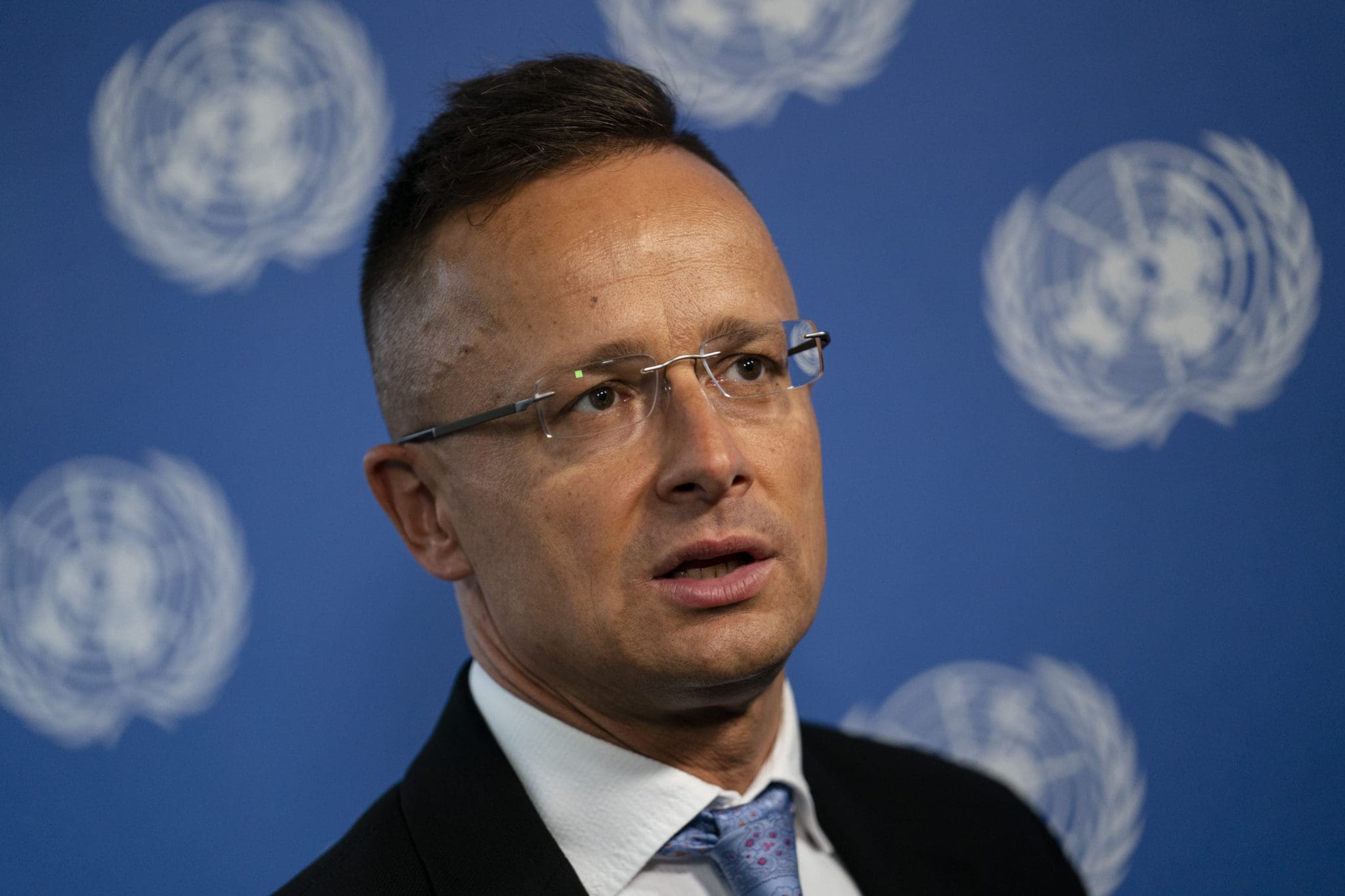
Last week, anti-Orban journalist Szabolcs Pannyi made headlines for claiming Hungarian Foreign Minister Péter Szijjártó had violated confidentiality agreements with the EU Council for speaking between meetings with his counterpart in Brussels. The problem? As foreign minister, Szijjártó speaks to counterparts in many multiple countries, as is the norm for someone in his position and presumably other council members, with colleagues being more in favor or less in favor of the aims of those discussions. The EU is a political entity that engages other political entities, even those with whom it may disagree, so the premise that one member may not do so is a tad far-fetched.
The bigger problem was that Pannyi allegedly obtained recordings of these “illegal” discussions via a very illegal wiretap, reportedly with the assistance of another EU member, rumored to be Poland, whose Foreign Minister Sikorski has long been known to be keen on replacing Orbán and whose wife is American journalist Anne Applebaum, who has long made a career of animosity towards Orbán.
Now, a “new” report is out from foreign-funded, anti-Orbán portal VSquare, except there does not appear to be much new in it.
Szijjáró himself made a good summary of it with a post on X. “It has long been known that foreign intelligence services, with the active involvement of Hungarian journalists, have been intercepting my phone calls,” he began his post.
“Today they have made a new ‘major discovery’: they proved that I say the same publicly as I do on the phone. Nice work!”
Referencing his very public work against Russian sanctions, the Hungarian foreign minister continued: “For four years we have been saying that sanctions are a failure, causing more harm to the EU than to Russia. Hungary will never agree to sanction individuals or companies essential for our energy security, for achieving peace, or those with no reason to be on a sanctions list.”
He also noted his work/discussions with other non-EU members regarding sanctions: “However, the wiretap list is not complete. I have also regularly consulted with foreign ministers from several non-EU countries on sanctions-related matters.”
The fact that left-liberal media and Brussels are trying to shine a light on Szijjártó’s dealings with Moscow or his counterpart there, Sergei Lavrov, is intriguing, given the vast coverage of his trips and clear aims over the past few years.
Hungary has, in fact, been a constant thorn in the side of Brussels during the Ukraine war due to its desire for peace, a halt to sanctions, preservation of its much-needed Russian energy supplies (which it has been granted by Brussels for now, along with Slovakia), and its desire to absolutely not use (i.e., steal) frozen Russian assets to use as a joint loan for Ukraine. It has also continuously opposed EU accession talks for Ukraine. None of this is news.
Just last March, in the wake of the incoming Trump administration, when hopes for a ceasefire and ultimate peace in Ukraine were high, Remix News wrote about Szijjártó’s trip to Moscow, which he openly spoke about on Facebook.
“The U.S.-Russian peace talks reached another milestone yesterday, making the world a safer place again. We have been saying for three years that communication channels must be kept open,” he wrote at the time.
Szijjártó explained that his Moscow trip would focus on peace, secure energy supplies, and “enhanced economic cooperation.”
What is news is that a foreign-funded journalist has allegedly helped to wiretap a government official, by reportedly handing his phone number to at least one foreign intelligence service, and Orbán’s government is taking action.
“It’s a serious matter,” Orbán said last week. “The fact that the foreign minister of a sovereign country is being intercepted with the intervention of the authorities and secret services of another country, using Hungarian journalists, or at least one for sure, is very serious.”
One lawyer states that Pannyi faces life imprisonment for espionage and treason.
Regarding the specific revelations, the question is also raised whether the Hungarian public, never known to be a fan of Ukraine, will generally care about any so-called “revelations.”
“The basic problem the Hungarian opposition face is that they’ve assumed Hungarian voters are as obsessed with RUSSIA as they are – a sort of political narcissism. In reality Hungarian voters – and European voters more generally – don’t care that much. So it’s a big dud,” wrote Philip Pilkington, the author of “The Collapse of Global Liberalism” and the host of the Multipolarity podcast,
The basic problem the Hungarian opposition face is that they’ve assumed Hungarian voters are as obsessed with RUSSIA as they are – a sort of political narcissism. In reality Hungarian voters – and European voters more generally – don’t care that much. So it’s a big dud. 🇭🇺🗳️ https://t.co/eNzALoecbV
— Philip Pilkington (@philippilk) March 31, 2026