Spain, France, and the Netherlands are the worst performers in the European Union when it comes to enforcing the deportation orders of foreign nationals with no right to reside in the bloc, according to the latest Eurostat data for 2025.
Full data sets for all quarters of last year have now been published by the European Union’s statistics agency, which show that there are more than three times the number of third-country nationals ordered to leave the bloc than there are actual returns of those handed expulsion orders.
Across the European Union, a total of 492,175 third-country nationals were ordered to leave EU territory last year, but only 152,610 deportation orders were actually enforced. This equates to an overall enforcement rate of roughly 31 percent.
Those issued with a deportation order in 2025 and those returned are most likely different people, with deportation proceedings often taking years to enforce. The data, however, still exposes the reality that, each year, there are far more illegal migrants being told to leave than are actually being removed.
Percentage-wise, Spain is the worst performer of all EU member states — the Socialist government issued 53,695 deportation orders last year, but returned just 5,705 people ordered to leave at an enforcement rate of just 11 percent.
France is equally poor but on a greater scale. The country issued 137,550 orders to leave in 2025, by far the highest total in the bloc, yet only registered 18,925 actual returns at a rate of 14 percent.
Similarly, the Netherlands issued 30,970 expulsion orders, returning just 4,855 at 16 percent.
By contrast, Germany, which had enforcement rates of 35 percent and 33 percent in 2023 and 2024, respectively, saw a surge in returns last year, with 36,075 returns to its 55,240 deportation orders issued — an enforcement rate of 65 percent.
The highest performers with regard to enforcement rates could be found in Malta (97 percent) and Slovakia (89 percent), while several Baltic nations also posted strong returns compared to orders issued. Lithuania had an enforcement rate of 87 percent, Estonia 82 percent, and Sweden returned 76 percent of those issued, with a deportation order.
What the data doesn’t tell us is how long those who were returned stayed in the country in question, only that returns in some countries, like Germany, have ramped up compared to the number of orders being issued. In simple terms, however, returns in Germany are on the rise, from 15,440 in 2023, to 18,695 in 2024, to 36,075 in 2025.
80 % des OQTF prononcées en Allemagne sont exécutées, en France, il n’y en a que 15 %.
Ce gap immense démontre non seulement l’incompétence évidente de nos dirigeants, mais surtout, vient contredire le récit de ceux qui répètent à l’envi qu’il n’est pas possible de reprendre le… pic.twitter.com/2LFBZQDeBJ
— Marine Le Pen (@MLP_officiel) April 9, 2026Marine Le Pen, a grandee of France’s National Rally, highlighted the figures taken only from the last quarter of last year, to expose the flaws in the French government’s approach.
“This immense gap demonstrates not only the evident incompetence of our leaders, but above all, it contradicts the narrative of those who endlessly repeat that it is not possible to regain control of our migration policy,” she wrote on X.
It should be noted, however, that there are far more deportation orders issued across the European Union every year than those subject to one actually returning home. Last year, there was still a net increase of around 340,000 illegal migrants residing on EU territory who had been told to leave.
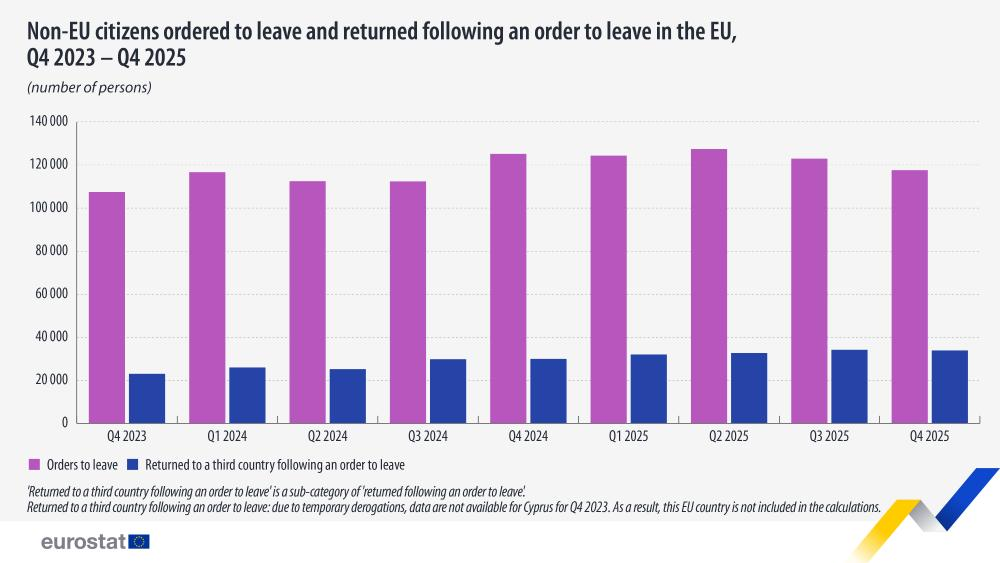
As the graph from Eurostat above shows, each quarter results in tens of thousands of more illegal migrants being told to leave and failing to do so — and only a fraction of those are forcibly removed.