
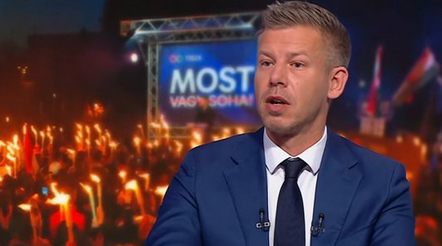
Péter Magyar made his first appearance on Hungary’s state broadcaster channels as prime minister-elect on Wednesday, giving back-to-back interviews on Kossuth Rádió and M1 television. In both, he said that suspending the operations of the news outlets would be among his government’s first acts once in office.
“It’s not about revenge,” Magyar said, arguing that Hungarians “deserve public media that shows reality.” He framed the election result as a political earthquake, telling the radio host that “a revolution has taken place” and accusing the broadcaster of spreading falsehoods.
Magyar clashed repeatedly with the presenters, accused the broadcasters of propaganda, and refused to engage with several questions. At one point, he claimed suggestions from the broadcaster that his plans were unlawful were akin to “a thief in a store starting to yell at the policeman.”
Alongside the media crackdown, Magyar outlined plans to reclaim assets transferred under the previous government. He singled out the Matthias Corvinus Collegium, which had received major shareholdings in Hungarian companies such as MOL and Gedeon Richter. Magyar said these stakes, along with other assets allocated to politically linked organizations, would be taken back by the state — raising questions over the legality of reversing transfers that were approved under prior legislation.
Magyar ve veřejnoprávních médiích: Lhali jste o mých dětech. Zpravodajství zastavíme krátce po nástupu vlády.
Péter Magyar se poprvé po roce a půl objevil ve veřejnoprávních médiích. Krátce po sobě vystoupil v rádiu Kossuth rádió i zpravodajské televizi M1. Na obou kanálech… pic.twitter.com/MZYpDwigzS
— Oliver Adámek (@oliver_adamek) April 15, 2026His remarks escalated further when asked about Hungary’s president, Tamás Sulyok. Magyar said he did not regard him as the legitimate head of state and suggested he should step down.
Magyar also met with the president on Wednesday. Under Hungary’s constitution, Sulyok is required to nominate the election winner as prime minister, and confirmed he would put Magyar forward at the inaugural parliamentary session.
I have arrived at the Sándor Palace to meet the President of Hungary.@DrTamasSulyok is unworthy of representing the unity of the Hungarian nation. He is unfit to serve as the guardian of legality. He is not fit to serve as a moral authority or a role model.
Following the… pic.twitter.com/aBChLJrv7K
— Magyar Péter (Ne féljetek) (@magyarpeterMP) April 15, 2026Magyar, however, responded with a public statement attacking the president’s legitimacy and calling for his immediate removal, saying he was “unworthy of representing the unity of the Hungarian nation” and “unfit” to serve in office.
Magyar’s approach mirrors developments in Poland following the return to power of liberal Prime Minister Donald Tusk in 2023. Tusk’s government moved quickly to take control of public broadcasting, suspending operations at state outlets and replacing leadership, arguing they had become politically compromised.
Critics at the time said the measures bypassed legal procedures. Jan Pospieszalski, a long-serving presenter at public broadcaster TVP, told Remix News at the time that the hostile takeover had been an unprecedented use of force, claiming it showed the authorities knew they were acting outside normal legal frameworks.
“I experienced a lot of things at TVP. I saw many CEOs being replaced. I also remember various more or less turbulent changes among directors. But I had never seen such jostling and pushing, with some outside people coming to forcibly lead people out of their offices, slamming and locking doors, jumping over people, and pushing MPs. Frankly, I had never seen such a use of force there,” he said.
“I started working at TVP in 1994. We were a new team, and we were not welcome there either. The post-communist establishment, to which the television personnel mostly belonged back then, treated us as a foreign body. But even those communists behaved much more decently towards us than what we see today on those cell phone video recordings in Warsaw,” he added.