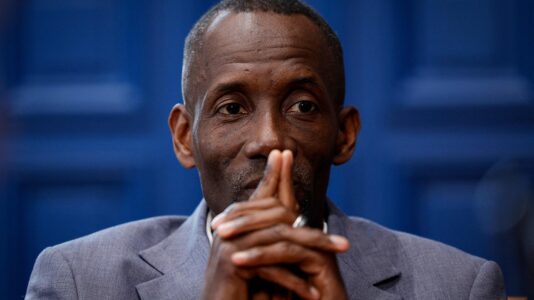
A prominent Berlin youth worker has issued a stark warning that Germany’s school system is breeding “mini-Islamists,” claiming that some Muslim students are forcing their strict religious norms on peers and creating a climate of fear in classrooms.
Wolfgang Büscher, spokesperson for the youth charity Arche, said staff across the organization are increasingly reporting cases of religious bullying linked to the growing influence of political Islam among young people.
“I want to warn society: The pressure that political Islam exerts on fellow students through Muslim children in our schools is constantly increasing,” he told Focus magazine, adding that educators are seeing the emergence of “little hardcore Muslims, mini-Islamists.”
According to Büscher, the problem is most visible in disadvantaged areas, where some schools have student populations with up to 90 percent migrant backgrounds. In these environments, he said, pupils who do not follow strict religious practices — including other Muslims — are being ostracized, harassed, and, in some cases, pressured to convert.
He also pointed to specific communities, saying the issue is not driven by students of Turkish origin but by those with family roots in regions such as Palestine, Gaza, Syria, and Iraq. In these cases, students who do not adhere to rigid interpretations of Islam are labeled “unbelievers” and subjected to intimidation.
His intervention comes as Berlin authorities await the outcome of a large-scale study into school violence and conflict, commissioned by Education Senator Katharina Günther-Wünsch and covering around 450 schools.
Previous attempts to address religious tensions have failed due to pressure from Islamic organizations. In 2021, Neukölln mayor Martin Hikel tried to establish a reporting office for confrontational religious behavior, but the initiative was abandoned after criticism that it could stigmatize Muslim students.
Despite mounting evidence, Büscher said he expects little to change. “No matter what the study reveals, in the end there will be a lack of courage,” he said, arguing that neither the political will nor the funding exists to tackle the problem head-on.
He suggested redistributing students from heavily affected schools to others with lower concentrations of migrant pupils as a possible solution, supported by subsidized transport. However, he acknowledged that such measures are likely to face strong opposition.
“Political Islam could develop into a much bigger problem in a few years if countermeasures are not taken now,” Büscher added.
As Remix News reported last month, a recent study by Germany’s Federal Criminal Police Office found that 45.1 percent of Muslims under 40 exhibit what it described as “latent or manifest Islamist attitudes,” including support for Sharia law over the constitution. Free Democratic Party politician Wolfgang Kubicki called the findings a “societal time bomb.”
Individual cases have also drawn attention. In Berlin, teacher Oziel Inácio-Stech said he suffered months of abuse and threats from students after revealing he was married to a man. “I’m living in a nightmare,” he said, describing the impact on his mental health.
Students began spreading rumors, refusing to attend his lessons, and shouting through classroom doors that he was a “family disgrace” and “impure.” One student told him outright, “You gay, get out of here. Islam is the boss here.”
In July last year, the German Education and Training Association called for expanded Islamic religious education in schools, saying structured teaching could provide balance and reduce the appeal of extremist interpretations. Such a move has been seen in Spain, where last year it was reported that approximately 200 schools across the autonomous community of Andalusia were now teaching Islam as part of the curriculum, sparking outrage from the local branch of the nationalist Vox party, which claimed the state had “succumbed to mass immigration.”
Similar concerns have been raised elsewhere in Europe. In Austria, long-serving educator Christian Klar warned of rising religious tensions and anti-Semitic incidents in schools, particularly in areas with high migrant populations.
“Islamic culture has completely different basic values than we have. I believe our basic values, our open, liberal society, are the right and best way of life,” Klar warned. This is a different form of life (…) and concerns, for example, the equality of men and women, dealing with violence, or defending family honor. I think we have to take a massive stand against this.”
Last month, Remix News reported on a case from Vienna in which a lone Christian student in their class was repeatedly called a “pig” by Muslim students and faced persistent harassment.
At the school in question, 230 of the 390 students are Muslim, nearly 60 percent. In total, the school features a 99 percent immigrant background. Only five out of the total of 390 students have no migrant background.