The left-wing U.K. government has claimed it is making real progress in tackling the ongoing migration crisis enveloping Britain after official statistics published on Thursday showed that net migration had decreased to 171,000 last year. However, that figure alone doesn’t tell the whole story.
“I promised to restore control to our borders. My government is delivering,” under-pressure Prime Minister Keir Starmer wrote on X in response to the latest publication by the Office for National Statistics.
“Net migration is now at 171,000, down from a high of 944,000 under the Conservatives,” added Home Secretary Shabana Mahmood, claiming the government had “restored order” after the unprecedented figures under the last Conservative administration.
Yet, a glance at the broader figures shows the reported number isn’t as impressive as the government would have you believe.
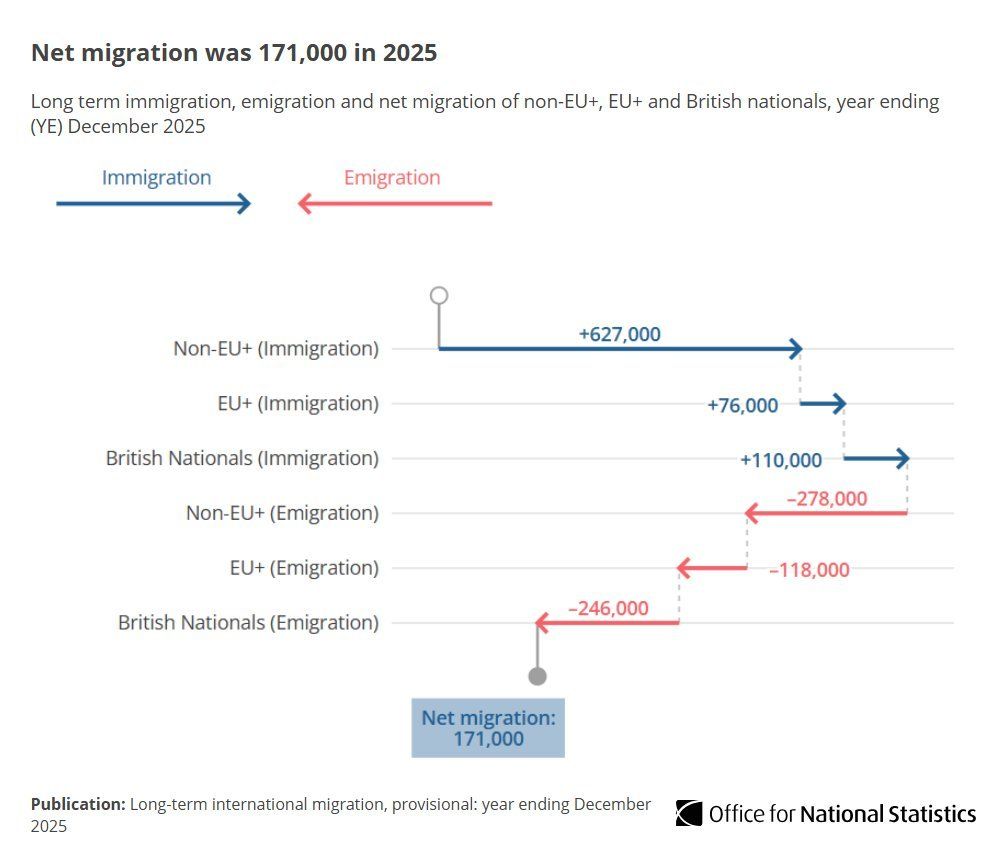
In the year ending December 2025, the total number of people immigrating to Britain stood at 813,000. For comparison, this figure is around two-thirds of the population of the U.K.’s second-largest city, Birmingham.
That figure comprises 110,000 British nationals returning to the U.K., and 76,000 EU citizens. By far the largest contingent of immigrants was from non-EU countries, accounting for 627,000 arrivals.
The 171,000 figure is also largely offset by emigration — nearly a quarter of a million (246,000) British nationals left the country, while 118,000 EU nationals and 278,000 non-EU nationals also packed their bags.
Total emigration of 642,000 was marginally down on the 680,000 recorded the previous year.
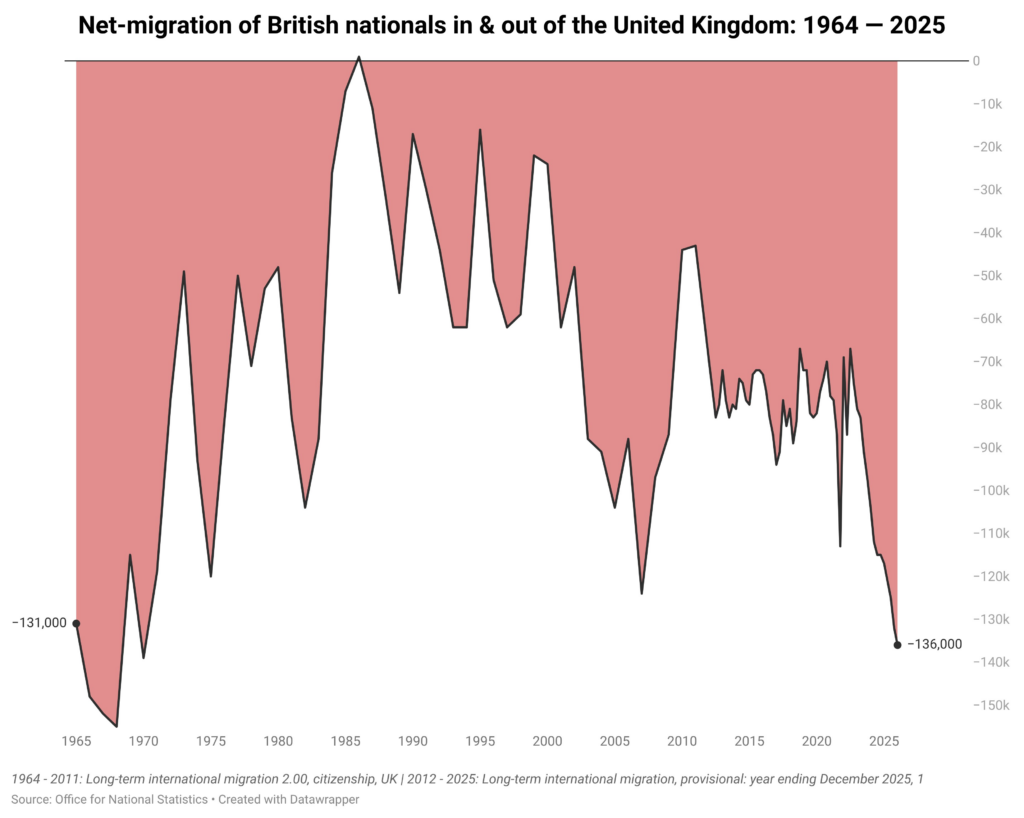
So, while the headline figure looks impressive, that is still a considerable decline in British nationals — down a net figure of 136,000 — effectively being replaced by largely non-EU immigrants. A total of 138,000 Indians, 56,000 Pakistanis, 54,000 Chinese, and 47,000 Nigerian nationals arrived.
The figures suggest that Britain remains a major destination for long-term migrants, and the scale of departures has become an increasingly important factor when reflecting on the overall migration picture.
The net figure for British nationals was the largest exodus since the 1960s.
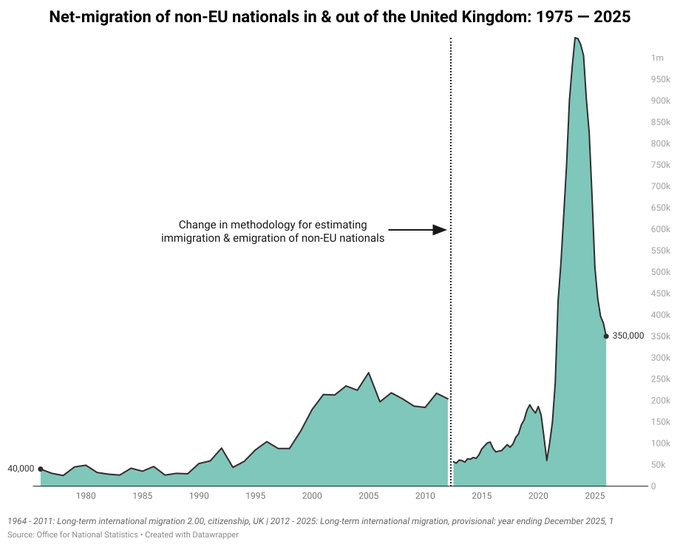
Meanwhile, non-EU net migration to the U.K. still remains higher (by some margin) than in any other year preceding 2021.
Migration monitoring groups released statements on Thursday contesting the Labour government’s assessment that it was successfully tackling the problem.
“Our immigration system is dysfunctional,” wrote the Centre for Migration Control. “Three quarters of a million foreign nationals still arrive every year, and one in five people living in Britain was not born here.
“Rather than heed these warning signs, Labour ministers will insist they have ‘taken back control,'” it added.
Other commentators noted that the Home Office no longer publishes the numbers of immigrants who entered the country on a visa that has since expired, and assumes they have left, leaving the figures contentious.
Reminder that net migration figures have been unreliable since the Home Office stopped publishing visa overstayer numbers in 2020
And recent falls in net migration have supposedly been driven by non-EU student/grad visa-holders, who have the strongest incentive to overstay https://t.co/Tpoi2tLphz pic.twitter.com/s1lcd6JeMD
— David Algonquin (@surplustakes) May 21, 2026“If people’s visas expire and ONS has no record of them leaving the country, they simply assume that they have left — one reason to treat emigration and ‘net’ migration figures with care,” noted Conservative MP Neil O’Brien.
Academic Matt Goodwin, who most recently stood for the right-wing Reform U.K. party in a by-election, warned, “The British people are being demographically replaced – there is no other term for it.”
Migration Watch U.K. called the recent migration wave into Britain “one of the most rapid and drastic demographic changes, outside of war, in human history — no wonder the public are concerned!”
It further questioned why the British public should be “thankful that net migration has ‘crashed’ from the city a size of Birmingham arriving in a single year, to a city the size of Norwich.”
“Where is the infrastructure for this massive inflow of immigrants?” it asked.