This is an article about China’s booming automobile industry and Germany’s declining automobile industry, but in reality, it is really an article about how anti-immigration China increasingly dominates the open borders, multicultural West.
That is not the typical way to open an article in our modern Western press, but this framing is entirely accurate, fair, and a reflection of reality.
For one, we need to stop trying to understand China entirely through the lens of “communism” or “authoritarianism.” Whether it is Bloomberg, Spiegel, the Wall Street Journal, the New York Times, or the Guardian, all of these media megaphones endlessly gloss over a core reality: China is an ethnostate that exists to advance the interest of the Han Chinese people.
Not only is China incredibly successful in this regard, but there is nothing inherently wrong in pursuing this goal. In fact, it not only accounts for China’s increasing strength, but also accounts for the economic success of a range of Asian countries, including Japan, South Korea, and Taiwan, all of which feature stringent anti-immigration policies that ensure ethnic and cultural homogeneity.
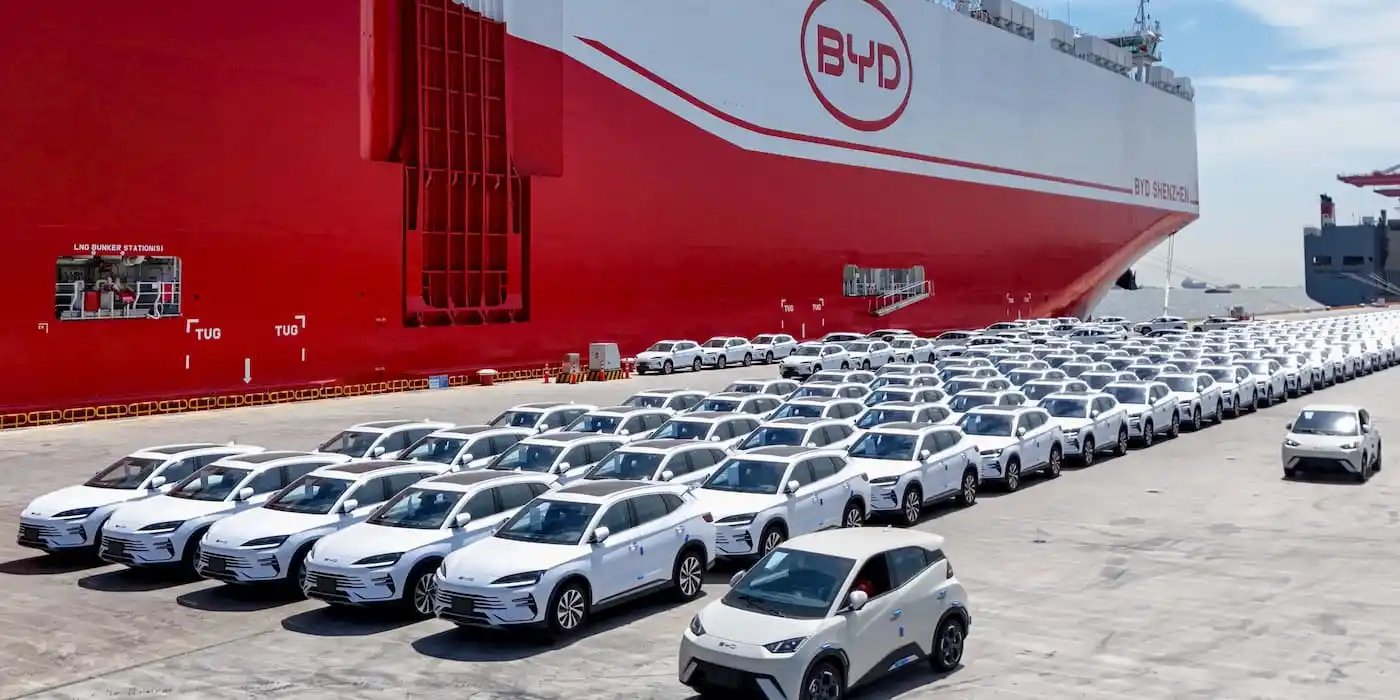
The latest data from Germany’s automobile industry only adds to the growing body of evidence that despite years of diversity and mass immigration, Germany is failing. The data shows that China has now become Germany’s largest supplier of new passenger cars after imports from China more than doubled in the first seven months of 2026, official figures show.
The surge in Chinese vehicles is the main driver behind a sharp rise in overall car imports. Notably, at the same time, German exports declined.
This is far from the only data point. Remix News has been running an ongoing series comparing Western countries like Germany that have tied their economic fortunes to mass immigration to anti-immigration Asian countries (part 1, part 2, part 3, part 4, part 5, and part 6). Once again, the latest figures prove that despite claims that immigration has made the German economy stronger, the reality is that Asian countries are proving this baseless claim wrong many times over.
Between January and July, 175,000 new passenger cars arrived from China in Germany, 13.8 percent of all imports and 120.9 percent more than in the same period a year earlier. That leap pushed China ahead of other importers, including the Czech Republic which sent 173,000 cars and Spain with 157,000 cars. A year earlier, China had ranked only fourth among supplier countries.
At the same time, German exports of new passenger cars fell. Around 2 million vehicles left the country, 4 percent fewer than a year earlier. Their value dropped 8.9 percent to €73.5 billion.
These numbers do not tell the full story either and actually underplay the strength of the Chinese auto manufacturing industry.
Headlines also now routinely dominate the German press regarding the decline of the auto sector, including planned layoffs for tens of thousands of VW workers.
How does China beat out Germany?
China has pulled ahead of Germany by investing in its own native population instead of relying on foreign labor. In fact, there are more foreigners in just one German city, Berlin, than there are in all of China, a country of 1.4 billion people.
Many German leftists and even those in the Christian Democrats (CDU) claim the German economy would fall apart without immigrants. However, China and other Asian countries provide a sharp contrast to this ideological and factually unsound narrative. Instead, these Asian countries sharply rejected mass immigration and turned to innovation, automation, and investment in research and development. At the same time, Asian countries are known for their stringent and in-depth education systems designed for the benefit of their own native populations.
The result is that these Asian nations have now soared ahead of languishing European economies that chose open borders and foreign workforces, which often fueled illusory GDP growth resembling a pyramid scheme based entirely on rising populations rather than true innovation and productivity growth.
In key industries, including automobile production, machine tools, chemical production, and renewable energy, China and other anti-immigration Asian countries are leapfrogging ahead. This is all on top of China’s chokehold on rare earth metals, which theoretically could allow China to shut down production of Western weapons, automobiles, and renewable energy, just to name a few sectors.
Europe relies on protectionism to block superior and cost-effective Chinese technology
In terms of automobile exports to Europe, China’s growth has to be put in context. The reality is that China would be on the verge of bankrupting or overtaking nearly every European automobile company if it was not for extreme protectionism.
China’s growth in Europe is mostly coming from hybrid vehicles, as EU tariffs on battery electric vehicles (BEVs) can go as high as 45 percent. On the other hand, plug-in hybrid electric vehicles (PHEVs) only face the standard 10 percent duty.
Without these tariffs on BEVs, the European EV automobile market would collapse due to Chinese competition. Despite these barriers, more and more Chinese vehicles are making their way into the European market. China is simply far too innovative in nearly every aspect of EV production. China is also building battery production plants within Europe because the Europeans can no longer do it themselves. Even top automobile executives, whether in the United States or Europe, admit they are years behind China.
European automakers are so far behind that they rely on batteries, which are by far the most expensive and vital components of any electric vehicle, almost exclusively from China. China accounts for over 80 percent of global battery cell production and supplies a major share of the cells and lithium iron phosphate (LFP) chemistry used in European-branded electric vehicles. There are other players, however, these also include immigration-restrictionist nations like South Korea and Japan.
Europe is now racing to place tariffs on PHEVs as well, as European automaker CEOs beg for relief. However, these same European automakers would have no electric vehicle market at all if they were cut off from Chinese batteries.
For those who do not want to read long treatises on the dominance of Chinese automakers, there are also plenty of video formats available that explore this topic. This video from “Modern MBA” is just one that illustrates just how far ahead Chinese auto manufacturers are in terms of innovation and development. This dominance is not down to cheap labor either or even government subsidies. At its heart, this dominance is about the engineering talent and technological leapfrogging Chinese automakers have managed to achieve in an extremely short time.
Diversity has not benefited the West
It seems as Europe becomes more “diverse,” it also falls farther and farther behind in terms of industrial strength, with the automobile industry perhaps one of the most glaring examples. However, this basic claim undersells just how far European industry has fallen in comparison to China.
China, with its anti-immigration policies, has ascended into the modern age and pulled ahead in key modern industries on a scale that is unprecedented in world history. Just like many other modern Asian nations that pursue similar anti-immigration policies, instead of relying on waves of cheap foreign labor, China continues to automate and innovate around its falling population through robotics, engineering and artificial intelligence.
The future of Germany and other Western nations also appears less and less bright. A multicultural student body has led to chaos in classrooms, falling test scores, lower achievement, and conflict among students across the Western world. Meanwhile, systems like Singapore and major Chinese cities, such as Beijing, Shanghai, Jiangsu, and Zhejiang, consistently maintain elite scores in mathematics, reading, and science cycle after cycle of PISA testing.
That is why headlines like “Asia dominates global education. A historic decline for the West,” are par for the course.
If White European countries pursued similar policies as their Asian counterparts, these same Western news outlets that dominate the West would endlessly berate them as racists, Nazis, and xenophobes. There is some occasional sniping at the immigration policies of these Asian countries, yet this central and core policy of maintaining ethnic homogeneity is more or less ignored.
For one, these countries are not White, so mostly White journalists do not know how to approach this topic.
However, there is another reason and it is perhaps more important.
If these same journalists continuously attacked the Asian tigers on a daily basis for being racist and xenophobic — while still complaining that they are continuously more successful in terms of education, innovation, and economics — then their Western liberal audiences might begin to second-guess their own open-borders policies.
It could also be possible that Western liberal audiences are not actually as smart as they think they are, and they will forever fail to make this connection.
Nevertheless, on a fundamental level, these Asian countries represent a core threat to the open-borders vision that has been relentlessly promoted among Western countries.
The reality is the Western world is confronted daily with the failures of diversity and multiculturalism.
The other reality is that we are ruled by elites, business executives, and an ideologically captured populace that not only refuses to acknowledge this despite facts, figures, data, and real-world experience. In fact, those who point all of this out are facing persecution, censorship, and even imprisonment.