For the first time in European history, an EU party alliance could be outright banned in the European Parliament, which would mark a major blow to democracy and rule of law.
The Europe of Sovereign Nations Group (ESN), which includes nine right-wing European parties, has been relentlessly attacked by the EU establishment since its founding in 2024. The ESN’s largest party member, the Alternative for Germany (AfD), has also been the target of efforts for an outright ban at the national level in Germany. While left-wing and establishment parties are struggling to implement a ban on the AfD in Germany, at the European federal level, democratic checks and balances and the rule of law are far weaker.
Now, the Authority for European Political Parties and European Political Foundations (APPF) is seeking to de-register the ESN, which would strip it of all its funding and de facto lead to the end of the party.
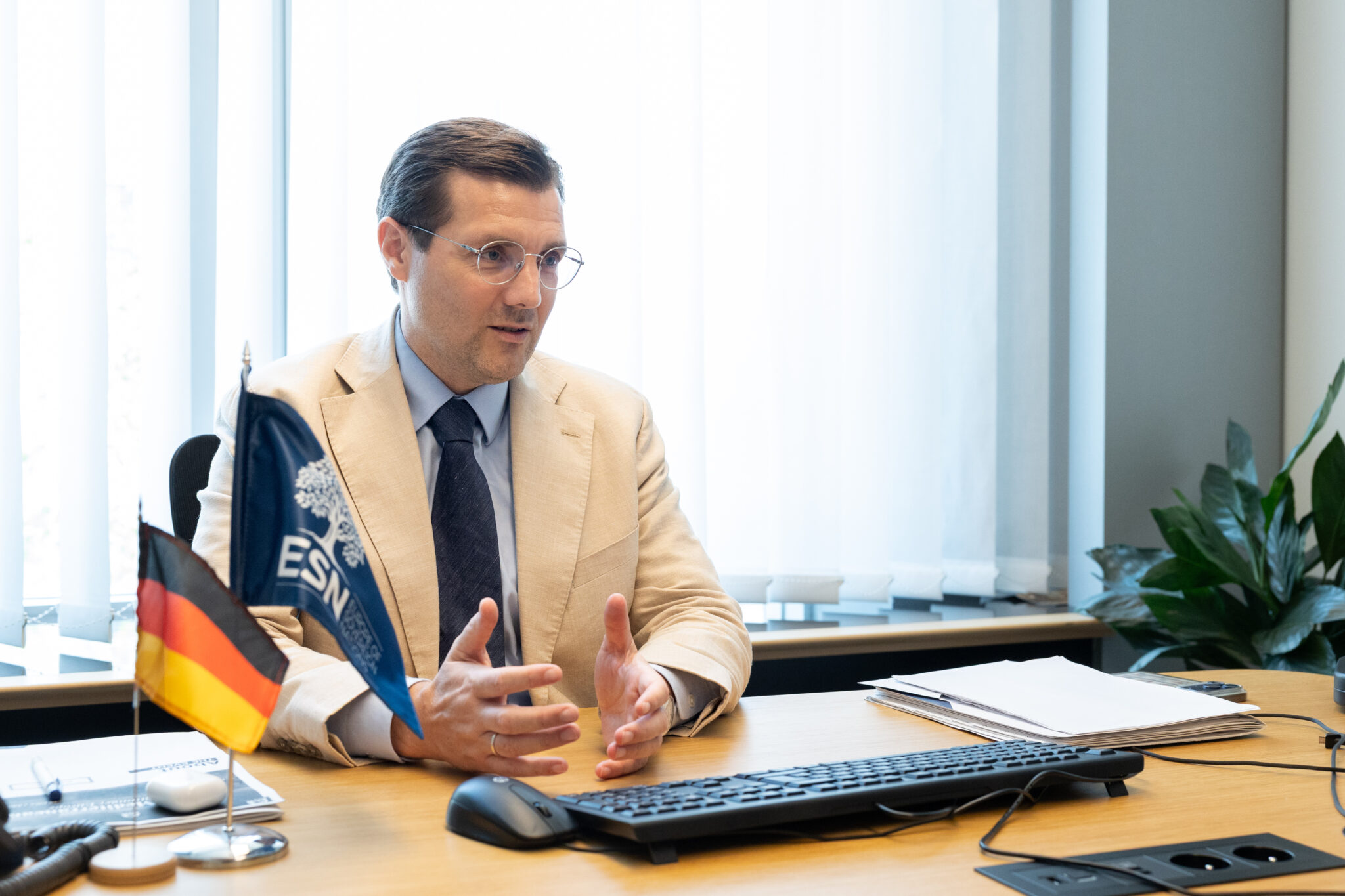
German MEP Alexander Sell of the Alternative for Germany (AfD) party is a founding member of the ESN and has since become the president of the Sovereignty Foundation (SF), the foundation formally associated with the ESN. He said he is speaking as the president of the SF and discussed the efforts his party is taking to fight this de-registration, how much of the APPF’s actions are an extension of the political warfare being waged against the AfD at the national level, and even touches on his own personal motivations for participating in politics as an AfD member despite the massive degree of personal attacks and even physical threats.
There is a lot of discussion about your party facing a potential ban from this European watchdog [Authority for European Political Parties and European Political Foundations (APPF)], but how realistic is it that your party will actually be banned in the near future?
It’s a realistic scenario because the authority — the European Authority for Political Parties and Foundations (APPF) — has the power to de-register parties. They register European parties and they also have the authority to de-register a European party, and that is what they are planning to do.They have a couple of accusations against us. They have a 300-page dossier on our party.
So they will start the investigation, but they will give us the chance to answer the accusations. And then they have the authority to ban our party.
And do you have any idea of what the political leanings of the people in this watchdog are? Does your party view a negative outcome as already a foregone conclusion?
Well, there are some indications that this is a political maneuver, because the director of this authority, [Pascal Schonard,] is German and he used to work for the CDU. He was a member of Klaus Welle’s cabinet. For almost a decade, Klaus Welle was Secretary-General of the European People’s Party and the EPP–ED group in the European Parliament.
So I think there are political intentions behind this attempt to de-register our party. But still, I don’t think it is 100% guaranteed, because in the end you have to acknowledge that on the European level there are many parties like ours. There is a shift to the right all over Europe.You have governments — for example in Italy, the Czech Republic or Slovakia — that are led by patriotic forces. So I don’t think it will be that easy.
The majorities in the European Parliament are also shifting to the right because that is what voters want.They want patriotic, realistic and more free-market-oriented policies, and that is what we are seeing on the European level. We want to get rid of bureaucracy, we want to get rid of climate policy, we want to secure our borders — and we have majorities for that.
So I think this attempt to ban our party will not be easy, because European voters are demanding something else.I mean, you have to take into account that the AfD is the strongest political party in Germany, polling at around 29%, which is a large margin ahead of the CDU. So I think it will be very controversial to ban our European party.
But what real checks and balances are there if they move forward with a ban? Would you appeal?
Yes, we will appeal the decision by the authority. Definitely. And I think we have good reasons to appeal, because what they are accusing us of is that we are not respecting European values. Well, I don’t agree with that. We are very democratic — the AfD is very democratic. Our partner parties from other countries are very democratic. We would never come up with the idea of banning political competition. That is not how we work. We are working for democratic majorities.
So I think we are respecting European values of democracy in a more serious manner than other parties. Also, talking about the rule of law: we have always criticised the European Union for breaking its own laws. For example, in the attempt to rescue the euro and in the migration crisis, they violated the laws that the EU itself had decided on — and that is what we have criticised from the beginning.
So I would say that we are actually the defenders of the rule of law within the European Union, and those are the arguments we will bring forward in court if we have to appeal the decision by the European authorities.
So, during this appeal process, would your grouping be banned right away or would it continue to exist during the appeal?
The authority has the right to ban or de-register a party. So from the moment the authority takes a decision, our party is banned.
The efforts at EU level almost seem to mirror what is happening in Germany itself. Do you feel that this is simply an extension of what is already happening in Germany?
Yes, definitely. I think this is the easier route for them than banning the AfD at national level. There is less attention on the European political party, and in Germany they would need a decision by the Constitutional Court, which is harder to obtain than a decision by the APPF. So I think they chose to attack us at the European level.
There is also still no money for an AfD political foundation, even though this is normally standard for any political party of our size in the Bundestag, right?
Talking about the political foundations, just to give you an idea of the amounts involved: around 700 million euros per year is distributed to the political foundations of the CDU, SPD, the Greens, the liberals and the Communist party (editor’s note: Left Party).
These are incredible figures. They use that money, for example, to recruit in the universities. That is something we are not able to do, because they are denying us those funds and they keep changing the rules on how to obtain the money. It used to be available after two terms in parliament, and they changed it. They are still denying us that money, which puts us at a huge disadvantage, because we would have access to 60 to 70 million euros that we could use for scholarships in universities or to fund research.It is a really important instrument in the political debate, and we are being denied it on an unlawful basis.
That is the situation. You have to understand: they are still talking about banning the most successful party in Germany, according to the polls. We are the strongest party in the polls by a large margin, and the losing parties are seriously considering prohibiting our party and calling it “protecting democracy” while actually prohibiting democracy. That is the situation in Germany.
I think it is an unprecedented case, and it shows that true democracy is still not very well established in Germany, unfortunately.
[Chancellor Friedrich] Merz has already said that he did not want to ban the AfD because it “stinks of attacking a political rival.” There would also be electoral consequences for the CDU, since knocking out the AfD could create a huge vacuum that the left would fill. The CDU could then be sidelined. Do you think it is realistic that the CDU will go along with this?
I think at national level they will not, because there is also international attention on this case. The Americans and others around the world are watching what is happening in Germany. It would be a huge scandal, and I think it would seriously weaken Friedrich Merz’s position internationally if he ended up abolishing democracy in Germany. So I don’t think they will go that far.
But at European level it is a different story. I think the CDU itself — or at least a majority within the CDU delegation in the European Parliament — would very much go along with it. On the other hand, I see that the EPP is not united on this.
You have to remember that some members of the EPP, such as Forza Italia and the Partido Popular in Spain, are already in coalition with right-wing parties — members of the Patriots for Europe or the ECR. So the so-called cordon sanitaire, the firewall as it is called in Germany, is not working at European level.
I think the same will apply to this decision to ban us: they will not have all their EPP members on side. Many of them, especially outside Germany, realize that voters want different policies and that we are driving these new policies. They understand that cooperation will eventually be necessary — and they are already seeing this in Italy, Spain and France.
You had the deportation regulation, where a French MEP worked together with one of our MEPs. So to go so far as to prohibit, for the first time in history, a European political party would create tensions inside the EPP — and rightly so. I hope there are still some democrats left within the EPP.
The APPF even cited the term “remigration” as a basis for this ban. But this term is also being used by the Patriots for Europe grouping. How long before that party is targeted in the same way?
Well, we could talk about a lot of comments. If you look at the left, the way they talk about Israel and the right of the state of Israel to exist, you could also argue that this goes against the idea of human dignity. The same applies to slogans like “From the river to the sea.” It is not as if accusations could not also be made against other parties.
These terms are so vague that you could find something against almost any party. They researched statements by members of our national member parties long before we even founded the ESN. So they are holding us responsible for comments made years ago, when the ESN did not even exist.It is the same for all the other European parties — including the EPP and the Social Democrats.
You will always find some member somewhere, perhaps in Spain or Slovakia, who has said something that could be argued to go against “European values.” It is simply a question of resources. This authority has the resources to produce a 300-page dossier, and we do not. But it would be easy to produce a similar report on any other European political party.
I understand that your grouping wants to give its members freedom of speech and that there are probably differing views among the parties in your grouping. But how much can this watchdog punish the entire party for comments made in the past by individual politicians?
Well, that is exactly what we are doing. I do accept that, as a European political party — and this is also in our statutes — we have to ensure that our national member parties adhere to so-called European values. I also share these values: the rule of law, democracy and respect for human dignity.I think we need better methods to ensure we can sanction members who contradict these values, so that our national parties respect them.
That is what we are doing. We changed our statutes last Friday at a general assembly. For example, we expanded the board. Until now we did not have a representative from each member party on the board. Now we will have representatives of every national member party on the ESN board. So if something controversial is said or published in one of our member states, we will have a contact person we can talk to — someone who is also responsible for taking corrective measures.
We have implemented these changes because we recognize our responsibility for all our national member parties, and the new structure will allow us to intervene more effectively when necessary.
Just a personal question. AfD members and politicians face a constant stream of attacks, and this potential ban could be seen as an extension of that. In Eastern Europe, even parties considered more right-wing operate in a more right-leaning environment without a large Antifa scene that wants to set your car on fire. As an AfD politician, how do you deal with the psychological pressure of facing extremely high levels of personal attacks and even the threat of physical attacks on an almost constant basis?
One of the main characteristics of the German mindset is conformism — a conformism that can even extend to violence against non-conformists. That is what we are seeing now. They burn our cars, they attack our houses. They try to debank us. We are still looking for a bank account for the foundation.
For foreigners it is sometimes hard to understand how this can happen in Germany. Germany is a very conformist society: you are not supposed to step out of line. The AfD is stepping out of line because too many things are going wrong in Germany. It started with migration, well, actually it started with the euro crisis, I recently saw figures from UBS in Switzerland on average wealth distribution in Europe. Germany is behind Greece and far behind Spain, Italy and France — yet we remain the biggest net contributor to the European Union, even though we are significantly poorer than those countries.
If you travel to Italy, Spain or France, you can see there is more wealth there. But people are not allowed to say this.
The same applies to migration. The problems are obvious if you look at German cities, but we are not allowed to point them out. This is due to the very strong conformism in Germany. You are supposed to support the European Union, open borders and migration. You are supposed to support Ukraine against Russia. It is very hard for Germans to object to any of this.
This differentiates us from countries like France, which has a history of revolution, or the Anglo-Saxon world, which has a tradition of healthy mistrust towards government. Germans have very high trust in their government. They do not dare to criticize those in power.
That is one of the reasons I can live with the attacks and the social ostracism. I am convinced that we have the better arguments. People are suffering, and eventually the suffering will become so great that they will realize they have been betrayed by their government. They will understand that we were right from the beginning — and we are already seeing this in the polls.
In some eastern German states we are polling at around 42%, at least above 40%.This is also because East Germans have already experienced one government collapsing. They saw socialism fail and they saw that all the propaganda produced by the socialist regime was a lie. That is why they do not believe the propaganda of the current German government, and they are voting for the opposition — which is us.