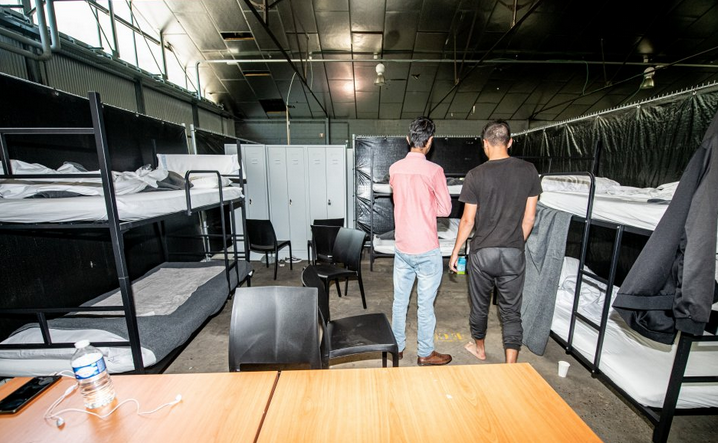
Belgium will phase out thousands of asylum reception places currently housed on military sites to make way for defense needs, but ministers do not appear to be in a hurry, as they confirm that all such centers will be shut down by 2040 at the latest.
Around 4,000 asylum places are set to eventually disappear under the government’s “defense district” plan, which provides for the renovation of existing military bases and the creation of new ones across the country, according to reporting by Le Soir.
The announcement was made by Asylum and Migration Minister Anneleen Van Bossuyt and Defense Minister Theo Francken.
In recent years, Belgium repurposed a number of military facilities to cope with pressure on its asylum system, opening nine reception centers on defense sites nationwide. Those facilities collectively provide nearly 4,000 places but are now scheduled for gradual closure.
The first sites, located in Ypres and Koksijde, are due to shut by the end of this year. Timelines for the remaining centers in Arlon, Tournai, Florennes, Glons, Houthalen-Helchteren, Namur, and Neder-over-Heembeek have yet to be confirmed.
Van Bossuyt insisted the closures would not lead to a shortage of accommodation. “The current decrease in the number of registrations shows that the planned reduction in reception capacity at the Defense sites can be fully absorbed within the existing network,” she said, adding that authorities would continue to monitor global developments.
Francken framed the decision as a return to core military priorities, arguing that the use of defense infrastructure for asylum housing was always intended as a temporary measure. “Using defense infrastructure to accommodate asylum seekers was necessary during a crisis, but it cannot be a structural model,” he said.
He added that reforms to the asylum system, combined with a reduction in arrivals, were easing pressure on capacity and allowing the armed forces to refocus on their primary role. “By reforming the asylum system and gradually reducing the number of asylum seekers received, we are easing this pressure and allowing our barracks and military sites to once again fully dedicate themselves to their primary mission: training, operational readiness, and protecting our security.”
Belgium has sought to implement restrictions on asylum claims over the past year, despite rulings from the country’s top court to suspend newly introduced legislation.
Last July, the government passed a new law that allowed authorities to classify an asylum claim as a “subsequent application” if the applicant already has refugee protection in another EU member state. As stated by Etias, many asylum seekers who eventually arrive in Belgium have just that, having usually landed in Spain, Greece, or Italy, where asylum applications are first made, before migrating to their country of choice.
However, last month, Belgium’s Constitutional Court suspended the measure and referred the matter to the Court of Justice of the European Union, indicating the move may contravene EU law.
Van Bossuyt insists the measure had been working, citing data that showed asylum seekers making claims in Belgium who had refugee protection elsewhere had dropped by 83 percent in the first four months after the law came into force.
She claimed the measure was necessary to prevent “asylum shopping.”