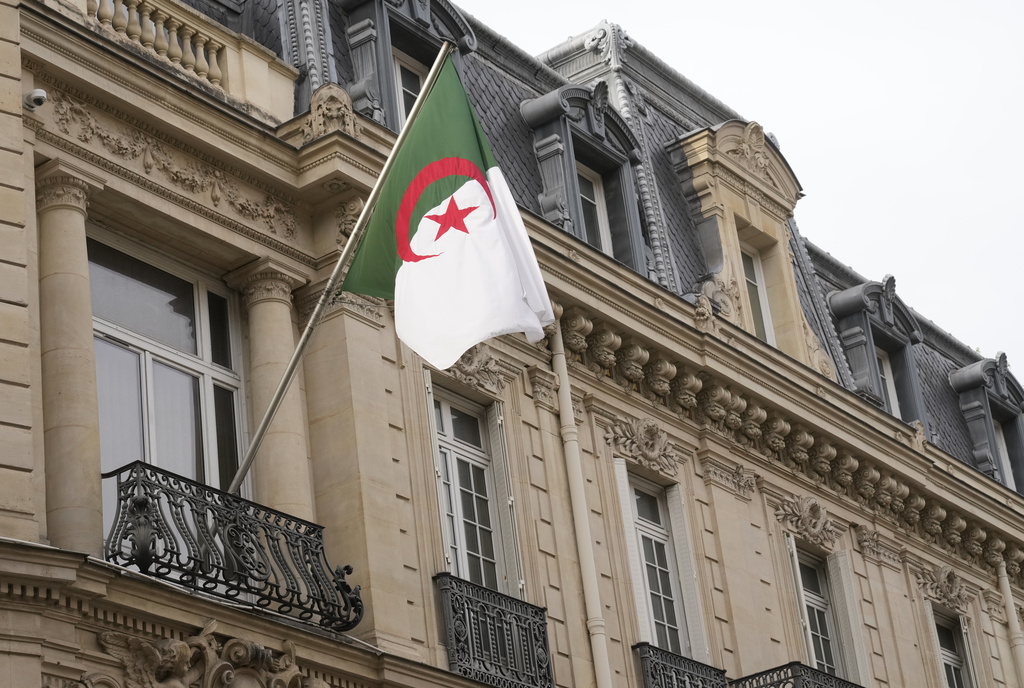
In the wake of a report that has shed light on exactly how much Algerians benefit from the Franco-Algerian agreement of 1968, many are talking about revisiting and even tossing the decades-old agreement.
Shockingly, the report was not written by anyone from the political right, but instead by two Macron deputies from the centrist Renaissance, Charles Rodwell and Matthieu Lefebvre.
Remix News has written at length about the ongoing tensions between Algeria and France, namely, outrage from Algiers at Macron’s backing of Morocco’s plan for Western Sahara, the imprisonment of French-Algerian writer Boualem Sansal, and France’s attempted expulsion of Algerian influencers for inciting violence against those opposed to the Algerian regime, as well as for hateful comments against France.
However, we have also extensively covered the issue of crimes committed by Algerians in France and across Europe, including cases in Germany, Austria, and Spain.
So, it comes as no surprise that people are reacting furiously over this report, pointing out just how easy Algerians have it in France, i.e., coming to France and living off the state.
Xavier Driencourt, who spelled out the highlights in Le360, called the report a “bible” of information regarding the “cost of Algerian immigration in France.” He further states that this cost is estimated at some €2 billion per year, “not including indirect costs (housing, employment, legal costs, court congestion, etc.).”
Co-writer of the report, Charles Rodwell, reportedly explains that blame does not solely rest on the 1968 agreement, but also on the 1980 Social Security Convention, as well as “the crazy jurisprudence of the Council of State, which reinforced the privileges of Algerians.” It is this sort of fatal combination that has enabled Algerians all these years to live off the bountiful generosity of the French taxpayers.
Driencourt kindly lists the exact ways, based on Charles Rodwell and Matthieu Lefebvre’s report, in which Algerians “win every time.”
The French state’s “largesse” towards Algerian nationals includes being able to come to France on a single short-stay visa, instead of having to secure a long-stay visa. They are also automatically granted a “private and family life” residence certificate, without a regular entry visa.
Family reunification is also easier. The spouse of a French national will be granted a residence permit without having a long-stay visa. Potentially sham marriages and even polygamy are swept under the rug. Judges must not demand any verification of their living together, their “common life.” And in the case of polygamy, a residence permit cannot be withdrawn.
Access to social benefits must be a huge draw for Algerians, as “no length of residence condition is necessary to obtain the minimum income (RSA) or the minimum old age pension (APSA).” This is true even if the Algerian has never paid into the system. Meanwhile, other foreigners must show they have been paying in for 5 or 10 years before being able to draw benefits.
A rather shocking fact noted by Charles Rodwell and Matthieu Lefebvre is that Algerians are the only nationality not required to promise to respect the “values of the Republic” or to speak even minimal French to gain residency.
No company? No problem. Algerian students are automatically granted a residence permit as a “trader” or entrepreneur, without having to prove their “company” exists.
On an even more disturbing note, the Middle Eastern practice of Kafala (forcing migrant workers to work for a single employer for their entire permitted residency) “is expressly recognized and enshrined in French law,” which Driencourt notes is “a source of numerous abuses as I observed in Algiers.”
Saudi Arabia has abolished the system, but kafala is still prevalent in Arab countries, including Qatar, Kuwait, and Jordan.
Driencourt reserves some special words for the Council of State, France’s highest administrative court and a legal advisor to the executive branch, calling it “out of touch” and harshly criticizing the manner in which judges have interpreted the 1968 agreement.
“Even an Algerian who constitutes a threat to public order cannot have his residence permit withdrawn! The same remark applies to a polygamous Algerian!” we read.
Algeria also benefits, it should be noted, and in no minor way: “Since Algeria refuses to pay retirement pensions to Algerians who do not live in Algeria (presumably, they live in France), it is France that, without any legal or international obligation, takes charge of the retirement pensions of said Algerians… The deputies estimate the amount of pensions paid to Algerians residing in Algeria at €1 billion.”
There is also apparently an issue of growing hospital debts from Algerians, as Algeria never reimburses French hospitals for care received by Algerian nationals. However, the government has previously stated that the outstanding amount owed on this front is only some €2.5 million.
The Macronists’ report is nevertheless clear on the state of Algerians in France: “a poorly integrated community, which benefits from multiple exemptions and advantages, living off French social benefits,” writes Driencourt.
The conclusion of the report’s authors is that the long-standing agreements with Algiers must be denounced. Writing that is one thing. Doing so may be far more difficult.