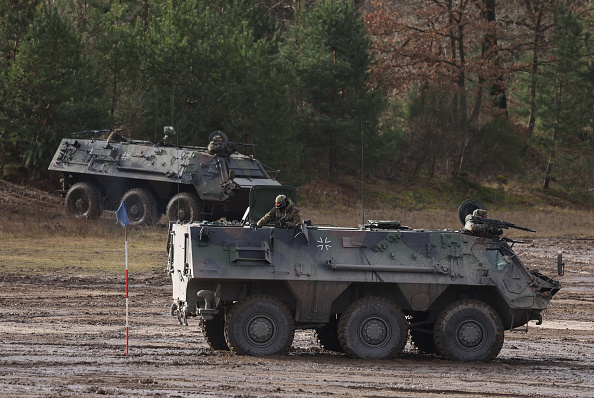
Five German state premiers have launched a direct challenge to Chancellor Friedrich Merz over plans to replace the Bundeswehr’s aging “Fuchs” armored personnel carriers with vehicles from Finnish manufacturer Patria, warning that such a deal would undermine both national security and Germany’s defense industry.
Hesse’s Minister-President Boris Rhein of the CDU, who first raised the alarm in September, has now been joined by Winfried Kretschmann (Green Party, Baden-Württemberg), Markus Söder (CSU, Bavaria), Olaf Lies (SPD, Lower Saxony), and Hendrik Wüst (CDU, North Rhine-Westphalia). Together, they penned a highly critical letter to Merz, urging the government to abandon the planned purchase and prioritize German-made systems.
“In the context of the urgently needed expansion of the Bundeswehr, we see the necessity of giving priority to products of the national defense industry, not only from an economic perspective, but also from a technological and security policy perspective,” the letter states, as cited by the Bild newspaper.
The row centers on the planned successor to the Fuchs, which has been built for decades by German defense giant Rheinmetall. The federal government is considering buying Patria’s 6×6 armored vehicle as part of a €2 billion order for up to 1,000 units, despite Rheinmetall offering its own alternative, the Fuchs 2.
The premiers complain that Berlin is already moving ahead with procurement from foreign manufacturers, including the Patria heavy mortar system and the CAVS “Pioneer Group” variant, even before domestic options have been properly considered. Although parts of the Patria vehicles would be assembled in Germany, the state leaders warn that “even if a foreign system were to be finally assembled in Germany, the added value would still largely take place abroad.” They also argue that switching from the Fuchs platform after decades of use would generate additional costs that have not been adequately calculated or taken into consideration.
Their concerns are heightened by the scale of Germany’s planned involvement in the multinational Common Armored Vehicle System (CAVS) program. Under a deal first announced in July 2025, Berlin is in talks to buy around 3,500 Patria 6×6 armored vehicles worth up to €5 billion. The CAVS initiative, which includes Finland, Latvia, Sweden, Germany, and Denmark, aims to standardize armored vehicles across participating nations, but critics say it risks sidelining domestic manufacturers and exporting jobs abroad.
“We ask you to also consider purely national solutions, from domestic production with domestic added value, when considering the successor to the Fuchs,” the premiers urge.
The German government is seeking to increase its defense spending from 2 percent of GDP to 3.5 percent by 2029, and therefore, significant expenditure is expected. However, state leaders want to ensure that “Made in Germany” is prioritized before looking further afield.