

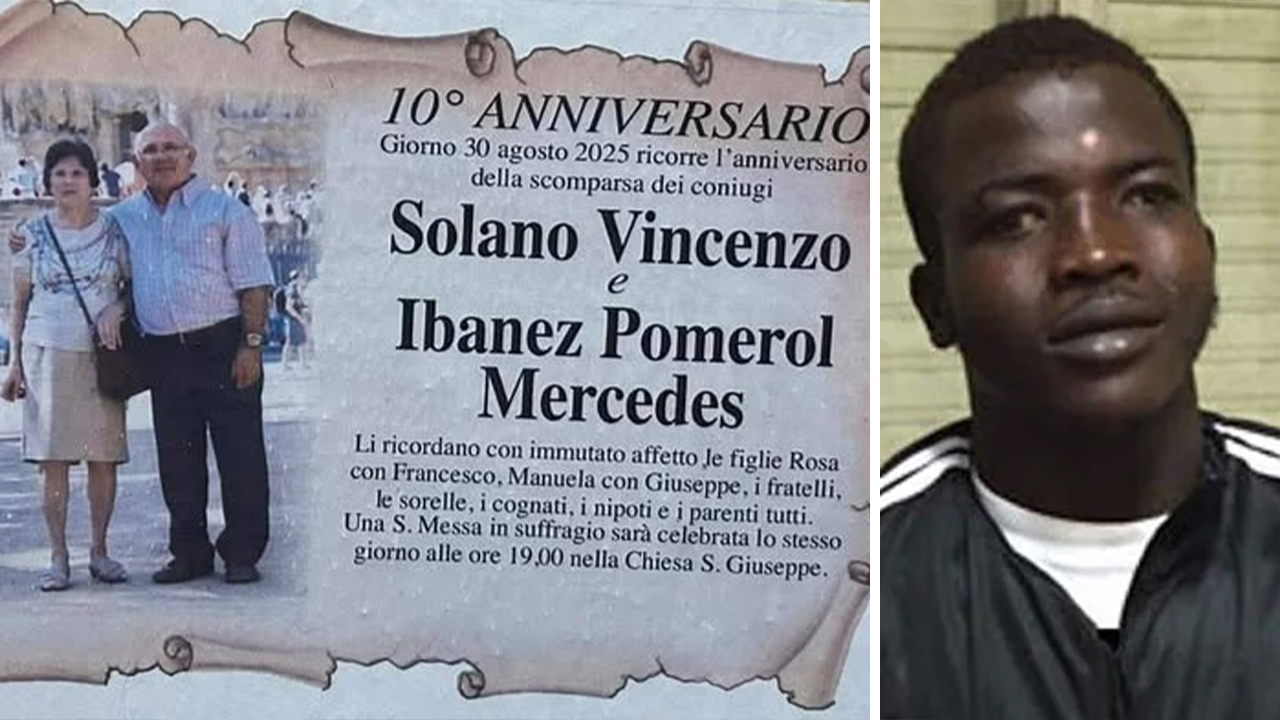
An Italian woman whose parents were murdered in a brutal attack by an Ivorian asylum seeker a decade ago has accused the state of abandoning victims while prioritizing the rights and welfare of offenders, in an interview with Il Primato Nazionale.
Rosita Solano, whose parents Vincenzo, 68, and Mercedes, 70, were killed in their home in Palagonia, Sicily, in August 2015, said she no longer feels like an Italian citizen because of what she described as a complete lack of protection and support for victims of violent crime.
In the attack, Mamadou Kamara, an 18-year-old Ivorian asylum seeker housed at the Mineo reception center, broke into the couple’s home, beat Vincenzo Solano to death, raped Mercedes Solano, and threw her from a balcony while she was still alive. He had only been in Italy since for around two months, having arrived illegally on June 8.
Kamara later returned to the reception center, where investigators found stolen belongings from the victims’ home. His life sentence became final in July 2022.
The horrific double murder made national headlines at the time, and fuelled anti-mass immigration sentiment at the peak of the migrant crisis. Matteo Salvini, who is now Italy’s deputy prime minister, said at the time, “From what war was this guy escaping??? If he’s guilty, jail for life, with HARD LABOR!”
Speaking recently to journalist Francesca Totolo, Solano said the crime had permanently destroyed her family’s life. “After that night, our lives changed forever. We no longer live. Nothing is the same as before. We live in fear,” she said.
⚠️ Nell’agosto del 2015, il 18enne richiedente asilo ivoriano Mamadou Kamara si introdusse nella casa dei coniugi Solano: uccise di botte Vincenzo e poi violentò Mercedes, gettandola dal balcone quando era ancora in vita.
L’intervista alla figlia Rosita.https://t.co/oBFDPYCCzU
— Francesca Totolo (@fratotolo2) January 19, 2026She described her parents as quiet, hardworking people who had integrated fully into the communities where they lived, including during periods when they themselves had emigrated abroad for work. “They always respected the laws and the environment in which they lived,” she said.
Solano argued that the crime exposed systemic failures in security and oversight, particularly at the Mineo reception center, which she described as “a ticking time bomb waiting to explode.” She said authorities were aware of serious problems at the facility, including criminal activity, long before it was eventually closed in 2019. She recalled that then-opposition politician Matteo Salvini, who is now Italy’s deputy prime minister, visited her family after the murders and promised the center would be shut down.
Asked what had gone wrong more broadly, Solano blamed weak controls, a lack of citizen protection, and what she called the absence of “certain and exemplary sentences.” She argued that offenders often believe they will not face serious consequences and are therefore likely to reoffend once released.
“In Italy, those who commit crimes are protected, legally assisted with free legal aid, food, and lodging, while those who suffer a crime count for nothing,” she said. “Victims are abandoned and invisible.”
“No immediate medical or psychological support, no help, no protection,” she said when asked what services had been made available to her in the aftermath of the gruesome double homicide, further revealing that families were left to cover legal and therapeutic costs themselves.
She questioned why Italy has an ombudsman for prisoners but not for victims of violent crime, and said she wanted answers from those in power.
Solano now sits on the board of the National Union of Victims (Unavi), an organization that supports victims of violent crime and their families. She said her involvement was driven by a desire to ensure that others do not endure the same experience. “I’ll never get my parents back, but I can be useful to someone else,” she said.
“I’ve been repeating the same things for 10 years, and I won’t stop repeating them,” she added.
Read the full interview here.