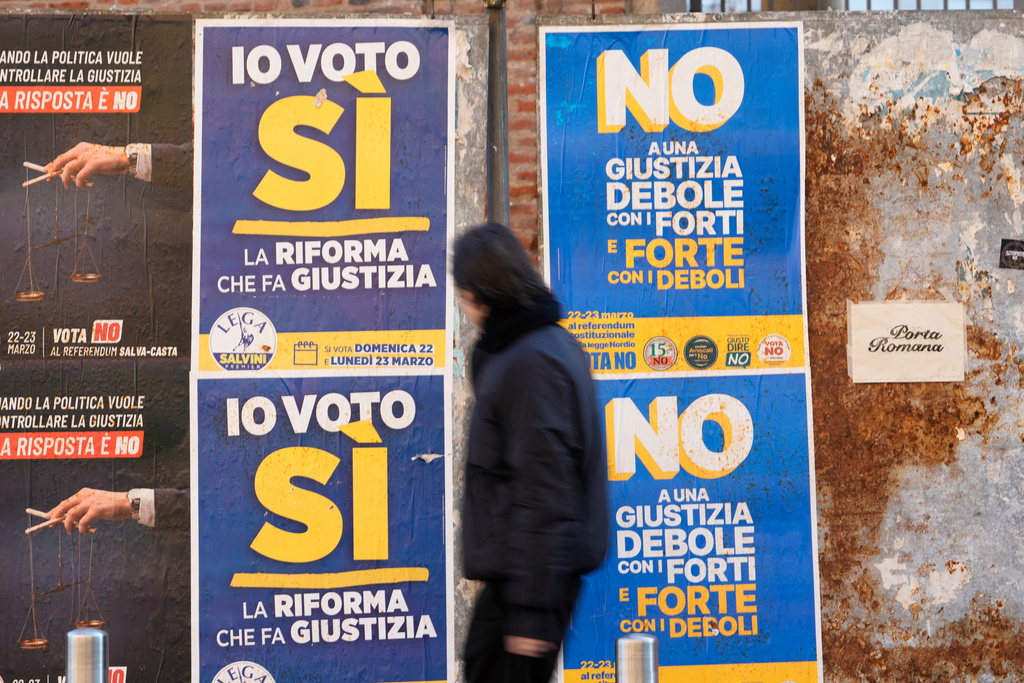
Exit polls from Italy’s constitutional referendum on justice reform indicate a narrow advantage for the “No” camp, in what would mark a political setback for Prime Minister Giorgia Meloni’s government if confirmed by final results.
Initial data from the Opinio Italia consortium for RAI put the “No” vote between 49 percent and 53 percent, with the “Yes” camp trailing closely at 47 percent to 51 percent. Separate projections from Tecnè for Tgcom 24 similarly show the “No” side ahead, with estimates ranging from 50 percent to 54 percent.
An instant poll conducted by YouTrend for Sky TG24 also points in the same direction, placing the “No” vote between 49.5 percent and 53.5 percent, compared to 46.5 percent to 50.5 percent for “Yes.”
Partial official figures show turnout at 58.55 percent, based on roughly half of polling stations counted.
The referendum centered on a package of justice reforms that would significantly reshape Italy’s judicial system, particularly by separating the careers of judges and public prosecutors, who currently belong to the same professional body and can move between roles. Under the proposed changes, magistrates would be required to choose a single career path from the outset, a move the government argues would strengthen impartiality in trials.
Pronta per il voto. Ricordate: c’è tempo fino alle 15 di oggi per recarsi al seggio. Partecipare è importante. pic.twitter.com/7EKzKDSTFZ
— Giorgia Meloni (@GiorgiaMeloni) March 23, 2026The reform would also alter the structure and selection process of the Superior Council of the Judiciary, the body responsible for overseeing appointments and discipline within the legal system. Additional measures would tighten disciplinary rules for magistrates and introduce changes intended to increase accountability.
The referendum has been framed by opponents as a broader test of confidence in Meloni’s leadership. The “No” campaign, backed by opposition parties and civil society groups, appears to have mobilized effectively, with campaign organizers expressing cautious optimism following the exit polls.
At the headquarters of Meloni’s Brothers of Italy (FdI) party in Rome, senior figures said they would await firmer projections before drawing conclusions. Internal sources suggested the relatively high turnout offered some grounds for hope, but acknowledged uncertainty over the outcome.
Italy, BiDiMedia poll:
FdI-ECR: 29%
PD-S&D: 22%
M5S-LEFT: 13% (+1)
FI-EPP: 8%
AVS-LEFT|G/EFA: 7%
LEGA-PfE: 6% (-1)
FN-ESN: 3%
Azione-RE: 3%
IV-RE: 2%
+E-RE: 1%
DSP~NI: 1%
NM-EPP: 1%
PRC-LEFT: 1%
PLD-RE: 1%
ORA!-*: 1%
PaP~LEFT: 1%
+/- vs. 11-14 February 2026
Fieldwork: 28… pic.twitter.com/S08za4BHaw
— Europe Elects (@EuropeElects) March 7, 2026Despite the referendum’s uncertain outcome, recent polling suggests Meloni’s political position remains relatively strong. A BiDiMedia survey conducted between late February and early March places Brothers of Italy comfortably in first place with around 29 percent support, well ahead of the Democratic Party on roughly 22 percent, while the Five Star Movement trails at around 13 percent.
With support for the right-wing coalition government remaining stable, a defeat in the referendum may not be as politically damaging for the current administration as opponents would like it to be.
Final results are expected later on Monday.