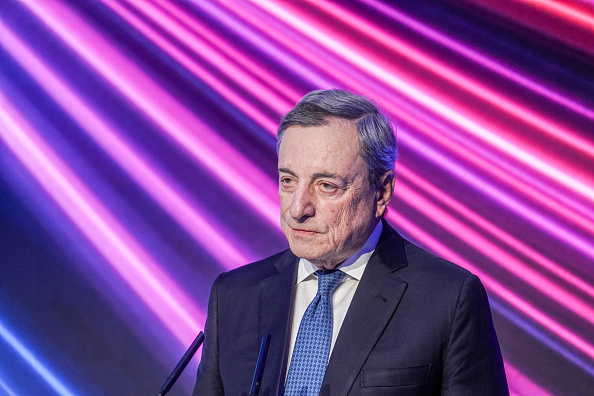
Former Italian prime minister and former European Central Bank president Mario Draghi has urged European Union member states to move toward a more federal structure, warning that Europe risks economic and geopolitical decline unless national governments surrender more powers to Brussels.
Speaking while receiving an honorary doctorate at KU Leuven in Belgium on Monday, Draghi argued that Europe faces a future in which it risks becoming “subordinated, divided, and deindustrialised at once” as global power shifts further toward the United States and China.
Draghi said the collapse of the current economic world order leaves Europe exposed unless it acts collectively, declaring that “the collapse of this order is not itself the threat… the threat is what may replace it.”
He argued Europe must choose between remaining dependent on global powers or transforming into a political force capable of defending its own interests. “Of all those who today find themselves squeezed between the United States and China, only Europeans have the option of becoming a true power themselves,” Draghi said.
The tone is reminiscent of previous Eurocrats who have used geopolitics and economic crises to call for “more Europe.”
“We must decide: do we simply remain a large market, subject to the priorities of others? Or do we take the necessary steps to become a power?” Draghi asked.
He argued that Europe commands influence only when powers are centralized at the EU level, pointing to areas such as trade policy, competition law, the single market, and monetary policy. “Where Europe has federated on trade, on competition, on the single market, on monetary policy, we are respected as a power and negotiate as one,” he said. It should be noted that many Europeans considered these areas to be highly bureaucratic, and vie to push through a “one-size-fits-all policy” on nations.
He claimed that fragmentation in defense, foreign policy, and industrial strategy leaves Europe vulnerable. “Where we have not… we are treated as a loose assembly of middle-sized states to be divided and dealt with accordingly,” he said.
He added that economic strength alone cannot protect Europe if it remains militarily dependent on the United States. “A Europe unified on trade but fragmented on defense will find its commercial power leveraged against its security dependence, as is happening now,” Draghi warned.
The former ECB president also criticized both Washington and Beijing, saying Europe now faces pressure from both sides. He described a United States that “emphasizes the costs it has borne while ignoring the benefits it has reaped,” while warning that China “controls critical nodes in global supply chains and is willing to exploit that leverage.”
Draghi also suggested Washington now openly benefits from European political fragmentation, saying the U.S. imposes tariffs on Europe, threatens European interests, and “makes it clear, for the first time, that they consider European political fragmentation to serve their own interests.”
His remarks are likely to intensify criticism from Eurosceptic politicians and commentators who argue Europe’s economic stagnation and political tensions stem not from insufficient integration but from excessive centralization and regulation by Brussels. They contend that further transfers of power away from national governments would deepen voter alienation and further weaken democratic accountability across the bloc.