
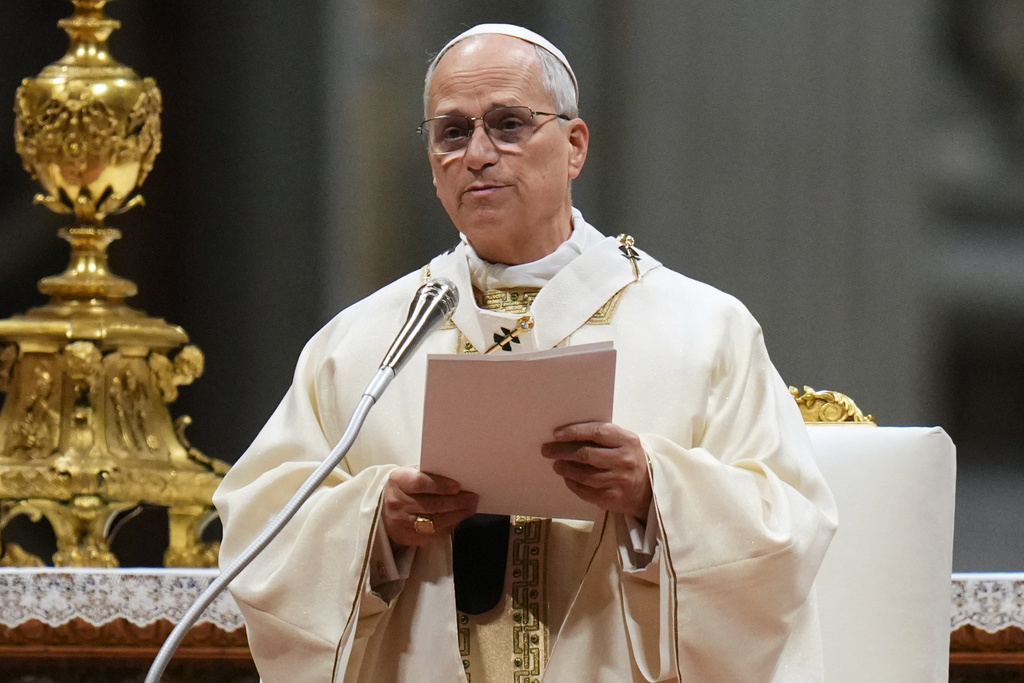
In his annual address to the diplomatic corps at the Vatican, Pope Leo XIV—the first American to be elected to the papacy—issued a stern warning regarding the erosion of civil liberties and the rise of ideological conformity in Western nations. The Pontiff expressed deep concern over what he perceives as a systematic retreat from open dialogue.
“It is painful to see how, especially in the West, the space for genuine freedom of expression is rapidly shrinking,” the Pope said during his address.
“At the same time, a new Orwellian-style language is developing, which, in an attempt to be increasingly inclusive, ends up excluding those who do not conform to the ideologies that are fueling it,” he added.
✝️ Right as the UK considers banning X, Pope Leo XIV speaks out against mass censorship.
"It is painful to see how, especially in the West, the space for genuine freedom of expression is rapidly shrinking."
"At the same time, a new Orwellian-style language is developing, which,… pic.twitter.com/2xBX0wBUIO
— Remix News & Views (@RMXnews) January 9, 2026The forceful remarks come at a time when multiple Western governments are looking to ban X, a platform committed to free speech. At the same time, the EU and many Western European governments are already partaking in broad censorship and mass surveillance efforts.
In fact, EU Commission President Ursula von der Leyen recently said that Brussels is now partaking in “prebunking,” which means censoring information before it spreads online, even if that information is accurate.
So here we have Ursula von der Leyen describing free speech as a virus and censorship as its vaccine……. pic.twitter.com/ApIUT4UMPq
— Richard (@ricwe123) December 24, 2025
“And finally, it takes resilience. As technology evolves, we need to build up societal immunity around information manipulation. Because research has shown that prebunking is more successful than debunking… in short, prevention is preferable to cure.
Perhaps if you think of information manipulation as a virus. Instead of treating an infection once it has taken hold—that is debunking—it is much better to vaccinate so that the body is inoculated.
Prebunking is the same approach. Because disinformation relies on people passing it on to others. It is essential that people know what malign information influence is and what the techniques are that are behind it…
And as the knowledge goes up, our chances of being influenced goes down, and that builds up the societal resilience that we will need.”
Regarding Orwellian terms, the EU and various leading governments and NGOs often invoke terms such as “disinformation,” “misinformation,” and “influence networks,” without even referencing any specific evidence, giving them broad leeway to define these terms to their benefit. Now, these terms are being used to wield a massive censorship crackdown, which is only building in intensity on a nearly monthly basis.
“In the current context, we are seeing an actual ‘short circuit’ of human rights,” he said, as fundamental freedoms, including speech, conscience, religion, even life, face new restrictions “in the name of other so-called new rights.” He said this creates space for force and oppression.
According to Leo XIV, these trends not only impoverish discourse but also actively “threaten the right to freedom of conscience.“
Moving from the subject of language, the Pope addressed fundamental rights that are increasingly under threat in modern societies, specifically focusing on freedom of conscience and religious freedom. He defended conscientious objection as a vital safeguard for human dignity, stating that “Conscientious objection is not rebellion, but an act of fidelity to oneself.”
He argued that this principle reflects the truth that a free society “does not impose uniformity but protects the diversity of consciences,” a stance that he believes prevents authoritarian tendencies and encourages ethical dialogue.
In this regard, he insisted that healthcare professionals must be able to refuse participation in abortions or active euthanasia.
The Pope warned that religious freedom is also in jeopardy across the globe. Quoting Pope Benedict XVI, he described it as “the first of all human rights.”
He explicitly rejected the concept of a “right to abortion,“ emphasizing that the protection of human life remains the “indispensable foundation of all other human rights.“
He highlighted the alarming scale of the issue, noting that “64 percent of the world’s population” currently suffers from serious violations of this fundamental right.
The Holy See, he continued, demands full respect for Christians and “the same for all other religious communities.” On the sixtieth anniversary of Nostra Aetate, he reaffirmed a “categorical rejection of all forms of antisemitism,” while emphasizing the necessity of Jewish-Christian dialogue and the recognition of their deep common roots.
Despite these calls for harmony, the Pope pointed out that the persecution of Christians remains one of the most widespread human rights crises in the world today. This crisis affects “over 380 million believers worldwide,” many of whom face high or extreme levels of discrimination and violence.
He specifically honored the victims of violence in Bangladesh, the Sahel, and Nigeria, as well as those killed during the June terrorist attack on the parish of Saint Elias in Damascus and victims of jihadist violence in Cabo Delgado, Mozambique.
Finally, he identified subtler forms of discrimination targeting Christians even within majority-Christian societies in Europe and the Americas. He noted that in these regions, believers may face restrictions when proclaiming the Gospel, particularly when they speak out to defend “the dignity of the weakest, the unborn, refugees and migrants, or promote the family.”
Regarding conscientious objection, he advocated for the right to refuse military service on moral grounds.
Beyond social issues, the Pope criticized the current international political climate. He noted a dangerous shift where the diplomacy of dialogue is being abandoned in favor of a policy of strength. In a somber assessment of global tensions, he warned that war has “become fashionable again“ and that a “warlike mood is spreading“ across the globe. He lamented the relative weakness of international organizations in the face of these escalating crises.
Finally, addressing specific regional conflicts, the Pope turned his attention to South America, calling on the international community to respect the “will of the Venezuelan people“ and to ensure the protection of their fundamental human and civil rights.