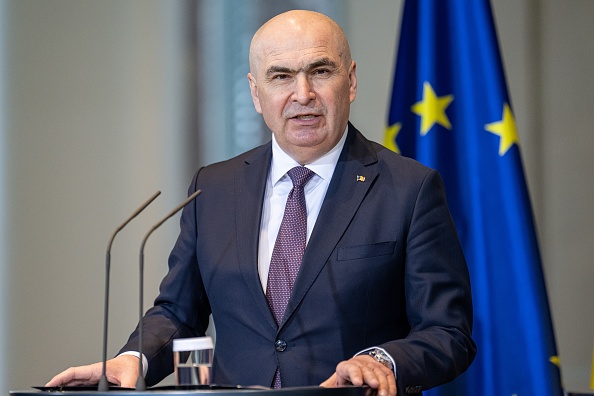
Romania’s pro-European government collapsed on Tuesday after Prime Minister Ilie Bolojan was ousted in a no-confidence vote backed by the Social Democratic Party (PSD) and the right-wing nationalist Alliance for the Union of Romanians (AUR).
The motion passed with 281 votes in favor, well above the 233 required to bring down the government. Just four lawmakers voted against the motion, while three ballots were annulled, according to the official vote count. Bolojan will now remain as interim prime minister with limited powers until a new government is formed.
The vote brings down the entire government less than a year after it was sworn in and makes Bolojan the seventh Romanian prime minister to be removed by a no-confidence motion since Emil Boc was ousted in 2009, according to Romanian newspaper Libertatea.
The crisis erupted after the Social Democratic Party withdrew its ministers from the government two weeks ago, ending its coalition with Bolojan’s National Liberal Party. The Social Democrats then joined forces with the Alliance for the Union of Romanians, the opposition party led by George Simion, to submit the motion against the prime minister.
The alliance marked a major political reversal for Social Democratic leader Sorin Grindeanu, who had repeatedly insisted his party would not enter an alliance with the nationalist party while he remained in charge. Simion had also previously ruled out any deal with the Social Democrats, saying in 2024 that he would resign from public office if he ever made an alliance with them.
“George Simion does not clap his hands with the Social Democratic Party,” Simion said at the time. “George Simion does not form an alliance with the Social Democratic Party. George Simion is the only one capable, energetic enough, young enough, determined enough, to finish with the Social Democratic Party in Romania.”
Despite those pledges, Social Democratic and Alliance for the Union of Romanians officials announced in late April that they would work together on what they described as the “technical” drafting of a joint no-confidence motion.
Former Deputy Prime Minister Marian Neacsu, speaking for the Social Democrats, said the move followed “several rounds of discussions” between the parties and insisted the cooperation was “an exclusively technical matter.”
The collapse follows weeks of instability triggered by the Social Democrats’ decision on April 20 to withdraw political support from Bolojan. Bolojan responded the following day by announcing that the National Liberals were breaking the coalition with the Social Democrats, accusing Sorin Grindeanu’s party of creating the crisis. Social Democratic ministers formally submitted their resignations days later.
President Nicusor Dan must now hold consultations with parliamentary parties before nominating a new candidate for prime minister. He has, however, indicated that Romania will remain on a pro-Western course and has ruled out appointing a prime minister from the Alliance for the Union of Romanians.
Democracy in Romania has been rocky for some time, highlighted by the botched presidential election in 2024, the first round of which was rerun in controversial circumstances after AUR’s preferred candidate, Calin Georgescu, had his victory annulled by the Constitutional Court.
Simion eventually ran as the nationalist candidate, losing in the second-round run-off to Dan, the liberal, pro-EU mayor of Bucharest at the time.
The fall of the government comes at a sensitive moment for Romania, which is under pressure to rein in its deficit, protect its credit rating, and meet European Union reform targets needed to unlock billions in recovery funds.