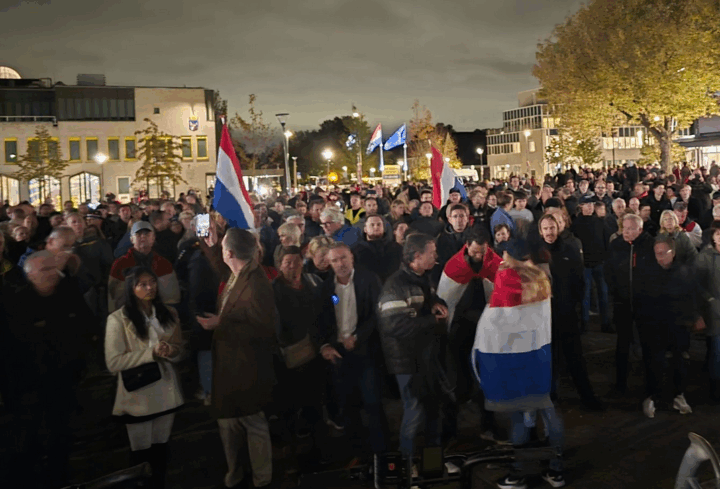
A Dutch town is on edge as plans to build two asylum reception centers within two kilometers of each other have sparked fierce protests, political backlash, and warnings of deepening community divisions.
Residents of Uithoorn, a town southwest of Amsterdam, have taken to the streets over proposals that would see one 250-person asylum center built in their town and another 280-person facility constructed just over the municipal border in Amstelveen. The proximity of the two sites has triggered widespread anger and fears that the town is being asked to shoulder more than its fair share of the burden.
“Many people came with the best intentions,” 55-year-old resident Sandra told De Telegraaf, who joined a protest near the town hall on Tuesday evening. The peaceful demonstration quickly turned violent when a group in the crowd started throwing fireworks and eggs at police officers, leading to four arrests.
Residents have since resorted to flying the Dutch national flag in peaceful protest at the move, mirroring a movement taking place in the United Kingdom, but authorities have been quick to take them down, citing intimidation.
Local officials acknowledged the anger felt by residents. “We had the impression that the asylum seekers’ center in Uithoorn was largely supported, but since the plans in Amstelveen, a tipping point has been reached,” said Petra van Leeuwen, chair of the Gemeentebelangen party on the local council.
Uithoorn had already agreed to host an asylum center for 250 people, a decision taken by the city council in November 2024. “That wasn’t easy, but there seemed to be understanding,” Van Leeuwen said. “Until Amstelveen announced its plans. Then the mood changed.”
The new Amstelveen facility would host 280 asylum seekers and sit directly on the border with Uithoorn. Van Leeuwen said the impact would be felt almost entirely on the Uithoorn side. “The nearest residential area in Amstelveen is miles away. No one there notices anything, but here we do. We’re getting two asylum centers less than two kilometers apart. I completely understand that residents think that’s too much.”
“Tuesday’s demonstration showed how high emotions have run. That’s okay, but we will not tolerate threats, violence, or disrupting the democratic process,” a spokesperson said. The council warned of “growing division” and urged residents on both sides of the debate to express their views peacefully. “Everyone should feel safe to express their opinion, whether you’re for or against.”
The municipality of Amstelveen said it “understands” the concerns but insisted the new center was within its rights and obligations. “We informed Uithoorn from the beginning,” a spokesperson told the Dutch newspaper, adding that the location was chosen because Amstelveen already hosts two other reception sites.
Many Dutch municipalities have previously said they are struggling to cope with national asylum demands and insist they have little choice but to comply with government orders on migrant quotas. An objection can still be filed against the permit COA has applied for to renovate the Uithoorn site.
The unrest in Uithoorn reflects a broader backlash against asylum reception across the Netherlands, driven by concerns over safety, social cohesion, and public finances. A survey by broadcaster AT5 this year found that seven in ten Amsterdam residents, for instance, now avoid parts of the city because they feel unsafe — a figure that rises to 85 percent among women, with half reporting harassment, intimidation, or assault.
Amsterdam, which was ranked Europe’s safest city by The Economist as recently as 2019, has seen public confidence erode sharply.
In Berlicum back in March, a protest against another proposed asylum center saw fireworks thrown at a town hall, eggs hurled, and pigs’ feet hung on a fence. “My 25-year-old son has been trying to find a place to live for years, but there’s nothing available,” one resident said. “Yet housing for people from far away appears overnight. How is that fair?”
Similarly, in the small town of Doezum, home to just 700 residents, there are plans to house 100 refugees in temporary accommodation despite objections.
Fears about safety have been heightened by high-profile crimes involving asylum seekers. In January, five underage asylum seekers were convicted of gang-raping a 31-year-old homeless woman in a park in Helmond.
Other problems have arisen near reception centers. The Dutch railway operator NS has considered removing the Maarheeze station from its service routes due to harassment, fare evasion, and other incidents linked to a nearby asylum facility. In 2024 alone, 2,700 incidents were reported there, forcing NS to spend €2.3 million annually on security, including fences, cameras, and five full-time guards.
The strain on the asylum system is also financial. At the beginning of this year, the Immigration and Naturalization Service (IND) paid a record €36.8 million in penalty payments to migrants last year due to delays in processing their applications — more than triple the previous year’s figure. Nearly 30,000 asylum seekers successfully sued for compensation, with payouts of up to €7,500 each. A recent ruling by the European Court of Justice could see those costs surge beyond €100 million if the Dutch state is found liable for thousands of more overdue cases.
Meanwhile, the government is spending billions on temporary accommodation, including housing thousands of asylum seekers in hotels and even cruise ships. Rates paid by the state have exceeded €300 per night in some cases, with more than 100 hotels and ship operators profiting from the arrangement.
Geert Wilders, the leader of the right-wing Party for Freedom (PVV), has vowed to suspend asylum applications and implement far stricter measures. His party is expected to win the upcoming snap election at the end of this month, but without a majority in parliament, it is unlikely that he will have the power to follow through on his election promises.