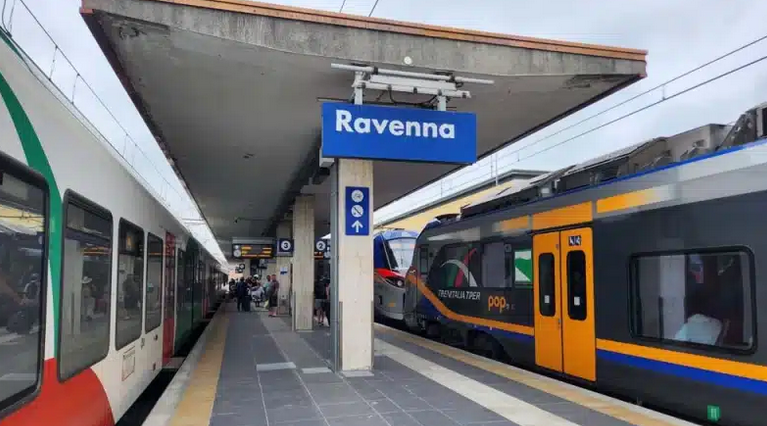
A homeless foreigner accused of sexually harassing female railway workers on three separate occasions at Ravenna train station has been issued with a one-year banishment order after union complaints and police intervention, but female workers are raising the alarm on insecurity while carrying out their duties.
According to the transport workers’ union FIT CISL, the incidents involved a migrant who regularly frequents and sleeps at the station. Two female contractors employed by Mast, a cleaning company working for the railways, were targeted during early-morning shifts on Dec. 29, Jan. 4, and again at dawn on Jan. 13.
As reported by Il Resto del Carlino, the women begin work at around 5 a.m., when the station has just opened, and passenger numbers are low. Manola Cavallaro, regional secretary of FIT CISL Emilia-Romagna, said the man followed a repeated pattern. “First he jokes to get close, then, when they try to move away, he gropes them,” she said.
In the most recent incident, union officials said one of the women was able to avoid further assault only because a colleague intervened. Cavallaro added that a female passenger was also reportedly harassed by the same individual.
“The workers are terrified,” she said. “The fear isn’t just physical, it’s psychological. You go to work knowing there’s this person wandering around, watching you, approaching you. And you don’t know how far he will go.”
The victims filed formal complaints with the railway police, which were combined into a single case file. Despite the complaints, the man continued to move between the station and the city center for several days.
“This is what’s wrong,” Cavallaro said. “Three complaints, and this person was still there. After what happened in Bologna, it’s no longer clear where the line lies.”
She was referring to the killing of Alessandro Ambrosio, a 34-year-old Trenitalia conductor who was fatally stabbed near the staff parking area at Bologna’s main railway station on Jan. 5. Ambrosio was found shortly after 6 p.m. local time and later pronounced dead. Police said he was not on duty at the time of the attack.
“In Bologna, the murderer had already had problems with the law and was still in Italy. Here in Ravenna, there’s a person with three complaints for harassment who continues to hang around the station,” Cavallaro said. “Today he’s harassing, tomorrow he could have a knife. That’s what’s scary.”
The measure imposed by the authorities bans the 27-year-old foreign national identified as the suspect from Ravenna train station and the nearby Speyer Gardens for one year, after he was assessed as a threat to public safety.
Transport unions said the response came only after repeated warnings. For more than a year, Filt Cgil, Fit Cisl, and Uiltrasporti have raised concerns with local authorities and the Prefecture about security conditions at the station. In a memo dated Dec. 1, 2025, the unions cited “persistent security issues,” a lack of protective measures, and specific concerns, including sexual misconduct.
The Ravenna case is part of a broader pattern of violence against rail staff in Italy and wider Western Europe. In November 2024, a train conductor on a regional service in Genoa Rivarolo was stabbed twice during a ticket inspection by two young men of North African origin. One attacker, a 21-year-old Egyptian, allegedly used a knife, while the second suspect was a 17-year-old minor with Italian citizenship. The conductor was left in serious condition, prompting a nationwide eight-hour strike by six railway unions.
That same month, another conductor on the Porretta-Pianoro regional line near Bologna was severely beaten after asking a passenger of North African origin to present a ticket. The worker suffered serious injuries, including the loss of two teeth. It was the third violent attack on railway staff reported that month.
Similar incidents have been recorded in Germany. In February 2024, a 57-year-old railway employee in Karlsruhe was assaulted by a migrant male during a ticket inspection. Police said the attacker punched, kicked, and choked the worker, then urinated on her in front of witnesses before fleeing. The suspect later assaulted people at a nearby supermarket.
In March, another incident in Magdeburg involved a Malian woman travelling without a ticket who scratched a conductor’s face and throat before attacking two federal police officers who arrived at the scene. In Thuringia, railway staff have reportedly been advised not to check the tickets of foreign passengers following a rise in threats and intimidation linked to asylum seekers.
In France, official data has also highlighted the scale of violence on public transport. According to figures from the Interior Ministry, 69 percent of violent crimes on public transport in the Île-de-France region are committed by foreign nationals, with Africans responsible for 52 percent, despite representing just over 3 percent of the population.
Data published in September 2025 showed that 64 percent of violent robberies and physical and sexual assaults on public transport in Paris were committed by foreigners, with 43 percent attributed to North Africans.