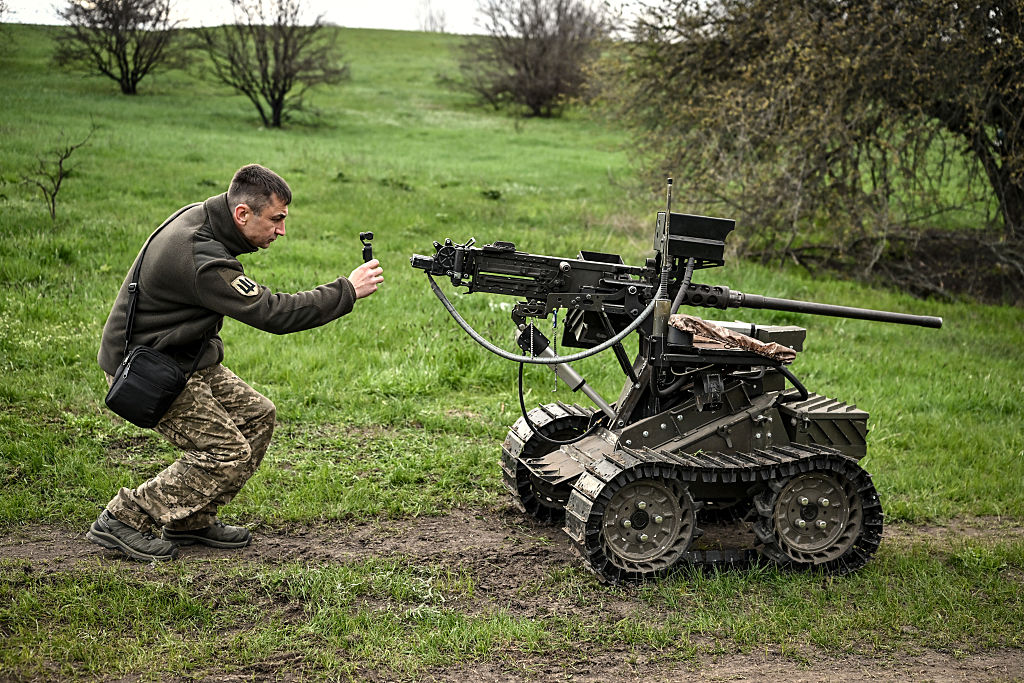
A future of drones and robots fully participating in war, absent any humans on the frontlines, is being driven by the war in Ukraine. Now, the Ministry of Defense of Ukraine, which now has millions of drones at its disposal, wants to remove human soldiers entirely from logistic roles and keep humans as far from the front as possible by replacing them with robotics.
“The primary mission currently is to fully address the front’s need for ground robotic complexes and ensure their rapid integration into combat units,” writes a statement from the ministry on its official website. “These systems have already proven their worth by performing essential logistics and evacuation tasks, with the military completing more than 9,000 missions using such platforms in March alone. The ultimate objective is to convert up to 100% of frontline logistics to robotic solutions.”
Just today, CNN published an account of what Ukraine alleges to be the first case in which a ground robotics system stormed a position and took prisoners.
“The position was taken without a single shot being fired,” said Mykola “Makar” Zinkevych, the Ukrainian unit commander who ran the mission, to CNN. “Robots don’t bleed,” he added.
Now, Ukraine is looking to ramp up production, including a contract for 25,000 units in the first half of 2026, a figure that doubles the total procurement for the entirety of 2025. To date, the defense procurement agency DOT has finalized 19 contracts with manufacturers totaling UAH 11 billion.
Warfare has continuously evolved over centuries to allow one army to attack another army from a distance. The introduction of aerial and rocket-based warfare allowed for attacks to be conducted sometimes hundreds of kilometers away. However, ground-based combat between soldiers, often still hand-to-hand, as seen in trench warfare in Ukraine, means that soldiers are still very much in harm’s way. A new era of robotics and drones, however, means that the need for soldiers may be greatly reduced, if not one day removed entirely
.
Several systemic changes have been implemented to remove obstacles and speed up deliveries. One major shift allows contracting to remain active even when product values fluctuate. Previously, changes in tax legislation regarding VAT applications caused delays for many contracts, but these issues are now being managed through a comprehensive resolution.
A specialized competence center for ground robotic complexes is also being established under the Ministry of Defense. This center will collaborate with the General Staff and active military personnel to hasten the deployment of these systems and serve as a single point of interaction for all manufacturers.
The Ministry is also overhauling its approach to long-term planning by allowing manufacturers to receive contracts for the following year, starting immediately. This change provides businesses with the stability needed to forecast production and ensure the timely delivery of necessary volumes.
The ground robotics sector has become one of the most dynamic areas of defense technology, growing from a nonexistent industry at the start of the full-scale war into a full-fledged market. Through the support of the Brave1 cluster, the market now features more than 280 companies and over 550 distinct solutions, supported by 175 grants for innovation.
According to the ministry, this growth has spurred the development of adjacent technologies, including engineering complexes for mining and demining, battle platforms for direct engagement, land-based kamikaze drones, and automated turrets designed to counter air targets.
Mykhailo Fedorov summarized the current trajectory and the administration’s goals by stating, “Focus (is) on creating affordable and effective impact NQFs that can be scaled quickly. Together with the manufacturers, they recorded key challenges: scaling of production, standardization, training, localization of components, training grounds, and integration into combat processes. In each direction, according to the President’s task, we prepare solutions to ensure an uninterrupted supply of technologies to the front.”
There are plenty of critics regarding the shift towards robotics in warfare, with worries that such systems will make “war too easy.” However, virtually every major army in the world is moving forward with AI, robotics, and autonomous drone systems that are promising to reshape warfare.
Notably, Ukraine has managed to hold off Russia in large part due to its drone warfare operation, which went from 3,000 drones at the beginning of the war to millions in production now. As a result, despite Russia’s large manpower advantage, Ukraine has been able to inflict incredible casualties on Russian troops and keep Russia’s territorial gains to a minimum.
Russia has responded with electronic warfare systems and jamming devices, leaving Ukrainian engineers constantly reworking software and electronic defenses to overcome these adaptations.