
Frankfurt am Main has long championed its reputation as a “melting pot of cultures,” priding itself on being Germany’s most international and diverse hub, but the reality is that crime has soared and the city is more unlivable than ever.
As Bild newspaper reports, “No German city is more diverse, more international, or more colorful. But here, too, something has slipped in the last ten years – the cityscape has changed noticeably.”
Frankfurt’s main train station neighborhood is now notorious
One of the first sights newcomers see is the 53-hectare area surrounding the main train station, known as the Bahnhofsviertel, which has transitioned from an upscale commercial district to a focal point for social friction.
Jens Spahn noted in a Bild interview: “Look at a main train station, in Duisburg, in Hamburg, in Frankfurt. Neglect, drug dealers, young men, mostly with a migration background, mostly from Eastern Europe or Arab-Muslim cultural areas. This also has to do with irregular migration, as it looks in our city centers, in the marketplaces,” he said.
Local business owners have felt this shift firsthand. Bernhard Hahn, who moved his historic music store “Cream Music” in 2017 after over a century in the district, previously stated: “The most accomplished figures are coming to Taunusstrasse, seriously addicted people, drug tourists. The dealers are waiting for them. Our customers have to run slalom to come to us,” he said.
Today, authorities estimate that roughly 5,000 addicts are supplied by 300 dealers in the area, leading to 36 major police raids since 2024.
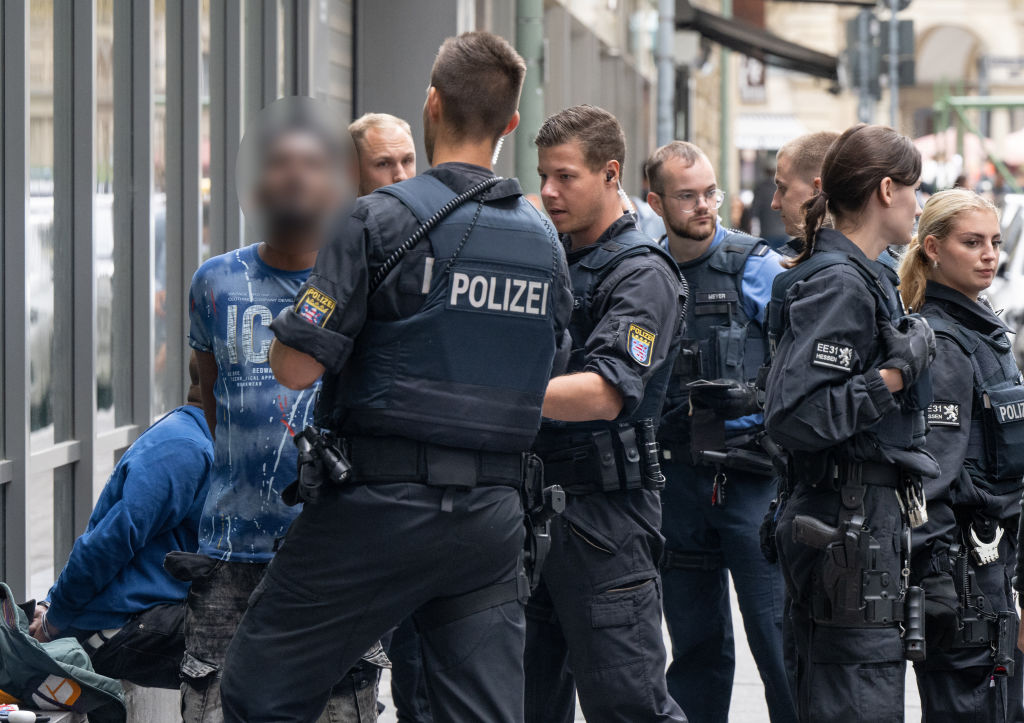
Four months ago, public broadcaster BR launched a documentary about the chaos in this district detailing how police are dealing with violent offenders often willing to use a knife or weapon, including on the officers themselves.
Famed Youtuber Kurt Caz also descended on the area, revealing just how brutal, violent, and dirty it has become, with his video earning nearly 8 million views. In other words, the problems of Frankfurt have gone mainstream to the point that they are attracting a global audience.
Changing demographics
Frankfurt’s population has surged to over 776,000. While foreigners made up 27.3 percent of the population in 2015, that figure rose to nearly 32 percent by late 2024. When including those with a migration background, the proportion reaches 58 percent.
Religious demographics have also drastically shifted, with Muslim residents now totaling 137,000 people while Christian residents are 218,000, down from 300,000 in 2010.
The city’s culture is also rapidly changing, with Ramadan street decorations now in place while traditional Easter customs have largely faded from public areas.
Crime has soared
Since 2015, crime has soared in Frankfurt, with foreigners responsible for the vast majority of serious crimes, amounting to 57.4 percent. It must also be noted that all Germans with a migration background are also not counted in these statistics, underlining that the problem is likely far worse when second-generation migrants are taken into consideration.
Since 2015, the number of brutality cases has gone from 9,115 to 14,258 in 2024. At the same time, rapes have nearly quadrupled, going from 436 to 1,623.
Police data shows that non-German suspects dominate in the crime data. They are responsible for 64.1 percent of all rapes and 100 percent of cases of serious sexual assault.
In addition, 51.5 percent of all bodily harm cases, 61.5 percent of human trafficking cases, and 83.3 percent of all forced prostitution.
When it comes to murder, foreigners are also killing at extremely high rates relative to Germans. Foreigners are responsible for 60 percent of murder cases, 54 percent of manslaughter cases, and 100 percent of serious sexual assaults.
Shopping districts in ruin
On the major shopping streets, including the famous Zeil, migrant youth gangs are making it more difficult for retailers to operate than ever.
Joachim Stoll of the Hessen-Süd Trade Association said that space is less and less in demand, with the famous Zeil now dotted with more and more vacancies.
In the evening, migrant youth gangs, known as “Talahons,” descend to these public areas, such as the Zeil, where they wear designer clothing and act “gangster” for TikTok videos.
A police investigator who spoke to build said it is “a completely new phenomenon that didn’t exist ten years ago. There were always teenagers, but this is different.“
Public spaces face increasing issues with littering and public urination. In response, Lord Mayor Mike Josef has significantly increased fines, including a €1,000 penalty for illegally dumping bulk waste.
The presence of police is now a common sight in these hot spots, leading to an atmosphere where residents often feel unsafe or even unwilling to venture out into shopping districts. The Frankfurt Christmas market is another once safe space that now requires millions of euros worth of bollards and security barriers.
“Frankfurt should become cleaner and more livable. Anyone who violates the rules will face noticeable consequences in the future,” claimed Mayor Josef.
However, for the people living in Frankfurt, there is little evidence of consequences.
Jewish life threatened
Jewish residents have also noted that there is an increasingly intense environment in the city. Since Oct. 7, 2023, there have been increasing anti-Israel demonstrations and anti-Semitic incidents.
“I pay close attention to what I wear – my clothes make it clear that I belong to the Jewish faith. There is an Islamist-motivated anti-Semitism that worries me. Because of this threat, I don’t always feel safe,” said Rabbi Zalmann Gurevitch.
Soaring rents
Frankfurt’s influx of hundreds of thousands of migrants has sent rent costs soaring to record levels while pushing many people to the periphery of the city. Although mass immigration is one factor of many, it is a primary driver of housing and rental price increases across Germany. After all, the population of Germany would have long since fallen to more sustainable levels if newcomers were not consistently arriving.
In fact, the rental situation is so bad in Frankfurt that documentaries from German public broadcasters declaring “Rental Madness” are appearing on Youtube.
Segregation is high
Frankfurt is often ranked inconsistently, with some surveys noting it is a great city to live in, while others, such as this one, report it is ranked as the second-worst city for expats to live in. However, like many cities across the West, there are tremendous differences between neighborhoods and living areas.
This has to do with segregation, with wealthier White Germans and other well-off foreigners, many from other EU countries, congregating in the suburbs and certain upscale neighborhoods. In fact, in one study from the journal Frontiers of Sociology, Frankfurt was determined to be the most segregated city in Germany, with foreigners tending to congregate in certain low-income neighborhoods.
If segregation is a sign of a failure of multiculturalism, then by this metric, Frankfurt is the greatest failure.
However, this is nothing new to the West. Often, the most multicultural and liberal cities, many of which pride themselves on being anti-racist, feature the highest levels of segregation. New York City, for instance, has the highest segregation in the educational system of any city in America, a fact that would surprise many who believe New York City is a “melting pot.”
If Frankfurt is the most diverse and international city in Germany, it does not bode well for the future of the country. Unless severe immigration policies restricting immigration come into play, this could be the norm in every corner of Germany within the next 10 to 20 years. In other major cities like Hamburg and Berlin, this reality is already mostly in place.