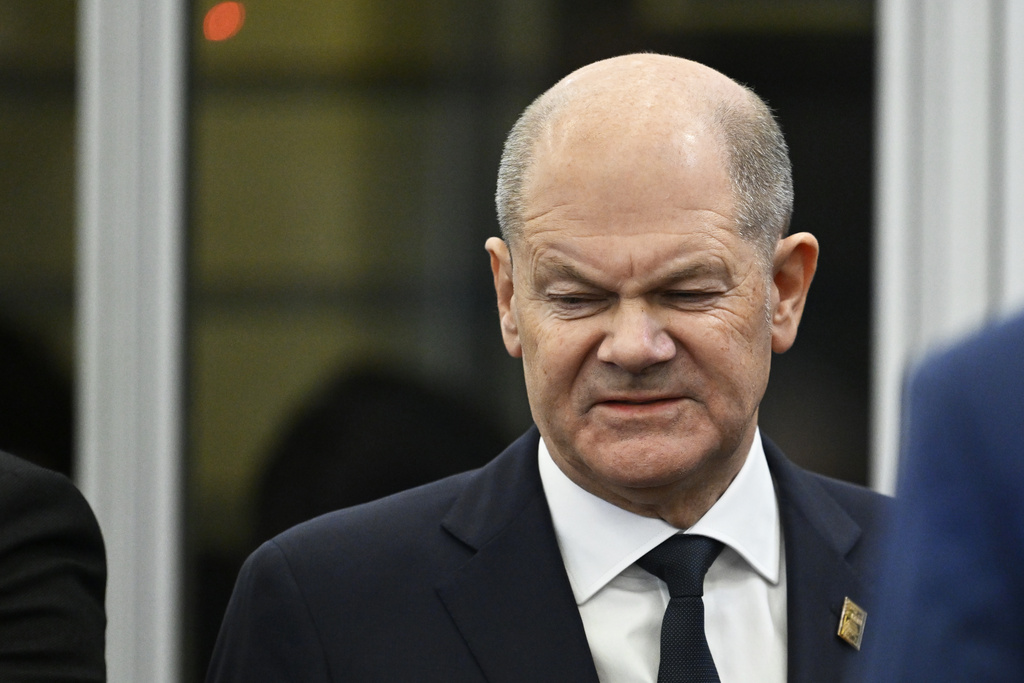
Former Chancellor Olaf Scholz (SPD) spoke at the Social Democratic (SPD) faction meeting this week. It is one year this week since he handed the reins over to Friedrich Merz (CDU), with the gathering serving as an interim assessment of the ruling CDU/CSU-SPD coalition, and he issued warnings to his party about the rising popularity of the Alternative for Germany (AfD).
The coalition, he emphasized, must maintain its distance from the AfD party, i.e., its “firewall policy,” and must avoid any premature dissolution of the current coalition, which would leave Germany in the hands of a minority government.
Scholz and the ruling coalition have reason to be nervous. As Remix News reported last week, April polling shows the AfD at a record high of 28 percent, while the CDU/CSU is at 24 percent and the SPD stands at 14 percent.
According to participants, Scholz warned against any coalition with the right-wing, anti-migration party. He recalled, writes Tagesspiegel, that there had been left-wing majorities in the Bundestag after the 2005 election, but the SPD had “acted responsibly” and not governed with the Left (initially the PDS), because it was “impossible to govern with them.”
Similarly, it is impossible to govern with the AfD today, he told those gathered, effectively stating that the AfD was not a party in line with the principles of democracy.
Following the 2005 federal election, the CDU/CSU/SPD “grand coalition” was established under Chancellor Angela Merkel and has been in power for the majority of years since. Now, however, it is once again facing threats, namely from increased voter dissatisfaction over a stagnant economy, job cuts, rising energy prices, and migrant crime, and welfare abuse.
Noting that “much is at stake,” the former chancellor said internal disputes must be overcome to continue ruling Germany in what he believes is the right direction. Scholz labeled the AfD an “anti-pluralist party” and reminded the faction that the SPD has always rejected populism.
Chancellor Merz himself has been increasingly “unsure” of the coalition’s ability to hold, despite attempting to promote recent healthcare reforms and a new budget. Meanwhile, everyday Germans are struggling to obtain healthcare and stay employed.
“Why are we cutting costs, but not in politics?” one woman asked him at a citizen’s dialogue last week.