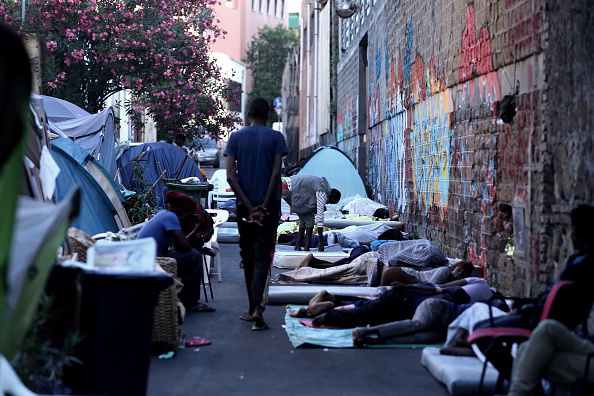
Residents in Rome’s San Lorenzo district are sounding the alarm over a surge in violence they say is increasingly driven by homeless migrants, after another brutal street attack left a man hospitalized and renewed calls for urgent security measures.
The latest incident unfolded in Piazza di Porta San Lorenzo, where a 30-year-old Gambian man allegedly slashed a Moroccan man with a broken bottle in the middle of the street, striking his neck and face and leaving him collapsed on the ground.
The victim was rushed to Umberto I Hospital, where he remains in serious condition, while police used footage captured at the scene to quickly identify and arrest the suspect after he fled.
For many locals, however, the attack is just the latest in a growing pattern. Residents say the area has become dominated by groups of vagrants, often intoxicated or under the influence of drugs, who regularly fight among themselves but also target passersby at random.
“The problem is that they don’t just fight among themselves, they also attack us residents. Men, women, and even children,” Sofia, a waitress who lives near Piazza dei Caduti, told Il Messaggero.
According to the Italian newspaper, a neighborhood assembly has now been called in response, with residents describing a situation that has become “unsustainable.”
Katia Pace, head of the local committee organizing the meeting, said violence has escalated sharply in recent weeks. “Cases have increased visibly in the last two months. Just a few days ago, two women were beaten and robbed,” she said.
Despite stepped-up patrols and recent police operations that led to multiple arrests in nearby districts, residents say the response falls short of what is needed to restore order.
“It’s not enough,” said Maria, another concerned resident. “We can’t live like this anymore.”
Scenes of disorder that are fuelling insecurity have become commonplace, locals say. In public parks, families with young children are forced to navigate areas where men sleep on benches, drink heavily, argue, and urinate openly, heightening fears about safety and hygiene.
Concerns have also been raised over attacks involving minors. In one case, a 12-year-old girl was targeted, while a separate incident saw a Tunisian man arrested after assaulting a woman and fracturing her nose and cheekbone. The attack, captured on surveillance footage, triggered a wave of additional complaints from women reporting similar unprovoked violence.
“There have been at least 15 cases,” said Pace, adding that those responsible are typically “homeless foreigners” living in the area, many of whom are said to suffer from addiction or mental health issues.
Encampments have spread across multiple parts of the district, including along the Aurelian Walls and several central squares, with tents and makeshift shelters now a regular sight.
“The patience of those who live here is not infinite,” another resident told Il Messaggero, warning that vigilante-style reactions could emerge if the situation continues to deteriorate.
The unrest in San Lorenzo reflects broader concerns across Italy, where similar incidents involving migrant populations have heightened perceptions of insecurity, particularly in urban areas.
In Ravenna earlier this year, female railway workers reported repeated harassment by a migrant who continued to frequent the station despite multiple complaints. “The workers are terrified,” said union official Manola Cavallaro, warning that the failure to act sooner risked more serious violence.
In Milan, a 25-year-old man was left with severe head injuries after being attacked by two Bosnian Muslims for his watch near the city center, later warning others to avoid the area at night.
“Just a word of advice: In Milan, don’t turn towards the Duomo because it’s not safe. I had my head smashed in for a watch,” said victim Alessandro Briguglio last summer.
Official data has also pointed to the scale of the issue. Milan’s police commissioner told lawmakers that foreigners were responsible for around 80 percent of predatory crimes in the city, while Interior Ministry figures indicate that foreign nationals are disproportionately represented in certain violent offences despite making up a minority of the population. In particular, 44 percent of all sexual offenses are reportedly committed by foreign nationals.
At the same time, more than 30,000 foreign nationals are currently serving sentences outside prison under alternative measures, raising further questions about enforcement and public safety.
Despite these concerns, the Rome city council has still been encouraging families to take in migrants. In September last year, it launched a call for proposals to find families willing to host migrants with valid residence permits in their homes for the next three years.
Officials say the service is intended to provide “a welcoming environment geared toward inclusion and autonomy,” helping young adults in particular to gain independence.