

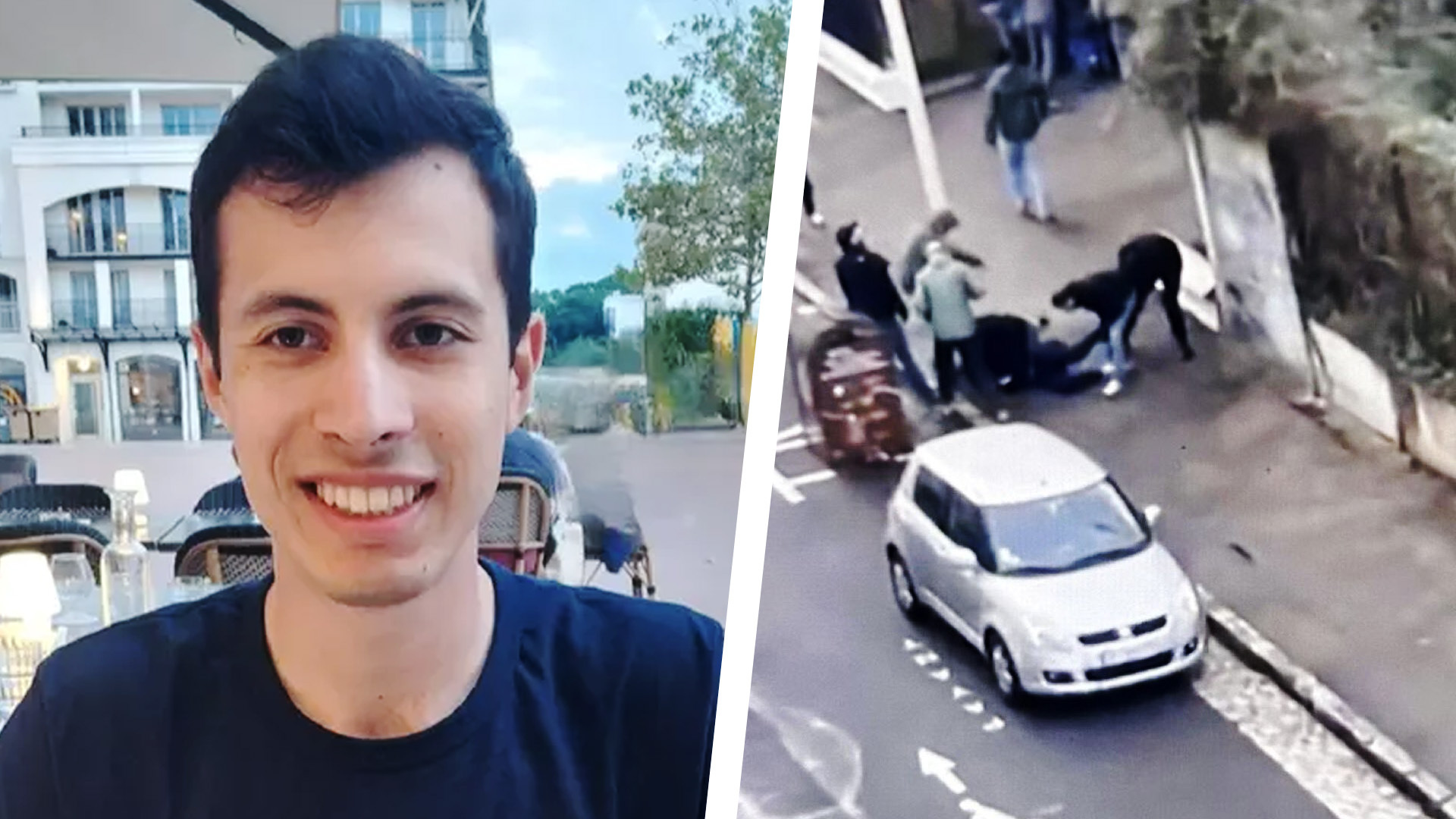
Quentin Deranque, a 23-year-old French data and computer science student with no prior criminal record, was killed following a lynching by Antifa thugs on the sidelines of a conference held by far-left LFI MEP Rima Hassan in Lyon. Now, more information is coming out about the young man, described by his close friends as “non-violent” and a pious Catholic, who lost his life defending the women of the feminist activist group Collectif Némésis.
“His image is the only thing we have left of him,” said his parents following his death in an interview with Le Figaro.
For a number of days, Quentin’s parents resisted sharing his photograph, seeking to shield the memory of their son.
🇫🇷✝️After Antifa thugs beat 23-year-old Quentin Deranque to death in Lyon, a friend of Quentin describes the premeditated ambush attack against them.
"There must have been around 40 of them, between 30 and 40. Armed with metal knuckle gloves, some had sticks or even used what… pic.twitter.com/zCtyWhKF1B
— Remix News & Views (@RMXnews) February 17, 2026Their lives have fallen apart since Friday morning when a friend of Quentin’s arrived at 4 a.m. to deliver the news: Quentin had been rushed to Édouard-Herriot Hospital. The victim’s parents arrived in time to the hospital to see him before he succumbed to a head injury caused by his attackers. As of Monday, his body remained with forensic experts.
In the family’s released portrait, Quentin is shown as a slender, athletic young man of mixed heritage—his mother is of Latin American origin. His roommate Rémy fondly recalls teasing him as a “skinny kid,” which eventually prompted Quentin to take up weight training and boxing to hold his own.
Far-left activists in Paris tear down posters paying tribute to 23-year-old Quentin Deranque, who was beaten to death by masked "antifascists" in Lyon last week. pic.twitter.com/TQ0hNUyKww
— Remix News & Views (@RMXnews) February 16, 2026France lost a beautiful mind
Quentin was described as the conscientious one of his friend group. He worked as a dedicated data science student at Lyon 2 University, where he balanced his studies in finance and computer science with a job at the SNCF, often working late into the night.
Friends remember him as “discreet,” “humble,” and deeply connected to his family in Vienne, his sister in Bordeaux, and his relatives in Peru.
However, his true passion lay in his massive library. Known for his vast erudition, Quentin could discuss political philosophy, from the Jacobin universalism of Anacharsis Cloots to fierce debates on Rousseau’s “The Social Contract.” In the realm of theology, he was known for refuting Calvinist predestination and studying the “Summa Theologica” alongside modern papal encyclicals. His intellectual foundation was built upon the triptych of Aristotle, Saint Thomas Aquinas, and Saint Augustine.
“Quentin became Catholic for identity reasons: patriotism and the love of God are linked in him”, summarizes Domitille, Quentin’s friend, who sees in his journey within Catholicism as a sign that Quentin was a person who was “complete, who likes to see things through to the end.”
🇫🇷🔴 JUST IN: Shocking footage of Antifa thugs murdering French nationalist Quentin D. in Lyon has now been released.
Quentin, who was studying mathematics and was described by friends as a pious Catholic, was protecting the French feminist activist group @Coll_Nemesis when a… https://t.co/slFpF1wB0E pic.twitter.com/ETW50KMItQ
— Remix News & Views (@RMXnews) February 14, 2026Though baptized as a child, Quentin’s turn to the Catholic faith was a later, intellectual discovery. He became a fixture in Lyon’s traditionalist Catholic circles, frequenting Saint-Georges and Saint-Just. He joined the choir, served the homeless, and was deeply moved by the traditional Latin Mass, though he also attended modern services at Sainte-Croix. He also participated in projects to renovate his local church as well.
Friends describe him as a “missionary” at heart.
“He was concerned with passing on the faith, especially to younger people,” notes his friend Domitille. He saw faith and reason as inseparable, often participating in pilgrimages like the one to Chartres to reconnect with his roots.
Faith, identity, and politics
For Quentin, Catholicism was “integral”—it could not be separated from civic life. This led him to a right-wing, nationalist worldview. He served as his father’s confirmation sponsor and was active in parish fundraising and missionary work.
“He was right-wing, nationalist and illiberal, he loved his people and his civilization but at the same time embraced modernity”, said a friend, Vincent.
While not a formal member, he participated in Academia Christiana events. He also protested against euthanasia legislation and had brief associations with groups like Action Française and the Audace collective. He was involved in the founding of a nationalist branch in Bourgoin-Jallieu called Les Allobroges, participating in poster campaigns and the 2025 May 9th Committee march.
Despite the constant backdrop of political tension in Lyon between nationalist and Antifa groups, activists note that Quentin had never personally encountered such violence before the night of Feb. 12. That evening, he was beaten so severely that he was left for dead, ending a life defined by a relentless “quest for truth.”
French police indicate that six suspects have been identified in the brutal beating death, but so far, no arrests have been made. The family has only been left to mourn in the meantime.