

The Netherlands’ housing shortage has risen to 410,000 homes, even as 44 percent of all social housing in the country is occupied by households with a migration background — a figure more than double the size of the current deficit.
An annual report from consultancy Capital Value, as cited by De Telegraaf last month, found that the housing shortage has grown from nearly 400,000 to 410,000 homes, equivalent to 4.8 percent of the total housing stock. Previous governments had aimed to reduce the shortage to 2.1 percent by 2031, but it is now projected to stand at 3.9 percent by that date.
At the same time, data compiled by the platform Nederland In Beeld shows that of the Netherlands’ estimated 2.2 million social housing units, 44 percent — approximately 972,000 homes — are occupied by households with a migration background.
“While 8 percent of the annual allocations go to status holders, the total occupancy by households with a migration background is ~44 percent and growing,” the platform states.
Migration background is defined as first and second-generation immigrants. Third-generation households are not included in the 44 percent figure. When third-generation households are factored in, the estimate rises to 1.2 million units, or 55 percent of the entire social housing stock.
The platform notes that “Statistics Netherlands (CBS) does not publish a total figure for ‘social housing occupancy by migration background.’ This calculation combines several CBS datasets: home ownership by origin, household size, and status holder statistics. Percentages are estimates with a confidence margin of ±5 percent.”
Status holders — asylum seekers who have been granted temporary residence permits, typically valid for five years — account for 7.9 percent of annual social housing allocations. However, that percentage includes all allocations, such as transfers between social housing properties where a family is freeing up another home.
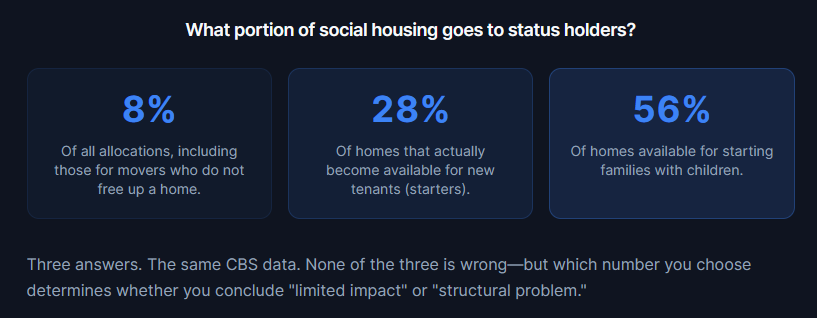
When the figures are limited to first-time allocations, the share of status holders rises sharply to 28 percent, according to the data cited.
The 44 percent figure of social housing units occupied by first or second-generation immigrants has doubled from 22 percent in 2000, and is forecast to rise to 51 percent by 2030.
A total of 92 percent of Syrian first-generation immigrants reside in social housing, in addition to 90 percent of those born in Somalia, Afghanistan, and Eritrea.