

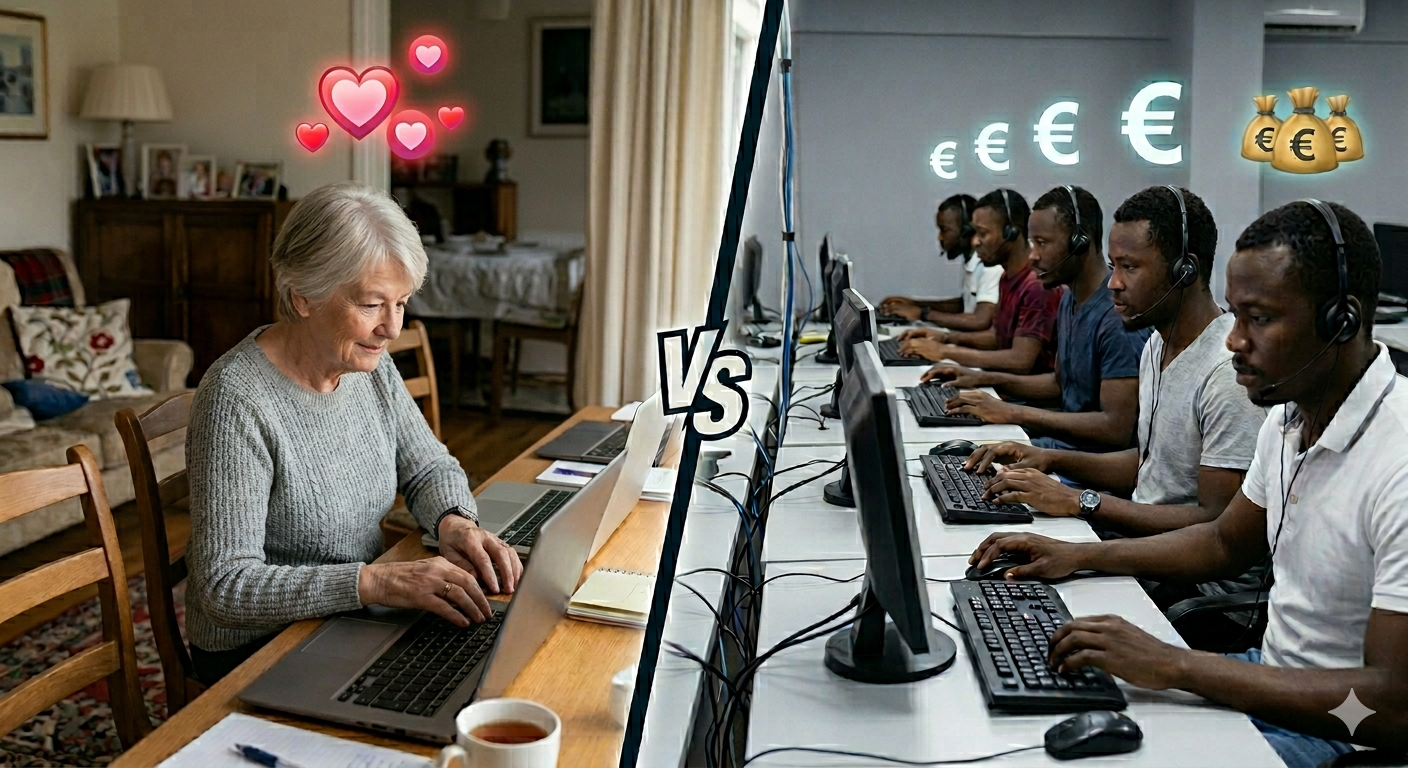
In a truly incredible story, a German mother of four from Bavaria thought she had found the love of her life on the dating platform Lovescout24. She fell so deeply in love that she sent her love interest €1.5 million from her husband’s firm, only for it to turn out the money was going to an African gang focused on love scams.
She placed her trust in a man presenting himself as soldier “Ruiz Calvo,” who claimed to be in financial difficulty, and over the course of more than a year transferred the money into Swiss accounts on his behalf. Eventually, however, the married woman grew suspicious and alerted the police.
Despite only speaking to her fictitious lover on the phone twice, she sent him a fortune of her husband’s money.
However, it took her 39 money transfers before she realized she was dealing with a fraudster. In September 2024, the woman, who is from the Donau-Ries district north of Augsburg, finally confessed to her husband and they jointly filed a police complaint.
How did the woman have access to so much of her husband’s money? She worked as the accountant for his firm, where she siphoned off the money. Now, she is under investigation for fraud.
One of the fraudsters on trial
One of the alleged fraudsters has been arrested. After filing the police complaint, the woman received a message from “[email protected]” where she was told she could reclaim all her money in exchange for a payment of €13,700 as a “procedure opening fee,” with the individual posing as an Interpol agent.
Police advised the woman to play along, but to insist on a German bank account number, on the grounds that she no longer trusted foreign banks. The ruse worked, and the man behind the email account sent an IBAN belonging to a man from Verden in Lower Saxony, who had made his account available at his brother-in-law’s request. That brother-in-law was arrested in Paris in July 2025 and subsequently extradited to Germany.
Now, 29-year-old Daouda T. is being tried in Augsburg’s regional court, wearing an ankle bracelet. According to the indictment, the asylum seeker operated as a logistics coordinator for a romance fraud gang originating from the Ivory Coast, using 86 bank accounts and seducing German men under the alias “Jennifer.”
Whether he also posed as the fictitious soldier Calvo remains unclear.
In total, 17 victims were targeted across Germany by the same network. The gang extracted huge amounts of money from the victims, yet those behind the operation have largely been unidentified.
The investigating officer in the case told the court: “The soldier claimed to be on a foreign mission and had no access to his account containing €1.3 million. She was supposed to help him buy the account back from the French state.”
The money was split between the gang, with Daouda T. receiving a share. However, the court has learned that he gambled away his share of the money on sports betting.
“He committed the crime out of financial hardship,” his defense attorney, Florian Engert, claimed in court.
Judge Stefan Lindig convicted him of attempted commercial and gang fraud and sentenced him to 18 months in prison. The victim was not present at the hearing.
German women are especially prone to love scams
Recent studies have highlighted Germany as particularly affected, with reported financial losses in 2025 reaching approximately €380 million, which accounted for roughly 86 percent of all recorded losses from these scams within the EU.
According to German public news outlet SWR, “more and more people, mainly older women or middle-aged women, are falling for so-called love scamming. This refers to fraud by feigning a partnership or even intent to marry when people meet on the Internet.”
The advent of AI-generated video, which can make someone take on an entirely new identity, has greatly enhanced the power of these love scam networks. Scammers target people who are often single and lonely, exploiting their emotions and gaining trust over time
Women are certainly not the only victims, but so far, they statistically fall victim to these crimes more often than men.
In January of this year, a major Nigerian love scam gang was tried in Germany. The high-profile trial at the Dresden Regional Court concluded with the sentencing of a Nigerian fraud network that specialized in laundering money stolen from lonely women.
Throughout the proceedings, the defendants — Hamsik E. (24), Sylvester E. (27), Ayomide N. (25), and Precious O. (25) — maintained a defiant display of wealth. Even while arriving from prison, they wore luxury labels such as Louis Vuitton. On paper, three were employed in vague professions, such as “designer,” while one was officially unemployed and collecting social benefits. Precious, the woman, was allegedly a “part-time waitress.”
The Presiding Judge Karl-Dietmar Elser did not seem to be impressed with their luxury clothing or accessories and handed down sentences of nearly four years each for aiding and abetting commercial and gang-related fraud. The judge noted that Precious O., specifically, earned the nickname “Gangster-Doll“ for her “behavior,” which included laughing at her victims in chats and conversations.
Remarkably, during the trial, Bild newspaper highlighted that the scam had many layers of sophistication, and in fact, one of the women appeared to still have trouble believing it was a scam. During the trial, Bild stated that she was still in contact with the fake doctor and continued to value his “attention and kind words.” During the scam, various problems were presented with the alleged doctor’s efforts to reach Germany, which left the woman paying to help him, which led to her financial losses.
Several members of the scam group, operating from Nigeria, have never been brought to justice.