

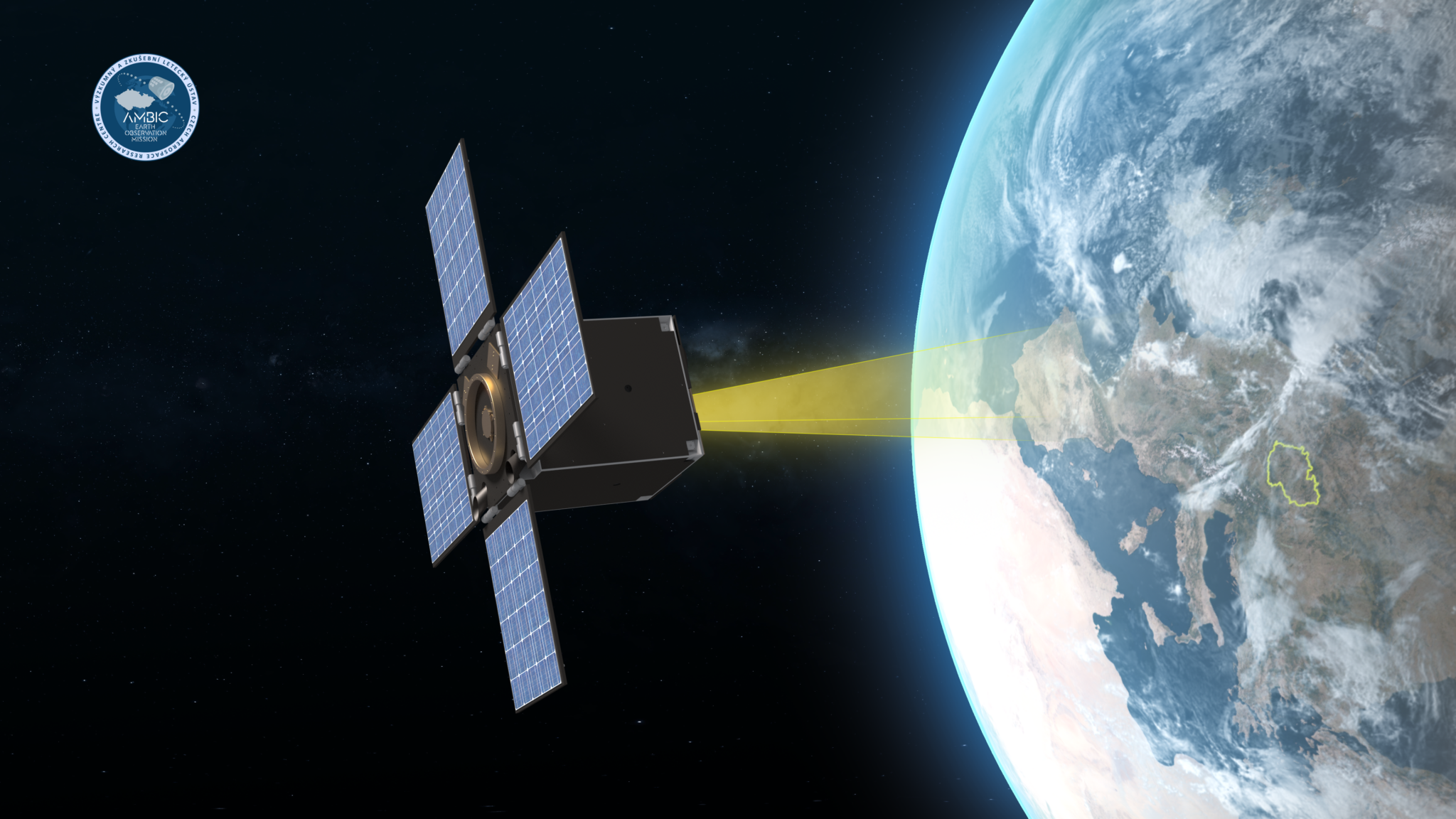
The Czech Republic is moving ahead with plans to launch a new domestically developed satellite capable of delivering hundreds of images of the Earth each day for state use, in a project officials say could eventually help with everything from disaster response to transport monitoring.
As reported by Echo24, representatives of VZLU Aerospace, the Czech national aviation and space center, and the European Space Agency have now signed the contract covering development of the AMBIC satellite, along with a universal satellite platform intended for future missions. The satellite is expected to be ready for launch in 2030.
Once in orbit, the satellite is expected to capture up to 400 black-and-white and color images per day at a resolution sharp enough to identify objects the size of a car. It will operate in low Earth orbit at an altitude of up to 550 kilometers.
Officials say the data could prove valuable to helping emergency services respond to fires and floods, and the imagery could also be used to monitor roads, railways, protected natural parks, and illegal dumping sites.
Christine Klein, head of the European Space Agency’s (ESA) Industrial Policy and Audit Department, welcomed the Czech government’s decision to entrust the agency with implementing the broader Czech Ambitious Missions project, of which AMBIC forms a part.
The contract signed with ESA not only covers the AMBIC mission itself. It also commits VZLU Aerospace to create a universal satellite platform for spacecraft weighing between 80 and 200 kilograms. That platform is intended to be adaptable for different payloads, including telescopes, and will be designed for low orbit missions at up to 550 kilometers with an expected service life of three to five years.
VZLU Aerospace previously developed the VZLUSAT-2 satellite, which became the first Czech satellite to capture high-resolution color and black-and-white images of the Earth. That spacecraft also carried scientific instruments, including a space X-ray detector. It was launched aboard a SpaceX rocket in January 2022 and completed its mission before burning up in the atmosphere at the end of last year.
The company has also sent the SATurnin-1 satellite into orbit for military intelligence purposes and is currently working on the VZLUGEM constellation, a project involving several satellites designed to cooperate with one another.
Those missions followed the earlier VZLUSAT-1, which the company says became the longest-operating Czech satellite in the history of both the Czech Republic and former Czechoslovakia.