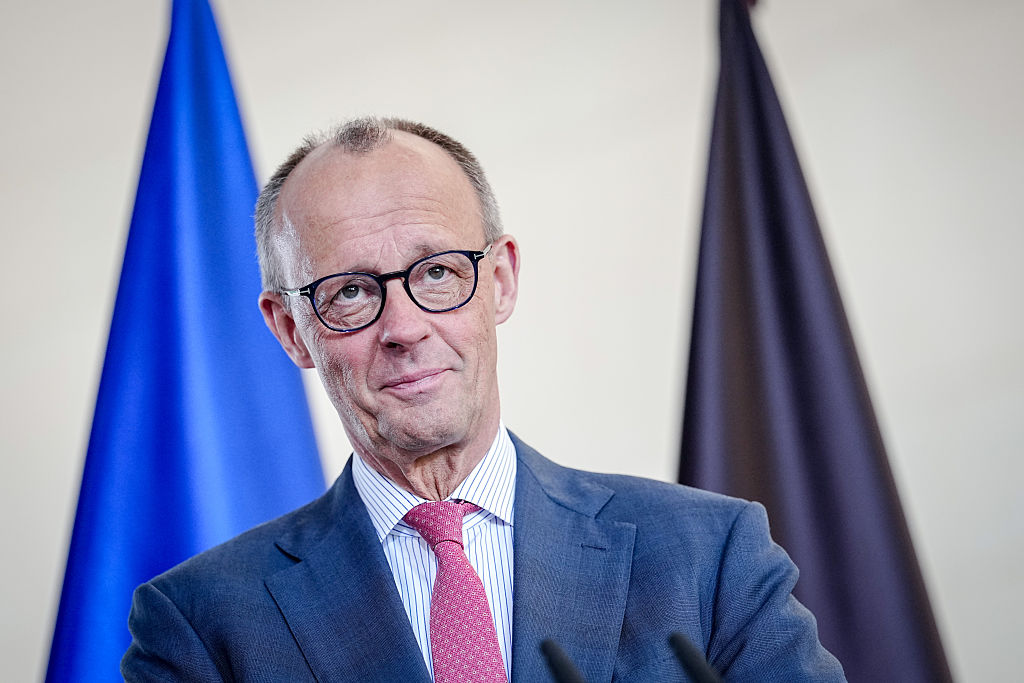
In what would be a monumental turn of events in German politics, the governing coalition is beginning to show some serious cracks, with German Chancellor Friedrich Merz hinting that snap elections could come in the future.
While touting Germany’s planned healthcare reforms and a deal on the 2027 budget on Wednesday, seemingly assuring those present that his volatile coalition could still govern, he also raised doubts when he was asked about his coalition’s ability to survive to the end of its term, stating that “no one can guarantee anything.”
During the press conference, Merz said the government’s healthcare reform, approved by the Berlin cabinet following months of intense debate, was “one of the most significant social welfare reforms of recent decades.”
BREAKING NIUS: Der Kanzler will nicht mehr garantieren, dass die Koalition hält: "Garantieren kann niemand für nichts."
An einem Tag der wehleidigen Horror-Kommunikation ("Kein Bundeskanzler vor mir hat so etwas ertragen müssen.") setzt Friedrich Merz noch einen drauf. Er kann… pic.twitter.com/ZYnXKNZAG8
— Julian Reichelt (@jreichelt) April 29, 2026Merz is under intense pressure, with the rival Alternative for Germany (AfD) party pulling ahead as the most popular party in the country, reaching a record of 28 percent of support in the latest Insa poll, a record high. Merz’s own approval is at rock-bottom levels, with data showing that 83 percent of Germans are dissatisfied with his performance. Germany’s economic problems are one of the major factors driving resentment, with the latest energy shock not helping matters.
Addressing the AfD’s growth, along with the Left Party, he stated: “The rise of the fringes is a direct symptom of a center that is seen as indecisive.”
Citing the crisis his government is facing, Merz claimed in a quote that has been widely panned since he uttered it: “No chancellor before me has had to endure something like this,” while responding to a question about his plummeting approval ratings.
He cited various factors that have led to political instability, including the rise of populism, the neglect of infrastructure for 20 years, and crises like the war in Iran.
Following the cabinet meeting, Merz told reporters that the deal “demonstrates that this coalition is willing and able to make decisions.” He further noted, “We can compromise and we negotiate, even if things get a little shaky at times,” adding, “That is simply part of the process.”
Despite his claims, the junior far-left Social Democrats and Merz’s CDU are coming into open conflict. Now, given the CDU’s desire for deep cuts to social programs, the SPD is pushing back.
Merz argues that the healthcare system is heading for a crisis, and that without reform, the budget deficit could grow to €40 billion by 2030.
The SPD is not Merz’s only problem, as a significant right-leaning faction of the CDU is increasingly unhappy with his performance and what they feel is the CDU’s inability to pass laws and reforms with the far-left SPD as its partner.
CDU MP Christian von Stetten, for example, reportedly told a business event recently that the coalition would “definitely not” last the full four years of its term.
Among the other proposals the coalition is attempting to pass is an income tax law, which Finance Minister Lars Klingbeil (SPD) said would cut the tax burden “several hundred euros per year” for low-income households while raising taxes on the wealthy. The draft budget framework shows that spending will amount to €543.3 billion, with €105.8 billion earmarked for Germany’s military.
Klingbeil acknowledged “passionate discussions” and “conflicting positions” between the coalition partners. Among the right-leaning CDU politicians, there has been sharp criticisms of government spending, with many desiring to put a lid on welfare payments, among other areas.
There was much speculation that the last Olaf Scholz government would fall apart before its term ended, but in that case, all the parties hung on until near the very end. A similar scenario could play out here, where both the CDU and SPD remain at loggerheads, but fear losing power, especially to a surging AfD.
There are also rumors that the CDU may pursue ruling with a minority government. There are discussions about calling a vote of no-confidence. A Welt article published today, which interviews dozens of insiders, explores the fact that Merz has “exhausted” his number of close confidantes and that anger is growing in CDU ranks.
“In recent days, the possibility of a vote of confidence has been circulating in Union circles.
This means that the Chancellor would have to ask the question in the Bundestag whether the majority of the members of parliament who elected him to office still support him. In the Union, this is seen as an instrument to push through major reform against all odds by directly linking it to the fate of the government. Or, in case of failure, to pave the way to a minority government,” writes Welt.
In Germany, a chancellor can call a vote of no-confidence and lose but still govern with a minority government. In such a case, the CDU may require a shift to working with the AfD to pass major legislation. However, German governments, unlike other national European governments, are not designed to run as minorities for long, with the political economy of the country geared towards stable coalitions.