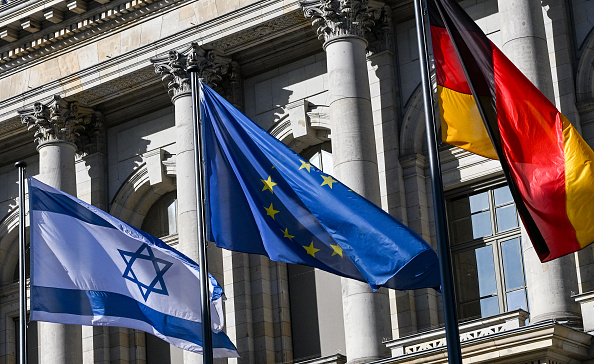
A move to end the EU-Israel Association Agreement has been struck down, led by objections from Germany, Austria, and Italy. The accord, in existence since 2000, has served as the framework for EU-Israeli relations pertaining to both trade and foreign policy, with a key pillar being Israel’s access to the markets of EU member states.
Last week, Spain, Ireland and Slovenia wrote a letter to the EU High Representative for Foreign Affairs Kaja Kallas, citing Israel’s decisions by Prime Minister Benjamin Netanyahu, as well as laws passed by its parliament and actions taken by its military.
It cited, most recently, the death penalty approved by the Israeli parliament as evidence of “systematic persecution, oppression, violence and discrimination exerted against the Palestinian population.”
“In such a grave situation, we call on the European Union to uphold its moral and political responsibility, and to defend the very core values that have underpinned the European project since its foundation,” they wrote.
Going even further, the letter highlighted that Israel has essentially broken its agreement with the European Union. “Not only a grave violation of fundamental human rights, but also a step backwards in Israel’s commitment to democratic principles, as underlined by your March 31 statement, and therefore a violation of Article 2 of the EU-Israel Association Agreement.”
Spain has cited Article 2 for more than two years to take action against Israel and attempt to invalidate the agreement.
“Bold and immediate action is required, and all actions must remain on the table. The European Union can no longer remain on the sidelines,” the letter concluded.
However, the ministers gathered at the Foreign Affairs Council meeting in Luxembourg ultimately rejected the proposal.
German Foreign Minister Johann Wadephul called any move to suspend the agreement “inappropriate,” reports Politico, joined by his Austrian counterpart in a push for “critical, constructive dialogue.”
Before the meeting, Italian Foreign Minister Antonio Tajani told reporters that “There are neither the numerical nor the political conditions” for such a measure to be taken.
A partial suspension requiring majority approval would also not have passed, given Italy and Germany’s objections. According to Politico, Kallas did raise the possibility of targeted measures that do not dismantle the wider trade agreement and do not require unanimity, with Tajani reportedly supporting her on this. “I believe it is better to sanction individually those responsible, I am thinking of violent settlers,” he stated.