

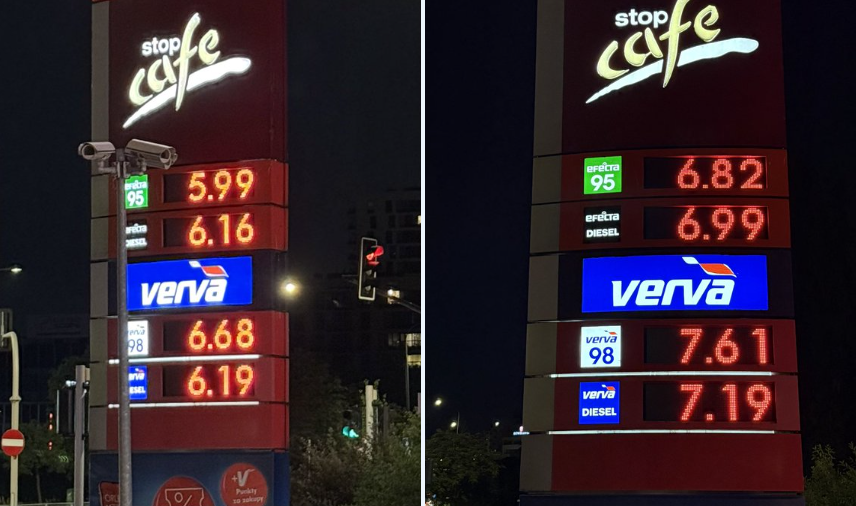
The simultaneous expiration of emergency fuel subsidies across Europe has triggered a coordinated wave of dramatic price spikes at the pump. In countries like Poland, Germany and Spain, motorists woke up to a harsh new economic reality as temporary government relief programs officially ended, causing fuel taxes to snap back to their standard, higher rates.
On the night from Tuesday to Wednesday, fuel prices at gas stations in Poland went up sharply. Conservative Law and Justice (PiS) politicians ironically write about a “holiday gift” from the government.
As of July 1, subsidies ended and maximum fuel prices ceased to apply, with VAT rate on fuel returning to 23 percent. Just after midnight, photos from gas stations appeared on social media showing drastic price increases, even by one złoty for diesel.
“From the very beginning, the government has made it clear that the Fuel Price Below package is temporary, due to the situation in the Middle East, oil prices have skyrocketed to as much as $115-116 per barrel. Today it is $70,” said Finance Minister Andrzej Domański on Tuesday on Polsat News.
Asked how much fuel prices would increase on Wednesday, the head of the Ministry of Finance replied that the changes would be “different at different stations.” He estimated that “an average of 30-40 groszy can be assumed.” In turn, Reflex analysts said that the prices of gasoline and diesel fuel could increase by 40-60 groszy per liter.
Fuel prices are up sharply. A wave of comments “Midnight has struck, the CPN package is being withdrawn and price increases are being made at stations. Quite noticeable, as you can see. Photos from a moment ago from Grochów, before and after midnight,” wrote Jakub Wiech via the X platform.
“You have a holiday gift from the Civic Coalition. Oil at $73, dollar at 3.7 PLN – with similar parameters in our times, fuel was 5.60,” said Daniel Obajtek, former CEO of Orlen and current PiS MEP.
“A holiday gift from Donald Tusk for Polish families,” wrote Michał Dworczyk from Law and Justice on X.
Wakacyjny prezent od Donalda Tuska dla polskich rodzin.
Łyso Wam? https://t.co/nS5HDbblEa
— Michał Dworczyk (@michaldworczyk) July 1, 2026Prices also jumped in Germany
Mirroring the abrupt transition in Poland, drivers across the border in Germany faced a remarkably similar fiscal shock. On July 1, Germany’s federally subsidized “fuel discount” expired as scheduled, forcing the reinstatement of standard energy taxes on gasoline and diesel.
The temporary tax cut had originally been introduced in May to cushion households and power-hungry manufacturers from a massive energy shock triggered by conflict in the Middle East and supply disruptions in the Strait of Hormuz. For two months, the emergency program effectively lowered the energy tax burden by approximately 17 cents per liter for both gas and diesel.
However, the German government firmly rejected calls to extend the multi-billion euro subsidy into the summer. Parliamentary leadership noted that while the tax break successfully insulated consumers during the peak of the crisis, continuing the program was no longer financially viable given rigid national debt limits.
The resulting pivot back to standard taxation immediately sent retail prices surging at German stations. Even before the official midnight deadline, heavy lines formed at pumps nationwide as motorists scrambled to fill their tanks, anticipating price hikes that market analysts warn could approach near-record daily jumps once the full tax increase is absorbed.
In response to the sudden spike, Germany’s Federal Cartel Office has pledged strict oversight, warning major oil companies and station operators against using the tax transition to mask unjustified price gouging during the summer holiday rush.
Other countries also saw jumps, including Spain, which had significantly slashed the standard Value-Added Tax (VAT) on transport fuels down to 10 percent. This officially expired on June 30. Starting today, July 1, the VAT snapped back to its standard 21 percent, instantly triggering price jumps at Spanish pumps identical to the shift seen in Poland and Germany.