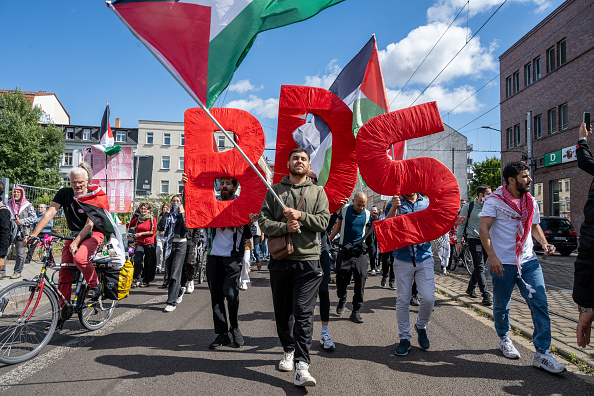
The student parliament of the Heinrich Heine University in Düsseldorf passed a resolution supporting the Boycott, Divestment and Sanctions (BDS) campaign against Israel, including an academic boycott of Israel.
Similar BDS-related resolutions have appeared at other German universities (e.g., in Berlin), sometimes triggering strong backlash and even political consequences. The university in Düsseldorf currently has multiple partnerships and joint research projects with Israeli institutions, including medical and scientific collaborations.
The resolution argues that cooperation with Israeli universities makes the university “complicit” in alleged actions of Israel in Gaza, and calls for ending academic partnerships, stopping exchange programs, and reviewing and potentially cutting research collaborations, writes Welt.
The University of Düsseldorf maintains various partnerships with Israeli educational institutions. As a partner university, it organizes, for example, the nationwide Israel exchange program, in which both students and faculty can participate.
However, a student BDS group claims Israeli universities are linked to the military and contribute to weapons development, justifying the boycott of institutions — not individuals.
Welt notes that the university’s Faculty of Law maintains close ties with the Radzyner Law School at Reichman University in Herzliya and is named after Holocaust survivor Harry Radzyner, who supported the University of Düsseldorf after the Nazi era.
Out of the 17 elected student representatives, 11 voted in favor of the BDS resolution, 7 of which are members of the Socialist-Democratic Students’ Association (SDS), a university group affiliated with the Left Party. Three Green members and one from “Die Liste” also voted in favor, while the two representatives from the Ring of Christian-Democratic Students (RCDS) and one member of the Liberal University Group reportedly voted against it.
SDS seeks “a boycott of Israeli institutions that profit from the genocide and the apartheid regime in Palestine.” Their post on Instagram states: “Israel occupies and colonizes Palestinian land, discriminates against Palestinian citizens of Israel, and denies Palestinian refugees the right to return to their homeland.”
The group further explains that Israeli universities are not independent from state activities but train soldiers, research military technology, and “ideologically educate people with a Zionist mindset.”
Max Fockenberg of the RCDS (Ring Christlich-Demokratischer Studenten – Association of Christian Democratic Students) counters that Germany has “a historical obligation to Israel. Research collaborations allow us to strengthen partnerships and promote democracy in the Middle East.”
“Excluding researchers and students simply because they work at an Israeli university is nothing short of antisemitism. The university administration must make it clear that boycotting Israel has no place on campus,” Fockenberg told Welt.
Michael Ilyaev, chairman of the Jewish University Group (JHG) Düsseldorf, agrees. “Boycotts divide people and promote hatred and ignorance,” Ilyaev told the portal. “The university should foster academic exchange and bring together people with differing opinions,” he added, emphasizing that these interactions “break down prejudices.”
Ilyaev also asked: “Why are you boycotting Tel Aviv University in Israel – but not the partnership with Isfahan University in Iran or Peking University in China?”