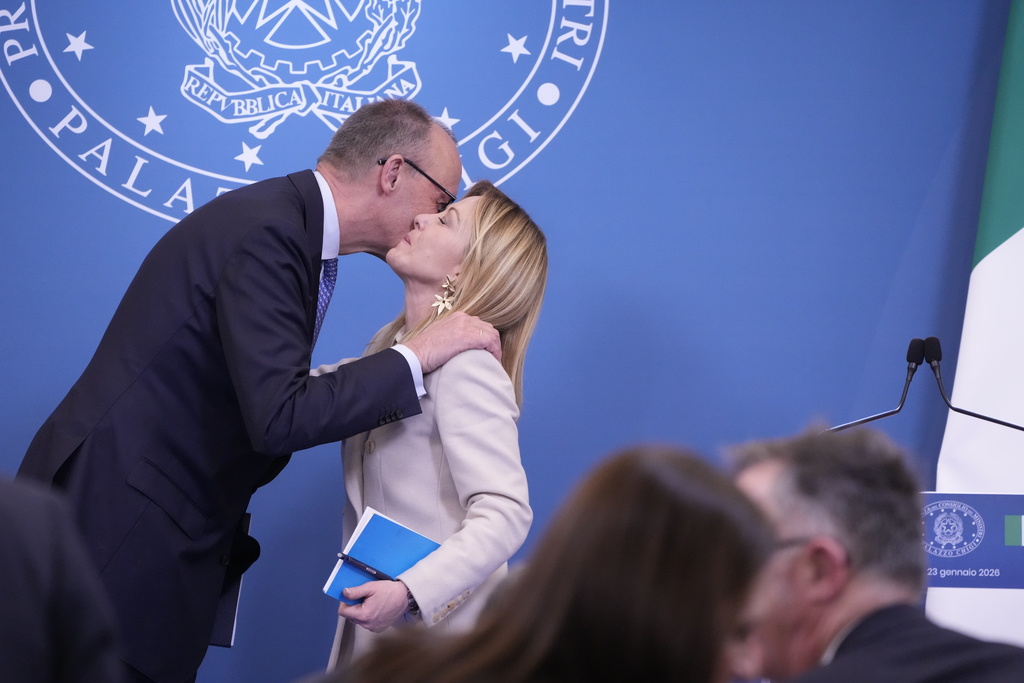
Italian Prime Minister Giorgia Meloni and German Chancellor Friedrich Merz have signed a “partnership agreement” in Rome, focused on strengthening security policy and Europe’s defense industry, taking stricter action against migration, curbing Brussels’ “overregulation,” and stimulating trade, according to a Telegraph piece cited by Mandiner.
The U.K. portal says Italy and Germany “have seized the steering wheel of Europe from Emmanuel Macron at a turning point in history,” predicting that French President Emanuel Macron will not be happy with this new friendship, as it appears to cast a shadow over France and more pointedly, the traditional Franco-German power axis.
At their meeting, Merz told press: “Italy and Germany are closer than ever.” And one EU diplomat was quoted as saying Berlin “needs partners it can work with,” and Rome seems more stable than Paris at the moment.
Italian officials have said the deal points to a “new center of gravity” within the EU, according to the Telegraph, which also reminds readers that a lot has changed in the past few years. While Meloni had been considered by many to be a Eurosceptic populist, she is now seen as a “pragmatist” and one of the most influential European leaders.
The paper concludes that the Merz-Meloni duo would push the continent’s political agenda
“in a more conservative direction,” while Paris’s influence would further decline.
The U.K. portal then ponders a new reality, where France is the “new Italy,” over concerns including debt and political uncertainty. France, they say, is starting to look like a “problematic member state of the EU,” while Italy under Meloni is trying to govern itself into the opposite position.
One French source told the portal that Merz believed it would be difficult to explain to the German public why it would be a good idea to “share debt” with a partner who “hasn’t been able to balance its budget for fifty years.”
Meanwhile, Meloni has “put things in order” in her country.
The portal also believes a Merz-Meloni axis would not enforce French-style anti-Americanism and confrontational behavior towards Donald Trump.
The analysis highlights Merz’s NATO commitment and transatlantic reflexes, and characterizes Meloni as a “Trump whisperer,” including Elon Musk among his connections. Still, the authors warn that Paris can be “pushed aside,” but “it cannot be ignored.”
Macron’s term ends in 2027, but a piece in Le Monde last summer indicated the French president may be looking to run again in 2032, telling youth at a party rally, “I will need you in two years, in five years, in 10 years.”
.