

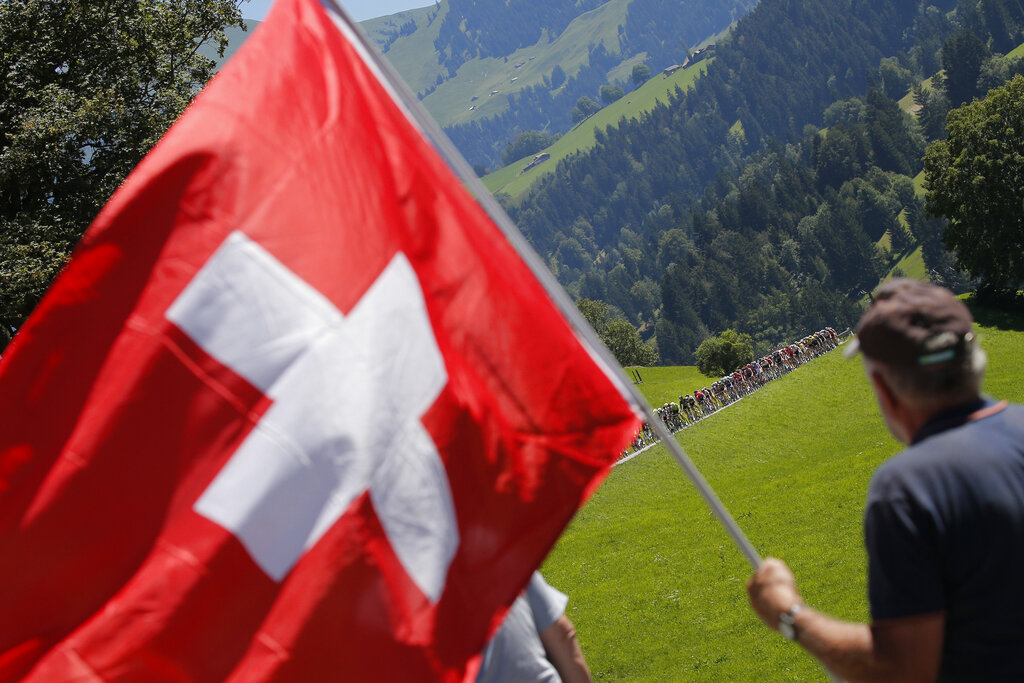
Switzerland will be tackling the issue of mass migration this June in a national referendum on June 14 where voters will decide on an upper population limit to the Alpine nation.
The Swiss People’s Party’s (SVP) initiative, “No to 10 million Switzerland,” aims to stop Switzerland from exceeding a population of 10 million. The one exception would be if there are more births than deaths. The country currently has just under 9 million permanent residents.
If the population exceeds 9.5 million before 2050, the Federal Council and Parliament would have to take measures to ensure compliance with the limit, “particularly in the area of asylum and family reunification,” according to Blick.
The initiative’s text indicates that Switzerland would have to renegotiate “international agreements that drive population growth,” and, if that is not enough, the country would need to end the free movement of persons agreement with the EU.
According to the Federal Council and a parliamentary majority, the initiative will only create new problems, while those in favor believe it will help regain control over and limit immigration.
Remix News first covered this referendum in 2022, when supporters of the vote were first organizing, with organizers pointing to Switzerland’s strained housing and social benefits systems, but also to environmental concerns associated with overpopulation.
The proposed referendum comes at a time where Europe increasingly faces environmental catastrophe, a housing crisis, and huge strains on public resources due to soaring immigration levels. Many European nations are among the most densely populated nations in the world and life in them is only expected to become more crowded in the near future unless dramatic action is taken. Switzerland is no exception.
“Our country is cracking in every corner. We are going through the debacles of recent years. If we don’t intervene, we will be overtaken by events,” said Marcel Dettling, the SVP’s campaign manager back in 2022.
“Today, there is very strong economic migration,” he said. “Whoever has set foot in Switzerland will never leave the country. Migrants from Africa have welfare rates of 34 percent.”
Between 2002 and 2022, Switzerland’s population increased by 21 percent. It has only grown in the last three years.
“If Switzerland grows so strongly again over the next 20 years, everything will collapse,” said Matter, who serves as a national councilor. According to him, the country’s financial reserves for education, health and transport are exhausted.
“It is urgent to leave the model of quantitative growth for qualitative growth.”
It is important to note that Switzerland has featured a number of referendums on the topic of immigration in the past, including the famous 2014 referendum “against mass immigration,” which won with 50.3 percent of the vote. The SVP-backed referendum was designed to place strict quotas on immigration, but despite winning the vote, the referendum was more or less made toothless by the Swiss parliament.
Switzerland was threatened by the EU over any attempt to restrict free movement, with the EU warning Switzerland that any abandonment of free movement would have meant that all EU agreements became null and void, which would have presented severe economic consequences for the country.
The SVP harshly criticized the final agreement, which failed to implement immigration quotas but instead offered moderate improvements regarding job market conditions for the Swiss. The SVP called it “a betrayal of voters’ wishes” and unconstitutional, while the EU commission celebrated the “hugely watered-down version of the initiative.“
The Swiss right’s attempt to tie the immigration to environmental causes was a development that Remix News also wrote about in 2022.
The current Western model promotes the idea of endless GDP growth through mass immigration. More immigrants equal more consumers, more housing construction springing up across the countryside, and more Third World peoples adopting a First World lifestyle.
Left-liberal and Green parties across the Western world have simultaneously called for Europeans to have fewer children to save the environment, while promoting mass immigration from Middle Eastern, African, and Asian countries, with these newcomers known for their notoriously high birth rates. At the same time, countries like Switzerland, Germany, and the United Kingdom are breaking population records due to immigration, leading to a severe strain on the environment and social welfare models within these European nations — a development that has been rejected by only a handful of nations such as Denmark and Hungary.
The right, if it wants to survive, may have to tie environmental causes and climate change, which the youth of Europe overwhelmingly believe is occurring, to soaring population growth through immigration. The Swiss referendum may be a nod to a growing reality. Any referendum that calls for immigration restriction is likely to fail given the growing pro-migration youth vote, but if it can be tied to green causes, such a referendum may have a chance.
Futhermore, the SVP argues that this endless population growth model is not only unsustainable, but actually will not result in the desired outcome of endless economic growth.
SVP National Councilor Manuel Strupler states that purely “quantitative” immigration does not guarantee higher per capita growth. Furthermore, this type of immigration “dilutes” the values of Switzerland.
“At some point, someone will have to pay the costs of our current policy. We have a duty to the next generation to preserve the values that have made Switzerland successful”
Thomas Matter argues that population growth has actually reached the point of harming economic growth and will help push the country into recession. He says that while the population will increase by 2.5 percent in 2022, per capita income will only rise by 2 percent:
“They want us to believe that immigration rhymes with growth. But in reality, we are heading towards a recession,” he said.
In June, Swiss voters will also take part in another referendum in June, a left-wing initiative against reforming the Civilian Service Act. The reform aims to make it more difficult for recruits to switch from the army to civilian service.