

Blog

  • No diesel, no loan, no sanctions: Orbán slams Zelensky for continued shutdown of Friendship pipeline, vows to block 20th sanctions package today in Brussels

    No diesel, no loan, no sanctions: Orbán slams Zelensky for continued shutdown of Friendship pipeline, vows to block 20th sanctions package today in Brussels

    Today, the Foreign Affairs Council will hold a meeting at 10 a.m. to discuss the 20th sanctions package against Russia in support of Ukraine. Hungary has vowed to block this unless Kyiv reopens the Druzhba (“Friendship”) pipeline that transports oil from Russia to both Hungary and Slovakia. It has also threatened to shut off all diesel shipments and refuse any military loan.

    Hungary has remained defiant on the issue of the pipeline, as it has secured exemptions from the EU for Russian oil, as has Slovakia. Kyiv has claimed that damage to the pipeline is to blame for shipments being stopped, but Budapest has cried foul, claiming that Zelensky is trying to create an energy crisis to help the opposition party, Tisza, win the upcoming parliamentary election in April.

    Yesterday, Hungarian Foreign Minister Péter Szijjártó posted on X: “At tomorrow’s Foreign Affairs Council, the EU aims to adopt the 20th sanctions package. Hungary will block it. Until Ukraine resumes oil transit to Hungary and Slovakia via the Druzhba pipeline, we will not allow decisions important to Kyiv to move forward.”

    Szijjártó confirmed that Hungary’s crude oil supply remains secure, with strategic reserves sufficient for 96 days. However, Hungary also expects Croatia to comply with European rules and allow Russian crude oil to arrive by sea from mid-March.

    Prime Minister Viktor Orbán also posted that Hungary will do what it must to secure the country’s energy supply and will enact “countermeasures” until Druzhba shipments are enabled. “No diesel shipments from Hungary to Ukraine. Refusal of any military loan to Ukraine. No support for sanctions; the 20th sanctions package will be rejected.”

    Ukraine is also highly reliant on Hungary for electricity, with Budapest’s exports amounting to as much as 40 percent of Kyiv’s power demands.

    So far, the Hungarian government has rejected cutting Ukraine’s electricity, citing “humanitarian” reasons.

    “We have also reviewed the issue of electricity exports and decided to proceed with particular caution, as any suspension would primarily affect civilians in Ukraine as well as Hungarian communities in Transcarpathia, and we do not seek to cause additional hardship to them,” wrote Balázs Orbán, the prime minister’s political director. “Our steps are a response to decisions by the Ukrainian political leadership that endanger Hungary’s energy security and attempt to influence the Hungarian elections. Hungary will not be blackmailed.”

  • ‘You can kill in France with impunity,’ says bereaved mother after migrant killer in stabbing of 18-year-old Théo held not criminally responsible

    ‘You can kill in France with impunity,’ says bereaved mother after migrant killer in stabbing of 18-year-old Théo held not criminally responsible

    The mother of 18-year-old Théo Muxagata has said, “You can kill in France with impunity,” after the Senegalese migrant who fatally stabbed her son over call charges to his homeland was declared criminally irresponsible by a French court.

    Ousmane Diallo, a 67-year-old Senegalese national, had been on trial since Tuesday before the Seine-et-Marne Assize Court over the stabbing which occurred on July 10, 2021. On Friday, the court ruled that he could not be held criminally responsible for his actions and ordered his involuntary hospitalization in a psychiatric facility.

    The killing followed a dispute over €93.62 in additional charges for phone calls Diallo had made to Senegal. Prosecutors said the accused entered the Bouygues Telecom store in the Claye-Souilly shopping center and became enraged, stabbing Muxagata and seriously injuring another employee in the frenzied attack. A third employee was targeted but escaped unharmed.

    Muxagata managed to leave the shop after being wounded but collapsed a short distance away inside the shopping center. He later died from his injuries.

    In lengthy pre-trial evaluations, Diallo was examined by three separate panels of psychiatric experts to ascertain whether or not he could be found criminally responsible for the attack. As reported by Le Figaro, two concluded that he lacked the capacity to understand or control his actions at the time of the offenses, while a third found that his judgment was impaired but suggested the Senegalese national was not suffering from a mental illness.

    The court ultimately found Diallo guilty but not criminally responsible for Théo’s death, meaning he will not receive a prison sentence and will instead be sent to a psychiatric unit for treatment.

    In an interview with Le Figaro, the victim’s mother expressed her devastation at the verdict.

    “The past week marks the end of a long and painful process. We waited four and a half years to be told that Mr. Diallo is guilty but not responsible. It’s hard to hear and impossible to accept. Whose fault is it then? This verdict has devastated us. We’re struggling to come to terms with it; it’s a crushing blow. We feel a sense of injustice and anger. You can kill in France with impunity. Furthermore, he had already committed acts of violence in 2003; why was his residency permit renewed?” she asked.

    She also disputed the psychiatric conclusions, arguing that the attack showed signs of planning.

    “He made threats in the shop the day before: ‘I’ll be back if I don’t get my money.’ On the day of the crime, he checked his bank account before leaving home to see if he had been reimbursed. He also took the trouble to take a knife and hide it. There was premeditation, and he intended to kill.

    “He seemed to fully understand everything he was doing. For me, when someone is in a ‘delusional’ state, they are in their own world and don’t think about anticipating what they need. In my opinion, he is responsible,” she added.

    In a statement outside the courthouse on Friday, the lawyer for the victim’s mother said, as cited by CNews, “This decision was felt to be particularly unjust because the evidence in the case demonstrated that Mr. Diallo was aware and determined to commit a crime, and that diminished responsibility should not have been taken into account.

    “As a consequence of this decision, Ousmane Diallo has been involuntarily committed to a psychiatric hospital, but Théo’s family is wondering for how long.”

  • Syria asks Germany not to deport its citizens back home, warning it would make country ‘unsafe’

    Syria asks Germany not to deport its citizens back home, warning it would make country ‘unsafe’

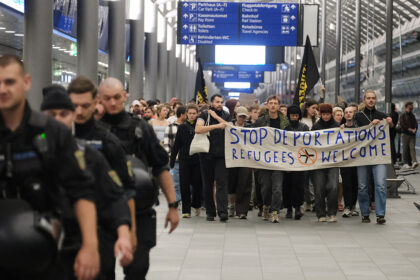
    Syria has formally asked Germany for patience over the deportation of Syrian nationals, warning that the return of thousands could lead to insecurity in the country and worsen the country’s fragile humanitarian situation.

    As reported by Welt, Mohammed Yaqub al-Omar, director of the consular department at the Syrian Foreign Ministry, urged Germany “to understand the Syrian refugees and give us more time for reconstruction.” He warned that “the return of thousands of Syrians to Syria at this time could exacerbate the humanitarian crisis and mean that many people will have to live in refugee camps.”

    According to al-Omar, 1.5 million people are currently living in tent camps in northern Syria alone due to destroyed homes, schools, roads, and a lack of electricity. Large-scale deportations from Germany, he suggested, would place further strain on already overstretched infrastructure.

    Politicians from the Christian Democratic Union (CDU) and its Bavarian sister party, the Christian Social Union (CSU), argue that legal protection grounds no longer apply, but members of the co-governing left-wing Social Democrats (SPD) were more amenable to Damascus’ request.

    “Residence rights are not determined by the wishes of the countries of origin, but by whether a claim to protection exists. This claim, however, ceased to exist after the fall of the Assad regime,” Alexander Throm, domestic policy spokesman for the CDU/CSU parliamentary group, told Focus magazine. He added that returns to safe areas of Syria are possible, asking, “Who, if not Syrians, should rebuild the country after the civil war?”

    Marion Gentges, Justice and Migration Minister in Baden-Württemberg from the CDU, warned against delaying deportations because of the current debate. “We have an interest in ensuring that serious criminals and dangerous individuals leave our country. Therefore, such deportations, including those to Syria, must be carried out consistently,” she said.

    The topic of Syrian deportations could lead to friction within the federal coalition, however, with SPD lawmakers suggesting that Damascus’ request for more time was reasonable.

    “Syria still needs time to create structures that allow for returns,” said Serdar Yüksel, SPD chairman of the German-Turkish Parliamentary Group. In many areas, he reported, there are “no schools, no hospitals, no running water, no sewage system.” In some places, there is “virtually no reconstruction” taking place, he added, without responding to the suggestion that perhaps Syrians themselves should be leading the reconstruction.

    The issue is already partially addressed in the coalition agreement between the CDU/CSU and SPD, which provides for the resumption of deportations to Syria, beginning with criminals and individuals considered threats to public safety. However, a broader deportation policy back to the country has not been agreed upon.

    Alice Weidel, co-leader of the Alternative for Germany (AfD), slammed the request by the Syrian government, and suggested that a remigration policy for Syrians would already be in full force were her party in office.

    She wrote on X, “Syria is demanding that Germany not send back criminal Syrians – and the German government is complying. With the AfD in government, the deportation offensive would begin immediately – and the safety of its own citizens would be prioritized!”

    Her party added in a separate post, “Syria refuses to take back Syrians – so the country doesn’t become ‘unsafe.’ Criminal Syrians are supposed to stay in Germany – and the German government is complying. Instead: launch a deportation offensive, send Syrians back to Syria!”

    Voluntary deportation programs were launched in some German states last year, but resulted in extremely poor conversion rates. Despite financial incentives being offered at German taxpayers’ expense, just a fraction of those offered assistance to return home took up the offer.

  • Austrian couple sentenced to life for torturing and starving their 3-year-old son Elias to death

    Austrian couple sentenced to life for torturing and starving their 3-year-old son Elias to death

    In a landmark ruling that has gripped the Austrian public, the Innsbruck Regional Court has handed down life sentences to Austrians Kevin and Nathalie M., both 27, for the systematic starvation and torture of their 3-year-old son, Elias.

    The verdict, delivered after a harrowing trial, also included a mandate for the mother to be committed to a psychiatric institution. The couple had previously admitted to the horrific abuse that ended their son’s life in May 2024.

    Prosecutor Verena Pezzei categorized the depravity of the case as unparalleled in her closing remarks, as documented by Austrian outlet Kronen-Zeitung. She noted, “We have something so cruel here in that this district has never seen – not even across Austria. They tortured their three-year-old son to death and made fun of him.”

    Elias, pictured a year before he was starved to death.

    The prosecution detailed a five-month period of escalating violence in which the toddler was regularly assaulted and restrained. The child’s life ended in a cramped, 50-centimeter drawer, where he succumbed to the combined effects of hunger and thirst.

    During their private communications, the couple dehumanized the boy, and believed that he was possessed by an evil old woman named “Dorothea,” who they called “the old woman.” They attempted to frame the abuse as a spiritual struggle against a “demon” they claimed occupied his body. This narrative was rejected by forensic psychiatrist Adelheid Kastner, who testified there was “no delusion and no illness.“

    Kastner suggested the parents used the child as a scapegoat for the pressures of poverty and the demands of caring for their three other daughters.

    The core of the judicial evidence consisted of 125,000 chat messages exchanged between the parents. These records demonstrated a collaborative effort to organize and document the child’s suffering. The prosecutor highlighted one particularly dark exchange: “Killing is not enough – he must die in agony.”

    The court heard that Elias was confined for long stretches in a lightless room and a windowless bathroom. According to the prosecution, the child’s “mouth was often taped shut, hands and legs tied with cable ties.”

    Adding to the trauma was that his older sister, aged six, recalled to authorities that she heard the haunting sound of the toddler desperately pounding on the door in an attempt to escape his confinement.

    While Nathalie M. remained largely stoic, Kevin M. offered a public apology during the proceedings.

    “There is no explanation for what happened, nothing would even begin to explain it.“

    He further stated, “I recognize my mistake; it is inexcusable. I regret every day, I am deeply sorry that my three other children witnessed Elias’s suffering.”

    The atmosphere in the courtroom turned somber when a video of the victim was played for the jury. While the audience could only hear the boy’s cries, the footage was so distressing that one observer walked out, muttering: “I don’t understand it.”

    The judges ruled that the couple purposefully neglected and tormented Elias, taking advantage of his absolute vulnerability. The case remains one of the most significant and disturbing chapters in Austria’s legal history. While the parents remain in custody, it is not yet clear if they intend to challenge the life sentences.

  • ‘We’ll be monitoring this case’ — US State Department condemns killing of Quentin Deranque

    ‘We’ll be monitoring this case’ — US State Department condemns killing of Quentin Deranque

    The U.S. government has weighed in on the killing of French conservative student Quentin Deranque by far-left militant activists, warning that “violent radical leftism is on the rise,” and demanding that those responsible be brought to justice.

    In a statement posted on X, the U.S. Department of State Bureau of Counterterrorism said, “Reports, corroborated by the French Minister of the Interior, that Quentin Deranque was killed by left-wing militants, should concern us all. Violent radical leftism is on the rise, and its role in Quentin Deranque’s death demonstrates the threat it poses to public safety. We will continue to monitor the situation and expect to see the perpetrators of violence brought to justice.”

    Under Secretary of State Sarah B. Rogers also addressed the case, warning about the consequences of pandering to political extremism.

    “Democracy rests on a basic bargain: you get to bring any viewpoint to the public square, and nobody gets to kill you for it,” she wrote.

    “This is why we treat political violence — terrorism — so harshly. Once you decide to kill people for their opinions instead of persuading them, you’ve opted out of civilization. We will continue to watch this case,” she added.

    Deranque, 23, was fatally beaten in Lyon following clashes linked to a far-left demonstration. French prosecutors have confirmed that 11 individuals have been arrested in connection with the attack.

    Those detained include two parliamentary staff members affiliated with the hard-left La France Insoumise (LFI) party led by Jean-Luc Mélenchon, and a former intern of LFI MP Raphaël Arnault. One of the parliamentary assistants, Jacques-Élie Favrot, has now been indicted for intentional murder, serious violence, and criminal association, and his role and the roles of others in the far-left party La France Insoumise are leading to calls for a political “firewall,” usually reserved for the right, to be applied to the left in France.

    News of the killing has reverberated across Europe, sparking protests, as well as a diplomatic spat between Paris and Rome.

    Italian Prime Minister Giorgia Meloni publicly expressed solidarity following Deranque’s death, warning that “polarizing ideologies” and a climate of hatred were contributing to growing militancy across the continent. Her remarks prompted a sharp response from French President Emmanuel Macron, who rebuked foreign leaders for commenting on French domestic affairs.

    Macron said he was “always struck by the fact that nationalists, who do not want to be disturbed in their own country, are the first to comment on what happens elsewhere,” in comments that were widely interpreted as directed at Meloni.

    Meloni hit back on Thursday evening in an interview with Sky TG24, lamenting the fact that Macron “did not understand” the difference between interference and expressing solidarity and concern.

  • Former Portuguese soldier accused of stealing NATO data for Russia believed to have been hired by third parties

    Former Portuguese soldier accused of stealing NATO data for Russia believed to have been hired by third parties

    The 23-year-old man who planned to sell confidential NATO data from a computer and tablet belonging to a Swedish Navy officer to Russians is reportedly a former Portuguese soldier.

    According to information obtained by Lisbon weekly Sabado, cited by Do Rzeczy, the man was detained by Ukrainian authorities in 2023 on suspicion of espionage. At the time of his arrest, he was in possession of a weapon. He was ultimately deported to Portugal, from where he regularly traveled to Luxembourg.

    His attempt to sell confidential NATO info to Russia ultimately failed, and he was caught red-handed. According to investigators, the Portuguese obtained the data during an international conference held at the Naval Academy in Lisbon, which focused on robotic experiments with unmanned systems. The accused allegedly broke into a hotel housing NATO officers, stole the Swedish Naval officer’s equipment, and copied the data onto a portable drive.

    The 23-year-old was allegedly assisted in the theft by two other individuals, who are also under investigation. However, the investigation, which is ongoing, is focused on uncovering third parties believed to have commissioned the theft.

    The Lisbon Prosecutor General’s Office announced that the Portuguese national has been charged with attempted espionage, aggravated theft, using someone else’s identity document, and making false statements. He is also being charged with possession of child pornography and falsely attributing espionage to individuals unrelated to the activity.

  • Italy: German woman found beheaded near Florence, North African suspect arrested

    Italy: German woman found beheaded near Florence, North African suspect arrested

    A woman believed to be a 44-year-old German national has been found decapitated in a park in Scandicci, near Florence, and Italian authorities have arrested a North African migrant in connection with the gruesome murder.

    The victim’s body was discovered late Wednesday morning in the former site of the National Research Council. The remains were located near an abandoned building, just 100 meters from the local high school, that had been walled up to prevent unauthorized access, but which was reportedly being used by squatters.

    Initial reports suggested the woman had been stabbed, and investigators later confirmed that a blood-stained machete had been seized as evidence at the scene. Authorities believe the victim’s head had been severed and that her body was dismembered in an apparent attempt to conceal the crime.

    According to the Italian news agency Ansa, as cited by Bild, a man who apparently knew the victim had been secretly living inside the abandoned structure from which the emergency call was made. He has since been arrested. The suspect, described by La Repubblica as a North African man with prior convictions for drug offenses. Despite his criminal record, he remained in Italy.

    The man owned a pit bull that was allegedly guarding the body when police arrived. Officers were initially unable to approach the remains for around an hour because the dog would not let anyone near. Once the animal was secured, investigators were able to recover the suspected murder weapon and begin detailed forensic work.

    No identification documents were found on the victim. While she is believed to be a 44-year-old German woman, a DNA test will be carried out to confirm her identity. An autopsy has also been ordered to determine the precise cause and time of death.

    Prosecutors are still working to establish whether the woman was killed at the site in Scandicci or whether her body was transported there in an effort to hide it. Investigators currently suspect the perpetrator attempted to clean the area after the killing in order to destroy evidence.

    “We learned from press sources that a terrible tragedy occurred today in Scandicci that deeply alarms us,” said Scandicci Mayor Claudia Sereni, as cited by Sky TG24. “We express our utmost confidence in the work of law enforcement and the investigation coordinated by the Florence Public Prosecutor’s Office, confident that full clarity will be shed on what happened.”

    “We know that, along with collaboration with law enforcement and an increasingly widespread presence throughout the area, we must invest heavily in the social capacity to prevent tragedies like these, including addressing marginalization and the complex implications of social degradation, which municipalities are too isolated and under-resourced to address,” she added.

  • Killing of Quentin Deranque: Political firewall against the left forming in France after numerous far-left extremists are indicted for murder

    Killing of Quentin Deranque: Political firewall against the left forming in France after numerous far-left extremists are indicted for murder

    After far-left militants beat conservative Catholic Quentin Deranque to death in Lyon, one of their members, Jacques-Élie Favrot, has been indicted for intentional murder, serious violence, and criminal association. His role and others in the far-left party La France Insoumise is leading to calls for a political “firewall,” usually reserved for the right, to be applied to the left in France.

    Favrot is now in pre-trial detention for the barbaric murder of the 23-year-old victim, who was protecting the feminist activist group Collectif Némésis during a demonstration.

    Favrot is a parliamentary assistant to far-left La France Insoumise (LFI) deputy Raphaël Arnault, who was the founder and leader of the extremist leftist militia Young Guard, which was dissolved by the French state.

    Favrot’s lawyer confirmed that his client admitted to being present at the scene and participating in the violence against Deranque and other individuals.

    However, Favrot denies delivering the fatal blows that killed Deranque. The Lyon prosecutor stated that Favrot played a “leadership role” in the sequence of violence.

    So far, seven people have been charged, including another employee of the far-left LFI, named as Adrien B. Many of these suspects have been indicted with intentional homicide.

    Three of the suspects have links to the ultra-left movement and two have criminal records, according to France Info.

    “Two of them refused to explain the facts, in particular. The others acknowledged their presence at the scene, and some admitted to having dealt blows to Quentin Deranque or other victims. On the other hand, they all contested homicidal intent,” according to Thierry Dran, public prosecutor of Lyon. “It is in particular thanks to the in-depth study of the numerous videos that investigators were able to put a name to the seven suspects. Identifying those present at the scene was difficult. And to this day, there are still several people to identify.”

    Political earthquake and potential firewall

    The role of the far-left LFI in the murder is being described as a “political earthquake” in France.

    “The far left has killed,” said Jordan Bardella, the leader of the National Rally.

    He accused LFI founder Jean-Luc Mélenchon and his movement of serving as an “ideological incubator for violent movements” that “install a climate of tension and disorder on the streets as in the National Assembly.”

    The National Rally leader now calls for politicians to end the firewall usually reserved for the right and now apply it to the left.

    “I therefore call for the formation of a genuine cordon sanitaire to isolate La France Insoumise and keep it away from the institutions, whether in the National Assembly, where these MPs sit on numerous bodies, or with a view to the next local elections,” said Bardella.

    Mélenchon, however, has only reacted with outrage, deflecting blame for the murder and placing it on the peaceful activists of Collectif Némésis.

    “The Collectif Némésis group must be banned because it is dangerous, it attacks our meetings, it attacks our leaders, it threatens us with death.” According to Mélenchon, the group is the real “threat,” not Antifa, even though the Collectif Némésis members and its security team have been targeted with literal death on the streets of France.

    His claims come as pressure grows to investigate his party for supporting shielding left-wing terrorists, including the members just arrested in connection with the murder of Deranque.

    Bardella is not the only one calling for a firewall against the LFI. Others on the left appear to be equally revolted by LFI.

    Raphaël Glucksmann, MEP for the eco-party Place publique, said that an alliance with LFI is impossible. “It is unthinkable, I tell you, unthinkable, that we on the left continue to have the slightest doubt about a possible electoral alliance with La France Insoumise,” he said.

    These political developments come just before local elections and national elections next year.

    The case has also sparked international outrage, with Italian Prime Minister Giorgia Meloni condemning the murder of Deranque. The United States has also commented on the murder.

    “Democracy rests on a basic bargain: you get to bring any viewpoint to the public square, and nobody gets to kill you for it. This is why we treat political violence — terrorism — so harshly. Once you decide to kill people for their opinions instead of persuade them, you’ve opted out of civilization,” wrote Under Secretary of State Sarah B. Rogers.

  • Meloni fires back at Macron after French president tells Italy to ‘mind its own business’

    Meloni fires back at Macron after French president tells Italy to ‘mind its own business’

    Italian Prime Minister Giorgia Meloni has responded bluntly to French President Emmanuel Macron after he suggested she should refrain from interfering in France’s domestic affairs. The exchange stems from Meloni’s public expression of solidarity following the death of Quentin Deranque, the right-wing student who died after an attack by suspected far-left militant activists.

    Macron, speaking from New Delhi during an official visit to India, mocked foreign leaders who comment on events in France. “Let everyone stay at home, and the sheep will be well looked after,” he said. “I am always struck by the fact that nationalists, who do not want to be disturbed in their own country, are the first to comment on what happens elsewhere.”

    Meloni had described the death of Deranque as “a wound for the whole of Europe,” writing on X that “no political idea, no ideological opposition can justify violence or turn confrontation into physical aggression. When hatred and violence replace dialogue, democracy always loses.”

    Deranque, a mathematics student, died in the hospital two days after being beaten and kicked in the head by masked attackers in Lyon. The assault followed clashes linked to a far-left demonstration near the city’s Institute of Political Studies. Investigators say at least six individuals took part in the attack, and a total of 11 arrests have now been made. Suspects have been described as militants linked to La Jeune Garde, a far-left group that has since been banned by French authorities.

    Responding directly to Macron’s rebuke, Meloni said she was “very struck” by his words and had not expected such a reaction. She insisted her comments were not an intrusion into French domestic affairs, but a broader reflection on the “growing polarization and political violence across Western democracies.”

    “I see a climate that I do not like,” she said. “I see it in Italy, I see it in France, I see it in the United States. I also commented on the murder of Charlie Kirk at the time.”

    Meloni rejected the charge of interference outright, drawing a sharp distinction with solidarity. “I think interference is something else,” she said. “Interference is, for example, when a leader is elected by their own citizens and hears a foreign state say, ‘We will monitor the application of the rule of law.’ That is interference.”

    This remark is thinly veiled criticism of comments made by French officials following her election victory in 2022, when France indicated it would monitor the new Italian government’s adherence to democratic values.

    Meloni also noted that France had granted political asylum “to the cream of the crop of the Red Brigades for several decades,” suggesting Paris was in no position to lecture others on sensitivity in matters of political extremism.

    The Red Brigades were a far-left Italian terrorist organization that carried out kidnappings, bombings, and assassinations — most notoriously the 1978 abduction and murder of former Prime Minister Aldo Moro.

    “Expressing solidarity with the French people on a matter that clearly concerns everyone is not interference. So I am sorry that Macron did not understand that,” Meloni concluded.

    Beyond the Macron row, Meloni also addressed several major issues in the wide-ranging interview. She defended Italy’s upcoming justice reform referendum, insisting it is a “common sense” measure designed to improve accountability within the judiciary and should not be turned into a vote on her government.

    On foreign policy, she pointed to cautious progress in efforts toward peace in Ukraine and the Middle East, stressing the need for a “just peace” and continued international coordination.

    Domestically, she outlined a €5 billion energy relief package to cut household and business bills, emergency reconstruction funds exceeding €1 billion following severe storm damage in southern regions, and praised Italy’s performance and organization at the Winter Olympics, describing it as proof of the nation’s resilience and global standing.

  • Will Poland’s largest conservative party split up?

    Will Poland’s largest conservative party split up?

    Will there be a split in Law and Justice (PiS), the largest conservative party in Poland? Poles have answered this question in a new poll.

    Recent weeks have been a difficult period for PiS. The party has been steadily losing support to the Confederation of the Polish Crown and the Confederation. To make matters worse, the group is also grappling with internal conflict between Mateusz Morawiecki and politicians around Jacek Sasin and Patryk Jaki, among others.

    Is the party at risk of a split? Poles were asked about this issue in an SW Research survey. 41.2 percent of respondents believe it will not happen, while 29.7 percent believe a split will occur. Another 29.2 percent of respondents have no opinion on the matter.

    Kaczyński has already chosen the prime minister

    The PiS leader announced that he has already chosen a candidate to be the next prime minister. The name will be announced in March. Meanwhile, the party is in turmoil.

    According to media reports, Mateusz Morawiecki may leave the party and form his own group. Up to 40 members of parliament may leave PiS along with the former prime minister.

    According to journalists, Morawiecki wants to be ready to leave PiS by the time the lists for the 2027 parliamentary elections are being created. This is intended to give him a strong negotiating argument. “We’re traveling around the country, gauging sentiment, and building social media, because that’s where we could collect signatures to run independently,” the source told Zero.pl.

    What about financing the new project?

    “We’re least concerned about finances. Money is important, of course, but if you have leaders as popular as Mateusz Morawiecki and an efficient organization, you can ask our supporters for support,” said the source.

    The survey was conducted on Feb. 18, 2026, by SW Research using online interviews (CAWI—Computer-Assisted Web Interview) on the SW Panel website. As part of the study, 800 surveys were conducted with a nationwide sample of adults. Quota sampling was used, assuming the sample was representative in terms of the overall distribution of gender, age, and town-size class.

  • ‘Thief, get ready for the rope’ – Death threats issued against former PiS justice minister who took political asylum in Hungary

    ‘Thief, get ready for the rope’ – Death threats issued against former PiS justice minister who took political asylum in Hungary

    Former minister of justice under Law & Justice (PiS), Zbigniew Ziobro, was officially granted asylum in Hungary in January, having fled there in late 2025. His status was granted under the justification that he was being falsely accused of crimes in his home country by Tusk’s Civic Coalition (KO) government and being politically targeted by the Polish Prosecutor’s Office.

    Ziobro has reported receiving various threats on his life. Now, however, the threats are directed at his child and attorney, as well as himself, including the most recent one, which has come from a KO activist. Ziobro has divulged the content of the threat to “Super Express,” cited by Do Rzeczy. For this reason, he decided to file a motion to prosecute the perpetrators.

    “Thief, get ready for the rope. Budapest is smaller than you think, you scumbag,” reads the message sent to the PiS deputy leader.

    “This entire spectacle of slander and threats” is on Prime Minister Donald Tusk, said Ziobro. “If anything happens to my loved ones or my attorney, you will bear full responsibility,” he told the Polish prime minister.

    Super Express journalists attempted to contact the sender of the message, but were unsuccessful. However, they found that “during the 2024 local elections, this man unsuccessfully ran for the position of councilor in Starachowice from a committee supported by the Civic Platform. He was also photographed in the company of Civic Coalition politicians.”

    Ziobro recalled another similar situation with another KO activist 16 years ago. “I remember 2010. Civic Platform activist Ryszard Cyba was looking for me all over Warsaw to kill me. He also approached Jarosław Kaczyński, but was frightened by the armed guards. He admitted in court that he was afraid the guards would shoot him. A piece of paper found on him had three names written on it: Kaczyński, Ziobro, Kurski – his targets. Ultimately, he murdered an employee of the PiS parliamentary office in Łódź, Marek Rosiak,” the former justice minister told the newspaper.

    In his opinion, we are now dealing with a similar situation.

    “Another activist associated with the Civic Platform (PO) wants to kill. Only today, it’s the result of a manhunt organized by Donald Tusk himself,” he added. The politician recalled Jan Rokita’s words from November of last year, when he said of an attempt to bring the politician to justice: “The goal of this action is Ziobro’s death.”

    “I’ve never reported threats before, as they only targeted me personally. This time, however, because the threats come from a Civic Platform (PO) activist, are directly related to the incitement personally perpetrated by Donald Tusk, and also affect my loved ones, I must file a report. Last week, I notified the prosecutor’s office of the threats against my child and attorney. Now I’ll add a colleague from Tusk’s party to the report,” Ziobro announced.

  • Election interference? With Ukraine blamed for cutting oil flows to Hungary, Croatia also refuses to transfer Russian oil in violation of EU law

    Election interference? With Ukraine blamed for cutting oil flows to Hungary, Croatia also refuses to transfer Russian oil in violation of EU law

    The energy supply dispute has reached a new level in Central Europe after Zagreb made it clear that it will not allow Russian crude oil to be transported via the JANAF pipeline to Hungary and Slovakia.

    Hungarian Foreign Minister Péter Szijjártó announced this week that Hungary would stop the transport of diesel fuel to Ukraine, after it halted the transit of oil via the Friendship pipeline on Jan. 27 and has not resumed it since. Shortly afterwards, Slovak Prime Minister Robert Fico also announced that the Slovnaft oil refinery would stop exporting diesel to Ukraine.

    Szijjártó made it clear that Hungary expects Croatia to comply with EU law and step in to fill the shortage created for Hungary and Slovakia due to Kyiv’s refusal to reopen the Druzhba pipeline.

    Economy Minister Ante Susnjar has indicated that Croatia is ready to help the two countries with oil from non-Russian sources, in accordance with European Union legislation and OFAC rules, but Hungary has countered that this is not in compliance with EU rules, which Szijjártó has pointed out state that if land transit of Russian crude oil is impossible, Budapest and Bratislava can also purchase from Russia by sea.

    Susnjar said that JANAF is capable of transporting 15 million tons of oil per year, which exceeds the combined capacity of the Százhalombatta and Bratislava refineries, so there are no technical obstacles. He added that transportation fees account for only about one percent of the total cost of oil. According to him, as explained by Index, the real issue is that Russian oil is about 30 percent cheaper than alternatives.

    Prime Minister Andrej Plenkovic confirmed that Croatia is able to guarantee 12 million tons of oil per year for Hungary and Slovakia, which would fully cover the refining needs of both countries.

    Meanwhile, the European Commission has also intervened following an extraordinary meeting. “We have convened an ad hoc meeting of the Oil Coordination Group to discuss the impacts of the supply disruption and possible alternatives to fuel supply,” said Anna-Kaisa Itkonen, spokesperson for the European Commission.

    She further added, as quoted by Euronews, “We are in contact with Ukrainian authorities on the timeline of repairing this (Friendship) pipeline. It is very, very important that this is not misinterpreted to mean that we would be exerting any kind of pressure on Ukraine.”

    Still, the EU commission has made it clear that they are concerned about Ukraine’s own energy security, indicating they do not want to see Hungary and Slovakia blocking diesel fuel from the war-torn country. Hungary also stated yesterday that it may decide to cut off electricity and natural gas transports to Ukraine as well, as confirmed by Reuters.

    Szijjártó stated that they are in constant contact with the Ukrainian authorities about the schedule for repairing the pipeline. He noted that Hungary expects the European Commission to comply with European Union rules and that the Brussels body should not behave like the “Ukraine Commission.” He also called on them to take the EU rules on the import of Russian crude oil seriously and to signal to the Croatians that they cannot refuse the sea transport of Russian oil from Hungary and Slovakia during the outage of the Friendship pipeline.

    The Hungarian foreign minister has also made it clear that there are no physical or technical obstacles to restarting the oil pipeline, claiming that Zelensky’s refusal to restore service on the Druzhba is election interference, given it plays directly into the opposition’s hands right before parliamentary elections in Hungary this April.

  • ‘Stay at home!’ — Macron rebukes Meloni for speaking out on Quentin Deranque’s death after far-left attack

    ‘Stay at home!’ — Macron rebukes Meloni for speaking out on Quentin Deranque’s death after far-left attack

    French President Emmanuel Macron has rebuked Italian Prime Minister Giorgia Meloni for commenting on the death of 23-year-old nationalist activist Quentin Deranque, who was fatally beaten in Lyon following clashes linked to a far-left demonstration.

    According to remarks cited by Corriere della Sera, Macron, speaking from New Delhi during an official visit to India, urged foreign leaders to refrain from intervening in French domestic affairs.

    “Let everyone stay at home, and the sheep will be well looked after,” Macron quipped. “I am always struck by the fact that nationalists, who do not want to be disturbed in their own country, are the first to comment on what happens elsewhere.”

    Meloni had earlier written on X that “the death of a young man in his early twenties, attacked by groups linked to left-wing extremism and swept away by a climate of ideological hatred that spans several nations, is a wound for the whole of Europe.”

    She added, “No political idea, no ideological opposition can justify violence or turn confrontation into physical aggression. When hatred and violence replace dialogue, democracy always loses.”

    Deranque, a 23-year-old mathematics student, died in the hospital two days after being beaten and kicked in the head by a group of masked attackers in Lyon. The assault occurred following a small demonstration by nationalist feminists at the city’s Institute of Political Studies, where the far-left La France Insoumise party MEP Rima Hassan was holding an event. Deranque had been helping provide protection at the event.

    Investigators say at least six individuals took part in the attack. State prosecutor Thierry Dran told a news conference that Deranque suffered fatal damage to his skull and brain as a result of repeated blows.

    Nine people have been arrested in connection with the killing. Among those detained is Jacques-Elie Favrot, a parliamentary assistant at the National Assembly for a deputy from La France Insoumise, the party led by Jean-Luc Mélenchon.

    Those suspected of involvement have been described as militants linked to La Jeune Garde, a far-left group that has been banned by French authorities.

    The case has placed significant pressure on La France Insoumise and its leadership. Mélenchon denied any connection between his party and the attack.

    “Our party has nothing to do with this story. Those who accuse us are committing a libel,” he said. “We express our consternation, but also our empathy and compassion for [Deranque’s] family and friends. We have said dozens of times that we oppose all forms of violence.”

    However, the killing has prompted strong reactions from figures on the French right and demands for Mélenchon to face up to the consequences of his party’s rhetoric and self-proclaimed “anti-fascist” agenda. Jordan Bardella, leader of the National Rally, told CNews, “Quentin’s death is a turning point.”

    “Jean-Luc Mélenchon has a lot to answer for. His political movement has created a breeding ground for ultra-violent groups, and the far-left must now be held accountable,” Bardella said.

    Éric Zemmour, leader of Reconquête, described the murder as part of a broader historical pattern. “We have to stop blaming our society. It’s indicative of the degree of violence of the far left over the last 100 years,” he told reporters.

    Right-wing MEP Marion Maréchal also criticized Macron’s remarks, suggesting that the issue of political violence carries particular resonance in Italy and France.

    A few hours after Macron’s comments, sources at Palazzo Chigi expressed “astonishment” at the French president’s words.

  • An end to anonymity? German Chancellor Merz says he wants to see the names of those who criticize the government and ‘speak out’

    An end to anonymity? German Chancellor Merz says he wants to see the names of those who criticize the government and ‘speak out’

    German Chancellor Friedrich Merz says he wants to end anonymity on the web, saying users should be required to use their real names, which he says will protect a liberal society.

    “I want to see real names on the Internet. I would like to know who is speaking out,” Merz said in the evening at the political Ash Wednesday event in Trier. “In politics, we also face a conflict in our society with our real names and open sights. Then I expect the same from everyone else who is critical of our country and our society.”

    He further stated that those advocating anonymity on the Internet are “often enough people who demand the greatest possible transparency from others in the shadow of anonymity.”

    A free and anonymous web has been a boon to free speech

    The rise of the web and its ability to allow users to question power and social mores over the last two decades has arguably been the greatest gift to free speech in centuries. Citizens can directly speak their mind to Merz and other world leaders in real-time in the comments section on various social media platforms, all without exposing their identity to authorities, which could lead to forms of retribution. To do away with this would be to do away with one of the major democratizing elements that underpin Western society.

    History has taught us that there is often a severe cost for speaking against power. Certainly, during the Nazi and Stasi eras, anonymity and a wide-open web would have been a gift to dissidents looking to challenge the status quo.

    The reality is that for illegal acts, there is already no anonymity in Germany or other Western countries. If authorities want to find you, they can. In Germany, it is already illegal to call a politician a “fat pig,” or insult them in a demeaning manner. Merz has himself already sued many internet users. In some cases, police have shown up early in the morning to conduct house raids for what many critics say were innocuous comments, such as calling Annalena Baerbock the “worst foreign minister ever” or calling Robert Habeck an “idiot.” As can be seen, even mild criticism and insults can warrant the most aggressive and intrusive form of state reprisal in Germany.

    It is also notable that Merz, who has one of the highest unfavorability ratings of any Western leader, is pushing for ending anonymity at a time when anti-establishment right-wing parties are surging. It appears Western establishment parties like Merz’s Christian Democrats (CDU) no longer have any solution other than to crack down on dissent and target anonymous users.

    The social costs of challenging the status quo

    Currently, the biggest hotbed issue in Germany and across the West is mass immigration. Critics of this incredible societal transformation are labeled “racist” and can suffer job or social consequences, including physical assault.

    It is no wonder Germans and other web users seek a degree of anonymity on the web while voicing their opinion. In fact, polling shows that three-quarters of Germans believe fear of repercussions is silencing free speech. Merz and others want to supercharge an environment where people pay hefty prices for speaking their mind.

    Even very moderate voices become major targets, attacked for questioning the mainstream societal orthodoxy on immigration. Julia Ruhs is a great example. A high-profile presenter and journalist, she details how she became labeled a “racist” when she wanted to research the topic of gang rapes by migrants in Bavaria. She said it is still a “taboo” to research topics regarding why “certain population groups are more susceptible to committing sexual offenses.”

    “That’s when I realized the whole editorial imbalance when you dedicate yourself to such a topic,” Ruhs said.

    She added that it became an environment where she was told: “You’re not allowed to say that and you’re totally racist.”

    When her first episode of “Klar” addressed the topic of migration, a massive internal wave of criticism hit. Approximately 250 NDR employees signed an open letter distancing themselves from the show, accusing Ruhs of one-sided and populist reporting. She was then effectively canceled from presenting on NDR.

    It is no surprise that many other Germans have no desire to go through the same hell. If a young and intelligent woman is tarred and feathered for even looking to research the topic of migrants and gang rape — which all the evidence shows is a major problem in Bavaria and the rest of Germany — it means that it is often effectively a “social death” to discuss such topics out in the open.

    Those who challenge this topic, whether it’s an AfD politician or a more “mainstream” journalist like Ruhs, are courageously voicing their opinions in a society that often produces severe social consequences for anyone who deviates from the norm. However, not everyone has the resources, whether mental or financial, to deal with such a toll.

    Speaking your mind is dangerous

    Merz ultimately has an entire team of security professionals protecting him at all hours.

    For those comments that he believes cross the line, he can file lawsuits, and he actively does. In fact, politicians in Germany can make a nice living suing users for insults, as they get a cut of the proceeds. For those who threaten his life, the police are a phone call away. Their anonymous username is not going to help them.

    For others, the consequences can be much more severe. AfD politicians have had their cars set on fire, their children harassed in school, their personal addresses doxxed, and have faced severe assaults on many occasions.

    In the U.S., Trump was nearly assassinated in three separate incidents. In Slovakia, Robert Fico was shot multiple times and nearly died by someone who did not like his politics. In France, a right-wing activist was just beaten to death on the streets of Lyon last week.

    There is no climate of open and free discourse in the West anymore.

    Of course, the same standards apply to the left. If someone with a far-left viewpoint wants to post “refugees welcome” in a town with far-right supporters, this person should be able to without fearing for their personal safety.

    Will anonymity come to an end?

    It is probably only a matter of time before anonymity will be banned on the web, both in Germany and elsewhere. The masses are quickly turning on the establishment across the West as their quality of life deteriorates, due to economic policy decisions, a loss of security, failing school systems, soaring debt, and uncontrolled and unrelenting mass migration.

    In turn, the West is heading towards a Chinese-style level of social control. Efforts like “chat control” from the EU, identification required to access social media, and police raids for social media comments are becoming standard across the West.

    It is notable that Merz is falling into the same camp as the repressive far-left Spanish Prime Minister Pedro Sanchez In his speech at the World Economic Forum in Davos, Sanchez declared countermeasures against social media that sound remarkably similar to Merz.

    “First, I propose to put an end to anonymity on social media,” he declares. “My second proposal is to force open the ‘black box’ of social media, the algorithms, once and for all,” said the Spanish prime minister.

    In Germany, the Social Democrats (SPD), to their credit, say they are currently opposed to ending anonymity, citing the need to protect critics of power. The party argues that the internet is an important “safe space,” especially for persecuted political activists. Currently, the CDU would need the support of the SPD, their coalition partner, to pass any major law in this regard. The SPD’s stance can be praised, but this stance could also change in the future. Currently, the SPD is pursuing an age check for social media instead, requiring everybody to upload their ID to prove they are not minors.

    Furthermore, the SPD is currently pursuing an entire ban against the AfD, which is the most popular political party in the country in nearly every poll. So, they have a mixed record on democracy and free speech.

    There is no doubt that the window for free and anonymous discourse on the web is rapidly closing at the same time the establishment becomes more desperate.

    As John Paul Stevens of the U.S. Supreme Court Justice said: “Anonymity is a shield from the tyranny of the majority… [It] provides a way for a writer who may be personally unpopular to ensure that readers will not prejudge her message simply because they do not like its proponent.”

    In turn, Thomas Paine, the famed enlightenment thinker, wrote: “Anonymity is the only way for a man to speak the truth to power without being silenced by the noise of his own name.”

    We should trust the reason of these two men far more than the likes of Merz and Sanchez, but for now, the Merzes and the Sanchezes of the world have all the power.

  • France: Brothers Mohammed and Ilyass assault and rob 87-year-old woman inside her home outside of Paris

    France: Brothers Mohammed and Ilyass assault and rob 87-year-old woman inside her home outside of Paris

    Two brothers, Mohammed S. and Ilyass S., have been formally charged following a violent home invasion targeting an 87-year-old woman in Triel-sur-Seine outside Paris.

    The assault occurred at 3:00 a.m. on Nov. 28, 2025, when the victim’s home suddenly lost power. After her son arrived to restore the electricity and departed, the attackers entered her residence.

    At 5:30 a.m., the woman was confronted in her bedroom by two men, while a third accomplice stood watch in the garden. One of the men threatened her with an iron bar and pushed the 87-year-old woman into her basement to open her safe. They stole a Rolex watch, a Breitling watch, a pearl necklace, and her telephone. The suspects then fled.

    Investigators took DNA swabs at the scene and identified Mohammed S., while telephone records revealed that the brother, Ilyass, was in the area during the robbery.

    The siblings are a known criminal team and live together in Poissy. They have a history of drug offenses, thefts, and threats.

    Police raided their home on Feb. 16, and while they did not find the watches, they discovered narcotics, including amphetamines, cocaine, and cannabis.

    Both men deny the charges.

    As Remix News has reported numerous times, foreigners or those with a foreign background are vastly overrepresented in criminal statistics, including robbery.

    Last year, 30-year-old French-Arab man from Marseille, Yamine H., went on trial for at least 10 extremely brutal home-invasion robberies, including one where he beat a 90-year-old woman and locked her in a closet.

    In 2025, two siblings in their 80s, one 82 and the other 84, were violently beaten by a man who was attempting to rob them of jewelry and money. During the robbery, he told them he was robbing them out of revenge for what France did to Africa.

    In 2024, an African “serial attacker” beat and robbed 17 elderly women, including some over the age of 90. Also, last year, another African migrant beat and robbed 10 elderly women in Paris, including breaking an elderly doctor’s vertebrae, which kept her from treating patients for two months.

    In 2023, Walid E. robbed and raped a 96-year-old woman inside her apartment in Clichy-la-Garenne (Hauts-de-Seine).

    In another harrowing video, an 89-year-old French woman was robbed and beaten on camera for a mere €10. Remix News has covered many more incidents of elderly French women being raped and robbed by migrants in the country over the years, which are contained in our archives.

    France saw a dramatic increase in rape, drug use and physical assault across France in 2021. French President Emmanuel Macron has admitted that at least half of all crimes are committed by foreigners in Paris.


  • Norway: Afghan and Syrian grabbed woman walking home and gang-raped her behind a school, court hears

    Norway: Afghan and Syrian grabbed woman walking home and gang-raped her behind a school, court hears

    Two migrants from Syria and Afghanistan have appeared in court this week in Stavanger, Norway, accused of the aggravated rape of a woman in her early twenties following a night out last summer.

    The trial opened on Monday in Norway’s district court, where prosecutors detailed how the incident unfolded and presented testimony from the victim.

    According to the charges, the woman had been walking home from Stavanger city center last July when one of the defendants followed her on foot after she declined his advances.

    She filmed part of the encounter on her mobile phone and shared it on Snapchat, saying, “I do not want to be with you! Goodbye.”

    As reported by Document.no, shortly afterwards, both men, named as Muhammed and Khan, are alleged to have forced her into a car and driven her to a secluded location outside the city where the assault took place.

    Prosecutors classify the offense as aggravated rape because it was allegedly committed by more than one person and involved coercion. Both defendants have now acknowledged criminal responsibility, although they dispute aspects of the prosecution’s account. One defendant, originally from Syria, earlier denied guilt but has since admitted involvement and expressed “anger and remorse” in court, asking the victim for forgiveness.

    The defense has argued that the sexual contact was voluntary, but the prosecution maintains the evidence shows a lack of consent.

    One of the accused men previously escaped custody after his arrest but was later recaptured abroad and returned to Norway.

    Under Norwegian law, the penalty for aggravated rape can be up to 15 years in prison.

    The trial continues.

  • London mayor Sadiq Khan faces backlash after BBC investigation exposes scope of grooming gangs operating in the city

    London mayor Sadiq Khan faces backlash after BBC investigation exposes scope of grooming gangs operating in the city

    London Mayor Sadiq Khan is facing renewed criticism after a major BBC investigation found that vulnerable girls as young as 14 are being lured into forced sex by gangs operating across the capital.

    The investigation, based on weeks of reporting and interviews with dozens of people, including five survivors of gang-based violence, concluded that exploitation by organised groups is rife in parts of London.

    Some victims told the BBC they were raped by multiple men as “payment” for unpaid drug debts run up by gangs that controlled them. Others said they had been groomed solely for sex. The investigation also found that girls were often drawn into criminal activity such as drug dealing, weapons trading, and phone theft before being sexually exploited.

    One Metropolitan Police officer described young girls and women as the “lowest rung” within gang hierarchies, saying they were groomed and exploited “for everything.”

    Public debate over grooming gangs in the U.K. has often focused on northern towns such as Rotherham and Rochdale. A government-commissioned report last year found that in Greater Manchester, South Yorkshire, and West Yorkshire, there was evidence of “disproportionate numbers of men from Asian ethnic backgrounds amongst suspects for group-based child sexual exploitation.”

    Further investigations have found the same in other towns and cities, including Telford, Oxford, Derby, Birmingham, Halifax, Peterborough, and countless others.

    Last year, Khan said there was no “indication of […] grooming gangs” of the type seen in Rotherham operating in London. Following the BBC findings, a spokesperson for the mayor said he wanted to support police to tackle “all child sexual exploitation in the capital, including grooming gangs.”

    Survivors told the broadcaster how exploitation often targeted girls from broken homes or troubled backgrounds.

    “I didn’t feel like I was groomed or exploited. I didn’t think I was a victim. It’s taken me a while to realise I was used and manipulated,” one victim told the BBC.

    Another survivor, Milly, said she was 15 when she was passed between different men.

    “I was getting passed around different men every night – sometimes 10 or 15 a month,” she said, describing how she was plied with drink and drugs before being taken into bedrooms by different men.

    “I don’t remember their names really. It sounds horrible, but I just know they were Asian. Sometimes they just said, ‘Oh, you’re a nice, young White girl,’” she added.

    A third victim, Ruth, said: “They didn’t want anything but sex. I was low and they gave me expensive things so I felt wanted and then slept with them. It felt like I had multiple boyfriends giving me attention.”

    Detective Sergeant John Knox, head of the Metropolitan Police child exploitation team in Lambeth and Southwark, said girls inside gangs “cannot say no to sex.”

    “Within that gang world, the girls are at the lowest rung and they have to do as they’re told. And that includes sexually,” he said, adding that if a girl cannot refuse, “she’s being raped and that’s how we look at it as the police.”

    Knox estimates at least 60 children in his south London area are currently being exploited by gangs, some as young as 13.

    The BBC findings prompted sharp criticism from political opponents.

    Susan Hall, leader of the Conservatives in the London Assembly, said the report was “shocking” and accused the mayor of dismissing concerns.

    Shadow Justice Secretary Nick Timothy wrote that the mayor had claimed there were no rape gangs in London and that “everyone knew that was nonsense.”

    Last month, Hall pressed the mayor on whether grooming gangs were operating in London and called for funding for a dedicated inquiry. She accused Khan of previously dismissing her concerns, telling him, “I asked if we had grooming gangs in London. You dismissed my question by saying you didn’t know what I meant. I have to tell you, the rape victims knew exactly what I was talking about.”

    Hall urged the mayor to apologize to victims who, she said, felt their experiences had been downplayed.

    Khan refused to concede the point, replying during the exchange that the issue was too serious to “play party politics.”

    Previously, he argued that the “specific type of systemic cases” seen in some northern towns were not the same as the more “complex” patterns of exploitation in London, refusing to acknowledge that the phenomenon of Asian grooming gangs raping White girls as seen across many U.K. cities was not prevalent on the London scene.

    In October, the Metropolitan Police announced it will re-examine at least 1,200 child sexual exploitation cases following a national review, and previously confirmed it was reviewing 9,000 cases spanning 15 years.

    An independent inquiry into grooming gangs chaired by Baroness Longfield is expected to begin later this year, with the Home Office stating it will have full powers to compel evidence and conduct local investigations.

  • Amid an economic boom, Poland’s shrinking population is the country’s biggest challenge, writes German newspaper

    Amid an economic boom, Poland’s shrinking population is the country’s biggest challenge, writes German newspaper

    Despite a roaring economy, Poland’s rapidly shrinking population is the biggest challenge facing the country today, according to the German daily Welt.

    The publication discusses an “unpleasant truth” that may affect the country’s future, despite its impressive economic results.

    “Indeed, Poland amazes observers. While countries such as France and Germany are plagued by numerous crises, especially economic stagnation, Poland is forecast to experience an impressive 3.4 percent economic growth for the current year,” writes Welt.

    Notably, Poland is a country that has pursued a remarkably strict immigration policy in comparison to other Western European nations. While that began changing under the previous conservative government and has continued to accelerate under Prime Minister Donald Tusk, the country is still remarkably homogenous. And yet, despite claims from the left that diversity is the only way to maintain a successful economy, by many measures, Poland seems ascendant while countries like Germany are struggling with economic crisis.

    “In Warsaw, as a symbol of economic strength, one skyscraper after another is growing into the sky, new highways are being built, the first nuclear power plant of the country is being built, and a new central airport is to be built. The Polish administration is well digitized, the city centers are spruced up. Wages are rising, industrial and service jobs are being created,” writes Welt, while describing how the country continues to transform itself.

    The article further notes that Poles are increasingly moving back to their country due to the “high quality of life.” Notably, many of the countries known to promote mass immigration simply do not offer the same standards that Poland offers now, even if Poles can earn higher wages elsewhere.

    As Remix News reported last year, more Poles moved back to Poland than Poles moving to Germany for the first time last year.

    Demographic crisis looms

    However, author Philipp Fritz emphasizes that the demographic problem in Poland is particularly acute. All large European countries are grappling with population decline, but in Poland, this process is progressing at a faster rate.

    “This is an unpleasant truth, one that experts and politicians are aware of, but which is not receiving the attention it deserves,” writes Welt.

    Data from the Central Statistical Office shows that at the end of 2025, the Polish population was approximately 37.33 million, approximately 157,000 fewer than in the previous year. In 2025, approximately 238,000 live births were recorded, while the number of deaths was approximately 168,000 higher, representing a negative natural increase of -4.5 per 1,000 inhabitants. Poland has some of the lowest birth rates in Europ,e with no sign of improvement on the horizon.

    The fertility rate has fallen to around 1.10, well below the replacement level of 2.1. Forecasts indicate that if current trends continue, Poland could have fewer than 30 million inhabitants in 2060, which would mean a significant reduction in its population potential within the European Union.

    Rejecting Islamic immigration

    Although Poland may be facing a difficult demographic situation, the country appears to be going the “Japan route.” That means limited migration and migration from culturally similar countries like Ukraine. That is not to say that there is not growing Third World migration, but the majority of it has been from other European countries — at least so far.

    “We must ensure that migration meets our needs and that it involves well-qualified people who integrate well. Ukrainians are culturally close to Poland. Problems in Western Europe, in Germany for example, must give us pause. Migration from Islamic countries is therefore not desirable,“ says Michal Kot, a demographic expert.

    Both he and his colleague Bartosz Marczuk, who work for the conservative think tank Instytut Sobieskiego, have written a book on the demographic development in Poland entitled “How to prevent the demographic catastrophe.” They advocate pro-family policies, restrictions on social media, and social programs that encourage family formation.

    They also believe migration can play a positive role in the country’s future, but only in a limited capacity.

    Marczuk emphasizes the word “controlled.” He said there are 1.5 to 2 million Ukrainians in Poland, and they are viewed very favorably, including a high employment rate compared to other migrant groups.

  • As Spain prepares to legalize up to 1.3 million migrants, two brutal crimes highlight the cost of open borders

    As Spain prepares to legalize up to 1.3 million migrants, two brutal crimes highlight the cost of open borders

    Two tragic cases highlights a disturbing pattern of gender-based violence that has reignited a fierce national conversation in Spain. Both incidents involve foreign nationals — an Algerian man in Xilxes, Valencia, and a Moroccan man in Calella, Barcelona — and occur against the backdrop of a leaked police report suggesting the imminent legalization of roughly 1.3 million undocumented migrants.

    In Xilxes, the community is mourning a woman and her 12-year-old child after the Civil Guard arrested her 39-year-old Algerian husband for breaking a restraining order. Police believe he slashed both their throats. According to investigation sources, the victims belonged to a family of deaf people well known in the town, according to Diario de Sevilla.

    The woman was already integrated into the Viogen system, a specialized tracking network for gender-based violence, where her situation had been recently assessed as a “medium risk.”

    The suspect had been issued a restraining order that was supposed to remain in effect until 2027, following a previous arrest for sexist violence last year. The judicial police are now working to clarify how the suspect was able to bypass legal protections to commit what appears to be a double crime.

    Attack in Barcelona

    Similarly, in Calella, a 24-year-old Moroccan man was arrested after a brutal attack that left his partner in a state of brain death and her mother in critical condition. The man is alleged to have used a blunt object to smash the daughter’s skull in, leaving her in a state of brain death.

    The alleged perpetrator had been a fugitive for weeks until he was finally located in Onil after the Criminal Investigation Division issued a search and arrest warrant for double attempted murder, according to La Gaceta.

    The events generated a strong social alarm in the area, where neighbors reported the extreme violence of the attack.

    Police eventually managed to identify and proceed to arrest him when they verified that he had a court order in force, highlighting yet another case where a suspect with a known legal history committed an act of extreme violence.

    1.3 million illegal migrants could be legalized

    These types of cases have become central to a heated national debate in Spain following a leaked police report regarding the legalization of up to 1.3 million migrants. While the government officially estimated that 500,000 people would benefit from a new regularization decree, a confidential risk analysis from the National Centre for Immigration and Borders (CNIF) suggests the number could be more than double that figure.

    These incidents have provided political ammunition for those critical of the mass regularization plan described in the leaked police document. Opponents argue that the 1.3 million figure, which includes roughly 250,000 to 350,000 asylum seekers, represents a risk to public order that the state is not prepared to manage.

    The leaked report warns of a powerful pull factor and expresses fear of administrative collapse within immigration units. Critics use the cases in Xilxes and Calella to question whether the government can adequately vet such a large number of applicants, especially when current systems like Viogen failed to prevent the tragedy of a woman who was already known to be at risk

    Foreigners vastly overrepresented in crime

    As Remix News reported last year, the CEU-CEFAS Demographic Observatory report, titled “Demography of Crime in Spain,” examines the evolution of crime across various demographic groups and geographical areas in the country, and the researchers are warning about “imported crime” due to mass immigration.

    Some of the key findings indicate that foreigners, who make up 31 percent of Spain’s prison population, commit per capita 500 percent more rapes and 414 percent more murders than Spanish citizens. The highest rates are seen among Arabs and Latinos, with many of them hailing from countries in South America known for their extremely high crime rates.

    On a more regional level, the crime statistics are equally alarming. The Ertzaintza, the autonomous police force of Spain’s Basque Country, published its first report ever on the origin of detainees, with the data showing that 64 percent are foreigners, despite foreigners only making up approximately 14.1 percent of the population.

    There were 80,111 crimes between January and September 2024, with 64.21 percent of those arrested being foreign nationals and 35 percent identified as Spanish.

    For serious crimes like intentional homicide or murder, foreigners committed 53.8 percent of all such crimes. A total of 13 people were arrested and three were investigated. Six of those arrested were Spanish (either Basque or from other regions of Spain), and seven were foreigners. Two were from Maghreb and five from Latin America.

    For sexual assault, foreigners were responsible for 68 percent of all cases.

    For robbery with force, foreigners were responsible for 68.6 percent of cases.

    For robbery with violence or intimidation, they committed 81.9 percent of all cases.

  • Hungary to stop transit of diesel fuel to Ukraine in wake of Zelensky’s refusal to reopen Friendship pipeline

    Hungary to stop transit of diesel fuel to Ukraine in wake of Zelensky’s refusal to reopen Friendship pipeline

    Hungary has announced that it will stop diesel fuel deliveries to Ukraine until Kyiv restarts oil transit via the Druzhba pipeline to Hungary.

    Reminding people that “a large part of Ukraine’s gas, electricity and diesel imports arrives through or from Hungary,” he accused Ukrainian President Volodymyr Zelensky of playing politics, namely, attempting to create an energy crisis to help the opposition Tisza party in the election this April.

    “We cannot be expected to guarantee another country’s energy security while our own supply is put at risk. Energy cooperation must be mutual and based on respect, not pressure,” he posted on X, underlining the “essential role” Hungary plays in Ukraine’s energy security.

    Prime Minister Orbán also posted on Facebook: “The government has decided: we will stop the transport of diesel from Hungary to Ukraine with immediate effect, until the Friendship oil pipeline is restarted.” Hungary also stated yesterday that it may decide to cut off electricity and natural gas transports to Ukraine as well, as confirmed by Reuters.

    Szijjártó confirmed that Hungary’s crude oil supply remains secure, with strategic reserves sufficient for 96 days. Hungary also expects Croatia to comply with European rules and allow Russian crude oil to arrive by sea from mid-March.

    Hungary’s crude oil supply is ensured by two pipelines, reminds Mandiner, the primary one being the Friendship (Druzhba) pipeline through Ukraine and the Adria pipeline in Croatia serving as more of a supplementary one.

    Hungary imported around 4.9 million tons of crude oil via the Friendship pipeline last year, while only 400,000 tons arrived via the Adria pipeline.

    “So Hungary’s energy supply is always on solid footing when it comes to crude oil, because it has two legs,” he said, noting that transit via the Friendship pipeline stopped on Jan. 27, and following Ukraine’s decision, it has not restarted since then, even though this would be entirely possible technically.

    According to Szijjártó, Zelensky’s refusal to restore service on the Druzhba is election interference, given it plays directly into the opposition’s hands. There are no physical or technical obstacles to restarting the oil pipeline, he notes.

    “This is open interference in the Hungarian elections, which we reject! We reject political interference!” said Hungary’s FM, who also asked everyone to stand up against Ukraine in the recent National Petition and say no to war, the financing of Ukraine, and higher energy prices.

    Péter Szijjártó underlined that although the import of Russian crude oil is prohibited under current European Union rules, landlocked Hungary and Slovakia are exceptions, as the two countries have been granted exemptions for pipeline transport.

    He then highlighted that this rule also includes another clause, according to which if land transit of Russian crude oil is impossible, Budapest and Bratislava can also purchase from Russia by sea.

    “That is why, at the end of last week, the Slovak Minister of Economy and I officially notified the Croatian government that we are taking advantage of this European rule and intend to transport Russian crude oil to Hungary and Slovakia via the Adriatic oil pipeline.” 

    According to him, MOL has ordered Russian crude oil for sea transport, a total of 500,000 tons. 

    “This shipment can arrive at the Croatian port around the first days of March, and from there it will take five to ten days for this crude oil to reach MOL’s two refineries in Hungary and Slovakia,” he continued.

    “The European rule is binding on everyone, including Croatia. It is not about restructuring the Hungarian energy supply, but about living by a European rule. It is not a favor, not a kindness, not a humanitarian act, but respecting European rules,” he said.

    He also believed that although the Croatian side believes that the transport of Russian crude oil may even run into U.S. sanctions, this does not apply to MOL. Szijjártó noted that he and his Slovak colleague had written to the European Commission on this matter, and then warned in relation to possible responses that Hungary and Slovakia play a very important role in Ukraine’s electricity, natural gas, and diesel supplies.

  • Direct democracy? Czech government moves forward on referendum law, but rules out votes on EU and NATO

    Direct democracy? Czech government moves forward on referendum law, but rules out votes on EU and NATO

    The Czech government has begun active work on a long-promised nationwide referendum law, launching a working group under the Ministry of Justice to prepare a draft constitutional bill.

    The initiative was pledged before the elections by both the hard-right Freedom and Direct Democracy (SPD) party and the populist ANO movement. The working group will operate under Justice Minister Jeroným Tejc, with one representative from each coalition party.

    According to the ministry, the draft legislative work plan sets December 2026 as the latest possible deadline for submission, but officials say the goal is to present the proposal significantly earlier, potentially within this year.

    However, the law will not include the option of voting on withdrawal from the European Union or NATO. SPD leader Tomio Okamura confirmed that while his party supports including such provisions, coalition partners oppose it.

    “I submitted it to the Chamber of Deputies in the last election period. Now there will be a discussion about the parameters so that we can find a coalition agreement,” Okamura told Echo24. He added that the proposal will be based on the government’s program statement, “so unfortunately without the EU and NATO, because the coalition partners do not want it, only the SPD wants it.”

    Okamura said that votes on other international issues should remain possible, including matters such as rejecting the adoption of the euro or opposing the EU migration pact.

    Justice Ministry spokeswoman Marcela Nevšímalová said the working group’s first task will be to formulate a substantive framework defining the basic parameters of the constitutional law. This includes determining who would be authorized to initiate a referendum and which topics would be excluded.

    “The group will start working as soon as representatives of the coalition parties are nominated,” Nevšímalová said, adding that although December 2026 is the outer deadline, “the goal is to submit the draft much earlier.”

    Debate is already emerging over how many signatures would be required to trigger a nationwide vote. Former Justice Minister Helena Válková previously floated a threshold of 500,000 signatures. Former constitutional commission head Kateřina Valachová suggested a possible compromise between 350,000 and 500,000.

    Libor Vondráček, head of the Standing Committee on the Constitution, argues that such figures are too high and says the system should be inspired by Switzerland to ensure referendums are realistically attainable. He cited neighboring Slovakia, where a 350,000-signature threshold has rarely led to successful votes.

    Vondráček confirmed that the SPD parliamentary cohort will not attempt to reintroduce EU and NATO withdrawal provisions, acknowledging that this would contradict the government’s program statement. He said he hopes the first concrete outputs from the working group could emerge by the end of the current semester.

    The proposal must secure a constitutional majority of 120 out of 200 lawmakers in the Chamber of Deputies. The governing coalition holds 108 seats and may need support from opposition parties such as the Pirates or STAN. Civic Democrats have signaled reluctance, with ODS deputies indicating they are unlikely to back the referendum law.

    If passed by the lower chamber, the bill would then require approval by at least 49 senators in the upper house, where ANO currently holds 15 seats but is seeking gains in upcoming elections.

    Coalition partner Motorists has also taken a cautious stance. Renata Vesecká, chair of the Constitutional and Legal Committee, said the issue has not yet been discussed in concrete form, but reiterated that withdrawal from the EU or NATO will not be included.

  • Syrian home care worker told 80-year-old victim her vagina ‘doesn’t look that used’ during home visit sexual assault in Sweden

    Syrian home care worker told 80-year-old victim her vagina ‘doesn’t look that used’ during home visit sexual assault in Sweden

    A Syrian-born home care worker in the Swedish city of Vänersborg has been sentenced to one year in prison after being convicted of sexually assaulting an 80-year-old woman under his care, according to a ruling by the Vänersborg District Court.

    The 48-year-old man, a father of six who arrived in Sweden during the 2015 migrant crisis and obtained Swedish citizenship in October 2024, was found guilty of assaulting the elderly woman during a home care visit in August last year. As a Swedish citizen, he cannot be deported under current legislation.

    SVT reported that the man must also pay the victim 100,000 SEK, around €9,440 in compensation.

    According to court proceedings cited by Samnytt, the accused spent an extended period inside the woman’s home, during which he reportedly commented on her house, asked about her marital status, and inquired whether he could rent a room there.

    The woman later told investigators the man pressed his finger against her genitals, saying he “drilled,” “pressed,” and “screwed” her vagina for what she estimated to be between 15 and 30 minutes. She also said the man commented that her vagina “doesn’t look that used.”

    The victim reported the incident to another home care worker the following day and also informed a family member, after which the case was reported to police.

    During police questioning, the man admitted touching the woman’s genitals but claimed the act was a form of treatment requested by the woman, saying he was applying lubrication at her request. The court rejected this explanation.

    Investigators examining the man’s mobile phone also discovered pornographic material indicating a sexual interest in elderly women, including visits to a website known as “Grannyspace,” according to the verdict.

    In addition to the sexual assault conviction, the man was also found guilty of assaulting his 13-year-old daughter and unlawfully threatening his first wife. According to court documents, he threatened to kill his wife in front of their children after she refused to share a bedroom with him.

    However, he was acquitted on separate charges relating to child endangerment and an additional count of unlawful threats.

    Social services in Vänersborg were already familiar with the family due to reports of domestic conflict, including allegations that the father physically punished his children and had entered into a second marriage under Muslim custom, which reportedly contributed to tensions within the household.

    According to the court’s judgment, the elderly victim has suffered severe emotional consequences following the assault and has expressed that she no longer sees any point in continuing to live.

    “For her, this has meant severe abuse. Moreover, it is by home care staff and in her home, where she has the right to feel safe,” the victim’s attorney Gunilla Johansson told SVT.

  • German court orders X to hand over data to German-based NGOs to identify ‘disinformation or foreign interference’

    German court orders X to hand over data to German-based NGOs to identify ‘disinformation or foreign interference’

    A Berlin appeals court has legally compelled Elon Musk’s social network X, formerly Twitter, to provide two German-based NGOs with access to public data regarding Hungary’s upcoming parliamentary elections, slated for April 12, 2026.

    The judicial order was issued on Feb. 17 and came about due to a lawsuit launched by Democracy Reporting International (DRI) and supported by the Society for Civil Rights (GFF).

    The legal action was initiated after X declined to provide the requested data in November 2025. As Remix News noted about this case in early this month: “With campaigning intensifying ahead of Hungary’s April vote, the legal battle over platform data now adds another layer to an already charged political environment, one in which the question of who defines and defends democratic legitimacy remains deeply contested across Europe.”

    DRI maintained that this data is essential for identifying “possible risks of disinformation or foreign interference” within the Hungarian electoral landscape.

    Following X’s initial refusal, the Berlin high court intervened, ruling that the company must comply under the European Union’s Digital Services Act (DSA). The DSA grants verified researchers the legal right to extract data from major digital platforms to monitor systemic risks. Opponents of the DSA contend that these researchers aren organizations are adamantly opposed to

    Notably, during the presidential elections in Romania, the government moved to invalidate the entire vote, claiming Russia interfered on TikTok in favor of Călin Georgescu, who was the favorite to win the presidency in all major polling.

    Files published by the U.S. House Judiciary Committee found that the EU interfered in eight European elections, including Romania’s 2024 presidential election, when the courts annulled Călin Georgescu’s victory in the first round of voting.

    The House Judiciary Committe further wrote that “new, nonpublic documents cast doubt on the allegations of Russian interference that led a Romanian court to undo the country’s 2024 presidential election results. TikTok told the European Commission that it found ‘no evidence’ of a coordinated a Russian campaign to boost winning candidate Calin Georgescu—the key allegation made by Romanian authorities—and informed authorities of this finding. Since then, public reporting has shown that the alleged Russian TikTok campaign was actually funded by another Romanian political party.”

    Nevertheless, the annulment of a national election in Romania in complete violation of democratic norms has never been challenged by the EU. Even if it were proven that Russia ran a campaign on TikTok in favor of Georgescu, the question arises if this is grounds to annul an entire democratic election?

    Notably, the U.S. government contends that the EU is actively participating in election interference in numerous EU member states.

    The latest court decision from Berlin has drawn sharp rebukes from conservative European circles. The think tank MCC Brussels has raised alarms, suggesting that allowing EU-funded groups to scrutinize sensitive information regarding a national election creates “serious questions about democratic sovereignty.”

    In a formal statement, the organization pointed out that DRI receives significant financial backing from both the European Commission and the German Government — both entities tightly tied to groups strictly opposed to Orbán winning reelection. The MCC Brussels warned that such data demands could be seen as “external pressure rather than as an exercise in transparency.”

    This legal battle in Berlin unfolds amid an ongoing battle between EU institutions and the Hungarian government over national policies and rule of law. By applying the DSA in this manner, the German court has effectively broadened the reach of EU regulations, empowering Brussels-linked entities to monitor member states’ internal electoral processes.

    On Feb. 4, MCC Brussels launched the Democracy Interference Observatory (DIO), an initiative dedicated to tracking and exposing what it describes as “interference by the European Union and actors linked to it in national elections within the bloc.”

    “MCC Brussels today announces the launch of the Democracy Interference Observatory (DIO), a new initiative designed to expose, document, and analyse how the European Union and EU-linked actors shape national elections across Europe. MCC Brussels will be cooperating with other organisations dedicated to defence of free speech on the DIO project.”

    The MCC Brussels indicates that it already sought documents from the European Commission regarding interference in the Romanian elections. Even as Berlin courts order X to provide information, the EU commission is refusing to provide “crucial documents” related to its use of DSA to interfere in national elections.

    Already last year, MCC Brussels has sought access to EU Commission documents containing information on the Digital Services Act (DSA) proceedings related to the Romanian presidential elections. The Commission has denied access to these crucial documents though, with the explanation that the DSA overrides the EU’s own Transparency Regulation – a decision upheld by the EU Ombudsman on 19 December 2025.

    Yet recent releases by the U.S. House Judiciary Committee, based on internal documents from major digital platforms, reveal extensive coordination between government authorities, technology companies, and external organizations to police and steer political speech online. These disclosures demonstrate that large-scale, institutionalized content governance affecting democratic debate is not speculative, but already operational.

    As we see, political developments in Central and Eastern Europe point to the emergence of a recognizable operational pattern. 

    Following the Romanian elections, allegations of large-scale foreign interference were rapidly invoked to justify extraordinary regulatory measures, intensified platform enforcement, and expanded fact-checking operations. That same playbook is now beginning to appear in Hungary.

    Hungarian opposition leader Péter Magyar has publicly adopted the Romanian framing, warning of foreign (specifically Russian) interference and calling for stronger EU-level responses. In parallel, his head of Cabinet, Márton Hajdu, has publicly argued for the application of the EU’s Digital Services Act (DSA) and AI Act in Hungary to counter online “disinformation.” 

    There are valid concerns of election interference in nearly every national election in Europe and beyond. However, before Romania, no election was annulled in such a dramatic fashion in the EU due to alleged interference, raising concerns that a future template could be applied to other EU member states that do not vote the desired EU-approved candidate into office.

  • ‘Deep crisis’ – Germany sheds 124,000 industrial jobs in 2025

    ‘Deep crisis’ – Germany sheds 124,000 industrial jobs in 2025

    The economic landscape in Germany grew increasingly bleak in 2025 as the nation’s industrial sector accelerated its workforce reductions. According to a recent analysis by EY Consulting, which synthesized figures from the Federal Statistical Office, approximately 124,000 jobs were eliminated over the 12-month period — a 2.3 percent contraction.

    This trend represents a doubling of job losses when compared to the 2024 data, leaving the total industrial workforce at roughly 5.38 million by year-end.

    Jan Brorhilker, one of EY Consulting’s managing directors in Germany, highlighted the severity of the situation by labeling it a “deep crisis.”

    Despite Chancellor Friedrich Merz’s promise of an industrial and economic turnaround, the reality of the German economy shows that, so far, the country’s economic and employment crisis has only worsened.

    The primary driver behind these cuts is a sustained erosion of revenue. Since 2023, industrial sales have contracted by nearly five percent, forcing firms to reconcile their payrolls with a shrinking market.

    Despite the high number of layoffs, Brorhilker suggested the reduction has actually been conservative relative to the plummeting sales. He warned that “it would take a real and significant upswing to prevent further employment from melting down.”

    Overall industrial sales dipped by 1.1 percent in 2025, marking the tenth consecutive year of declines by the final quarter. While the automotive, paper, and textile sectors recorded heavy losses, the metal and electrical industries managed to report increases.

    The impact of the crisis has been unevenly distributed across the industrial landscape. The automotive sector was the primary casualty of 2025, accounting for 50,000 lost positions. Companies like Mercedes, which have seen falling profits while moving operations to other countries, have been special sore spots for the German economy.

    Last month, Mercedes confirmed it will relocate production of its A-Class from Rastatt, Germany, to Kecskemét, Hungary. Hungary’s foreign minister, Péter Szijjártó, confirmed the move and attributed it to what he described as a stable, investment-friendly economic policy. “An economic policy based on sound common sense and a stable government that continually attracts new investment projects from global companies in America, Asia, and even Germany,” he said.

    The right-wing Alternative for Germany party blamed the move on Germany’s “green climate and energy policies,” and argued for ending the energy transition, lifting the combustion engine ban, abolishing fleet emission limits, and rolling back reporting requirements.

    Textiles and paper also faced aggressive declines. Conversely, electronics and metalwork provided a rare bright spot by recording growth. The chemical and pharmaceutical sectors proved resilient as well, with a negligible loss of only 2,000 jobs.

    As Remix News reported last month, Andrea Nahles, head of Germany’s Federal Employment Agency, said that the labor market has been “stagnant for months,” with “no momentum” returning. In an interview with Web.de, Nahles said the number of vacancies has fallen for seven consecutive quarters and that the likelihood of unemployed people finding work has dropped to a record low.

    “We have an indicator that shows how likely unemployed people are to find a job again. The value is usually around seven, but is now at 5.7 – the lowest it has ever been,” she said.

    When evaluating the industrial sector’s health since the last pre-pandemic year in 2019, the long-term damage becomes even more evident. In total, the sector has shed 266,000 jobs, a decline of just under 5 percent in half a decade.

    The most alarming statistics over the last year remain tied to the automotive world, which has seen its workforce shrink by 13 percent, or 111,000 jobs, since 2019. Similarly, the textile industry shrank by 16 percent and the metal industry by 13 percent. Only the chemical and pharmaceutical industries, up 3 percent, and the electrical industry, up 2 percent, have expanded their headcount over this period.

    The outlook for the current year remains grim. EY anticipates that the combination of stagnant order books, fierce competition from China, and a wave of supplier bankruptcies will trigger further downsizing.

    A significant concern is the industrial flight as major automotive players shift their core operations abroad to countries such as Hungary, but also India and elsewhere. Brorhilker cautioned that the relocation of manufacturing and research and development “comes at the expense of jobs in Germany.” While some analysts hope for a marginal recovery this year, the Leibniz Institute for Economic Research Halle suggests that a meaningful reversal is not yet on the horizon.

    An Insa poll from two months ago, in December of 2025, found that Germans are deeply pessimistic about the economy.

    Overall, the Insa poll showed that a substantial 65 percent of respondents agree with the statement that the German economy is currently experiencing a significant decline. Only 21 percent disagree. This economic anxiety crosses party lines, with even half of Green and SPD voters acknowledging a downturn.

    In the same poll, Germans also pointed out that despite economic woes, Germans are even more concerned about migration. The poll showed that 50 percent of respondents agreed that migration is Germany’s biggest problem, while 38 percent reject this position.

  • Hungary expects ‘unprecedented’ election interference from Kyiv-Brussels-Berlin axis, says Hungarian FM Szijjártó

    Hungary expects ‘unprecedented’ election interference from Kyiv-Brussels-Berlin axis, says Hungarian FM Szijjártó

    An unprecedented level of interference is expected in the April 12 elections from the Kyiv-Brussels-Berlin axis, said Minister of Foreign Affairs and Trade Péter Szijjártó in Püspökladány on Tuesday, adding that these forces are ready to do everything in their power to change the government in Hungary.

    Speaking to local activists, Szijjártó highlighted that “Kyiv, Brussels, Berlin. This is the axis that is doing everything it can to bring about a change of government in Hungary,” as quoted by Magyar Nemzet.

    “Why? Because Hungary, the current Hungarian government, is the obstacle to Brussels, Berlin and Kyiv implementing the decisions they themselves consider most important: All of Europe should go to war, European money should be given to Ukraine, and Ukrainians should be brought into the European Union,” he warned his audience.

    “This is what Brussels wants, this is what Berlin wants, this is what Kyiv wants. And they know exactly that there is one obstacle to this: the sovereign national government in Hungary,” the Hungarian FM added.

    Szijjártó also underlined that Brussels has bought Péter Magyar, leader of the opposition Tisza party, by giving him immunity for various alleged crimes in Brussels. And he will therefore fall in line with their agenda, were he to be voted into power.

    “There are no legal proceedings against the chairman of the Tisza Party in Hungary today because he was protected by his immunity in the European Parliament. (…) Such a man obviously cannot say no this saviors, who are holding him in check,” he said.

    One of the things Brussels, Berlin and Kyiv will want is more war in Ukraine, and Tisza “will not say no to them. Neither to dragging Hungarians into the war, nor to taking the money of Hungarians to Ukraine, nor to bringing Ukrainians into the European Union,” he said.

    Szijjártó then accused Zelensky of attempting to create an energy supply crisis in Hungary via continuous attacks on the pipeline from Russia, explaining that Hungary has now turned to Croatia to guarantee the security of Hungary’s energy supply.

    He also took a jab at Croatia, stating: “Of course, the Croatians are trying to sanctify themselves by saying how fantastically helpful they are to us. The fact is that we are not asking for help or favors, but rather that they must comply with the mandatory European Union rule that states that if pipeline oil transportation is impossible for Hungary and Slovakia, then these two countries are entitled to buy Russian oil by sea. And since the pipeline runs from the sea through their territory, they must act in accordance with European rules in this matter.”

  • Hungary: Budapest seeks longer sentences for far-left Hammer Gang members in 2023 assaults

    Hungary: Budapest seeks longer sentences for far-left Hammer Gang members in 2023 assaults

    Two defendants now face longer sentences for their role in the February 2023 Antifa attacks in Budapest, when a group of the far-left activists, known as the Hammer Gang, brutally beat eight random people on the streets of Budapest. The Antifa criminals believed their targets to be members of a far-right demonstration, resulting in serious injuries for some of the victims.

    The prosecutor’s office is appealing against their suspended prison sentences, seeking to disregard the suspension provision and impose a longer term to be served in prison, according to Magyar Nemzet, based on information from the Budapest Chief Prosecutor’s Office.

    The first-instance court issued a non-final verdict in the case of non-binary Maja T. and her associates at the beginning of February. Maja T. was sentenced to eight years. According to the first-instance verdict, the defendants participated in violent acts in an organized manner, using a plastic-covered hammer, lead-lined rubber gloves, batons, and pepper spray.

    Several of them have already been brought to trial, although current MEP Ilaria Salis escaped prosecution due to her immunity in the European Parliament.

    Later, more attackers were identified, including the now convicted Maja T. The prosecutor’s office charged her with attempted assault causing danger to life within a criminal organization and attempted assault for nefarious reasons within a criminal organization.

    Just days ago, a group of Antifa thugs beat 23-year-old Frenchman Quentin Deranque to death in Lyon, France, after the Catholic conservative and a friend tried to protect a group of feminist activists protesting migrant violence from them. Nine have been arrested by authorities in that case, including a member of the far-left political party La France Insoumise.

    There have since been more urgent calls in France to declare Antifa a terrorist group. Last September, Hungary officially declared it as such.

  • 9 arrested in brutal murder of Quentin Deranque, including one member of French far-left party

    9 arrested in brutal murder of Quentin Deranque, including one member of French far-left party

    French police have arrested nine suspects in connection with the death of 23-year-old right-wing activist and devout Catholic Quentin Deranque.

    Quentin Deranque died last Saturday after being attacked by a group of Antifa suspects on the Lyon campus of Sciences Po, where far-left LFI MEP Rima Hassan was holding a conference. Deranque had stepped in to protect feminist activists from Collectif Némésis protesting migrants; the group seeks to shed light on rising violence against women perpetrated by migrants and found themselves being attacked by as many as 40 members of Antifa.

    Quentin and his friend were brutally beaten, and Quentin died of severe brain injuries after being kicked multiple times in the head while on the ground.

    One of the nine arrested was confirmed to be a parliamentary assistant to Raphaël Arnault, an MP for the far-left party, La France Insoumise (LFI). The MP posted on X: “As stated in a press release from his lawyer, my colleague Jacques-Elie Favrot has ceased all his parliamentary activities. As early as yesterday, before learning of his arrest this evening, we initiated the procedures with the services of the National Assembly to terminate his.”

    “Tonight, a parliamentary assistant to an LFI deputy was arrested. Without prejudging the outcome of the investigation and without infringing on the presumption of innocence, I reiterate that yes, a housecleaning must take place within your ranks. And quickly ,” wrote French President Sébastien Lecornu on X.

    Lecornu was responding to a post by LFI head Jean-Luc Mélenchon declaring that his party would be doing no house cleaning in their parliamentary group, “of which we are proud!”

    Mélenchon went on to blame the university and authorities for not doing enough to prevent the attack. posting that the majority of violence comes from the far-right. His most recent post, as of this morning, glorified his party and its members for “embracing” its political identity.

  • Czechia offers Druzhba pipeline support to Slovakia after oil supply disruption

    Czechia offers Druzhba pipeline support to Slovakia after oil supply disruption

    The Czech Republic has offered Slovakia the possibility of receiving oil supplies via the Druzhba pipeline after Russian deliveries through Ukraine were disrupted, Czech Industry and Trade Minister Karel Havlíček said following talks with Slovak Prime Minister Robert Fico in Bratislava on Tuesday.

    Supplies of Russian oil to Slovakia and Hungary via the Druzhba pipeline route through Ukraine were interrupted after January attacks damaged Ukrainian energy infrastructure, prompting concerns over fuel security in both countries.

    As reported by Echo24, Havlíček said the Czech Republic could immediately provide limited emergency quantities to Slovakia but warned that larger deliveries would require technical modifications that could take several months to complete.

    “Technical preparation, these adjustments may take several months. On the other hand, we are ready to provide some crisis quantities even in the current state. We are finding out how much we would be able to supply with existing technical equipment,” Havlíček said. He added that Prague is prepared to begin the necessary technical work without delay.

    Historically, crude oil flowed in the opposite direction through the Druzhba pipeline, from Slovakia to the Czech Republic. However, Prague has since diversified its supply routes and is no longer dependent on Russian oil following investments expanding western transit infrastructure.

    The Czech Republic now receives oil via the Transalpine Pipeline (TAL), which runs from Italy, and the IKL pipeline that connects the Czech system to TAL, significantly reducing reliance on eastern supply routes.

    In Slovakia, Russian crude is processed at the Slovnaft refinery in Bratislava, which is owned by Hungary’s MOL Group. According to Slovakia’s State Material Reserves Administration, Slovnaft has already requested access to oil from national strategic reserves amid concerns over supply continuity.

    The Slovak government must approve any release of emergency reserves. The country’s Ministry of Economy said Slovakia currently holds approximately 90 days’ worth of oil and petroleum products and is prepared to release stocks if required.

    Meanwhile, Slovakia and Hungary have also sought alternative supply options. Both governments previously requested Croatia’s cooperation to transport Russian oil via the Adria pipeline toward Hungary and Slovakia as part of efforts to offset disruptions along the Druzhba route.

    “We request Croatia to enable the transport of Russian oil to Hungary and Slovakia via the Adria pipeline, as our sanctions exemption provides the possibility to import Russian oil by sea if pipeline deliveries are disrupted,” Hungarian Foreign Minister Péter Szijarto wrote on X on Monday.

    “The security of a country’s energy supply must never be an ideological issue. We therefore expect Croatia, unlike Ukraine, not to endanger the oil supply security of Hungary and Slovakia for political reasons,” he added.

    Croatian Economy Minister Ante Susnjar indicated that his country was willing to assist. “Croatia will not allow Central Europe’s fuel supply to be endangered. We are ready to help solve the acute disruption,” he said in response.

  • German public broadcaster ZDF apologizes after AI-generated ICE arrest footage aired on flagship news program

    German public broadcaster ZDF apologizes after AI-generated ICE arrest footage aired on flagship news program

    German public broadcaster ZDF has issued an on-air apology after its flagship news program, Heute Journal, aired a segment containing AI-generated footage depicting U.S. Immigration and Customs Enforcement (ICE) officers arresting a migrant family.

    The controversy followed the Feb. 15 broadcast, which ZDF said examined fears in parts of the United States over immigration enforcement operations. Viewers quickly noted on social media that portions of the footage were artificially generated, with an OpenAI Sora watermark visible on screen.

    During Tuesday’s broadcast, ZDF deputy editor-in-chief Anne Gellinek addressed viewers directly, acknowledging what she described as a double editorial failure.

    “And now on a matter concerning ourselves. Here on Heute Journal on Sunday evening, we broadcast a report that contained editorial errors, which we would like to correct here,” she said.

    Gellinek explained that while reporting on real ICE operations, the program had shown AI-generated material instead of authentic footage.

    “When showing real operations carried out by ICE officers, the report displayed a video generated using artificial intelligence. The video was created with the AI tool Sora, as indicated by a watermark. The use of such AI-generated images violates the AI rules that are standard at ZDF,” she said.

    She noted that ZDF guidelines prohibit the use of AI-generated images or videos depicting people or political events in news reporting. While AI-generated material can be shown when reporting specifically on AI fakes, she said this was not the case in the segment.

    “Reports explicitly address AI fakes, but since this was not the case in the report, simply labeling it would not have been sufficient,” Gellinek added.

    A second error occurred in the same report when footage believed to show an ICE operation was later found to depict a separate police operation from 2022. According to Gellinek, verification procedures for social media footage were applied too late.

    “A double error, which we are now carefully reviewing, and which is particularly painful because we at ZDF News invest a great deal of effort to provide you with verified information. This time, we failed to do so. For that, I, as head of ZDF News, would like to expressly apologize to you, our viewers. This report did not meet our high standards,” she said.

    The segment itself showed scenes of a woman and two children being escorted away by officers presented as ICE personnel, with agents at one point referred to as “troops” in the narration.

    It remains unclear whether the AI-generated content was created internally or sourced externally and insufficiently verified before broadcast. ZDF has not provided details on how the material entered the production process.

    The broadcaster later removed the AI-generated footage and replaced the segment in its online media library. The updated version now carries a note stating, “Video subsequently changed for editorial reasons.”

    The incident has also revived debate over the funding and standards of Germany’s public broadcasting system. All households in Germany are required to pay a broadcasting fee of nearly €20 per month, financing networks including ZDF and ARD, amounting to several billion euros annually.

    ZDF says it is reviewing internal procedures following the incident to prevent similar editorial failures in future broadcasts.

  • Germany: Millions of euros robbed through false Covid-19 test scams by men with a foreign background

    Germany: Millions of euros robbed through false Covid-19 test scams by men with a foreign background

    The Covid-19 crisis may seem like ages ago, but massive fraud cases related to Covid-19 testing continue to reverberate through the German court system. Three recent cases illustrate how much was stolen from German taxpayers.

    In all three cases, they appear to be German citizens with a foreign background, although in the third case, the only evidence to support the claim is that the suspect fleeing to Turkey. No name of the suspect has been released in court records, which makes this finding impossible to ascertain at this time.

    Iyhab S.

    In the first case, earlier this month, the Hanover District Court sentenced a 27-year-old operator Iyhab S. to three years and five months in prison. Iyhab S., whose first name means “gift” in Arabic, defrauded the public of exactly €1,642,505 through a small testing center located in a backyard in Hanover-Anderten.

    Between March and December 2022, he collected these funds for tests that the public prosecutor’s office determined were almost entirely never conducted in the city of Anderten, according to German outlet HAZ.

    At the start of his trial, his lawyer, Michael Nagel, stated that all the charges are accurate.

    “The allegations are true,” his lawyer, Michael Nagel, said to start the trial at the Hanover District Court.

    His lawyer explained that his client had spent the money on luxury travel and cars in Monaco and Dubai, stayed in expensive hotels, and bought high-end goods.

    Judge Laurin Osterwold, while delivering his verdict, pointed to the man’s luxury lifestyle, stating: “Gucci, Louis Vuitton, the whole shebang.”

    The investigation into Iyhab S. uncovered clumsily manipulated data sets where the same 326 people were recorded as being tested in the exact same order on consecutive days, or individuals were shown as being tested multiple times within a single minute.

    A police data expert testified that this was technically impossible.

    While the defendant claimed to live off family support and have no knowledge of his business’s insolvency, investigators noted he had withdrawn €500,000 in cash. The court also highlighted a suspiciously low positivity rate of 0.04 percent compared to the regional average of 2.7 percent.

    “I am very sorry for how far things have come. I wish I could undo it, the judge suspected the money had been passed to a criminal organization,” said Iyhab S.

    Can G.

    This case mirrors the fraud committed by 27-year-old Can G.,, whose first name means “soul” in Turkish, who operated testing centers in Groß-Buchholz and Herrenhausen.

    He was sentenced to two years and seven months in prison for illegally obtaining €968,333.03 of which at least €877,058.33 was considered overbilled.

    Similar to the other cases, a data expert found impossible sequences of names and instances where a person tested negative three times within three minutes. The prosecutor argued that anyone who falsifies the billing should not earn anything, demanding the confiscation of the entire sum.

    Can G.’s defense team claimed their client could not repay the money because he and his fiancée had been robbed of up to €600,000 by armed assailants in late 2022.

    “I deeply regret everything,” said Can G.

    However, Judge Osterwold dismissed the robbery story as a tall tale. This specific robbery was allegedly linked to the operator of other testing centers, further suggesting a network of interconnected fraud.

    According to the Association of Statutory Health Insurance Physicians of Lower Saxony, approximately 40 testing center operators have been reported for fraud, with total estimated damages reaching around €18 million.

    Suspect fled to Turkey

    In a separate instance of crisis-related white-collar crime, a 28-year-old man from Gifhorn was apprehended at Berlin Airport after fleeing to Turkey to escape an investigation into a testing station in Braunschweig’s Bürgerpark, according to HAZ.

    He is alleged to have embezzled approximately €475,000 by billing for 90,000 tests when he had only documented 10,000 through his software.

    In one instance, he submitted invoices for 861 tests on two days when only 17 were actually conducted.

    Even as investigations began, the suspect attempted to bill for another €390,000 in fake tests, though this amount was never paid out. Following an international arrest warrant, the man was arrested in October 2025 upon his return to Germany and is currently in pretrial detention.

  • Spanish police analysis warns migrant amnesty could regularize up to 1.35 million people, almost triple government estimate

    Spanish police analysis warns migrant amnesty could regularize up to 1.35 million people, almost triple government estimate

    Spain’s planned mass regularization of illegal migrants could grant legal status to more than 1.35 million people, potentially nearly three times the government’s publicly cited estimate of 500,000, according to an internal analysis prepared by the National Police.

    The report, produced by the National Immigration and Borders Center (CNIF), cited by El Confidencial, estimates that between 750,000 and 1 million illegal migrants already living in Spain will likely apply for legal status, with most expected to qualify under the program’s relatively broad requirements. In addition, between 250,000 and 350,000 asylum seekers could also seek to benefit, bringing the total number potentially regularized to between 1 million and 1.35 million people.

    The figures significantly exceed the 500,000 beneficiaries cited by Socialist Prime Minister Pedro Sánchez and by far-left Podemos political secretary Irene Montero when announcing the measure last month.

    The mass amnesty was authorized by the Council of Ministers at the end of January through a royal decree mechanism, allowing the government to implement the policy without a full parliamentary vote after previous proposals stalled in Congress. The highly controversial measure was heavily criticized by social conservatives, both in Spain and across the West.

    Under the scheme, non-EU nationals who can prove they were present in Spain before Dec. 31, 2025, and who have lived in the country for at least five months are eligible for provisional residence and work permits, provided they have no serious criminal record. Deportation proceedings are suspended as soon as an application is submitted, and successful applicants receive a one-year residence permit eligible for renewal.

    CNIF analysts warned that the effects of the policy could extend beyond those already present in Spain. The report says the announcement has created “an international perception of Spain as a country more permissive with irregular immigration,” especially across Latin America, and risks creating a further pull factor.

    That pull factor has already been experienced in the Spanish enclaves of Melilla and Ceuta, as well as on the Canary Islands where arrivals have soared, as reported by Spanish migration expert Rubén Pulido.

    Vox party leader Santiago Abascal sharply criticized the policy, saying, “The tyrant Sánchez hates the Spanish people. He wants to replace them. That’s why he intends to create a pull factor by decree, to accelerate the invasion. It must be stopped. Repatriations, deportations, and immigration.”

    Police analysts note the measure has had “very intense media impact” in countries of origin, with online forums and social media now widely circulating information about how to obtain legal status in Spain.

    The report also predicts secondary migration movements from elsewhere in the Schengen Area, estimating that between 200,000 and 250,000 migrants per year could relocate to Spain in the medium term.

    Spain’s Ministry of Inclusion disputes these predictions, arguing that fixed deadlines and closed application periods mean there is no pull factor, but police unions have echoed CNIF concerns, warning the program risks overwhelming immigration units already under strain and could provide opportunities for criminal networks involved in human trafficking.

    Other institutions also suggest the government’s figure may be understated, according to El Confidencial. Spain’s Savings Banks Foundation (Funcas) estimated there could already be about 840,000 undocumented migrants in the country by the end of 2025.

    On the ground, demand for paperwork needed for applications appears to be rising. Long queues have been reported outside several foreign consulates in Spain as migrants seek criminal record certificates and other documentation. Police have also recorded a 60 percent increase in reports of lost passports, which investigators say can sometimes be used to obscure arrival dates or prior identities.

    Additional controversy has also surrounded comments made by Podemos figure Irene Montero, who argued after the amnesty announcement that newly regularized migrants should ultimately receive Spanish citizenship and voting rights, stating at a rally that she hoped to “replace fascists and racists with immigrants.” The remarks drew sharp criticism from political opponents and international commentators, including business figure Elon Musk, who accused the far-left politician of “advocating genocide.”

    Meanwhile, migration pressures continue at Spain’s external borders. Officers’ associations have warned that storm damage and structural deterioration have left sections of the border fence around the North African enclave of Ceuta vulnerable, allowing crossings to occur in seconds in some cases. Security forces have called for a comprehensive overhaul of the barrier, arguing that temporary repairs have weakened detection systems.

    At the same time, Madrid has asked the European Commission to help redistribute migrants arriving in the Canary Islands across other EU member states, arguing that outermost regions face disproportionate pressure. Critics note the request comes shortly after the government launched its large-scale regularization, while supporters say the move is necessary to ease local strains.

  • France: 23-year-old student Quentin Deranque, murdered by Antifa, leaves behind a family in mourning

    France: 23-year-old student Quentin Deranque, murdered by Antifa, leaves behind a family in mourning

    Quentin Deranque, a 23-year-old French data and computer science student with no prior criminal record, was killed following a lynching by Antifa thugs on the sidelines of a conference held by far-left LFI MEP Rima Hassan in Lyon. Now, more information is coming out about the young man, described by his close friends as “non-violent” and a pious Catholic, who lost his life defending the women of the feminist activist group Collectif Némésis.

    “His image is the only thing we have left of him,” said his parents following his death in an interview with Le Figaro.

    For a number of days, Quentin’s parents resisted sharing his photograph, seeking to shield the memory of their son.

    Their lives have fallen apart since Friday morning when a friend of Quentin’s arrived at 4 a.m. to deliver the news: Quentin had been rushed to Édouard-Herriot Hospital. The victim’s parents arrived in time to the hospital to see him before he succumbed to a head injury caused by his attackers. As of Monday, his body remained with forensic experts.

    In the family’s released portrait, Quentin is shown as a slender, athletic young man of mixed heritage—his mother is of Latin American origin. His roommate Rémy fondly recalls teasing him as a “skinny kid,” which eventually prompted Quentin to take up weight training and boxing to hold his own.

    France lost a beautiful mind

    Quentin was described as the conscientious one of his friend group. He worked as a dedicated data science student at Lyon 2 University, where he balanced his studies in finance and computer science with a job at the SNCF, often working late into the night.

    Friends remember him as “discreet,” “humble,” and deeply connected to his family in Vienne, his sister in Bordeaux, and his relatives in Peru.

    However, his true passion lay in his massive library. Known for his vast erudition, Quentin could discuss political philosophy, from the Jacobin universalism of Anacharsis Cloots to fierce debates on Rousseau’s “The Social Contract.” In the realm of theology, he was known for refuting Calvinist predestination and studying the “Summa Theologica” alongside modern papal encyclicals. His intellectual foundation was built upon the triptych of Aristotle, Saint Thomas Aquinas, and Saint Augustine.

    “Quentin became Catholic for identity reasons: patriotism and the love of God are linked in him”, summarizes Domitille, Quentin’s friend, who sees in his journey within Catholicism as a sign that Quentin was a person who was “complete, who likes to see things through to the end.”

    Though baptized as a child, Quentin’s turn to the Catholic faith was a later, intellectual discovery. He became a fixture in Lyon’s traditionalist Catholic circles, frequenting Saint-Georges and Saint-Just. He joined the choir, served the homeless, and was deeply moved by the traditional Latin Mass, though he also attended modern services at Sainte-Croix. He also participated in projects to renovate his local church as well.

    Friends describe him as a “missionary” at heart.

    “He was concerned with passing on the faith, especially to younger people,” notes his friend Domitille. He saw faith and reason as inseparable, often participating in pilgrimages like the one to Chartres to reconnect with his roots.

    Faith, identity, and politics

    For Quentin, Catholicism was “integral”—it could not be separated from civic life. This led him to a right-wing, nationalist worldview. He served as his father’s confirmation sponsor and was active in parish fundraising and missionary work.

     “He was right-wing, nationalist and illiberal, he loved his people and his civilization but at the same time embraced modernity”, said a friend, Vincent.

    While not a formal member, he participated in Academia Christiana events. He also protested against euthanasia legislation and had brief associations with groups like Action Française and the Audace collective. He was involved in the founding of a nationalist branch in Bourgoin-Jallieu called Les Allobroges, participating in poster campaigns and the 2025 May 9th Committee march.

    Despite the constant backdrop of political tension in Lyon between nationalist and Antifa groups, activists note that Quentin had never personally encountered such violence before the night of Feb. 12. That evening, he was beaten so severely that he was left for dead, ending a life defined by a relentless “quest for truth.”

    French police indicate that six suspects have been identified in the brutal beating death, but so far, no arrests have been made. The family has only been left to mourn in the meantime.

  • Slovakia to purchase more F-16s from the US as PM Fico focuses on beefing up his country’s defense

    Slovakia to purchase more F-16s from the US as PM Fico focuses on beefing up his country’s defense

    Slovak Prime Minister Robert Fico announced that Bratislava is in talks with the United States about purchasing F-16 fighter jets, and he is not happy that the orders are needed at all.

    His comments come in the wake of his meeting with U.S. Secretary of State Marco Rubio this past weekend, where they discussed further cooperation in energy, weapons, national sovereignty, and the V4.

    At the press conference held between Rubio and Fico, the Slovak PM said: “There’s an interest to increase numbers to 18 fighter jets, and now we’re discussing the topic about how to get four more of the planes to our armed forces because … it’s not a good sign of sovereignty that our airspace is protected by planes of the Czech Republic, Hungary and Poland.”

    Fico lays the blame for Slovakia’s predicament squarely on the shoulders of the previous government that handed the country’s fighter jets to Ukraine in 2022 and 2023. Defense News says this aid consisted of “13 outdated Mikoyan MiG-29 fighters.”

    Fico and his defense ministry even launched an investigation to see if the transfers made to Ukraine were illegal, given they were seen by the new government as having critically weakened the country’s defense capabilities, but this investigation has since been closed with no evidence found of wrongdoing.

    Hungary’s northern neighbor has so far announced an order for 14 fourth-generation American-made fighter jets, but Slovakia wants to acquire four more. The purchase could mean Bratislava would achieve greater independence in airspace policing missions than before.

    There is interest in increasing the number of fighter jets to 18, and now we are discussing how to get four more planes into our armed forces, because… it is not a good sign for sovereignty that our airspace is protected by aircraft from the Czech Republic, Hungary, and Poland,” reported the Slovak Ministry of Foreign Affairs, according to Portfolio.

    Bratislava had previously signed a contract back in 2018 for the purchase of 14 Lockheed Martin F-16 Block 70/72 fighters, with the last of these rolling off the production line last December.

    During the presser, Rubio also hailed Fico’s attention to his country’s security: “We’re always talking about military sales, and this is important. We’re very happy that the F-16 program is your program of choice.  We hope you’ll consider some others as well that we can work together on. One of the key components of any country’s national interest is the ability to protect its people.  There is no more important obligation of any government than the ability to protect your own people and your own nation.”

  • ‘Don’t use patriarchal oppression for votes!’ — Police union slams Green Party plan to allow headscarves in Berlin police

    ‘Don’t use patriarchal oppression for votes!’ — Police union slams Green Party plan to allow headscarves in Berlin police

    Berlin’s police union representatives have pushed back against the local Green Party’s election pledge to abolish the city’s neutrality law and permit police officers to wear headscarves on duty, warning that such a move would blur the line between personal faith and state authority.

    Angélique Yumusak, women’s representative of the German Police Union, sharply criticized the proposal in comments to the Berliner Kurier, arguing that visible religious symbols have no place in policing.

    “Headscarves have absolutely no place in the police force. Religion and state must be kept strictly separate,” she said.

    “Women who choose to wear this religious symbol of their own free will are free to do so in our country,” she said, but warned, “They have no place in a uniform. Anyone who chooses this profession knows the rules. I’m applying for a job, and the requirements are very clearly defined.”

    “Ideologies regarding religion are particularly pronounced here,” she said, warning that such a move could affect police operations in a city already fractured by political and religious tensions.

    In further comments from the German Police Union Berlin (DPolG), published on social media, the organization said the “headscarf-Islam obsession of the Berlin Greens is counterproductive for women. It suggests a moral code exclusively for women.

    “It is not in the interest of the state, but rather a fatal sign for our democracy, to use patriarchal oppression for votes,” it added.

    The renewed debate follows the Green Party’s election platform, which calls for the abolition of Berlin’s neutrality law governing religious symbols in public service. In its manifesto, the party writes, “We want to enable all people to live their religious convictions publicly and without discrimination,” adding that, “Regarding the neutrality law, we are following the jurisprudence of the Federal Constitutional Court and will finally abolish it.”

    The neutrality law still applies to police officers and members of the judiciary, even after recent legal changes affecting schools. In 2023, Germany’s Federal Constitutional Court overturned a blanket ban on teachers wearing headscarves, and since December, teachers in Berlin have officially been permitted to wear them in classrooms.

    Berlin’s governing CDU and SPD have so far defended maintaining neutrality requirements for police and courts, arguing that visible religious symbols could undermine public trust in state impartiality.

  • Germany: 15.5 million people do not speak German at home as new data exposes integration flaws

    Germany: 15.5 million people do not speak German at home as new data exposes integration flaws

    As many as 15.5 million people living in Germany now primarily use a language other than German at home, according to the latest figures published by Germany’s Federal Statistical Office (Destatis).

    Based on the 2024 microcensus, 77 percent of people living in private households spoke only German at home. A further 17 percent used German alongside at least one other language, while 6 percent reported not speaking German at home at all.

    In total, 15.5 million people communicated at home predominantly or exclusively in a language other than German. Turkish was the most common language after German, accounting for 14 percent of non-German home languages, followed by Russian at 12 percent and Arabic at 9 percent.

    Of the 21.4 million residents defined as first or second-generation immigrants, only 22 percent spoke exclusively German at home. More than half, or 55 percent, used German alongside another language, but within that group, German was dominant in just 22 percent of households, while another language was predominant in 78 percent. Nearly a quarter, or 23 percent, reported not speaking German at home at all.

    The survey only included those living in private residential housing, and thus, did not include the people living in asylum accommodation, meaning the figure will be considerably higher.

    The shift in language patterns is increasingly reflected in German schools. Figures released in November last year by Bavaria’s Ministry of Education for the 2024–25 academic year show that native German speakers are now a minority in almost one in five regular school classes.

    According to the ministry, 10,555 regular classes mainly consisted of pupils whose mother tongue is not German, while 257 regular classes had no native German speakers at all. Overall, students without a migration background were a minority in 11,110 regular classes, equivalent to 18.5 percent of all classes. In 320 regular classes, every student had a migration background.

    AfD lawmaker Markus Walbrunn, who requested the figures, called the results a warning sign, saying pupils who do not speak German at home “will not only find it harder to follow the lessons themselves, but ultimately also jeopardize the educational success of their classmates due to the additional attention they require from teachers.”

    He added, “Our children are becoming a minority in their own classrooms.”

    Language challenges are also being felt in recruitment for public services. Last month, in Berlin, police authorities said a growing number of applicants are failing entrance examinations due to insufficient German language skills.

    Police President Barbara Slowik Meisel told lawmakers that language deficiencies were the main reason many candidates failed computer-based entry tests.

    “We have a very serious problem with German language skills, regardless of nationality,” she said, adding that many applicants struggle to meet basic requirements.

    “I don’t want to criticize schools, but there is a problem with the educational levels young people are leaving school with,” she said, noting that around 80 percent of failed computer tests could be traced to language shortcomings.

    The Berlin police have introduced their own language tutoring programs in response, but recruitment targets remain difficult to meet. Of 1,224 training positions available annually, only 936 were filled last year, according to Interior Senator Iris Spranger.

    Language concerns extend beyond policing. According to earlier reporting, nearly half of foreign-trained doctors fail German medical language examinations in some regions. In Saxony, 112 of 200 Syrian doctors and 15 of 26 Ukrainian candidates failed language tests in 2023, with similarly high failure rates reported in Brandenburg, Bremen, Bavaria, Berlin, Hamburg, and other states.

    Officials and educators say the situation reflects both migration-driven demographic changes and broader challenges affecting all students, including declining written language skills, digital distractions, and growing classroom diversity.

  • German public broadcaster ran fake AI-generated clip of ‘ICE troops’ arresting a migrant family

    German public broadcaster ran fake AI-generated clip of ‘ICE troops’ arresting a migrant family

    The German public broadcaster ZDF has admitted to a significant editorial oversight after its flagship news program, Heute Journal, aired AI-generated images featuring U.S. Immigration and Customs Enforcement (ICE) agents arresting an immigrant family.

    After uproar on social media over the fake news segment, which included a visible OpenAI’ “Sora” watermark on the screen, the broadcaster expressed regret over the error and has since updated the report to remove the synthetic content.

    Critics pointed out that while it is becoming harder to differentiate fake AI content from real events, the appearance of the Sora watermark made it clear that this was AI content.

    The controversy from the Feb. 15 report featured fake AI scenes of a woman and two children being led away by ICE. During the segment, ICE agents were referred to as “troops.”

    When questioned about the incident, ZDF stated that the images should have been clearly marked. The broadcaster explained: “This marking was not transferred when the article was transferred for technical reasons.”

    The question now is whether ZDF generated these images in-house. ZDF has declined to comment on whether the editorial staff was aware that the footage was AI-generated at the time of the initial broadcast.

    If ZDF created them, the fact that arguably the biggest public broadcaster is creating AI-generated content for public broadcasting is raising concerns about how often AI-generated content has been produced without proper labeling in the past.

    In response, ZDF reiterated its commitment to transparency, noting: “ZDF’s AI principles stipulate that AI-generated images are always transparently labeled.”

    The incident caused further confusion when the original broadcast was temporarily removed from YouTube and the ZDF media library, leading some media outlets to report that the broadcaster had “deleted its fake video.” ZDF clarified that the removal was only a temporary measure while the editorial team replaced the AI sequences with authentic video and still images.

    A revised version of the program is now available in the media library, accompanied by a disclaimer stating: “Video subsequently changed for editorial reasons.”

    All German households are required to pay nearly €20 per month to fund ZDF and other public broadcasting outlets like ARD. That translates to billions every year.

    The outlets are routinely accused of bias against conservatives, including negative reports targeting the Alternative for Germany (AfD) and a high rate of rejection for AfD guests on the networks .

  • Germany facing delays in promised missiles for Ukriane as it calls on other countries to ‘do more’

    Germany facing delays in promised missiles for Ukriane as it calls on other countries to ‘do more’

    Germany has practically exhausted its stock of air defense missiles that it could still deliver to Ukraine, German Foreign Minister Johann Wadephul said in an interview with Deutschlandfunk radio, cited by Mandiner. The politician justified the delay in the delivery of the critical munitions by saying that Germany simply no longer has such tools. 

    He added that the Patriot missiles still available are American-made, and what comes off the production lines will be sent to Ukraine almost immediately, largely with European – mainly German – funding.

    The minister said that other European countries “could do more” as several states have air defense systems. He also recalled that German Defense Minister Boris Pistorius had previously called on partners to review their own stockpiles. Wadephul stressed that Ukraine is not only defending itself, but also the freedom of Europe, so greater solidarity and independence are needed in the defense and economic spheres.

    “Let’s review the old stocks again to see what else we can do, and if there is nothing left in the stocks that can be given to Ukraine, then let’s give money!” Pistorius reportedly said at a press conference.

    Pistorius also spoke in Brussels about the desire to strengthen conventional defense and deterrence forces within NATO’s European members.

    Meanwhile, Ukrainian President Volodymyr Zelensky announced new military aid packages in mid-February, including air defense missiles. However, a munitions factory in the United Kingdom, which was supposed to begin production in the summer of 2025, is being delayed. According to BAE Systems, the delay was due to a decision made during construction to double the factory’s capacity.

    For its part, Germany is planning to purchase a large batch of cheap drones together with other NATO member states. According to information from NATO sources, as cited by Mandiner, the drones must have a range of at least 500 kilometers. In a military defense situation, their purpose is to overwhelm enemy air defenses. The Russian army is currently using similar tactics with its Shahid drones in Ukraine. In addition to Germany, France, Great Britain, Poland and Sweden also intend to participate in the procurement through the so-called Elsa (European Long-Range Impact Measurement Approach) project. 

    Mandiner also drew attention to an article written for Welt and the Guardian by Sir Richard Knighton, the U.K.’s Chief of Defence Staff, and General Carsten Breuer, the German Army Chief of Staff, stating that Europe must prepare for a possible war.

    “Our security is more uncertain than at any time in decades. But if we work together and show strength, Britain, Germany and the rest of Europe can keep the peace,” they wrote. According to the authors, “This is a reality we must prepare for; we cannot sit back. Moscow’s military developments, coupled with its willingness to wage war on our continent, pose an increased risk that demands our collective attention.”

  • Polish fighter jets scramble again as Russia launches long-range attacks on Ukraine

    Polish fighter jets scramble again as Russia launches long-range attacks on Ukraine

    Tuesday morning, the Polish Army scrambled fighter jets and put its air defenses on alert to “secure and protect airspace, particularly in areas adjacent to threatened regions” in response to Moscow’s attack on Ukraine using Russian long-range aviation.

    Poland’s Operational Command highlighted that these actions were “of a preventive nature” due to the proximity of the attacks to NATO countries.

    “Attention. Due to the activity of the long-range aviation of the Russian Federation, which is carrying out strikes on the territory of Ukraine, military aviation has begun operating in Polish airspace,” the Operational Command of the Branches of the Armed Forces posted on X at 4:30 a.m.

    “In accordance with applicable procedures, the Operational Command of the Armed Forces has activated the necessary forces and assets at its disposal. Ground-based air defense systems and radar reconnaissance have reached a state of readiness,” they continue, adding that they will continue to monitor the situation and remain ready to respond.

    According to the RBK-Ukraine news agency, cited by Do Rzeczy, Russia launched a drone attack on Odessa overnight from Monday to Tuesday (Feb. 17). Infrastructure and a number of civilian buildings were damaged. A fire broke out in an apartment building in one of the city’s districts. Initial reports indicate two people were injured.

    The Russian Defense Ministry also said it shot down 151 Ukrainian drones overnight, according to TASS.

    Next week, Feb. 24, will mark four years since the Russian invasion of Ukraine, which has turned into the largest armed conflict in Europe since the end of World War II and the fall of Nazi Germany in 1945.

  • Church of England shoots down same-sex ceremonies again, cites legal, theological hurdles

    Church of England shoots down same-sex ceremonies again, cites legal, theological hurdles

    The Anglican Communion and the Church of England have faced significant challenges in modern times, with the church grappling with how to stay relevant while also preserving traditions for its more conservative members.

    The debate surrounding gay marriage was an extremely divisive topic, with a 10-year debate resulting in the rejection of same-sex seremonies in 2023. Now, the Church of England has voted again against standalone ceremonies for homosexual couples at its general council.

    The bishops concluded that theological and legal obstacles prevented the introduction of separate ceremonies, and so they were excluded from church practice, writes Hetek.hu.

    Back in 2023, the Anglican synod introduced new rules allowing for prayer blessings during Sunday services. This caused an uproar for many, especially as gay unions have been legal in England and Wales since 2013, while others opposed the new blessings as a dangerous path of “false teachings” and eroding the stability of the Church. One group even ended up proclaiming they no longer would recognize the Archbishop of Canterbury.

    At that time, the Church offered an official apology for the way all LGBTQI+ people had been treated.

    “For the times we have rejected or excluded you, and those you love, we are deeply sorry. The occasions on which you have received a hostile and homophobic response in our churches are shameful, and for this we repent,” their statement read.

    That three-year debate is now over, with the bishops’ motion passing by 252 votes to 132, with 21 abstentions. The results of separate votes showed a strong majority among the clergy and laity, and unanimous support among the bishops, with two abstentions.

    This apparently has ended the nine-year-old “Living in Love and Faith” project, which aimed to create special ceremonies for civilly married homosexuals to bless their relationships. The General Synod did agree to continue looking at the issue, but the bishops appear to be a permanent block against any change in stance.

    The Council has, however, supported the establishment of working groups for discussions on relationships, sexuality and gender, so that consultations can continue. 

    Since the early 1990s, hundreds of Anglican clergy across the U.K. have turned away from the church and converted to Catholicism, including 16 bishops. Some parts of the global Communion continue to grow, but the “mother church” in England faces decline.

    Yet another breaking point came for traditionalist Anglicans in 2025 when the Church appointed the first female Archbishop of Canterbury, Dame Sarah Mullaly, known for being a supporter of same-sex unions. She has also made it clear she will be leading the fight against misogyny.

    In a 2021 piece, quoted Roman Catholic journalist David Larson as predicting in Hetek that the Anglican Church would “barely make it” to its 500th anniversary in 2034.

  • Tunisian repeat offender jailed in France for rape and kidnap of 15-year-old Ukrainian refugee

    Tunisian repeat offender jailed in France for rape and kidnap of 15-year-old Ukrainian refugee

    A 28-year-old Tunisian migrant has been sentenced in France to 15 years in prison by the Seine-et-Marne Assize Court for the rape and kidnapping of a Ukrainian high school student in Meaux in June 2024.

    The convicted man was already subject to a deportation order at the time of the attack and was known to authorities for prior offenses, including theft and sexual assault. He had previously received an 18-month suspended sentence after sexually assaulting two women in the Paris metro, and had been serving this sentence at the time of the rape.

    As reported by Le Figaro, the attack took place on June 27, 2024, when the 15-year-old Ukrainian student, who had recently arrived in France with her mother after fleeing the Russian invasion of her home country, was approached by the man in Meaux. He led the high school student to his apartment in the city center for a drink.

    Once inside the apartment, she was raped. While the attacker was in the shower, the girl managed to escape. Trapped behind a glass door at ground level, she began screaming for help. A passerby alerted another man, who broke the glass door to free her.

    The victim and a woman who assisted her then took refuge in a nearby restaurant, where the girl called her mother, and witnesses contacted emergency services.

    The victim was taken to the hospital for her injuries, and the local authorities arrested the suspect later the same day.

    It later transpired that the Tunisian national had no right to be living in France and appeared 15 times in the police database for previous criminal offenses.

    French media reported how the defendant stayed silent during the trial, but later admitted to using violence against the schoolgirl and to the kidnapping. He refused, however, to confess to the rape, although he accepted that the victim had not explicitly consented to sexual intercourse.

    “This trial was highly anticipated by the victim but fell short of her expectations in terms of explanations. It’s somewhat frustrating and unsettling. We were hoping for at least some consideration,” the victim’s lawyer said following the sentencing.

    During the trial, the now 17-year-old victim acknowledged that she had voluntarily accompanied the man to his apartment. She said she later felt deep remorse about the decision.

    In addition to the lengthy custodial sentence, the Tunisian is also subject to a permanent ban from entering French territory.

    More than 18 months after the attack, the victim remains on a waiting list to receive psychological counseling.

  • Germany: Berlin Green Party’s manifesto calls to take in world’s climate refugees and end deportations despite housing and fiscal crisis

    Germany: Berlin Green Party’s manifesto calls to take in world’s climate refugees and end deportations despite housing and fiscal crisis

    During their state party conference this past weekend, the Berlin Greens finalized an election manifesto that places radical migration reform at the center of their platform. The party is advocating for the broad admission of individuals displaced by environmental factors like climate change, alongside expanded humanitarian programs for specific conflict zones.

    The centerpiece of the Green manifesto is a commitment to provide refuge for those fleeing environmental degradation. Following the vote, the regional association signaled its intent to make Berlin a primary destination for these individuals. Notably, the city has a long-term housing crisis, with the government spending now €1 billion a year on housing for migrants, a cost that has tripled in just four years. In addition, all current asylum accommodations are already full.


    “This will be our government policy,” announced Philmon Ghirmai, the Greens’ state chairperson. “We also want to reintroduce the admission of people affected by climate disasters.”

    To define the scope of this move, the party points to United Nations data suggesting that 86 million people globally reside in hotspots of the climate crisis. For context, Berlin currently hosts 37,592 registered refugees, a figure that has already stretched the city’s accommodation and financial resources.

    However, there is broad latitude to expand this 86 million much higher, especially if the worst predictions about climate change come true. Notably, China, which has far higher CO2 emissions than Germany, still refuses to take virtually any migrants, whether legal, illegal, or refugees. At the same time, China is pulling vastly ahead of European nations in terms of renewable energy technology, meaning China may have not only a more cohesive society in the end, but also produce more of the green technology that could potentially solve issues associated with climate change.


    Beyond climate-related migration, the Greens are pushing for localized reception initiatives. The party aims to mirror previous efforts by establishing dedicated pathways for residents of the Gaza Strip and Afghanistan. Notably, Afghans have some of the worst integration rates in Germany.

    The decision states: “We advocate the resumption of the country reception program for Afghanistan and want to extend the model to Gaza.”

    Approximately 30,000 Palestinians already live in Berlin.

    The Greens also want to block deportation, with the manifesto stating that 20,000 individuals currently slated for deportation in Berlin should be allowed to stay in Germany. They continue to reject deportations to Syria, Iran, and Afghanistan.

    The party wants to end mass accommodation facilities in Berlin, which account for the majority of where refugees are located. Instead, they intend to implement a “social housing program for refugees” that would see migrants housed in apartments distributed across all city districts.

    Berlin and cities across Germany are increasingly approaching a state of bankruptcy, in large part due to record spending on migrants.

    For the first time last year, the city of Berlin’s Senate has received a detailed breakdown of all asylum costs in the city, revealing the high costs of foreigners for Germany’s capital city.

    Last year, the city spent at least €2.1 billion on migrants, which equals 5 percent of the entire budget, reads a report prepared by the Senate Administration for the Main Committee of the House of Representatives.

    Berlin’s crime is also disproportionately committed by foreigners. Data from last year showed that foreigners are responsible for 43.9 percent of all crimes in Berlin in 2024. Murders and manslaughter also jumped over 50 percent compared to 2023.

    With the election for the Berlin House of Representatives scheduled for Sept. 20, the Greens are currently polling at 16 percent, trailing the CDU, the Left, and the AfD. However, a red-red-green coalition remains a mathematical possibility, which would give these manifesto points a potential path to becoming official policy.

  • ‘Civil war looming’ – Numerous suspects identified in connection with beating death of nationalist 23-year-old Quentin Deranque in Lyon, Macron calls for ‘calm’

    ‘Civil war looming’ – Numerous suspects identified in connection with beating death of nationalist 23-year-old Quentin Deranque in Lyon, Macron calls for ‘calm’

    The French city of Lyon is reeling following the death of 23-year-old mathematics student Quentin Deranque, who succumbed to injuries sustained during a violent assault from Antifa thugs on Feb. 12. Investigators have reportedly identified five to six participants in the lynching. Several of these suspects were allegedly previously flagged on “S” files, the French term for serious criminals, for their ties to the now-dissolved Antifa movement, Youth Guard (Jeune Garde).

    In the wake of the brutal killing, there are already those claiming the attack foreshadows a civil war in France.

    “The circumstances of Quentin’s death, as he came to protect the women of Collectif Némésis, are a foreshadowing of the civil war that is looming. The petty, servile foot-soldiers of ‘antifascism’ are the cannon fodder of Islamism, which seeks to overthrow our liberal and egalitarian social order and lock women away. Young Quentin is a hero,” wrote Florence Bergeaud-Blackle, the president of CERI and a doctor of anthropology.

    The vicious attack against Deranque, a pious Catholic, has shocked France, with even French President Emmanuel Macron commenting on the murder.

    “In Lyon, Quentin was the victim of an unprecedented outburst of violence. He lost his life at just 23 years old. To his family and loved ones, I send my thoughts and the support of the Nation. In the Republic, no cause, no ideology will ever justify killing,” wrote Macron. He further called for “calm” and “restraint” following the killing.

    The murder took place in Lyon at approximately 6:00 p.m. at the corner of Rue Victor-Lagrange and Rue Camille-Desmoulins. Video footage obtained published on French media sites depicts a harrowing scene where a final assailant, wearing a light-colored cap and khaki jacket, “delivers a final kick to his head” before fleeing.

    In the lead-up to the attack, Deranque was working security on behalf of the feminist activist organization Collectif Némésis, along with approximately a dozen other individuals. Approximately 40 Antifa activists pursued the group of women, resulting in running battles in which Deranque was cornered and kicked multiple times in the head by a large pack of Antifa operatives.

    Despite the severity of his injuries, Deranque briefly regained consciousness. Accompanied by his friend Max, who was also injured, the pair attempted to walk 1.5 kilometers to Quentin’s apartment rather than seeking immediate medical aid. According to accounts given by Max’s relatives, their roughly 1.5 kilometers journey was a long and arduous ordeal as Quentin D.’s condition, likely due to a cerebral hemorrhage, steadily worsened.

    The pair eventually reached Quai Fulchiron around 7:30 p.m. — 90 minutes after the attack — where a passerby intervened and insisted on calling emergency services. Deranque was declared brain dead the following day.

    The tragedy has ignited a firestorm of political accusations. Collectif Némésis has claimed that active members of the anti-fascist group Jeune Garde, including a parliamentary collaborator of MP Raphaël Arnault, were involved.

    Yaël Braun-Pivet, the president of the National Assembly, has suspended one of the potential suspects, Jacques-Elie Favrot, in response.

    “Following the death of Quentin in Lyon and in light of testimonies mentioning Mr. Jacques-Elie Favrot, parliamentary assistant to Deputy Raphaël Arnault, I have decided, as a precautionary measure and without prejudice to the outcomes of the judicial investigation, to suspend his access rights to the premises of the National Assembly, in order to prevent disturbances to public order that his presence might provoke,” she wrote on X.

    Raphaël Arnault is known as a far-left politician in the party of Jean-Luc Mélenchon, La France Insoumise (LFI).

    The lawyer for Arnault’s collaborator stated that her client “formally denies being responsible for this tragedy.” Arnault expressed “horror and disgust” over the death, stating on social media his wish that “all light be shed” on the circumstances. A hearing regarding the legality of the Jeune Garde dissolution was scheduled for last Wednesday but was canceled without explanation.

    In addition, the far-left extremist group Young Guard released a statement via their lawyer, Aïnoha Pascual, asserting that they “cannot be held responsible” for the events, as the organization had suspended all activities following its June 2025 dissolution.

    Jean-Luc Mélenchon’s LFI is now under fire from critics. Government spokesperson Maud Brégeon denounced the “moral responsibility” of the political party of Mélenchon, which, according to her, encourages “a climate of violence.”

    LFI is known for its deep ties with Antifa and extremist left-wing organizations, with some calling for a terror investigation into the party.

    Following the murder of Deranque, Collectif Némésis has launched a petition to declare Antifa a terrorist organization.

    “The day after an attack of extreme gravity against a young man in his 20s, Quentin, left for dead in the streets of Lyon by far-left anti-fascist groups, the government must take its responsibilities and classify the Antifa movement on the list of terrorist organizations,’ the group wrote. “We have been warning for many years about the dangerousness of these groups and about the extreme violence of which they are capable. Recent facts are unfortunately not isolated: They are part of a climate of intimidation, attacks and repeated pressure which aims to silence all ideological opposition through fear and violence.”

  • ‘It’s in our national interest that Hungary be successful,’ Rubio tells press in Budapest, praises Orbán’s relationship with Trump

    ‘It’s in our national interest that Hungary be successful,’ Rubio tells press in Budapest, praises Orbán’s relationship with Trump

    U.S. State Secretary Marco Rubio has signed a key nuclear cooperation agreement with Hungarian Prime Minister Viktor Orbán. Foreign Minister Péter Szijjártó spoke about the new golden age of Hungarian-American relations on his Facebook page, emphasizing that nuclear energy is a means of maintaining lower utility prices in Hungary over the long term.

    “Today, we are signing a very important agreement in the field of nuclear energy cooperation. Let us not forget that in Hungary, the means of maintaining the reduction of utility bills in the long term is nuclear energy itself,” said Rubio.

    He also noted that peace in Ukraine was a major topic, as Hungary has been the only country in Europe that has supported President Donald Trump’s peace efforts from the beginning. 

    “We are the only ones who did not supply weapons, we are the only ones who maintained diplomatic channels, and we are the ones who are ready to host the peace summit,” he says in his video message.

    At a press conference after his meeting with Orbán, Rubio, repeating what the Hungarian government had labeled a “golden age” between the two countries, focused on Orbán’s strong leadership as the reason so many American companies are investing in Hungary, especially in the field of energy.

    The U.S. secretary of state also underlined the key importance of Orbán’s personal relationship with Trump, adding that this was a key reason the U.S. is ready to help Hungary in any way, be that to overcome financial hurdles or other threats to Hungary’s stability.

    “It’s in our national interest, especially as long as you’re the prime minister and the leader of this country, it’s in our national interest that Hungary be successful,” said Rubio.

    On the energy front, Szijjártó additionally posted on X about approaching Croatia for alternative energy transit routes. “Since Ukraine refuses to restart oil transit through the Druzhba pipeline for political reasons, together with Slovak Economy Minister Denisa Saková we sent a letter to Croatian Economy Minister Ante Šušnjar.

    “We request Croatia to enable the transport of Russian oil to Hungary and Slovakia via the Adria pipeline, as our sanctions exemption provides the possibility to import Russian oil by sea if pipeline deliveries are disrupted. The security of a country’s energy supply must never be an ideological issue. We therefore expect Croatia, unlike Ukraine, not to endanger the oil supply security of Hungary and Slovakia for political reasons,” he posted.

  • ‘We will have to live with this toad’ – Ukrainian analyst says PM Orbán will win national elections and ‘pro-European pollsters’ are not credible

    ‘We will have to live with this toad’ – Ukrainian analyst says PM Orbán will win national elections and ‘pro-European pollsters’ are not credible

    Ukrainian political analyst Bogdan Popov, who is sharply opposed to Hungarian Prime Minister Viktor Orbán, has expressed deep skepticism regarding recent opinion polls that show the Tisza Party leading against Hungary’s governing conservative parties. Consequently, he sees little chance for Péter Magyar and his supporters to defeat the Fidesz–KDNP alliance in the parliamentary elections scheduled for April 12.

    Popov suggests that instead of relying on an opposition victory, Ukraine could have engaged in systemic efforts to unseat the Hungarian prime minister for victory. However, he said he does not believe this has occurred.

    “To be honest, my forecast is not very encouraging. I do not believe that any opposition force can win in Hungary. That is, if there was systematic work on the demolition of Orbán, we could have demolished him with the forces of Ukrainian information and psychological special units. But since, as far as I know, there is no systematic work, most likely we will have to live with this toad in the head of Hungary,” said Popov.

    The analyst dismisses polls showing an advantage for Péter Magyar, claiming that surveys from “pro-European pollsters” are unreliable, a belief that many other analysts have noted, citing previous results from these polling agencies that were up to 20 points off when the final national election results were announced. He argues that the core of Orbán’s electoral base remains extremely stable and difficult to disrupt.

    “And in fact, my prediction is quite pessimistic. I do not believe in the victory of any opposition forces in Hungary, because we look at the polls of all sorts of pro-European pollsters who get grants from liberals, which claim (the Tisza party) is now demolishing Orbán, and so on. In fact, the base of Orbán’s electorate there is like iron, and it is very difficult to knock it down,” he said.

    This video emerged following previous threats from a Ukrainian neo-Nazi major who was decorated by President Volodymyr Zelenskyy. That individual had earlier envisioned invading Hungary and hunting down Viktor Orbán. This figure, Yevhen Karas, was the former leader of the neo-Nazi organization known as the C14 group.

    There have been several instances of Ukrainian public figures threatening Hungary and its prime minister, including when he was added to an infamous ultra-nationalist kill list.

    As reported by Hirado.hu and summarized by Index, Bohdan Cservak, the first deputy chairman of the State Committee for Television and Radio Broadcasting of Ukraine and head of the Organization of Ukrainian Nationalists, also shared rather threatening views on Facebook. He wrote that “Times change, but the independent Ukraine, which is fighting a bloody war with Moscow, will never again allow Hungary to humiliate Ukrainians. And for the crimes committed, retaliation will inevitably follow.”

  • While some polls predict a Magyar victory in Hungary, analysts say that outcome is still far from certain, writes Polish newspaper

    While some polls predict a Magyar victory in Hungary, analysts say that outcome is still far from certain, writes Polish newspaper

    Hungary will hold its parliamentary election on April 12, with some polls showing a clear victory for the opposition Tisza party, but analysts are warning that victory for the Péter Magyar-led party is far from certain, writes Polish news outlet Do Reczy.

    According to the portal, Hungarian expert András Biro-Nagy says the upcoming vote could prove to be one of the toughest tests for incumbent Prime Minister Viktor Orbán after 16 years in power. At the same time, the analyst estimates that international support – particularly from Donald Trump – could significantly strengthen the Fidesz leader’s position.

    Biro-Nagy points out that a growing segment of society is tired of Orbán’s rule, and nearly half of Hungarians declare a desire for a change of government. Despite this, many voters still don’t believe there’s a viable alternative, and frustration with the current government may not be enough to overcome fears of political uncertainty.

    The expert emphasizes that one of the key elements of the prime minister’s campaign is emphasizing strong international relations – with the U.S., Russia and China. According to the analyst, the government’s message has focused on creating a sense of a threat facing Hungary and convincing voters that a change of government could weaken the country’s position in an unstable global environment.

    Biro-Nagy also points to differences in electoral strategies. While Peter Magyar has focused primarily on domestic issues, such as the cost of living and the quality of public services, Orbán has emphasized the importance of experience in international politics and presents himself as a guarantor of stability in difficult times.

    According to the expert, despite Tisza’s lead in some independent polls, the current prime minister still has a realistic chance of victory. The election outcome may depend on whether the opposition convinces voters that it can offer a credible and safe alternative. In the analyst’s opinion, Orbán’s campaign is based on the public’s belief that change is the greatest risk, while the opposition is trying to argue that maintaining the current course is the threat.

    Notably, during the last national election cycles, the left-leaning polls that predicting a close race that was neck and neck were incredibly off, sometimes as much as 20 points. Orbán scored a resounding victory during that vote. Polls seen as more right-leaning or even friendly to the Orbán government turned out to be vastly more accurate, which is an argument pro-Orbán forces are making once again.

    There campaign has been plagued with cloak-and-dagger tactics. Magyar notably got his start in the opposition by releasing secret recordings he made between him and his ex-wife, Judit Varga, who is the country’s former justice minister. Just last week, a still image was posted which showed a bed with what appears to be cocaine next to it, with news media reporting it was the still image from a full sex tape featuring Magyar. Magyar has since made a statement about the tape on X.

    Regardless of the outcome, it is clear that this race may only become more vicious as election day nears, which could lead to even polarization between Hungarians and the country’s politcal camps long after the race is decided.

  • Marco Rubio tours allies in Central Europe to strengthen ties and confirm US is still very much present in the region

    Marco Rubio tours allies in Central Europe to strengthen ties and confirm US is still very much present in the region

    The U.S. secretary of state has completed his trip to Slovakia and is already on the ground in Budapest to meet with Prime Minister Viktor Orbán in Hungary.

    Following Rubio’s meeting with Slovakian Prime Minister Robert Fico, the two countries confirmed continued collaboration to reduce dependence on Russian energy. Fico also told press that Slovakia hopes to sign a contract with U.S. firm Westinghouse to lead a consortium for a new nuclear power plant in Slovakia by 2040.

    Rubio and Fico also discussed the delivery of U.S. military equipment, with confirmation that the final four of 14 F-16 fighter jets ordered by Slovakia will be delivered by the end of 2026. Additional orders may also be on the way. Such purchases would be part of Fico’s commitment to raising Slovakia’s defense spending to the 2 percent of GDP threshold. Strengthening military capabilities is a key concern for the U.S., and the country welcomes its allies purchasing American-made weapons and defense equipment.

    “We’re very happy that the F-16 program is your program of choice,” Rubio said at the press conference.

    Fico was a vocal critic of the U.S. removal of Maduro in Venezuela, but Rubio championed their mutual interests and advocated for an even stronger partnership going forward. 

    Rubio also touched on cooperation with the Visegrad Four, the countries of Slovakia, Poland, Hungary, and Czechia. “Mr. Prime Minister, you mentioned that the Visegrad Group, the V4.  It is something we are eager to engage with as a forum in which we can find areas where we can work together and achieve cooperation.”

    However, the U.S. state secretary broadened his comments to include what he hopes to be deeper cooperation for the benefit of all of Europe and the world. “We believe that within the area of common alignment there are so many things we can work on together that are good for your country, good for our country, but frankly good for Europe and good for the world,” Rubio stated.

    Rubio is set to speak with Orbán this morning, while the Hungarian Prime Minister Viktor Orbán is expected to be in D.C. next week for the inaugural meeting of Trump’s Board of Peace.

  • 18 ways to reverse the EU’s immigration disaster and give power back to member states

    18 ways to reverse the EU’s immigration disaster and give power back to member states

    Due to years of uncontrolled mass migration, many Europeans are asking what concrete options there are to reverse course, with many feeling that the situation is hopeless and cannot be significantly reversed. However, a new report titled “Taking Back Control from Brussels: The Renationalization of the EU Migration and Asylum Policies” — produced by the Mathias Corvinus Collegium (MCC), Hungary’s Migration Research Institute, and Poland’s Ordo Iuris Institute — provides comprehensive solutions to the crisis.

    The paper’s core thesis offers bold and practical solutions today, noting that the power still rests with member states. The authors write: “European Union member states can reclaim effective authority over migration and asylum policy without changing the EU treaties.”

    The report outlines how asylum policy has “completely collapsed” in the EU and reached a point of “total failure.” The authors contend that the current system lacks democratic legitimacy and has turned the Schengen area into a “sieve” that facilitates illegal migration and prevents effective border protection. Given the recent legalization actions of the far-left Spanish government, aimed at regularizing approximately 500,000 migrants who can then move freely across Europe, the paper’s proposals may be more relevant than ever.

    The paper calls for a fundamental “paradigm shift” to restore migration sovereignty to individual nation-states, asserting that renationalization is a necessity for Europe to regain control over its borders and territory.

    The following 18 proposals from the second part of the paper outline a roadmap for this renationalization. The paper itself provides far more details about each proposal and is recommended reading for any European party looking for a blueprint to regain control of immigration.

    I. Opt-out and Derogations to Legal Frameworks

    Grant Member States an Opt-in/Opt-out

    Allow all Member States to request an individual opt-in or opt-out from the common EU migration and asylum policy, similar to the existing status of Denmark and Ireland.

    Insert a “Notwithstanding Clause”

    Amend the treaty to allow national parliaments to temporarily suspend EU migration rules when public order, security, or pressing national interests are at stake.

    Unilaterally Disapply problematic EU Acquis

    If treaty reforms are blocked, Member States should unilaterally stop applying the most problematic elements of the existing EU migration legal framework.

    Withdraw from or Suspend the ECHR

    Consider partial or total withdrawal from the jurisdiction of the European Court of Human Rights or temporarily suspending its application to regain border control flexibility.

    Derogate from the 1967 Protocol to the Geneva Convention

    Denounce this protocol to restore national flexibility and move away from “untouchable dogmas” regarding universal asylum obligations.

    II. A New Migration and Asylum Paradigm

    Restore National Competence for Readmission Agreements

    Return the power to negotiate and conclude readmission agreements with third countries to individual Member States, as the centralized EU model has failed.

    Condition EU Funding on Third-Country Cooperation

    Legally mandate that EU funding to third countries be strictly conditional on their effective cooperation in migration, particularly regarding returns and readmissions.

    Restore National Competence Over Returns

    Grant Member States full control over the detention and expulsion of illegal migrants without interference from the EU or the European Court of Justice.

    Outsource Asylum Processing to Safe Third Countries

    Enable Member States to establish mechanisms to outsource the processing of asylum requests to safe third countries outside the EU territory.

    Amend the Schengen Borders Code

    Revise the code to eliminate legal ambiguities that currently hinder border guards and lead to “abusive” claims of refoulement.

    Limit Free Movement to European Citizens

    Restrict the right of free movement within the Schengen area strictly to EU citizens to prevent illegal secondary movements.

    Prohibit Asylum Applications After Illegal Entry

    Enact rules that bar individuals from lodging asylum claims if they have entered the Union territory illegally.

    Radically Amend the Search and Rescue (SAR) Framework

    Change SAR rules to ensure the duty to rescue does not equate to a right of entry and prohibit any collusion with smugglers.

    Abolish EU Competence on Family Reunification and Integration

    Return full control over family reunification and integration policies to national governments, arguing these areas bring “no added value” at the EU level.

    Earmark EU Funding for Physical Border Infrastructure

    Specifically designate European funds to finance physical barriers like fences and walls at external borders.

    III. Reconsidering Civil Society and Agency Roles

    Reform Frontex to Help Member States

    Ensure the EU border control agency Frontex serves to assist rather than control member states and remove all NGO presence from its internal structures.

    Strict Transparency and Accountability for NGOs

    Subject any organization receiving European funds to rigorous rules on transparency, traceability, and accountability.

    Prohibit EU Funding for Pro-Migration Organizations

    Ban any direct or indirect EU funding for organizations that promote or facilitate illegal migration.

    “The time for decisive action is now.”

    One of the core points the paper tries to outline is that “contrary to popular belief, the EU does not possess exclusive competence in this field. While the Treaty on the Functioning of the European Union provides for a common asylum policy, it does not abolish national sovereignty over border control, internal security, or the determination of who may enter and remain on national territory.”

    In other words, there is an extraordinary amount that EU member states can accomplish in the area of migration policy if a determined national government is in place.

    One of the authors of the report, Jerzy Kwaśniewski, an attorney and the president of the Ordo Iuris Institute for Legal Culture, said:

    “Europe is facing an unprecedented legal crisis that is depriving member states of their ability to protect their own borders and citizens. After years of a common EU migration and asylum policy, the system has completely collapsed. The Schengen area has turned into a sieve through which illegal migrants move freely. Return procedures for illegal migrants are largely illusory. Meanwhile, overlapping international obligations have made effective border protection almost impossible from a legal standpoint.

    To make matters worse, European taxpayers are financing NGOs that directly facilitate illegal migration and obstruct effective border control. Given the total failure of the European Union’s common migration and asylum policy, further reforms within the current EU framework are no longer possible. A fundamental paradigm shift is needed — the restoration of migration sovereignty to nation-states, which alone possess the democratic legitimacy to decide who has the right to enter and reside on their territory.

    He added that “the renationalization of migration policy is no longer an option; it is a necessity. The alternative is a complete loss of control over Europe’s borders and the definitive end of our ability to manage our own territory. The time for debate is over. The time for decisive action is now.”

  • Antifa attack leaves young security guard brain dead while protecting female right-wing activists in Lyon

    Antifa attack leaves young security guard brain dead while protecting female right-wing activists in Lyon


    A security guard accompanying female activists from the right-wing feminist group Collectif Némésis has been left brain-dead after violent clashes in Lyon linked to protests surrounding an appearance by La France Insoumise MEP Rima Hassan, according to the group, as prosecutors opened an investigation into aggravated assaul

    The Lyon prosecutor’s office confirmed Friday that an investigation had been launched immediately following the events.

    “At this stage, the context and circumstances of these events must be determined,” judicial authorities said.

    Hassan had been invited to speak on Thursday evening at the Institute of Political Studies during a conference titled “Relations between the European Union and European Governments in the Context of the Middle East Conflict.” Students reportedly greeted the French-Palestinian MEP with a standing ovation inside the venue.

    Outside, activists from the Collectif Némésis collective gathered to protest Hassan’s visit. According to security sources cited by ActuLyon, tensions escalated around 6:30 p.m. when another group confronted demonstrators, leading to clashes. Videos shared online show chaotic scenes, including attempts to seize banners and at least one woman being knocked to the ground.

    According to Collectif Némésis leader Alice Cordier, members of the group’s security detail were then attacked.

    “A member of our security is between life and death after the Lyon action. He was lynched by the Jeune Garde Antifa,” Cordier wrote on social media.

    “The anti-fascists knocked him to the ground and beat him, leaving him for dead in the street. Quentin was swept to the ground, his head struck the pavement, and he was then lynched with kicks,” a statement from the organization read.

    “His attackers were masked, armed with reinforced gloves and tear gas, leaving little doubt about the premeditated nature of their attack,” it added.

    Emergency services were later called to Quai Fulchiron in Lyon’s 5th arrondissement around 7:40 p.m. after reports that two young men in their twenties had been assaulted. One victim was transported to the hospital with minor injuries.

    The second victim, aged 23, suddenly suffered severe medical complications. According to security sources, he collapsed while convulsing and required emergency intubation at the scene before being rushed to Édouard-Herriot Hospital.

    He is understood to have suffered severe brain injuries consistent with a cerebral hemorrhage. On Friday, his condition was described as critical, and Collectif Némésis later stated he had been declared brain-dead.

    Mayor Grégory Doucet condemned what he described as “the extremely violent brawl that took place yesterday,” adding, “Nothing can justify such clashes; I offer my full support to the victim and his family.”

    Nationalist MEP Marion Maréchal, the niece of National Rally grandee Marine Le Pen, wrote that the young man had been “lynched by an Antifa commando,” blaming what she described as judicial and political complacency toward radical-left violence.

    Reconquête leader Éric Zemmour added on X, “A member of the security team for the feminist Collectif Némésis is fighting for his life. He was reportedly beaten by militants from the Jeune Garde, a far-left movement founded by Raphaël Arnault, a close associate of Jean-Luc Mélenchon.”

    The violence also comes days after lawmakers of the far-left La France Insoumise (LFI) published a statement opposing government moves to dissolve the Jeune Garde antifascist organization, arguing such measures threatened freedom of association and expression.

    “At a time when racist crimes and offenses are multiplying in France, the priority of the Macronist government is to criminalize antifascist voices, just as it allows the international far right to come to power,” it had claimed.

    “Jeune Garde is essential precisely because it helps prevent the creation of an electoral far right, against neo-Nazi groups increasingly violent in France,” it added.

  • Macron tackles fertility head-on with a personal letter to all 29-year-olds in France

    Macron tackles fertility head-on with a personal letter to all 29-year-olds in France

    Ahead of Valentine’s Day, France has a message for young adults: Have kids before it’s too late.

    France’s Ministry of Health has announced that French President Emmanuel Macron will send out a letter urging 29-year-olds to have children before it’s too late, explaining that this age represents an important turning point in fertility.

    The ministry also announced a series of measures to “allow everyone to make informed, personal choices.” Health Minister Stéphanie Rist’s office has told press that “the role of politicians is not to be prescriptive but to open up possibilities,” according to Le Figaro.

    The letter, written by Macron, will be sent by the French government to all 29-year-olds, reportedly before summer’s end, providing scientific information on fertility and artificial insemination. Back in 2024, Macron had called for a “demographic rearmament.”

    The letter is part of a 16-point plan to halt France’s declining birth rate and ensure that French men and women do not face fertility issues later and wish they had had the proper information earlier in life. Macron “reiterates that fertility is a shared responsibility of women and men,” according to France’s Health Ministry, as both sexes have a “biological clock.”

    It also stated that one in eight couples suffers from infertility, and that women can freeze their eggs at the age of 29, even without a medical certificate, with social security covering the cost of preserving eggs until the age of 37.

    The health ministry’s plan envisages expanding fertility centers and researching various causes of infertility.

    France currently has 1.56 children per woman, much lower than the fertility rate of 2.1 needed to maintain a stable population, notes Hungarian portal HIrado, adding that it is still, however, higher than the rate in most countries in the Western world and in developed countries in the Far East (e.g., South Korea, Japan, China).

    Some young people expressed displeasure with Macron’s message and cited financial and environmental reasons for postponing having children. Parental leave is a big reason many have postponed having children.

    “My son will soon be two years old, and I am struggling to get paid for my maternity leave, which only lasted four months with a c-section,” wrote one woman, according to the women’s magazine Her.ie. Another said, “I wish one day mothers would be paid properly for taking care of their children in the first years of their lives. This is so important.”

    The ministry also highlighted that it will be conducting a thorough review of perinatal and maternal health, two areas where France is notably weak. “France has a higher maternal and infant mortality rate than its main European neighbors, maternal mortality remains unchanged, and infant mortality, particularly neonatal mortality, has been increasing slightly since 2011,” the ministry warns.

  • Migrant men in UK asylum camps to receive Valentine’s Day cards from children ‘as a welcome’

    Migrant men in UK asylum camps to receive Valentine’s Day cards from children ‘as a welcome’

    Adult male asylum seekers living at a government-run accommodation site near Crowborough in East Sussex have received Valentine’s Day cards made by local children as part of a welcome initiative promoted by a Green Party councillor, prompting criticism from opponents who say the move raises safeguarding concerns.

    Anne Cross, a Green councillor on East Sussex County Council, said she and her grandchildren created Valentine’s cards to deliver to men housed at the former Crowborough Training Camp, encouraging residents to engage with asylum seekers living there.

    “There is nothing like getting to know people and hearing their stories in order to dispel fear,” Cross said. “My grandchildren and I painted some Valentine’s Cards at the weekend, which we are going to be presenting to the men at Crowborough as a welcome.”

    She also urged local representatives to stand with “all those who share the love.”

    The initiative drew criticism from local Conservative MP Nus Ghani, who described the idea as inappropriate given concerns about safeguarding.

    Saying there was “widespread concern locally,” Ghani warned that encouraging children to create Valentine’s cards for “single adult men” was “highly irresponsible” and suggested there had been “no regard for safeguarding.”

    The site began accommodating asylum seekers on Jan. 22 as part of the Labour government’s plan to reduce reliance on hotels for migrant accommodation, which officials say costs taxpayers more than £9 million per day nationwide.

    Plans announced last October allow up to 500 single adult male asylum seekers aged between 18 and 65 to be housed at the site, with the first group of 27 men having arrived in late January.

    The move has sparked mass protests in Crowborough, with residents expressing concerns about safety and the suitability of the former cadet training facility, which critics say lacks sufficient security infrastructure.

    Kim Bailey, chairwoman of local campaign group Crowborough Shield, accused the government of ignoring local concerns. “[Home Secretary] Shabani Mahmood really does not want to listen. She has rammed this through under the cover of darkness without a care in the world for this community, and she’s bragging about it. It’s utterly disgraceful,” Bailey told Talk TV last month.

    She added, “This wasn’t an army barracks. It’s a cadet training facility. It’s not secure at all. It’s got the flimsiest of fences around it. She’s taken away this facility from young people to put in a few hundred asylum seekers.”

    Bailey also warned the population at the site would rotate every two to three months, meaning many more asylum seekers would pass through the town over time.

    The Home Office says the site is designed to be largely self-contained, with essential services provided on site to minimize pressure on local infrastructure. Officials say security checks, including biometric screening against criminal and immigration databases, are conducted on all residents, and that criminal activity is reported to police.

    However, criminality checks have all too often been found wanting, with hundreds of asylum seekers in recent years having found to already have criminal records abroad, or having faced criminal charges within weeks of arriving in Britain.

    Earlier this month, a Syrian migrant convicted in Germany in 2022 of sexually assaulting a 15-year-old girl was discovered to have been living for several months in a migrant hotel in Manchester. He is now resisting extradition to Germany, arguing he has established family ties in the UK through a wife and child.

    In January 2026, Sudanese asylum seeker Deng Chol Majek was sentenced to a minimum of 29 years in prison after murdering hotel worker Rhiannon Whyte, 27, in Walsall. Majek, who had arrived in the UK by small boat less than three months earlier, stabbed Whyte 23 times in an attack described in court as exceptionally brutal.

    In August 2025, Syrian asylum seeker Mohammed Sharwarq, who had been living at the Bell Hotel in Epping, was convicted of multiple sexual offenses alleged to have taken place between late July and mid-August.

    In 2025, Ethiopian asylum seeker Hadush Gerberslasie Kebatu, 38, was sentenced to 12 months in prison after being convicted of five offenses, including sexual assaults against both an adult woman and a 14-year-old girl. Kebatu had also been living at the Bell Hotel in Epping, and the case triggered protests in the town over the continued use of hotels to house asylum seekers.

    Court monitoring reported by The Sun last year also suggested that hundreds of asylum seekers housed in taxpayer-funded hotels have appeared before magistrates on criminal charges. According to documents cited by the newspaper, at least 339 cases involving defendants giving addresses linked to known asylum hotels were recorded in the first half of 2025 alone. The offenses ranged from theft and robbery to serious violent and sexual crimes, including seven alleged rapes and dozens of other violence-related charges.

  • Germany’s public debt is out of control, needs $220 billion by 2035

    Germany’s public debt is out of control, needs $220 billion by 2035

    According to a recent report by the International Monetary Fund (IMF), Germany needs around €220 billion in adjustments – savings or additional revenue – by 2035 to stabilize its public debt, which is considered to be achievable primarily by restructuring the pension system, reducing subsidies and targeted tax increases, Handelsblatt reported, as cited by Hungarian portal Portfolio.

    IMF analysis shows that the pressure on the German budget will increase drastically over the next decade.

    The primary factors behind the increase include an aging of society, with estimates stating that pensions and healthcare could cost nearly €100 billion more per year by 2035; a jump in defense spending, expected to be €22 billion per year; and a higher cost of borrowing, with interest payments on public debt expected to increase by around €18 billion, according to the IMF forecast.

    Unfortunately, the IMF writes, spending cuts are not enough. Experts are calling for future pension increases to be decoupled from wage growth and tracked solely by inflation. This alone could result in savings of around 1 percent of GDP by 2040. The IMF also recommends reviewing the possibility of early, tax-free retirement and adjusting the retirement age to life expectancy after 2031.

    To improve labor market efficiency, the IMF report additionally calls for increasing the number of hours worked and reducing part-time employment. This would mandate expanding the child benefit system and reviewing the joint taxation of spouses. Eliminating environmentally harmful subsidies is also essential for fiscal consolidation.

    Regarding taxes, proposals include closing the inheritance tax loopholes, especially tightening the generous exemptions for family businesses; raising property taxes and excise taxes on alcohol, which are low in Germany by international standards, as possible measures; and eliminating certain VAT exemptions for the hospitality industry, which the IMF says have had little impact on economic growth.

    All in all, without a fiscal adjustment of about 5 percent of GDP, the IMF says Germany’s debt ratio could become unmanageable in the long term.

    Notably, the IMF says nothing about increasing deportations or reducing immigration numbers, which is burdening Germany with approximately €50 billion in costs per year.

    At the same time, the IMF strongly warns against further increases in personal income taxes and social security contributions, as any further increases would weaken the incentive to work. According to the IMF, in terms of expenditures, given any room to maneuver, it would suggest higher public spending and lower income taxes.

  • Germany: Naked man rampages through Bavarian dog park, targets multiple woman before witnesses subdue him

    Germany: Naked man rampages through Bavarian dog park, targets multiple woman before witnesses subdue him

    German police have arrested a naked man who participated in a series of disturbing sexual attacks and an attempted rape in the Bavarian city of Wenzenbach.

    The chaos began at approximately Feb. 7 at 7:45 a.m. at a dog park on Regensburger Straße. Authorities received an emergency call reporting an attempted rape. According to the updated police account, a 24-year-old man from Regensburg, who was entirely naked throughout the duration of the crimes, began sexually harassing several women in the park. He eventually targeted a 47-year-old woman, groping her body while simultaneously exposing and touching his own genitals, according to the police report. For this action, the man was charged with attempted rape.

    The assault was only halted when a citizen courageously intervened, forcing the man to release the victim and flee the scene. However, the suspect’s rampage continued a few streets away. He reportedly forced his way into a vehicle and physically compelled the 52-year-old female driver out of the car.

    The situation ended at that point when two citizens tackled the suspect and held him on the ground until police arrived to take him into custody.

    Authorities noted that the 24-year-old was in the midst of a mental health crisis and was subsequently transported to a specialized psychiatric clinic.

    The Upper Palatinate Police Headquarters praised local “citizens who did not look the other way and intervened courageously!”

    There is no information about the background of the suspect at this time.

    Recently, cases of naked men rampaging through the streets of Germany have made headlines, including an African migrant who repeatedly runs naked through the streets of Neuffen.

    In Poland, two Ethiopian migrants were filmed running through the streets of Lubin.

  • Ukrainian MP says Orbán will be ousted in April election, warns Hungarians that austerity measures, for the sake of Ukraine, are coming

    Ukrainian MP says Orbán will be ousted in April election, warns Hungarians that austerity measures, for the sake of Ukraine, are coming

    Ukrainian MP Dmytro Mikisa has posted a video message warning Hungarian PM Viktor Orbán that he will soon be out of a job and a Tisza-led government will institute unpopular austerity measures on Ukraine’s behalf. Hungary will have an election this April, with many polls showing a landslide for Tisza, led by Brussels’ favorite Péter Magyar.

    Ukraine and Hungary have long been at odds over the Fidesz government’s refusal to send weapons to Ukraine, opposing continued aid for Ukraine in Brussels, and vowing to block any accession of Ukraine to the EU. Budapest has also insisted it geographically requires the flow of Russian gas and oil that transits Ukraine via pipelines that Kyiv has continuously sabotaged.

    In a direct statement to viewers, Mikisa says, according to Mandiner: “If Péter Magyar becomes prime minister, he will take the necessary steps, but they will be unpopular among the Hungarian people. Hungary is a country that is only European as long as other European countries allow it to be.”

    He then threw insults at Fidesz and Orbán, calling Hungary’s leaders “vile figures” and Orbán a “slimy” and “ordinary nobody,” adding that he is the prime minister only “for the time being.”

    The Ukrainian representative complained that the Hungarian prime minister had previously called Ukraine an “enemy,” a declaration echoed strongly by Hungarian Foreign Minister Péter Szijjártó. “We certainly won’t forget this, Viktor,” he said, claiming that the next prime minister in Hungary will “of course” be opposition leader Péter Magyar.

    Mikisa also says that the Ukrainian leadership “knows” what Péter Magyar and his government “will do,” which he says, as a first step, will “change the operating model.”

    According to Mikisa, these “reforms” will be unpopular among Hungarians. “Discontent among the population” will follow, so the new government will have to “explain to them” what is right.

  • The Polish right fears EU’s €40 billion armament loan comes with dangerous strings attached

    The Polish right fears EU’s €40 billion armament loan comes with dangerous strings attached

    Poland is facing an internal dispute over the EU’s Security Action for Europe (SAFE) program. Launched in 2025, SAFE is meant to provide €150 billion in long-term, low-interest loans through 2030 for joint purchases of weapons and other military equipment to help boost the bloc’s defense capabilities and military sector. Poland is expected to be its largest beneficiary, receiving over €40 billion.

    There are some requirements tied to the use of the loan. Equipment purchased must be made in Europe, while the money can be withdrawn over violations of a conditionality mechanism, e.g., rule of law concerns.

    While Prime Minister Tusk has been pushing hard for the loan, President Nawrocki is urging caution, not only the terms of the loan but also because he and his constituents feel it is mostly favorable to Germany, reports Politico.

    Confederation politician and deputy speaker of the Sejm, Krzysztof Bosak, also weighed in on the matter on X, calling the SAFE program “KPO on steroids,” referring to Poland’s  National Reconstruction Plan.

    “As in the case of the KPO, the European Commission has absolute power here, and if the Brussels oligarchs do not like, for example, the government elected by Poles in the next elections, the SAFE funds can be immediately blocked. This alone is reason enough not to fall into this trap,” Bosak wrote.

    The loan will also be denominated in euros, the MP pointed out, which poses a significant exchange rate risk for Poland. He further warns that even if member state representatives agree to it, it is unclear to what extent it will be implemented, because “independent purchases under SAFE are only possible for the ridiculously short period until the end of May this year.”

    “Tomorrow in the Sejm, we will be voting ‘pig in a poke’ – we agree to take out and repay the loan, but we still don’t know if and what we will be able to buy with that money,” wrote Bosak, adding that the need to rearm the Polish military is absolute. However, the money for this must be found elsewhere.

    Germany’s ambassador to Poland also posted on X in defense of SAFE: “Followed the #SAFE debate in Sejm. Surprising controversy about a program of €150 billion, from which Poland get’s the lion’s share of €44 billion. SAFE is designed to boost European defence capabilities. Given the threat by Russia there is no time to waste.”

    Law and Justice MPs were quick to respond, as cited by Do Rzeczy. “The German ambassador is worried about the SAFE debate. He’s probably worried about the expected stock market crash of Rheinmetall AG if SAFE is rejected in Poland and Tusk doesn’t deliver on the issue,” wrote MP Janusz Kowalski.

    “Symbolic. The German Ambassador is monitoring the legislative process in the Polish parliament for the bill implementing the German SAFE program… Mr. Ambassador, if the SAFE program is so wonderful, why hasn’t your country decided to take advantage of it?” commented Rafał Bochenek, PiS spokesman.

    Berger responded that Germany has a AAA rating and can therefore obtain cheaper financing. He added that “But because we want to support the rapid development of defence capabilities in Europe we have agreed – under the Polish Presidency – to contribute and co-fund the establishment of SAFE.”

    The EU is under increasing pressure to revamp its defense capabilities and industry, given a very unstable geopolitical situation, war in Ukraine, and uncertainty over continued American support for NATO at previous levels. All of Poland has been in agreement with this reality, but how it achieves its defense continues to be disputed.

  • After 2 French babies die, Europe’s baby formula scandal shows why the free trade Mecosur deal with South America will be a disaster

    After 2 French babies die, Europe’s baby formula scandal shows why the free trade Mecosur deal with South America will be a disaster

    Europe’s current crisis surrounding contaminated infant formula has become one of the largest recalls in the history of the European food industry. and the scandal has exposed a terrifying reality for all Europeans: if Europe cannot even trace and identify lethal toxins in the food supply of its most vulnerable citizens, it is in no position to open its gates to the massive, under-regulated agricultural markets of South America with the new Mercosur free trade deal.

    Major brands like Nestlé, Danone, and Lactalis pulling baby formula products across 60 countries, The tragedy centers on the bacterial toxin cereulide, which has already been linked to the suspected deaths of two infants in France. While the trail for this specific contamination leads back to a supplier in China, the structural failures revealed by the investigation provide a grim preview of what awaits Europe under the Mercosur agreement.

    While it is true that there is virtually no stopping Mercosur at this point, which was already passed by the European Commission without even a formal vote from the European Parliament, it is still worth noting how incredibly incompetent the European Union is and why it now represents a threat to Europeans’ food safety.

    European food law strictly mandates that companies must enable the traceability of their products at every individual production step. Yet, consumer advocates like Foodwatch note that even global giants like Nestlé took weeks to determine the source of the toxin.

    This raises a fundamental question of sovereignty and safety: If European authorities struggle to police existing global supply chains, how can they possibly monitor the vast agricultural plains of Brazil and Argentina, along with their various poorly regulated food processors and producers? The Mercosur pact will flood the European market with beef, poultry, and soy from countries where monitoring systems are notoriously opaque.

    If the European Union cannot manage a “silent recall” of baby milk produced partly in the Netherlands and Germany, Europe cannot rely on overseas regulators to ensure that South American imports meet the supposedly rigorous “Farm to Fork” standards Europeans expect.

    The scandal has also highlighted the danger of relying on corporate self-regulation, especially when dealing with countries outside the EU bloc. Relying on China for baby formula ingredients, given the country’s own questionable history with baby formula saw six deaths and 58,000 infants hospitalized in 2008, should be a wake-up call to Europeans who believe they can obtain cheap food products overseas without any public health costs.

    Nestlé detected traces of cereulide as early as November 2025, yet a comprehensive public warning did not follow until January 5, 2026. This “transparency gap” demonstrates that corporations—whether European or South American—prioritize brand protection and the avoidance of damage claims over immediate public safety. It also shows that even the biggest producers inside Europe cannot be trusted. Foreign corporations, which cannot truly be held accountable, can be trusted even less to ensure poorly tested and poorly regulated products are not shipped into European markets.

    Under the Mercosur agreement, this lack of transparency would be magnified. Brazil, the largest player in the Mercosur bloc, currently uses more harmful pesticides than almost anywhere else on Earth. Many of these chemicals are banned within the EU due to their carcinogenic and environmental impacts. Opening the market further invites a “race to the bottom” where European farmers, who are bound by strict environmental laws, must compete with South American mega-corporations that utilize chemical shortcuts with little to no oversight from the EU’s overstretched food inspectors.

    The German Association of Food Inspectors (BVLK) has already sounded the alarm, noting that they can currently “only manage half of the planned controls” due to staff bottlenecks. In Germany alone, food supervision is fragmented across 430 regional offices.

    While immediate acute cases of poisoning and outright death — as seen in the latest EU scandal involving baby formula — might be rare, pesticides are being fingered as a part of the Western world’s fertility crisis, along with rising rates of cancer.

    Adding the complexity of the Mercosur agreement to this strained system is a recipe for disaster. If 430 monitoring offices and health departments in Germany, responsible for the actual “boots on the ground” work of food safety, cannot seamlessly coordinate a recall for baby formula manufactured in the Allgäu region, they cannot be expected to verify the pesticide residues or bacterial safety of tons of meat and produce arriving from South America.

    The baby formula recall should prove definitively that Europe’s highly globalized food industry is already dangerously vulnerable. The fact that the EU food authority (EFSA) only just established a guideline for cereulide in February 2026 shows that regulators are constantly playing catch-up with industrial risks.

    The Mercosur agreement represents an intentional decision to increase this vulnerability. It asks Europeans to trust in the regulatory rigor of distant nations and the “goodwill” of global corporations—two things that the current scandal has proven do not exist. If Europeans cannot protect the infants in our own nurseries from contaminated ingredients sourced abroad, Brussels has no business signing away European food standards for the sake of a trade deal that will financially ruin European farmers.

    This crisis reinforces the investment thesis for “sovereign” and “traceable” infrastructure. While traditional food giants suffer massive hits to their image, the shift toward localized or highly scrutinized “closed-loop” production should be accelerating. Instead, Europe has taken a major step backwards.

    As Remix News already noted in our extensive coverage of the Mercosur agreement, this criticism comes on top of the fact that Mercosur will be a disaster in terms of carbon emissions and the destruction of the Amazon rainforest. Incredibly, Germany’s Green Party supports this agreement, which will ship food from halfway across the world and almost certainly worsen climate change.

  • Fresh from its mass amnesty announcement, Spain asks Brussels to relocate migrants from Canary Islands across Europe amid rising arrivals

    Fresh from its mass amnesty announcement, Spain asks Brussels to relocate migrants from Canary Islands across Europe amid rising arrivals

    The Spanish government has asked the European Commission to help facilitate the redistribution of migrants arriving in the Canary Islands to other parts of Europe as part of a broader package of measures aimed at easing the demands placed on the archipelago.

    Economy, Trade and Business Minister Carlos Cuerpo outlined the proposals in Spain’s Congress of Deputies on Wednesday during a question session with Canary Coalition deputy Cristina Valido, who raised concerns about pressures facing the islands.

    Cuerpo said Madrid had submitted a package of initiatives to Brussels designed to reinforce economic and social stability in the region, adding the government was willing to examine “all proposals” aimed at guaranteeing the archipelago’s “territorial cohesion.”

    Cuerpo said the government is seeking mechanisms to allow redistribution of unaccompanied migrant minors and transfer migrants arriving in outermost regions to other European territories to prevent what he described as an “overconcentration” of migrants in areas such as the Canary Islands.

    The Spanish government is effectively asking Brussels to take immigrants off its hands and move them to other countries that have strengthened their borders, despite only last month announcing a mass amnesty for over half a million illegal immigrants, which Spanish conservatives have said is creating a pull factor for new arrivals, predominantly from the African mainland.

    Spain’s population has meanwhile reached record levels. Data from the National Institute of Statistics, published on Thursday and cited by La Gaceta, shows the immigrant population surpassed 10 million for the first time, rising by roughly 540,000 in the past year and by about 2.5 million over four years.

    The country’s total population reached 49,570,725 inhabitants as of Jan. 1, 2026, after growing by 81,520 people during the final quarter of 2025. Colombians, Venezuelans, and Moroccans were the largest nationality groups arriving in Spain during the last quarter of 2025, according to official data.

    Soon, member states will be obligated under the controversial EU Migration and Asylum Pact, due to fully enter into force in June 2026, to accept relocated migrants or contribute financially if they refuse participation in relocation schemes.

    Several governments in Central and Eastern Europe have signaled opposition to mandatory redistribution policies, including Hungary, Poland, Czechia, Slovakia, Austria, and even in the Balkans, where Latvian Foreign Minister Baiba Braže recently told parliament that her country’s position remained firm against illegal migration, stating border protection had been strengthened and rejecting forced migration policies from Brussels.

    Migration pressures continue in Spanish territories beyond the Canary Islands, including the North African enclaves of Ceuta and Melilla. While migrants arriving now are not eligible under the current regularization program, critics argue that such measures create expectations of future leniency.

    Spain’s right-wing Vox party has strongly condemned the government’s policy. Party leader Santiago Abascal said, “500,000 illegals! The tyrant Sánchez hates the Spanish people. He wants to replace them. That’s why he’s promoting the pull factor to accelerate the invasion. We must stop him. Repatriations, deportations, and remigration.”

    In Aragón’s regional elections earlier this month, the first public test since the amnesty announcement, Vox significantly increased its vote share to double its seats, while support for Prime Minister Pedro Sánchez’s Socialist Party plummeted.

  • European Commission wrongly unfroze billions for Hungary and should annul its decision, EU’s top court adviser says in opinion published just weeks before critical election

    European Commission wrongly unfroze billions for Hungary and should annul its decision, EU’s top court adviser says in opinion published just weeks before critical election

    The Court of Justice of the European Union’s top legal adviser has published an opinion urging the court to annul a European Commission decision that lifted the suspension on the disbursement of around €10.2 billion in EU funds to Hungary, saying the Commission moved too soon and failed to properly justify its assessment.

    In an opinion published on Thursday, Advocate-General Tamara Ćapeta backed an action brought by the European Parliament seeking to strike down a decision made by the Commission in December 2023, which concluded that Hungary had met key conditions to address concerns over judicial independence to justify the release of funds previously withheld by the EU executive.

    Ćapeta’s core view was that once the Commission sets specific requirements a member state must meet to unlock payments, it “may not enable payment until each of those requirements has been fulfilled.” She said the Commission “incorrectly applied the requirements imposed on Hungary” by allowing funds to be disbursed “without any explanation” before certain required legislative reforms had entered into force or were being applied.

    The Advocate-General also said the Commission failed to carry out a proper assessment in several areas linked to the conditions it had imposed, including reforms relating to the independence of Hungary’s Supreme Court, rules on judicial appointments involving members of the Constitutional Court, and changes meant to remove obstacles to national judges making preliminary references to the EU court.

    She further faulted the Commission for not adequately addressing subsequent legislative developments that could “undermine or offset” the objectives of the reforms Hungary had undertaken.

    Separately, on a claim by the European Parliament that the Commission had failed to explain its decision-making, Ćapeta said the Commission breached its duty to state reasons and argued that, given the public interest in EU budget disbursements, the Commission owes an explanation “not only to Hungary, but to the EU citizens at large” as to why it released the funds.

    However, Ćapeta did not endorse the Parliament’s most politically charged allegation. On the claim that the Commission misused its powers, she concluded that the assertions were not sufficiently substantiated and proposed that the court reject that plea.

    Advocate-General opinions are advisory and not binding, but they are frequently followed in the court’s final judgments.

    The opinion comes at a politically sensitive time, just two months before Hungary’s hotly contested election, widely considered to be Prime Minister Viktor Orbán’s toughest test to date.

    Hungary’s leadership has long rejected rule-of-law and corruption criticisms and framed EU pressure as interference in national sovereignty.

    The release of the funds in question had been a longstanding dispute between Budapest and Brussels, and the Commission’s withholding of monies owed had fuelled accusations by the Orbán government of blackmail aimed at hurting the nationalist administration.

    Orbán previously also accused the Hungarian opposition of being in cahoots with Brussels to force a change in government. In May last year, the Hungarian leader accused the Tisza party of deliberately undermining Hungary’s economy and living standards to boost their own political ambitions.

    His remarks followed controversial comments made in the European Parliament during a budget control committee hearing, where Tisza MEP Kinga Kollár openly acknowledged the severe impact of the EU’s decision to freeze billions in funding and praised it for being effective, despite the consequences for Hungarian citizens.

    “It has had a serious impact on the Hungarian state. It cannot invest in public infrastructure. It cannot support the Hungarian economy and cannot provide basic social services to its people. Just to highlight a few examples from the RRF (Recovery and Resilience Facility), 50 hospitals could have been renovated, which did not happen. So you can actually say the conditionality regulation has been very effective and has had a very effective impact on the everyday lives of Hungarians,” Kollár stated.

    “On the positive side, the deteriorating standard of living has actually strengthened the opposition, and I am very positive about the ’26 elections,” she added.

    Last April, Orbán reiterated that the funds were not a gift or an act of generosity from Brussels, but were monies owed to Hungary as an EU member state.

    “This is the European Union, where we have rights, and we exercise our rights within the European Union. We are entitled to this money, you know? We don’t receive this as support or assistance, we have a right to this, for many reasons. First of all, we paid for it. This money is not given as a gift, we paid the price for it in advance,” he said.

  • Germany: Chinese serial rapist migrant sentenced to 14 years in prison after knocking out and raping multiple women across the country

    Germany: Chinese serial rapist migrant sentenced to 14 years in prison after knocking out and raping multiple women across the country

    A 44-year-old Chinese national who went on a rape spree for years before he was caught has now been sentenced in an extraordinary case in Frankfurt. The details of the case are especially disturbing, considering the scale of the rapes and the fact that many women were so drugged that they never even knew they were raped until police informed them later.

    In the Frankfurt Regional Court, the man, who has not been named, was found guilty on Friday of last week of attempted murder, aggravated rape, dangerous bodily harm, the distribution of violent pornographic content, and illegal trafficking in narcotics and pharmaceuticals.

    The suspect was sentenced to 14 years in prison and ordered to be in subsequent preventive detention. The court also ordered him to pay five-figure sums to each of his approximately victims, who were mostly Chinese as well.

    According to the court’s findings, between January 2020 and November 2024, the Chinese citizen drugged and raped women aged between 18 and 33 in several German cities, including Frankfurt, Göttingen, Nuremberg, Mannheim, and Dreieich.

    According to Tagesschau, there were 20 different crimes tried during the trial, but there was no specific number of victims published.

    He filmed and photographed his assaults, later sharing the footage in Telegram groups where he was called the “master” by other users due to his prolific raping abilities.

    Presiding judge Jörn Immerschmitt stated the men shared rape fantasies and provided tips and advice to each other in the chat.

    Notably, the group also referred to the infamous Gisèle Pelicot case in n France, which saw her husband organize men to come to his house and rape his drugged wife.

    “Haha, I want to take part in this action too,” said the Chinese convicted man, referring to Pelicot.

    The victims featured a wide array of different women, including the convicted man’s social circle, coworkers, close friends, lodgers, and neighbors.

    The man also used Chinese platforms Xiaohongshu and WeChat to find his victims and even posed as a woman in some cases while offering rentals for prospective tenants. Once he met up with the victims, he drugged them with narcotics, raped them, and often filmed the act.

    The woman in the case often had no idea they were even raped until the police approached them since they were sedated during the incident, creating a scenario where the trauma also only began long after the actual incident, according to taz newspaper.

    Judge Immerschmitt said the victim experienced “very serious life changes, probably forever,” and many suffer from suicidal thoughts. A number of women have left their jobs and moved cities as a result of what they experienced.

    The judge described a “narcissistic personality“ with a profound lack of empathy, with his actions becoming more brazen over the years.

    In one case, he raped a colleague in the middle of a livestream and in another instance, he raped a lodger next to an 11-month-old baby.

    Despite these shocking details, the judge, Immerschmitt, said that the court was deliberately not sharing certain details of the case with the public because they were too disturbing.

    The attempted murder charge was also tied to the sedatives the man used, which could have killed the women he targeted due to the high quantities of the drug. In eight cases, he sedated women with prescription sleeping pills and raped them, with the judge ruling that the fact that he sedated them meant he also accepted their potential deaths. In several cases, he left the women unconscious while he left the apartment.

    Investigators seized hard drives that contained 176,755 sexual videos and images, including serious sexual abuse of children.

    The trial has been ongoing since October of last year, but it has not been widely reported on, nor has there been any fierce public debate in Germany about the rights of women. There has not been a single major news story on German public television about the case. German public news outlet Taggespiegel provided sparse details of the case, but Taz newspaper provided arguably the most in-depth details of the rapes.

    Unlike the Pelicot incident, which sparked a national debate on rape, this case has sparked no type of national debate. There have also been no large-scale protests for the women involved, as there were in France following the Pelicot case.

    Remarkably, another Chinese national, 27, is currently on trial for drugging, raping and filming his girlfriend for months. During the trial, he confessed to his actions, saying they were “rash, selfish, dangerous, ugly and uncouth.” He told the court he found sleeping women “very beautiful.”

    German police data shows that Chinese nationals are consistently among the groups with the lowest rates of violent and sexual crime in Germany.

  • German courts could issue ‘speaking ban’ against major AfD politician in latest blow to free speech

    German courts could issue ‘speaking ban’ against major AfD politician in latest blow to free speech

    German courts are currently deliberating whether leading Alternative for Germany (AfD) politician Björn Höcke could be hit with a “speaking ban” during a campaign event in the city of Lindenberg im Allgäu.

    The move could signal a worsening of free speech in Germany, with Höcke using the legal proceedings to make the case that his fundamental rights are being violated.

    “Democrats of all countries, look to Germany! Right now, German courts are seriously deliberating whether I should be issued a speaking ban for political events! I am entitled to the fundamental right to exercise freedom of speech. I am a member of a constitutional body. I am the opposition leader of a German parliament,” wrote Höcke.

    “And then there is also the party privilege: So in the future, a supposedly neutral administration should be allowed to decide with whom a party may conduct election campaigning and with whom not? That is absurd! What we are witnessing here is yet another attack on parliamentary democracy in Germany,” he added.

    The move to ban Höcke from speaking comes after the city of Lindenberg im Allgäu lost its initial effort to ban the campaign event entirely. Now, the city is shifting its strategy to specifically bar Björn Höcke from the stage.

    The city originally attempted to cancel the AfD’s rental of the town hall entirely. However, the Augsburg Administrative Court blocked this move during urgent proceedings, declaring the total revocation of the hall inadmissible. Crucially, the judges noted that “as a milder priority measure, a ban on speaking for Mr. Höcke” was a legally viable alternative.

    According to a city spokesperson, Lindenberg is now pursuing this option, according to the BR news outlet.

    In response, the Westallgäu-Lindau AfD district association has signaled its intent to challenge this speech ban in court. In a court hearing expected to take place in Augsburg today, a final ruling is expected to be issued.

    The dispute centers on a rally scheduled for Sunday, Feb. 15, in the municipal Löwensaal, where the AfD intends to introduce its candidates for the upcoming local elections on March 8. The city moved to reclaim the hall once it became clear that Höcke, the Thuringian AfD leader, was on the guest list.

    City officials justified the move by stating they expected “criminal statements as well as statements approving of the Nazi dictatorship and anti-Semitic statements” from Höcke, specifically citing his two previous convictions for using a prohibited Nazi slogan.

    While the Administrative Court found the city’s concerns to be “understandable,” they ruled that canceling the rental outright violated the principle of equal treatment for political parties. The court maintained that the administration’s arguments were “not sufficient for such a step.”

    As the legal battle continues, local tensions are high. Opponents of the AfD have organized rallies and a demonstration, with at least 2,000 participants expected to gather in Lindenberg.

    Lindenberg is not the only municipality fighting a “Höcke appearance” this week. A similar battle is unfolding in Seybothenreuth, Upper Franconia, where Höcke is slated to speak on Saturday. The local municipality is also attempting to block his speech, and a decision from the Bayreuth Administrative Court is expected this Thursday.

  • German MEP sparks backlash after claiming gang rapes ‘do not exist’ in Germany — here are the facts

    German MEP sparks backlash after claiming gang rapes ‘do not exist’ in Germany — here are the facts

    A German Social Democrat member of the European Parliament has sparked outrage after claiming during a plenary debate that gang rapes “do not exist,” despite official crime data showing hundreds of cases recorded each year in Germany.

    Speaking in the European Parliament during a debate on Spain’s planned large-scale regularization of illegal migrants, SPD MEP Birgit Sippel objected to remarks made by AfD lawmaker Christine Anderson, who warned that Spain’s decision could have consequences for other European countries, including Germany.

    Anderson told the chamber, “Spain is declaring 500,000 illegals to be legal. A violation of Schengen. They can now maraud freely through Europe across all borders. And they will do so, and they mainly where there are the highest social benefits, like Germany. Our homeland is no longer recognizable. Brutal knife attacks and gang rapes have become everyday life in Germany.”

    Responding to Anderson’s speech, Sippel urged the chair to intervene, stating, “Can you please intervene? The former speaker used the words ‘people are marauding through Europe.’ That word ‘marauding’ is used for criminal gangs. She also spoke of group rapes that do not exist. I would ask you to intervene against such word choices and not just ask speakers to tone it down.”

    However, German federal crime statistics contradict the claim that such crimes do not occur. Data compiled by the Federal Criminal Police Office (BKA) and published through federal government replies to parliamentary questions show that cases categorized as group rapes — although not a separate legal category under German law — are recorded annually through police crime statistics filters identifying cases involving multiple suspects.

    According to the federal government’s official response, police registered 789 such cases in 2022, following 677 cases in 2021 and 704 cases in 2020, with annual totals consistently numbering in the hundreds over the past decade. Authorities note methodological changes over time, but the data nevertheless confirm that such offenses are recorded regularly across Germany.

    The figures originate from a parliamentary inquiry submitted by AfD lawmakers, to which the federal government replied that the term “gang rape” is not explicitly codified in criminal law, requiring special statistical filtering of rape offenses committed by more than one suspect. Fact-checking groups have argued that precise classification is complicated because several forms of sexual assault fall under the same legal provision, yet the government’s own statistics still show hundreds of incidents annually involving multiple offenders.

    Meanwhile, police data in Germany’s capital also show a sharp rise in sexual offenses more broadly. According to figures reported by Berlin media outlet B.Z., police recorded 7,475 sexual crimes in Berlin in 2024 — equivalent to more than twenty offenses per day, including more than two rapes daily. The data stem from a parliamentary inquiry in the Berlin House of Representatives and show that non-German suspects accounted for more than 38 percent of identified suspects, above their share of the city’s population.

    Just one day after Sippel made her remarks, Remix News reported how, in Düsseldorf, three Syrian nationals are accused of raping a 27-year-old woman after she became separated from friends, with two suspects currently on trial.

    Last month, we reported how a 15-year-old girl was dragged into a bush on Jan. 3, in the Wiesbaden district of Biebrich and raped by two men “speaking broken German,” who remain on the run from police.

    Authorities in Heinsberg arrested five Syrian men last year over the alleged gang rape of a 17-year-old girl, while in Dresden, two teenage suspects allegedly robbed and sexually assaulted a Czech tourist at knifepoint. Other recent trials involve cases in Düsseldorf and Heilbronn, where two Afghan nationals stood trial for drugging and raping two teenage girls, aged just 13 and 15.

    Sippel’s remarks quickly sparked anger online, with many users accusing her of dismissing victims’ experiences. Dozens of responses under Sippel’s social media posts criticized her intervention, with many users calling her remarks insensitive or disconnected from public concerns over crime and migration policy.

    One commenter wrote, “Completely detached from reality…disgusting, mocking, and terrible to deny and ridicule victims and facts in this way.” Another asked whether she would retract her statement publicly, adding that victims would want to speak with her.

    “A woman who lies by claiming that gang rape does not exist should resign immediately,” said a third.

    In total, 99 comments had been made under Sippel’s most recent social media post on Facebook — every single one expressed anger at the comment she had made in disregarding gang rape as a valid concern.

  • Russia has suffered 1.3 million casualties, according to a NATO source

    Russia has suffered 1.3 million casualties, according to a NATO source

    Losses for both Moscow and Kyiv continue to mount as the war in Ukraine is close to entering its fourth year.

    A unnamed high-ranking NATO official has estimated that last year alone, Russia saw 400,000 of its soldiers end up killed or wounded.

    “Moscow is thus sacrificing more men and women than in any European conflict since the Second World War,” he added, according to a report out of Die Welt. The source has also blamed Russia’s higher losses on insufficient medical care on the battlefield.

    In total, there are said to be some 1.3 million Russian soldiers dead, wounded, or missing, close to the 1.1 million estimate from British defense intelligence last October, although exact numbers have been difficult to confirm for either side. Of that 1.3 million caualty figure, approximately 350,000 have been killed.

    Last week, Zelensky told France 2 TV that 55,000 Ukrainian soldiers have officially been killed in action, while a “large number” are missing. In the summer of 2025, the Center for Strategic and International Studies in D.C., put the number of Ukrainian losses at 400,000.

    Both sides have been accused of hiding the real numbers, while critics have also claimed that Russia and Ukraine are inflating enemy losses.

    Ukraine is also facing a “difficult” frontline situation, with Russian forces making gradual territorial gains at several locations. The winter weather, according to the source, has been a particularly difficult hurdle.

    Areas under attack include the Lviv region, less than 60 kilometers from the Polish border, an EU and NATO member. Air defenses were used, according to Lviv’s mayor, Andriy Sadovyi.

    Meanwhile, the Ukrainian military claims to have attacked and hit an oil refinery belonging to the Lukoil group in the Volgograd region of southern Russia with drones overnight into Wednesday. The attack caused a fire at the facility, according to the Ukrainian General Staff.

    Of key importance has been the ongoing battle for a critical logistics hub for Ukraine, Pokrovsky, which remains heavily contested.


    Meanwhile, many have questioned how much longer Putin can keep up its military offenses, as the country has reportedly been selling gold to fund its war of aggression so fast that its holdings have dropped 70 percent.

  • Despite pressure from Trump, Zelensky says there will be no democratic election until security guarantees are in place

    Despite pressure from Trump, Zelensky says there will be no democratic election until security guarantees are in place

    Ukrainian President Volodymyr Zelensky has firmly denied media reports suggesting that he would announce the date of the presidential elections on Feb. 24.

    Posting on X, Zelensky insisted there would be no imminent election called, and also repeated that elections could only take place once security in Ukraine is established.

    “Feb. 24 is a special date. Even if there were an intention or relevant steps toward bringing certain elections forward, I believe it would be an utterly stupid idea to use such a date to talk about politics,” he wrote.

    “This is a very serious date – four years of war. It’s a large number of people who have defended our state and given their lives. And it is since Feb. 24 that our people have been defending their country every day. I could never do such a thing,” Zelensky continued.

    As to any future election, the Ukrainian president reiterated that a date will be proposed only when “all the relevant security guarantees are in place.”

    “We are ready for elections,” he wrote. “It’s very simple to do: establish a ceasefire – and there will be elections.”

    The last presidential election in Ukraine took place in 2019. According to the constitution, the president’s term lasts five years, but the war has demanded martial law, under which elections can be postponed.

    Zelensky may have a strong motive to make sure elections do not happen anytime soon. For one, his administration is still embroiled in a major corruption scandal, which saw his own justice minister resign and top aides arrested. One close business associate, Timur Mindich, even fled to Israel just hours before his residence was raided by anti-corruption police in Ukraine.

    New evidence continues to be gathered, but some critics say the investigation has grown dangerously close to Zelensky’s inner circle.

    In an indication that corruption may have reached every level of the Ukrainian government, there were also a number of arrests tied to a “cash-for-votes” scheme in the Ukrainian parliament.

    President Donald Trump has been one of the biggest proponents of elections in Ukraine and has openly criticized Zelensky’s decision to maintain martial law.

    In February 2025, Trump significantly escalated his rhetoric on Truth Social and in press conferences, explicitly branding Zelensky a “dictator without elections.”

    Zelensky tied any ceasefire to Ukraine’s accession to the EU, which he said must be part of a peace plan. “It is important that Ukraine does everything to be technically ready for EU accession by 2027. At least the main steps we will accomplish,” he noted, insisting that a “specific date” be in writing.

    “For us, the EU means specifics, because this is about security guarantees for Ukraine,” he added.

  • ‘No to 10 million’ – Switzerland to hold vote to cap migration in national referendum this June

    ‘No to 10 million’ – Switzerland to hold vote to cap migration in national referendum this June

    Switzerland will be tackling the issue of mass migration this June in a national referendum on June 14 where voters will decide on an upper population limit to the Alpine nation.

    The Swiss People’s Party’s (SVP) initiative, “No to 10 million Switzerland,” aims to stop Switzerland from exceeding a population of 10 million. The one exception would be if there are more births than deaths. The country currently has just under 9 million permanent residents.

    If the population exceeds 9.5 million before 2050, the Federal Council and Parliament would have to take measures to ensure compliance with the limit, “particularly in the area of ​​asylum and family reunification,” according to Blick.

    The initiative’s text indicates that Switzerland would have to renegotiate “international agreements that drive population growth,” and, if that is not enough, the country would need to end the free movement of persons agreement with the EU.

    According to the Federal Council and a parliamentary majority, the initiative will only create new problems, while those in favor believe it will help regain control over and limit immigration.

    Remix News first covered this referendum in 2022, when supporters of the vote were first organizing, with organizers pointing to Switzerland’s strained housing and social benefits systems, but also to environmental concerns associated with overpopulation.

    The proposed referendum comes at a time where Europe increasingly faces environmental catastrophe, a housing crisis, and huge strains on public resources due to soaring immigration levels. Many European nations are among the most densely populated nations in the world and life in them is only expected to become more crowded in the near future unless dramatic action is taken. Switzerland is no exception.

    “Our country is cracking in every corner. We are going through the debacles of recent years. If we don’t intervene, we will be overtaken by events,” said Marcel Dettling, the SVP’s campaign manager back in 2022.

    “Today, there is very strong economic migration,” he said. “Whoever has set foot in Switzerland will never leave the country. Migrants from Africa have welfare rates of 34 percent.”

    Between 2002 and 2022, Switzerland’s population increased by 21 percent. It has only grown in the last three years.

    “If Switzerland grows so strongly again over the next 20 years, everything will collapse,” said Matter, who serves as a national councilor. According to him, the country’s financial reserves for education, health and transport are exhausted.

    “It is urgent to leave the model of quantitative growth for qualitative growth.”

    It is important to note that Switzerland has featured a number of referendums on the topic of immigration in the past, including the famous 2014 referendum “against mass immigration,” which won with 50.3 percent of the vote. The SVP-backed referendum was designed to place strict quotas on immigration, but despite winning the vote, the referendum was more or less made toothless by the Swiss parliament.

    Switzerland was threatened by the EU over any attempt to restrict free movement, with the EU warning Switzerland that any abandonment of free movement would have meant that all EU agreements became null and void, which would have presented severe economic consequences for the country.

    The SVP harshly criticized the final agreement, which failed to implement immigration quotas but instead offered moderate improvements regarding job market conditions for the Swiss. The SVP called it “a betrayal of voters’ wishes” and unconstitutional, while the EU commission celebrated the “hugely watered-down version of the initiative.

    The Swiss right’s attempt to tie the immigration to environmental causes was a development that Remix News also wrote about in 2022.

    The current Western model promotes the idea of endless GDP growth through mass immigration. More immigrants equal more consumers, more housing construction springing up across the countryside, and more Third World peoples adopting a First World lifestyle.

    Left-liberal and Green parties across the Western world have simultaneously called for Europeans to have fewer children to save the environment, while promoting mass immigration from Middle Eastern, African, and Asian countries, with these newcomers known for their notoriously high birth rates. At the same time, countries like Switzerland, Germany, and the United Kingdom are breaking population records due to immigration, leading to a severe strain on the environment and social welfare models within these European nations — a development that has been rejected by only a handful of nations such as Denmark and Hungary.

    The right, if it wants to survive, may have to tie environmental causes and climate change, which the youth of Europe overwhelmingly believe is occurring, to soaring population growth through immigration. The Swiss referendum may be a nod to a growing reality. Any referendum that calls for immigration restriction is likely to fail given the growing pro-migration youth vote, but if it can be tied to green causes, such a referendum may have a chance.

    Futhermore, the SVP argues that this endless population growth model is not only unsustainable, but actually will not result in the desired outcome of endless economic growth.

    SVP National Councilor Manuel Strupler states that purely “quantitative” immigration does not guarantee higher per capita growth. Furthermore, this type of immigration “dilutes” the values ​​of Switzerland.

    “At some point, someone will have to pay the costs of our current policy. We have a duty to the next generation to preserve the values ​​that have made Switzerland successful”

    Thomas Matter argues that population growth has actually reached the point of harming economic growth and will help push the country into recession. He says that while the population will increase by 2.5 percent in 2022, per capita income will only rise by 2 percent:

    “They want us to believe that immigration rhymes with growth. But in reality, we are heading towards a recession,” he said.

    In June, Swiss voters will also take part in another referendum in June, a left-wing initiative against reforming the Civilian Service Act. The reform aims to make it more difficult for recruits to switch from the army to civilian service. 

  • Netherlands: Nigerian asylum seeker confesses to murder of 17-year-old as she cycled home, as prosecutors file further rape and assault charges

    Netherlands: Nigerian asylum seeker confesses to murder of 17-year-old as she cycled home, as prosecutors file further rape and assault charges

    A Nigerian asylum seeker accused of murdering 17-year-old Lisa in Amsterdam has confessed to the killing and to multiple sexual assaults, as disturbing new details emerged during a court hearing on Wednesday.

    Lisa was killed in the early hours of Aug. 20 last year while cycling home from central Amsterdam. Prosecutors say CCTV footage shows a man on a distinctive black bicycle with a white front fork following her route from Spaklerweg before remaining near the scene on Holterbergweg, where she was forced off her bike into the grass and fatally attacked.

    Investigators traced the suspect, known only as “Chris Jude,” to a nearby asylum reception center, where he had been staying for only a few weeks.

    During Wednesday’s hearing reported on by De Telegraaf, the presiding judge asked the suspect whether further charges of rape, attempted rape, and assault against other victims were correct and whether he was responsible for Lisa’s death and other attacks. The defendant replied, “Yes.”

    Prosecutors have since added further charges, including an attempted rape on Aug. 10 and the rape of another woman on the night of Aug. 14-15 in Amsterdam East.

    According to court reporting, the Aug. 10 victim was attacked while walking home after her bus was delayed. Prosecutors said the suspect threw her to the ground, covered her mouth, and shouted, “Don’t scream!” before a passing cyclist intervened, forcing him to flee. Shoes later found under the suspect’s bed contained the victim’s blood, prosecutors said.

    A few days later, he allegedly raped another woman in the same area.

    The court also heard that the suspect initially claimed memory loss and said he had grown up in orphanages, but investigators later established he has living family members in contact with him across Europe. Prosecutors said he later admitted his earlier statements were inaccurate and that he had not been ready to speak.

    Defense lawyer Dané Kisteman told the court the suspect has now made a full confession. She also added that her client had also confessed to incidents unknown to police, showing he was not acting strategically and that this was “evident” of an ongoing psychiatric problem.

    According to the defense, the suspect said he has heard voices since childhood and that their commands escalated, allegedly instructing him to rape and kill. The voices also urged him to take his own life, the lawyer said.

    The suspect is expected to undergo a psychiatric examination at the Pieter Baan Center in March to determine his criminal responsibility. Should he be deemed criminally insane, he would not face prison for any of the crimes, but would likely be sent to a psychiatric facility.

    Both prosecutors and defense lawyers agreed he should remain in custody pending further proceedings.

    The case will return to court after the psychiatric evaluation is completed.

  • ‘Bye-bye data center’ – Germany rebels against AI data centers, Frankfurt town rejects multi-billion euro construction project

    ‘Bye-bye data center’ – Germany rebels against AI data centers, Frankfurt town rejects multi-billion euro construction project

    Germany is increasingly rebelling against multi-billion-euro data centers, reflecting a trend seen in other Western countries. This time, Groß-Gerau, a town outside of the mega internet hub of Frankfurt, is the latest to reject the construction of a major data center over fears of rising power costs, diminished water and environmental resources, ugly aesthetics, and skepticism over job creation.

    Major U.S. investors were behind the push to build the 174-megawatt data center, but local residents and politicians have successfully stopped construction of the five-building complex, which represented €2.5 billion in investment.

    The city parliament of the southern Hessian district town officially stopped the construction of the project by Vantage Data Centers. According to German media reports, the assembly rejected the proposal in an 18 to 14 vote, according to Welt newspaper.

    The opposition was led by a coalition of mostly left-wing and libertarian parties — the SPD, Greens, FDP, Free Voters, and the Left Party. Meanwhile, the business-friendly CDU and the Free Voters’ Association backed the project.

    Although the investors had already purchased the 14-hectare site on the outskirts of the city, residents were not convinced they wanted a data center in their own backyard.

    Frankfurt already saturated

    Frankfurt, also a major financial hub, has already seen some of the densest clusters of data centers in Europe.

    In early 2026, NVIDIA and Deutsche Telekom launched a major industrial AI cloud in the region featuring over 10,000 GPUs, specifically designed for high-performance AI training and inference.

    The market in Frankfurt has surpassed 1.3 GW (Gigawatts) of live capacity, with projections to reach 2.5 GW by 2031. Frankfurt is currently on track to overtake London as Europe’s largest data center market within the next five years.

    Now, residents are revolting against these trends, with concerns over rising power costs, diminished water and environmental resources, and a lack of jobs generated by the centers.

    Skepticism and fear

    The town resisted for a variety of reasons, including aesthetics, a lack of jobs, and the sheer scale of the project.

    Residents also feared the five massive buildings would tower over and damage the cityscape of the town, which has just over 20,000 inhabitants.

    Mayor Jörg Rüddenklau (SPD) also did not believe the promised benefits would materialize, doubting the facility would generate significant new jobs or trade tax revenue.

    The same resistance has been seen elsewhere in Germany, and in fact, on a global scale. In Bavaria, local groups have successfully argued that these “server barns” provide almost no local jobs — often fewer than 50 for a multi-billion euro site — while occupying vast amounts of valuable industrial land that could be used for manufacturing and other purposes.

    In response to these growing concerns, the German government has introduced some of the world’s strictest regulations to appease locals.

    By 2028, new data centers must reuse at least 20 percent of their waste heat, and projects that cannot prove this are being rejected. Starting in 2027, all German data centers must also cover their consumption entirely with renewable energy. This is making it harder for investors to find viable sites, as they now need to be located near major wind or solar sites.

    Politicians celebrate

    Following the vote in Groß-Gerau, Mayor Rüddenklau emphasized that he refused to be pressured, describing the rejection as a vital course of action. His party’s parliamentary group was even more direct, stating that the “city would not be sold to a major investor.”

    The local Green Party also wrote on its website: “Bye-bye data center – billion-dollar ‘deal’ happily falls through.”

    The Green Party characterized the decision as a victory for the community, noting that “with the rejection of the project, an oversized, highly problematic urban planning and ecological project is off the table.”

    The party stated that the site would now be developed in a “socially acceptable and future-proof” manner.

    More resistance on the horizon

    Meanwhile, massive data center projects are advancing in other areas of Germany. A massive 300 MW “Mega Campus” is moving forward to serve the Brandenburg Wustermark region outside Berlin, but it has faced intense scrutiny over its impact on the local water table.

    Beyond Groß-Gerau, towns like Hanau are seeing organized “neighbor resistance.” Residents are citing a 2025 study showing that some data centers consume as much water as small cities during summer heatwaves to keep servers cool.

    Germany’s Energy Efficiency Act (EnEfG), which became strictly binding for many operators in 2025, has only exacerbated the problem. Grid connection requests have skyrocketed near many major cities. In Berlin alone, data center requests have reached nearly 3 GW, far exceeding what the city’s current infrastructure can handle.

    Data centers are driving up the price of electricity for households and starving other sectors of power.

    A similar conflict is also running in the German town of Maintal, where the U.S. firm “Edgeconnex” is pursuing a 170-megawatt data center.

    Critics say these projects are necessary for Germany’s “digital future,” but with AI data centers not only generating very few jobs, but also threatening to wipe out jobs for millions in the future, some local residents are having trouble understanding what they are getting out of these deals besides high energy prices, diminished water supplies, and ugly eyesores on the landscape.

  • Convicted Afghan rapist released after court blunder forces German appeal court to lift detention order

    Convicted Afghan rapist released after court blunder forces German appeal court to lift detention order

    An Afghan migrant convicted of repeatedly raping and violently abusing his former partner in Berlin has been released from custody after an appeal court ruled that serious judicial delays made his continued detention unlawful, triggering emergency protection measures for the victim.

    In June 2025, the Berlin Regional Court sentenced 27-year-old Afghan national Mahmood D. to seven years and nine months in prison following a trial into multiple assaults and rapes committed between 2022 and 2024. However, the verdict was not final because his defense appealed the ruling.

    On Jan. 19, the Berlin Court of Appeal lifted the arrest warrant against him, finding that procedural failures by the court violated the legal requirement that appeal cases involving detained defendants must be handled swiftly. Mahmood D. has since been released.

    According to reports cited by Tagesspiegel, Berlin’s State Criminal Police Office moved the woman to a secure location and placed her under protection after authorities learned the man allegedly threatened revenge for her filing criminal charges.

    The appeal court found that the presiding judge failed to complete the written judgment and trial records within the legally required timeframe, leaving the appeal process stalled for months. Judges described the delays as “massive” and ruled that continued detention was disproportionate.

    The court wrote, “This violation of the principle of expeditious proceedings alone must lead to the revocation of the arrest warrant,” adding that the case showed a “fundamental misapprehension” of the rules governing detention cases.

    The judge responsible was removed from his leadership role in December after defense complaints and has reportedly been on sick leave since, with disciplinary action now under review.

    Investigators allege Mahmood D. subjected his former partner to repeated beatings, sexual assaults, and threats with weapons in her home and in vehicles over several months. Police arrested him in May 2024, and he remained in custody throughout the trial until the appeal court decision.

    The conviction itself remains under appeal, but the court stressed that even in serious cases, detention cannot continue when delays are caused by failures within the justice system.

  • Germany: 3 Syrians allegedly raped a 27-year-old woman on the hood of a car, one complains of a female interpreter

    Germany: 3 Syrians allegedly raped a 27-year-old woman on the hood of a car, one complains of a female interpreter

    Three Syrians reportedly raped a 27-year-old victim on top of the hood of a parked car in the city of Düsseldorf when she became separated from her friends. Two of the Syrians are on trial, with the case also making headlines because the men are unhappy that a female interpreter has been assigned to them.

    The two Syrian nationals, 33-year-old Saad A. and 40-year-old Ahmed A. opened on Tuesday before the Düsseldorf Regional Court. The third suspect in the case remains at large.

    During the opening proceedings, Saad A. expressed his discomfort through an interpreter, stating he was “ashamed to be interpreted by a woman.” Both individuals require interpreters during the trial.

    Despite his protests, the trial will proceed under a female judge, and both men will be sentenced by her as well if they are found guilty.

    The prosecution alleges the assault occurred in the early hours of June 29, 2025, in Düsseldorf’s historic district at Stiftsplatz,

    At approximately 2:45 a.m., the woman, who was highly intoxicated, was lifted onto the car’s hood. Prosecutors claim that by this time, it was unmistakably clear the woman was incapacitated by alcohol and “showing almost no reactions.”

    The indictment describes a systematic assault where the defendants allegedly took turns raping the woman while two others acted as lookouts. Despite their efforts to hide the assault, a witness walking by saw what was happening.

    Other people were also nearby and asked what the suspects were doing, with the one witness stating that Ahmed A. reportedly claimed to know the victim, mocked her drunken state, and said, “She needs this.”

    Upon confronting Ahmed A. over this reply, the accused reportedly charged at the witnesses gathered, screaming that he “would also commit a crime against them.” 

    Bild reports that the witnesses demonstrated bravery and forced the perpetrators to flee. They immediately contacted emergency services and escorted the victim to a police vehicle at the nearby Burgplatz.

    Armed with witness statements and other evidence, police arrested Ahmed A. and Saad A. that same night. Investigators obtained DNA evidence from the victim’s body, which is the main piece of evidence in the case besides the witness statements.

    Both men face up to 15 years in prison.

  • Slovakia: Debate rages over transfer of inoperable military equipment to Ukraine as right-wing government calls the aid illegal

    Slovakia: Debate rages over transfer of inoperable military equipment to Ukraine as right-wing government calls the aid illegal

    The Slovak Ministry of Defense is appealing the decision of the Bratislava District Prosecutor’s Office, which terminated the proceedings against the transfer of MiG-29 fighter jets and the S-300 air defense system to Ukraine. The government coalition says the prosecutor’s office is wrong in maintaining that the donation to Ukraine was legal and justified.

    The Slovak Defense Ministry’s State Secretary announced that they will initiate a review of the prosecutor’s decision, reports InfoStart. According to Igor Melicher, the reasoning is contradictory and carries a dangerous message that anything can be done with political connections without consequences.

    The government led by Robert Fico claims that some of the weapons delivered to Ukraine in 2023 during the Heger government were still in service or at least could have been sold. According to Defense Minister Robert Kalinák and Deputy Speaker of Parliament Tibor Gaspar, even the inoperable MiG fighters represented significant monetary value. Tibor Gaspar argued that other countries still use this type today, so the state should have tried to sell it.

    The prosecution, on the other hand, speaks of a catastrophic technical condition. According to prosecutor Rastislav Remeta, the S-300 air defense system had not been modernized in accordance with NATO standards since 1989, which had only 48 missiles and a warranty which expired in 2016. Three of the MiG-29s had no engines, and the rest required constant maintenance, which could only be performed by Russian specialists. After the outbreak of the Russian-Ukrainian war, this was no longer conceivable for security reasons.

    Rastislav Remeta emphasized that the planes have been flying without weapons since 2019 because the missiles’ service life has expired, and from 2021, Slovakia could only field one plane for NATO air defense. “Slovakia did not use the transferred assets, but their maintenance cost tens of millions of euros annually,” he said.

    Slovakia, however, did not hand over the military equipment for free. Ukraine did not pay for it directly, but the European Union provided more than €211 million in compensation from the European Peace Facility, which is almost half of the original value of the equipment.

    The prosecutor’s office also acquitted Jaroslav Nad, the defense minister in the Heger government, who said the previous cabinet acted legally, economically and correctly in helping Ukraine. Jaroslav Nad rejected the charge of treason and spoke of a political attack.

    Prime Minister Robert Fico has sharply criticized the prosecutor’s office, accusing the judiciary of having taken on a political role and claiming that the transferred weapons had weakened Slovakia’s defense capabilities.

    Interior Minister Matús Sutaj Estok also joined the debate, saying: it is not normal that the previous government transferred key military equipment without compensation, and that Slovakia now needs the help of other countries – including Hungary and Poland – in air defense. According to the Slovak opposition, all competent bodies have confirmed that the donation was legal.

  • ‘No more asylum tourism’ – Right-wing victory in Brussels as EU parliament votes to ease transfer of migrants to third countries

    ‘No more asylum tourism’ – Right-wing victory in Brussels as EU parliament votes to ease transfer of migrants to third countries

    The European Parliament has approved new regulations to tighten EU migration and asylum policy, including the “safe third country” concept, with 396 MEPs in favor of the changes and 226 against.

    The rules will allow EU member states to deem asylum applications inadmissible if the applicant transited through a country deemed “safe” where they could have sought protection. They also facilitate the transfer of asylum seekers to third countries (outside the EU), even if the applicant has no direct connection to that country, provided a transit connection or similar link exists.

    Confederation MEP Ewa Zajączkowska-Hernik took to X to celebrate the win and explain what this means for migration.

    “We have just WON a crucial vote in the European Parliament regarding the application of the ‘safe third country’ concept, which I have been working on for the last few months! Please share and publicize this, so that as many people as possible can hear about it, because the mainstream media is silent!” Zajączkowska-Hernik shared on social media.

    The MEP said that the vote was a success “despite desperate sabotage attempts” by the Left, Greens, and Socialists. Zajączkowska-Hernik believes EU countries have been given a “real weapon” to combat illegal migration and put an end to fictitious bureaucratic procedures and abuse.

    The MEP confirmed that there will be no more looking for “special ties” that a migrant may have with a given country. “If he entered the EU in transit through a safe country (e.g., Turkey or Tunisia), his asylum application is inadmissible. He must return immediately!” Zajączkowska wrote.

    Moreover, “asylum tourism” will be stopped, and appealing a decision will no longer automatically halt deportation.

    “No more years of living free at taxpayer expense while left-wing lawyers drag out the proceedings,” she argues.

    In addition, member states will gain the right to conclude their own agreements with third countries on returning migrants. “Brussels can no longer block our negotiations; we just need to inform them before the agreement comes into force,” Zajączkowska-Hernik wrote.

    States will also be able to impose restrictions on freedom and detention to prevent migrants from disappearing before deportation.

    “Citizen safety is a priority. This is the first step towards stopping mass and illegal migration! I work for you and show that the right can win in the fight for the security of our citizens and borders!” wrote the MEP.

  • German politicians shoot down idea of paying WWII reparations to Poland with weapons

    German politicians shoot down idea of paying WWII reparations to Poland with weapons

    German politicians stress cooperation in the wake of the suggestion that Germany finance Polish armaments as reparations for World War II. Wolfgang Ischinger, chairman of the Munich Security Conference, had proposed that Germany provide Poland with military equipment, emphasizing that “Poland is a frontline state.”

    Poland has been vocal in its demand for what it says amounts to €1.3 trillion in World War II reparations Germany must pay for the crimes, deaths, and massive property destruction caused by the 1939-1945 occupation. Despite some discussions, Germany has long maintained that Poland renounced all claims to reparations in 1953.

    “From the Polish perspective, the issue of reparations remains unresolved,” he said in an interview for Die Welt, cited by wPolityce. “What if Germany, recognizing Poland’s role as a frontline state, gave Warsaw a submarine, a frigate or a few tanks?” Ischinger asked.

    German politicians and experts have since expressed their concerns with the idea.

    Thomas Erndl, spokesman for the defense policy of the CDU/CSU parliamentary group in the Bundestag, told Die Welt that there was no need for this because a strong Bundeswehr protects not only Germany but also its allies.

    “The brigade stationed in Lithuania is a visible sign of our solidarity as allies… If we all focus our efforts on rapidly expanding our military capabilities, and thus on guaranteeing our European security, historical sensitivity will play a subordinate role,” Erndl argued.

    Adis Ahmetović, spokesman for foreign policy of the SPD parliamentary group, emphasized that gaining Poland’s trust can only come from a stronger foundation. “Some of our partners, such as France and Poland, sometimes show reticence. Trust is not built through symbolic gestures like military donations, but through reliable and close cooperation. Therefore, it is essential to consistently deepen and further develop proven formats, such as the Weimar Triangle,” she said.

    “We should not allow ourselves to be distracted, let alone exploited, in the process of building a common European defense, which all of Europe is waiting for,” added Marie-Agnes Strack-Zimmermann from the Free Democratic Party, chairwoman of the European Parliament’s Defence Committee.

    Agnieszka Brugger, spokeswoman for security policy of the Green Party parliamentary group in the Bundestag, seemed confused by the idea, stating, “Conflating such a strange idea with the very delicate and difficult issue of ‘reparations’ is not very helpful.”

    “It seems a bit strange, and perhaps even paternalistic, to want to give weapons systems to a country that has been determinedly and successfully building one of NATO’s strongest conventional armed forces for years,” Professor Carlo Masala from the Bundeswehr University in Munich told Die Welt.

    CDU foreign policy expert Roderich Kiesewetter noted: “We cannot buy ourselves out of our responsibility to defend Europe by simply giving up a few tanks.”

  • Poland: 56.5% of Poles dissatisfied with Tusk

    Poland: 56.5% of Poles dissatisfied with Tusk

    According to the latest survey by the Social Changes studio prepared for Telewizja wPolsce24, more than half of Poles are dissatisfied with the actions of Donald Tusk’s government.

    A survey conducted by Social Changes for wPolsce24 shows that only 4.9 percent of respondents are “definitely satisfied” with the actions of Tusk’s government, reports wPolityce.

    While 29.9 percent of respondents are “rather satisfied,” this brings Tusk’s total positive sentiment to just 34.8 percent.

    The results clearly show that the majority opinion (56.5 percent) is negative on Tusk, with 29.3 percent of respondents “definitely dissatisfied” and 27.2 percent “rather dissatisfied.” Another 8.7 percent of respondents had no opinion on this matter.

    The survey was conducted through interviews with a sample of 1,000 people in January-February 2026.

    Notably, despite Tusk’s low approval rating, his Civic Coalition (KO) party is still the most popular party in Poland in many poll, hovering between 30 and 35 percent. His biggest rival, Law and Justice (PiS), hovers between 25-28 percent. The right has been split by rival parties — Confederation and the Confederation of the Polish Crown — but many polls still predict that the right may be able to form a coalition and govern if elections were held today.

  • Biggest potato harvest in decades leads to supply glut in Europe

    Biggest potato harvest in decades leads to supply glut in Europe

    In Berlin, residents have had the opportunity to obtain potatoes for free in recent weeks. The event was a reaction to the extraordinary harvest, with the whole of Europe reporting an excess of potatoes, sparking a crisis for many farmers selling the crop.

    The impetus for the free potatoes distributed in Berlin, known as “potato week,” came just before Christmas, when the head of operations of the search engine Ecosia approached the editor-in-chief of the newspaper Berliner Morgenpost with a proposal that the company would pay for transport and the newspaper would help inform the public. Thousands of tons of surplus crops from nearby farms were distributed. After the announcement, over a thousand places willing to function as dispensaries applied within two days.

    The situation in Germany shows how quickly the market can change. The local Ministry of Agriculture recorded a harvest of 13.4 million tons of potatoes, which is roughly 2 million tons more than the long-term average. Many growers expanded their areas for potatoes in anticipation of good purchase prices from previous years. However, favorable weather brought an exceptionally high harvest – the largest in the last 25 years – and the market collapsed. Part of the production thus ended up in biogas stations or as feed.

    The giveaway in Berlin has sparked the anger of many farmers in the region, who say the ministry’s efforts have led to their potato crop being even further devalued.

    Meanwhile, in Czechia, the president of the Czech Potato Association, Josef Králicek, points out that the potato market not only has to contend with a record harvest, but also a change in the situation on the global market. In previous years, up to 50 percent of European exports of potatoes intended for fries went to Asia. Recently, however, China has significantly reduced its consumption and has itself started supplying Asian markets with potato products.

    According to Králicek, this led to the collapse of the European market. In the Czech Republic, after a significant drop in prices, the situation is gradually starting to turn around. However, according to analysts, there is no danger of potatoes being given away for free in Czechia.

    “Europe has been strengthening potatoes for processing into fries, with around 50 percent headed outside the European Union. They go to America, they go to the Middle East, and they go to India, China and the like. The demand for these products grew. The factories contracted larger quantities, and the growers also pursued additional areas outside the contracted ones. And it was no exception that they actually received more for those non-contractual potatoes than what was in that contract, so it paid off for them,” said Josef Králicek.

    However, after interest waned from Asia, according to him, potatoes in Europe hit the ceiling, which also led to absurd situations, including the current situation where they are being given away for free in Germany.

    In the Czech Republic, according to Králicek, prices are strongly linked to developments in Germany. The spokeswoman of the agrarian chamber, Barbora Pánková, then pointed out that the situation in the Czech Republic was made worse by the import of cheap potatoes from France.

    The Czech Republic is not self-sufficient in potato production, with approximately 160,000 tons imported annually. It is therefore unlikely that similar events would appear on the Czech market. According to agrarian analyst Petr Havel, it could at most be a local decision of individual farmers who want to be altruistic.

    “A significant factor is last year’s harvest, which was favorable not only in Europe, but also in the Czech Republic. According to official statistics, 729,000 tons of potatoes were harvested here, which represents a year-on-year increase of 11.2 percent and at the same time the highest volume since 2011,” said the Czech Agrarian Chamber, which said that due to overproduction, the purchase price of potatoes fell from approximately five crowns per kilogram to 2.5 to three crowns depending on the variety. This has led to financial losses, because production costs are around five crowns per kilogram. In previous years, the Strategic Plan of the Common Agricultural Policy contributed to the expansion of crop areas.

    Due to the expected losses, according to both experts, it is likely that the areas under crop will be reduced in the next season. According to Králicek, this should be a decrease in the range of six to ten percent.

    In recent months, there has also been a significant drop in consumer prices for potatoes. It was most significant in the fall, when wholesale prices ranged between 15 and 17 crowns per kilogram, and during discount events, around six to seven crowns. According to data from the State Agricultural Fund, in mid-October the average consumer price was 9.91 crowns per kilogram, ranging from 5.40 to 17.90 crowns.

    However, with the start of the new year, potatoes become more expensive again. According to the fund’s statistics, the average price rose to 11.58 crowns per kilogram and ranges from 5.30 to 19.90 crowns.

    “In order for potatoes to maintain their quality so that they do not rot, they must be stored at an optimal temperature, which increases the energy costs of storage. Therefore, the price increases slightly over the winter. And that’s happening now. That price will rise even slightly. What happened at the end of last year is really not the standard,“ said Petr Havel about the development of potato prices.

  • Polish general to lead NATO Joint Force Command Brunssum for first time

    Polish general to lead NATO Joint Force Command Brunssum for first time

    A Polish Army officer will, for the first time, assume command of NATO’s Joint Force Command Brunssum, one of the alliance’s most important operational headquarters, under a new arrangement expanding the role of European allies in NATO’s military leadership.

    The announcement was made on Tuesday by Chief of the General Staff of the Polish Army, General Wiesław Kukuła, who said the appointment represents a milestone for Poland’s armed forces and its standing within the alliance.

    “For the first time in history, a Polish Army officer, a four-star general, will head the joint NATO command – JFC Brunssum,” General Kukuła wrote on X, adding that it was “an important demonstration of confidence in the Polish Army and our defense efforts!”

    The command in Brunssum, located in the Netherlands, oversees NATO operations and defense planning for Central Europe. Parallel joint force commands operate in Naples, covering Southern Europe, and in Norfolk, Virginia, U.S., responsible for the Atlantic region.

    Polish news outlet wPolityce noted that the current commander, German General Ingo Gerhartz, who assumed the post in June last year, will complete his term before a Polish general formally takes over. NATO has not yet confirmed which officer will assume the role.

    Poland currently has two serving four-star generals, General Kukuła himself and General Sławomir Wojciechowski, who represents Poland on NATO and EU military committees. However, officials note that one of Poland’s several three-star generals could be promoted before the transition occurs.

    Colonel Marek Pietrzak, spokesman for the Polish General Staff, said the change comes as part of a broader restructuring of responsibilities among NATO’s senior military commands.

    Under the new arrangements, command of JFC Brunssum will rotate between German and Polish officers. Meanwhile, the commands in Naples and Norfolk, currently held by American officers, will in future be led by Italian and British officers respectively.

    Former Polish Defense Minister Mariusz Błaszczak welcomed the development, calling it a major diplomatic and military success for Warsaw.

    “For the first time in history, a Polish general will head NATO’s Joint Command Brunssum! Huge congratulations to General Wojciechowski! This is a great success for Poland and proof that the actions initiated by our government, which strengthened Poland’s position among allies, are yielding tangible, long-term benefits,” Błaszczak wrote on social media.

    “This is the second such important appointment for a Polish officer, following General Adamczak’s time as Director General of the International Military Staff at NATO Headquarters,” the Conservative (PiS) politician added.

  • Russia dismisses ‘quick peace’ with Ukraine as Moscow has no intention of making concessions

    Russia dismisses ‘quick peace’ with Ukraine as Moscow has no intention of making concessions

    Russian Foreign Minister Sergei Lavrov has thrown cold water on any quick peace in Ukraine, as Moscow remains staunchly opposed to Ukraine’s proposed NATO membership.

    Russia also refuses to allow any Western troops to serve as a security guarantee on the ground in Ukraine, a key part of the West’s proposal to ensure peace.

    Lavrov has also taken direct aim at U.S. President Donald Trump, telling Ukrainska Pravda that the U.S. “abuses the position of the dollar in the global economy and turns the American currency into a weapon against states it finds objectionable.”

    Yesterday, in a video message posted for Diplomats’ Day, Lavrov additionally expressed Russia’s “solidarity with the peoples of Venezuela and Cuba,” as “only they can determine their own future.” His comments are clearly referencing the recent kidnapping of disputed Venezuelan President Nicolás Maduro by the Trump administration and recent rhetoric about attempting a similar action in Cuba. Cuba was made an official member of the BRICS economic bloc in January 2025, and Venezuela has lobbied hard to become a member as well.

    In yet another post from Feb. 9, the Russian Foreign Ministry posted a quote from Lavrov, stating, “the world is changing, yet the West is reluctant to relinquish its formerly dominant positions.”

    Meanwhile, Russian Deputy Foreign Minister Alexander Grushko, in an interview with the Izvestia daily, cited by Do Rzeczy, has also contributed to Russia’s hardline stance, declaring that without guaranteeing Moscow’s interests, a peace treaty will not be concluded.

    Grushko emphasized that while Russia formally recognizes the need to take Ukraine’s security into account, it considers its own strategic interests to be paramount. He believes the West is completely silent on guarantees for Russia, which Moscow believes makes achieving peace impossible. According to “Rzeczpospolita,” Russia’s list of demands primarily includes Ukraine’s permanent exclusion from NATO, a ban on the stationing of foreign troops on its territory, and commitments that Ukraine will not be used as a military base against the Russian Federation in the future.

    At the same time, Russia is signaling its readiness to provide its own security guarantees to European states. Moscow is reiterating its proposal for a legal commitment not to attack European states, which was supposedly left unanswered by the West.

    Russia’s position comes amid trilateral U.S.-Russia-Ukraine negotiations held in Abu Dhabi. Two rounds of talks have been held so far, and the expected date for an agreement is now mid-2026.

    One of the most contentious issues remains the NATO issue. Although Ukraine has signaled a willingness to compromise on short-term security guarantees, most European countries maintain that Kyiv’s path to the Alliance should remain open in the future.

  • Putin sent Iran $2.5 billion in cash after sanctions imposed under Trump’s first term

    Putin sent Iran $2.5 billion in cash after sanctions imposed under Trump’s first term

    Russia reportedly sent nearly 5 tons of banknotes worth $2.5 billion to Iran back in 2018. Some 34 shipments of cash, each containing banknotes worth between $57 million and $115 million, were allegedly transported by train and ship to the Central Bank of Iran.

    Journalists at the U.K.’s Telegraph, cited by Do Rzeczy, discovered customs documents and bank details for the secret transfers made through the Russian state-owned Probsvyazbank.

    It would mean the shipments happened just after Donald Trump imposed sanctions on Tehran during his first presidential term, with Russia providing Iran with financial liquidity when the ayatollahs’ regime was excluded from the SWIFT international banking system.

    Probsvyazbank had previously become an unofficial lender to the Russian arms sector. It was headed by Pyotr Fradkov, son of former Russian Prime Minister and head of the Foreign Intelligence Service (SVR), Mikhail Fradkov.

    The documents show that the cash was sent through the Russian trade corridor running across the Caspian Sea, first likely by train from Moscow to the port of Astrakhan, then by ship to the Iranian port of Amirabad, and from there again by rail to Tehran.

    The revelation of Moscow’s secret support comes as Trump is threatening the authorities in Tehran with military intervention, citing the regime’s violence against protesters in early January.

    The largest protests in Iran since the 1979 Islamic Revolution, some sources put the number of those killed by Iran’s military and security forces between 6,000 and 30,000.

  • Italy has 30,000 foreign convicts serving sentences outside prison

    Italy has 30,000 foreign convicts serving sentences outside prison

    More than 144,000 convicted offenders in Italy are currently serving sentences outside prison through alternative or community-based measures, according to new official data highlighted by Italian newspaper La Verità, with over 30,000 of them being foreign nationals.

    Figures from Italy’s justice administration dated Jan. 15, 2026, show 144,822 convicted individuals are not incarcerated but are instead serving alternative penalties such as community supervision, probation, or other non-custodial measures. Of these, 30,279 are foreign citizens, accounting for 21 percent of the total.

    The data indicates that most offenders serving alternative sentences are men, with more than 129,000 male convicts compared with roughly 15,800 women. The majority fall within the 30 to 59 age range.

    According to the breakdown by region of origin, foreign nationals under supervision most commonly come from African countries, accounting for 37 percent of foreign offenders in alternative measures. They are followed by individuals from other European countries outside the European Union at 23.8 percent, EU citizens at 18.5 percent, Central and South Americans at 11.2 percent, Asians at 9.4 percent, and Oceania at 0.1 percent.

    By nationality, the largest groups come from Morocco, Albania, and Romania, with 4,871, 4,147, and 3,890 roaming convicts, respectively. These nations are followed by Tunisia (1,824) and Nigeria (1,464). Smaller numbers come from countries including Egypt, Peru, Ukraine, Moldova, China, Pakistan, and several Latin American states.

    As investigative journalist Fabio Amendolara notes, Italian authorities classify these individuals as part of the country’s “external penal area,” meaning they remain under judicial supervision while living in the community rather than in detention facilities.

    The expansion of alternatives to imprisonment has been linked to reforms introduced in recent years, including measures promoted during the tenure of former Justice Minister Marta Cartabia, which sought to reduce prison overcrowding and expand the use of community-based penalties.

    In July last year, the Italian government weighed up the early release of more than 10,000 prisoners as a response to severe overcrowding. It was an unprecedented move by the Meloni government, which had previously opposed any so-called “prison-emptying” measures.

    Nordio noted that the move would simply apply an already existing legal provision that allows for inmates, with less than 24 months left to serve and convicted of non-violent offenses, to serve the remainder of their sentences outside prison.

    In August 2024, Italy experienced a wave of prison riots largely attributed to the issue of overcrowding, with detention centers in Turin, Bari, and Rome making headlines. In one instance, a nurse was taken hostage by the prisoners, and security guards were seriously injured.

  • Germany: 3 foreigners beat man at Rosenheim train station simply because he asked them to be quieter

    Germany: 3 foreigners beat man at Rosenheim train station simply because he asked them to be quieter

    At a German train station in the city of Rosenheim, three foreigners are accused of beating a 38-year-old man because he asked them to be quieter on Sunday morning. The beating comes shortly after a foreign national beat a German train controller to death earlier this month.

    The three suspects, who are from Yemen, Eritrea, and Sierra Leone, have all been charged with grievous bodily harm, according to the Federal Police Directorate Munich.

    After the man asked them to be quieter, an argument ensued, and the three men jumped the victim.

    When police arrived, they found two men on the ground in a fight. Witnesses told police that two other suspects had been involved and had just fled. Police tracked them down in the city of Rosenheim, according to Welt newspaper.

    The victim suffered several lacerations to his face due to the assault.

    The suspects are aged 35, 31, and 28 and have all been registered in the German immigration system.

    Police conducted a breathalyzer and found the men had elevated blood alcohol levels of “around one and almost two per mille.”

    The men have already been released from custody after being charged.

    The assault aligns with general trends, which show that foreigners are vastly overrepresented in serious crimes on German public transport.

    Foreigners are responsible for 62 percent of all crimes in the German state of Baden-Württemberg on public transport, despite being only 16 percent of the population.

    The state of Saxony, which has a relatively small migrant population, has seen a crime explosion, with 50 percent of crimes at train stations committed by foreigners

    According to German federal police data, foreigners commit 59 percent of all sexual crimes on German trains and train stations, the latest crime data shows. Sexual violence crimes have doubled between 2019 and 2024.

    This all comes at a time when the left is increasingly promoting public transport for the German population as a solution to climate change.

  • Switzerland: Pensioner shoved onto tracks in front of oncoming train in latest grotesque act of violence on European public transport

    Switzerland: Pensioner shoved onto tracks in front of oncoming train in latest grotesque act of violence on European public transport

    An elderly man was seriously injured on Sunday afternoon after being pushed onto railway tracks in front of an incoming train at Grenchen Nord station in the Swiss canton of Solothurn, with the attacker still at large.

    According to the Solothurn cantonal police, the pensioner was standing on the platform when an unidentified man approached and asked him for money. Shortly afterward, the suspect allegedly shoved the victim onto the tracks as a train entered the station.

    The train struck the man, causing severe injuries, particularly to his legs. Emergency services treated him at the scene before he was airlifted by helicopter to the hospital. Police say the suspect fled toward nearby parking areas and remains unidentified. Investigators say the man had spoken with several people in the station area before the assault and are appealing for witnesses. He was described as being 180 centimeters tall with a beard and a backpack. No further description was offered.

    The incident comes amid growing concern across Europe over violent incidents occurring on public transport networks, involving both passengers and railway employees.

    In Hamburg earlier this year, an 18-year-old girl died after a man dragged her onto subway tracks as a train approached Wandsbek-Markt station. Police said the two did not know each other and had been standing separately on the platform when the suspect suddenly seized the woman and forced both onto the tracks. Both were killed instantly when struck by the train. Authorities later identified the suspect as a 25-year-old man from South Sudan.

    In another German case that drew national attention, a 16-year-old girl was killed last August at Friedland station in Lower Saxony after being pushed in front of a freight train by an Iraqi national. He is currently undergoing psychiatric treatment after being deemed criminally irresponsible for the incident.

    Violence has also increasingly affected railway staff. Near Homburg, ticket controller Serkan C., 36, died after being violently assaulted during a ticket inspection. According to investigators, a 26-year-old suspect became aggressive when asked to show his ticket and allegedly attacked the conductor after being told he would have to leave the train. The victim was resuscitated at the scene but later died in hospital.

    There has been some confusion regarding the nationality of the attacker, with Greek media describing him as a Syrian national, and German outlets insisting he was Greek. He was later described as a “Greek resident.” Deutsche Bahn executive Evelyn Palla said the company was deeply saddened by the employee’s death, while the Railway and Transport Union called for stronger protections for transport staff.

    Government data in Germany indicated that during the first 10 months of last year, on average, five Deutsche Bahn employees were physically assaulted each day while on duty, with an additional four daily cases involving threats.

    Union officials in the German state of Thuringia have warned that staff increasingly face threats and assaults, and some conductors have reportedly avoided checking tickets in situations considered high risk following repeated confrontations.

    Passengers have also been targeted elsewhere. In France, official statistics published in September 2025 showed foreigners accounted for 41 percent of violent robberies and physical and sexual violence cases on public transport nationwide in 2024, rising to 64 percent in the Paris region. Authorities recorded an 86 percent increase in victims of violence on public transport over the past decade, with women accounting for the vast majority of sexual assault victims.

    Elsewhere in Europe, railway workers have also been victims of violent crime. In Bologna, train conductor Alessandro Ambrosio, 34, was found stabbed to death near a staff parking area at the city’s main station, prompting a homicide investigation. In Italy’s Verona, a Malian national was shot and killed by police after attacking an officer with a knife inside Porta Nuova station, a shooting later ruled legitimate self-defense by prosecutors after more than two years of investigation.

    Similarly, in Britain, foreign nationals accounted for nearly 40 percent of railway-related arrests last year and 79 percent of arrests for theft on trains, according to figures released through a Freedom of Information request submitted by the Centre for Migration Control (CMC) think tank.

    Switzerland has also seen serious cases beyond Sunday’s incident. Courts in Zurich are currently hearing a case involving a 63-year-old man originally from Sri Lanka, accused of repeatedly sexually assaulting teenage boys on trains running from Zurich toward Olten and Aarau. Prosecutors allege the assaults followed a deliberate pattern over several years.

    The migrant suspect told the Zurich High Court that he “occasionally feels the urge to touch young men” and claimed he was now prepared to take medication to suppress his sex drive.

  • Germany: Alleged Romanian pedophile on trial after sexually assaulting a 6-year-old girl in forest outside Europa-Park

    Germany: Alleged Romanian pedophile on trial after sexually assaulting a 6-year-old girl in forest outside Europa-Park

    A court trial has commenced at the Freiburg Regional Court in the German state of Baden-Württemberg regarding a kidnapping and sexual assault that occurred at Europa-Park in Rust. The defendant, 31-year-old Adrian V., faces charges of child abduction and sexual abuse following an incident that took place on Aug. 9, 2025.

    Surveillance footage captured the moment the defendant lured a 6-year-old girl away from the “Rulantica” water park, which is a section of Europa-Park. Authorities state that the child was taken to a nearby cornfield where the assault occurred, after which she was abandoned in a thicket.

    During the court session, the defendant confessed to the charges. Through his legal counsel, he issued a statement: “I very much regret what happened and would like to apologize to the parents and the girl.” While his defense noted that he was under the influence of cocaine and alcohol at the time, they acknowledged that substance use does not justify his actions, according to German newspaper Bild.

    Evidence presented during the trial also revealed that the defendant, who worked as a delivery driver, attempted to convince the child to also consume cocaine; however, the girl refused and discarded the substance.

    The victim was eventually located five kilometers away in Kappel-Grafenhausen, approximately two hours after her disappearance. Clad only in her swimwear and suffering from abrasions, she had navigated through forests and fields before being spotted by a truck driver.

    “One can imagine that after such a horrific act, a child’s soul is certainly not in a good state,” said Offenburg police spokesman Wolfgang Kramer at the time, who confirmed the girl was not seriously injured externally.

    Following the crime, Adrian V. fled to his home village of Lugașu de Jos in Romania. A subsequent European-wide search was conducted, with the suspect apprehended and extradited back to Germany to face charges.

    The victim’s legal representative emphasized the ongoing trauma the child continues to endure from being kidnapped and sexually abused.

    Due to a pre-trial agreement, the defendant is expected to receive a maximum sentence of four years and nine months in prison. The court is scheduled to deliver its final verdict on March 2.

    At the time of the incident, Europa-Park CEO Michael Mack said the park’s owners were “deeply saddened” and had contacted the girl’s family directly. A park spokesperson added that all 700 employees at Rulantica have been briefed on the attack and remain on high alert.

  • ‘Ukraine is the enemy,’ says Hungarian foreign minister as tensions escalate ahead of hotly contested election

    ‘Ukraine is the enemy,’ says Hungarian foreign minister as tensions escalate ahead of hotly contested election

    Ukraine is “currently our enemy because it is taking hostile steps against us,” Hungarian Foreign Minister Péter Szijjártó said on Tuesday, marking a sharp escalation in rhetoric as tensions deepen between Budapest and Kyiv ahead of Hungary’s upcoming parliamentary election.

    “As long as we have a sovereign national government, they cannot expect to be able to enforce their will,” Szijjártó said, warning that any country undermining Hungary’s security and sovereignty would be treated accordingly.

    “Anyone who wants to undermine the safe operation, energy security, and sovereignty of Hungary is taking hostile steps against us. Anyone who does this is our enemy. Ukraine is currently our enemy because it is taking hostile steps against us. We cannot, cannot, and will not allow this,” he added.

    The foreign minister’s remarks echoed statements made days earlier by Prime Minister Viktor Orbán at an anti-war rally in Szombathely, where he accused Ukraine of lobbying in Brussels to cut Hungary off from Russian energy supplies.

    “Ukrainians must give up their constant demands in Brussels to disconnect Hungary from cheap Russian energy. As long as Ukraine does this, our enemy is violating our elementary interests,” Orbán said.

    Relations between the two countries have deteriorated steadily in recent weeks. Budapest has accused Kyiv of attempting to interfere in Hungary’s April 12 election, which is widely seen as the toughest electoral challenge yet for Orbán’s Fidesz party against a largely unified opposition.

    In social media posts last month, Orbán claimed Hungary was facing “daily threats from Ukraine,” specifically naming President Volodymyr Zelensky, Foreign Minister Andrii Sybiha, and Ukrainian security services.

    “This will continue until the elections,” Orbán wrote, alleging Kyiv wanted “a pro-Ukrainian government in Hungary” and was targeting members of his administration.

    “We did not seek conflict, yet Hungary has been the target for days,” he said, adding that Hungary would not be distracted from defending national interests.

    Orbán also repeated his opposition to further financial assistance for Ukraine, stating, “We will not send money to Ukraine, because it is in a better place with Hungarian families than in the bathroom of a Ukrainian oligarch.”

    He further rejected proposals to ban Russian oil and gas imports and warned against Ukraine joining the European Union, arguing accession would “also import war.”

    “As long as Hungary has a national government, these issues will not be decided in Kyiv or Brussels,” Orbán wrote.

    Hungary and Ukraine have since summoned each other’s ambassadors as diplomatic tensions intensified, with Kyiv rejecting Budapest’s accusations of election interference as unfounded.

    Behind the dispute lie several unresolved issues. Hungary opposes efforts to curtail Russian energy flows to Central Europe, remains critical of EU financial and military support to Ukraine, and has long protested Kyiv’s policies affecting ethnic Hungarian minorities in Ukraine’s Transcarpathian region, including allegations of forced military conscription.

    Budapest also continues to resist Ukraine’s ambitions to join both the European Union and NATO, arguing such moves risk drawing Europe deeper into conflict.

    Hungary’s opposition parties, meanwhile, are widely viewed as more sympathetic to Ukraine and supportive of closer alignment with Brussels, which has withheld certain EU funds from Hungary over rule-of-law disputes and policy disagreements on sanctions, migration, and Ukraine.

  • Franco-Senegalese pedophile ring masterminded by Frenchman to ‘train good bottoms’ and purposely infect them with HIV now under investigation, 14 in custody

    Franco-Senegalese pedophile ring masterminded by Frenchman to ‘train good bottoms’ and purposely infect them with HIV now under investigation, 14 in custody

    Frenchman Pierre R., a restaurateur from Beauvais (Oise), perpetrated sexual crimes against youth, recruiting people to supply young victims, including the homeless, for a Franco-Senegalese pedophile ring that allegedly operated for 10 years.

    “Sex schools” to train “good bottoms” was reportedly his modus operandi.

    These are the crimes for which Senegalese police have arrested 14 people, according to SenePlus, citing an investigative report by Le Parisien’s Christel Brigaudeau.

    Pierre R. went so far as to even request recruiters “deliberately inoculate the underage boys caught in his web with the AIDS virus, so that they would no longer have an ‘exit.'”

    As Brigaudeau explained: “The deliberate transmission of a chronic disease, which is fatal in the absence of treatment, seemed to him an additional guarantee of submission, in a country where homosexuality is already taboo and repressed by law.”

    The ring goes back a decade, with early conversations of Pierre R. revealing his intention “to create ‘sex schools’ in discreet apartments, to build a pool of victims for the sexual exploitation of children, all boys, and as young as possible.” Recruiters in Senegal were specifically asked to find children aged three to 15 for these schools. Pierre R. asked one source to rent a room and sent him €450 to cover expenses.

    In return, the restaurateur demanded “filmed evidence of multiple sexual abuses on a teenager around 15 years old,” according to Le Parisien. However, he was not satisfied with the footage received, presumably because there were no “promised videos showing abuse on younger victims.”

    Pierre R. is suspected of having created, “among acquaintances close to the homosexual prostitution scene in Senegal, a network of ‘trainers’, tasked with attracting very young boys in great social vulnerability, to train them in sex and make them, in his words, intercepted during the investigation, “good passives” for clients.

    Although the crimes were apparently carried out in Senegal, at the direction of Pierre R, youth were also recruited in tourist hot spots, such as Marrakesh. One contact in Senegal and Morocco, reportedly received “some €2,000 from the Frenchman, in exchange for the promise to recruit four children, first in Dakar and then in Marrakech, and to inoculate them with HIV,” according to Le Parisien.

    Between 2016 and 2024, Pierre R. “maintained financial support for several contacts and sent more than €50,000 to various acquaintances in Senegal over the course of several months,” the paper notes. He also made six trips to the country, alone or with acquaintances, notably to the seaside town of Saly, south of Dakar.

    In one shocking note, investigators have reportedly found that students at Koranic schools, known as “talibés,” were specifically targeted. These students are children entrusted by their parents to institutions that are meant to provide them with religious and social education.

    “In recent years, a drift in this educational mission has been repeatedly denounced by humanitarian organizations, with many young talibés ending up on the streets of Dakar, forced to beg, often abused by all-powerful ‘masters’. And potential prey for all kinds of trafficking,” wrote Brigaudeau.

    On the networks where he exchanged messages with Senegalese, but also Moroccan, interlocutors, with the aim of organizing “sex parties” for his own benefit or that of potential “clients”, “Pierre R. readily called himself ‘papa’, ‘boss’ or, according to one of his pseudonyms, ‘Peter Babtou’, meaning Peter the white man,” reveals Le Parisien.

    The investigation into the number of victims and the range of crimes committed is ongoing. The French juvenile office, the central office against human trafficking (OCRTEH), and the Oise police are overseeing the case.

  • Orbán to visit Washington DC this month for Board of Peace meeting

    Orbán to visit Washington DC this month for Board of Peace meeting

    Hungarian Prime Minister Viktor Orban announced at a Fidesz gathering on Saturday that he will be visiting Washington D.C. in two weeks for an inaugural meeting of the Board of Peace. U.S. President Trump initiated the new group as an alternative to the United Nations, and Orbán believes it will help bring peace to Ukraine and other areas of the world.

    The White House has invited 60 countries, of which 35 have so far accepted, including Hungary, Israel, Turkey, Egypt, Saudi Arabia, UAE, Bahrain, Qatar, Argentina, Albania, Kosovo, Pakistan, Belarus, Kazakhstan, Uzbekistan, and Indonesia. China and Russia have not yet committed, while other major Western powers, including France, Germany, Norway, and the U.K. have declined. Canada, meanwhile, had its invite withdrawn.

    Peace in Ukraine remains central to Orbán’s campaign ahead of the April election. In his weekly interview last Friday, Orbán said that if Donald Trump had been president in 2022, there would have been no war in Ukraine. Budapest also believes that Western European leaders are “sabotaging” the U.S. president and his administration’s efforts to bring peace.

    “We are not the largest country, but we are the only ally of the United States in the cause of peace,” the Hungarian prime minister told listeners. He also warned against escalating a war between Europe and Russia, which he says is the goal in Brussels.

    The Fidesz leader also applauded the amount of American investments being made in Hungary, especially as the U.S. has been withdrawing elsewhere under the Trump administration.

  • ‘Put a stop to immigration from Stone Age cultures’ – New data shows foreign women commit domestic violence at a higher rate than Swiss men

    ‘Put a stop to immigration from Stone Age cultures’ – New data shows foreign women commit domestic violence at a higher rate than Swiss men

    New statistical data has highlighted the prevalence of domestic violence across different population groups in Switzerland, sparking a political debate over its root causes. SVP National Councillor Pascal Schmid argues that the figures identify this primarily as a migration problem, noting that even foreign women are accused of these offenses more frequently than Swiss men.

    Schmid requested data from the Federal Council, which provided an analysis of domestic violence frequency broken down by gender and nationality. The results show that for every 10,000 foreign men in the permanent resident population, 33.3 were accused of domestic violence in 2024, compared to 12.6 for Swiss men. For women, the rate was 13.2 for foreign women and 4.4 for Swiss women.

    The data shows that foreign women are accused of domestic violence at slightly higher rates than Swiss men, however, foreign men clearly dominate in this category of crime overall, according to Blick.

    In response to the latest Swiss data, Schmit wrote: “Domestic violence is not simply a problem solely affecting men, but primarily a migration problem.”

    This data comes after similar findings in Germany showed that women from certain foreign groups in 2024 were more violent than German men. The data showed that for 100,000 German men, 272 were suspected of a violent offense. For Syrian women, this figure per 100,000 was 336. Clearly, Syrian women were more violent than German men. Afghan women are also more violent, with a rate of 359, even more violent than Syrian women. Iraqi women have an incredible rate of 394, which is considerably more than that of German men.

    In Switzerland, research indicates that approximately 1 in 10 women will be a victim of physical or sexual violence in a romantic relationship during her adult life.

    Between 2011 and 2014, an average of 22 female and four male victims died on an annual basis due to violence in intimate partner relationships. In 2024, Switzerland recorded over 21,000 cases of domestic violence, representing a 6 percent increase from the previous year. This involves a wide variety of violent categories, including sexual assault, rape, stalking, abuse, physical assault, and murder.

    However, other politicians see violence as a multifaceted phenomenon, SP National Councillor Tamara Funiciello stated: “Violence is multidimensional” and that “we must combat it at all levels – now and regardless of its origin.”

    Funiciello successfully led a campaign for increased funding for women’s protection during the December budget debate, which resulted in an additional million Swiss francs towards prevention efforts.

    SVP stated that instead of throwing more money at the problem, the left needs to stop “turning a blind eye to the problem of crime committed by foreigners.”

    Schmid notes that “foreign women are thus more frequently violent than Swiss men. This proves that domestic violence is not simply a male problem, but primarily a migration problem.” He argues that “Instead of placing Swiss men under general suspicion, we must” address the issue through migration policy.

    “We have to put a stop to immigration from Stone Age cultures that have a completely different relationship with women and don’t know the concept of equality,” he added.

    The SVP is now demanding an expansion of offenses that trigger mandatory deportation to include all official domestic violence offenses. Schmid argues, “We have to crack down harder on perpetrators,” adding that “simply distributing flyers in 20 languages and employing even more social workers won’t achieve anything.”

    Funiciello maintains that the SVP is avoiding the real issues, stating, “The SVP is once again shifting responsibility onto a group instead of rethinking its own role models and seeking solutions for society as a whole.”

    She emphasizes that factors such as witnessing childhood violence and socioeconomic status are critical.

    “Financial problems due to low wages or cramped living conditions, which disproportionately affect foreigners, are more likely to lead to conflict situations,” she notes. She concluded that because women often lack the financial safety net to leave abusive partners, “we must combat it at all levels — now and regardless of its origin.”

    Of course, it could be argued that cramped living conditions in Switzerland are also a problem derived in large part due to mass immigration. There is currently a housing crisis in the country, with vacancy rates at a record low of less than 1 percent. This pattern of soaring housing prices tied to mass immigration has been seen throughout the Western world, including in Britain, Australia, Canada, and many other nations.

  • Afghan who slit throat of female jogger in France jailed for 22 years

    Afghan who slit throat of female jogger in France jailed for 22 years

    A French court has sentenced a 27-year-old Afghan refugee to 22 years in prison for attempting to murder a female jogger by slitting her throat during a knife attack in Reims, according to regional newspaper L’Union.

    Fayaz Khan Nagharia was convicted by the Marne Assize Court for the Dec. 31, 2022, assault on the banks of the Vesle River. Judges also ordered a permanent ban on his return to French territory once he completes his sentence. Prosecutors had sought the maximum penalty of 30 years.

    The victim survived after two passersby interrupted the attacker as he held her on the ground and cut her throat, narrowly missing a major artery. One of the witnesses, a nurse walking nearby with her mother, gave the victim first aid and called the police while fearing further attacks.

    “We both thought he was going to hit us,” the witness testified. “My mother instinctively screamed. That stopped him in his tracks.”

    Her mother later told the court, “We were alone. There was no one else there. I think if we hadn’t been there, he would have stabbed her several times.”

    Throughout the trial, the defendant reportedly showed little reaction. When asked by the victim why he had attacked her, his response was, “I don’t know.” His responses were issued only via an interpreter.

    The victim’s lawyer, Catherine Desgrippes, described the lasting psychological impact of the assault, telling the court, “Her executioner did not kill her physically, but he killed her from the inside.” She questioned whether the defendant’s motive was his cultural view of women. “She’s a European woman, athletic, living her freedom, running,” she noted.

    The defense lawyer argued the man’s violent background and traumatic migration journey from Afghanistan should be considered, describing him as someone who grew up amid war and instability. She warned against what she called a “sentence of elimination,” urging a punishment that would allow rehabilitation. “One day, he will be released. He needs a sentence that gives him the tools for an education, to allow him to integrate into society,” she said, as cited by the French newspaper.

    Investigators said Nagharia later displayed troubling behavior in pretrial detention, where he was held in isolation due to his being, according to authorities, a very high risk.

    The migrant’s conviction is subject to appeal.

  • Sweden: Arab charged after attempting to bite and gouge out eyes of male doctor for working with his wife

    Sweden: Arab charged after attempting to bite and gouge out eyes of male doctor for working with his wife

    A 36-year-old Lebanese man in Malmö has been charged with two counts of assault after allegedly attacking both his wife and a doctor at the health center where she works as a nurse.

    According to prosecutors, cited by the Samnytt news outlet, the woman sought treatment at her own workplace in early December after suffering a head injury that required stitches in an alleged assault by her husband, 36-year-old Salaheddine Hamze. Colleagues became concerned when she arrived bleeding and in shock, although she initially denied that her husband was at fault. Investigators later concluded she had been struck with an object at home.

    Roughly two weeks later, the man allegedly entered the same clinic and violently attacked a male doctor, reportedly over suspicions about his wife working with male colleagues. Witnesses told police the attacker punched and headbutted the doctor, wrestled him to the ground, bit him, and tried to force his fingers into the victim’s eyes. The doctor suffered bite wounds that later became infected, along with facial injuries.

    During the incident, the suspect is alleged to have told his wife, “Wait until we get home,” as staff intervened. Police arrested him outside the clinic shortly afterward.

    The defendant denies both assaults, claiming instead that the doctor attacked him and alleging colleagues were trying to persuade his wife to distance herself from him. He also denied assaulting his wife, telling police her injuries resulted from accidentally hitting her head on a cupboard.

    Police officers noted that the woman appeared extremely frightened during questioning, and investigators suspect she may be living under severe domestic control. Evidence in the case suggests the husband monitored her phone use and restricted her contact with others, particularly men.

    Despite the charges, prosecutors have not requested deportation, reportedly because the man has several children in Sweden.

    Sweden is grappling with an identity crisis after decades of mass immigration have led to disintegrated societies and a rise in honor-related violence.

    In September last year, a mother, father, and two adult children from a Palestinian family faced trial for unlawful deprivation of liberty after allegedly kidnapping their 20-year-old daughter and keeping her monitored because she wanted to integrate into Western society.

    And in May, seven people were charged in connection with the suspected honor killing of a woman in Eskilstuna, Sweden, after she attempted to divorce her husband.

    Honor-related child abductions of children at risk of becoming “too Westernized” have also risen significantly in recent years, often found back in their parents’ country of origin against their will.

    The Swedish government has been seeking to implement changes to protect Swedish values and social cohesion. In October last year, Sweden’s Deputy Prime Minister Ebba Busch called for a nationwide ban on burqas and niqabs in all public places, saying the country must “wake up from its naivety” about Islamism.

    “Islam must adapt in Sweden. You can be a proud Swedish Muslim, Christian, Jew, or atheist, but there are fundamental Swedish values that must apply to us all,” she said.

  • Spain: Moroccan migrant arrested for raping and strangling 54-year-old woman to death in Barakaldo

    Spain: Moroccan migrant arrested for raping and strangling 54-year-old woman to death in Barakaldo

    A 27-year-old immigrant of Moroccan origin is being accused of raping and murdering a Spanish woman, 54-year-old Josune M.D., in Barakaldo, near the city of Bilbao in the Basque region. The case has already caught the attention of the leader of the Vox party, Santiago Abascal, who said it shows the far-left government’s plans to regularize hundreds of thousands of migrants is a “crime.”

    Police officers found the woman’s corpse inside her own apartment. The preliminary autopsy indicates that the probable cause of death was strangulation, although part of her body was found submerged in a bathtub.

    Forensics also found a bruise on the head and injuries in the genital area. There was a clear lack of resistance on the part of the victim, but investigators believe a blow to the head rendered the victim stunned or unconscious before she was raped and murdered.

    The alleged suspect, who worked alongside the woman in the delicatessen of a supermarket in the Cruces neighborhood, attended a Christmas dinner with her and other colleagues the night before. Although the incident happened nearly two months ago, it is only now being reported by Spanish newspaper La Gaceta.

    After visiting several bars and entertainment venues in the Zaballa area, both left by taxi to the victim’s home in the Urban neighborhood. Footage shows that Josune was practically asleep during the ride, which ended shortly after six in the morning. However, both the man and the victim entered her home together.

    According to the Basque police (Ertzaintza) report, after the alleged murder, the suspect left the home but went back to retrieve his mobile phone, which he had forgotten inside. He even managed to have a bus driver call a locksmith, who allowed him back into the apartment.

    The apartment was flooded from a bathtub faucet he reportedly left running, but he picked up his device and left a few minutes later.

    Meanwhile, one of Josune’s daughters, surprised because her mother was not answering any calls, went to the apartment with her sister. They had previously heard the voice of a man on a home app connected to their mother’s home and wanted to investigate.

    It was the eldest daughter who found the lifeless body of her mother in the bathtub. A neighbor also arrived when he heard screams. Both of them then alerted the police.

    After leaving the victim’s home, police say the Moroccan man returned to the same bar to charge the phone and observe the police, who were already busy collecting surveillance video from the same establishment. The Moroccan was reportedly present when this was taking place, but he said nothing to the police at that time.

    Late,r he went to the police station in Getxo and told the police a version of events that left out any mention of murder or rape. He said he had only lost his wallet, reported it missing, and left.

    However, police quickly made a connection between the woman’s corpse and the Moroccan suspect. A homicide detective from the Territorial Criminal Investigation Service of Bizkaia located him at his home in Sopela and arrested him, just 12 hours after the murder took place.

    The court on duty ordered him to be placed in a provisional prison.

    Responding to the case, Abascal wrote on X: “Regularization… a crime against Spaniards.”

    He is referring to the recent drive by the Pedro Sanchez government to legalize over 500,000 migrants, without even a vote in parliament. The whole process was done through “royal decree.”

    Remarkably, in the same region where this rape and murder happened, recent bombshell police statistics showed that 64 percent of those arrested for crimes in the Basque region are foreigners, including 68 percent of sexual assaults and robberies. However, this group only makes up 14 percent of the Basque region population.

    The statistics, which cover January 2025 to September 2025, are in many ways groundbreaking for Spain. It is the first time that the geographical origin of those arrested and under investigation was included in police data.

    For serious crimes like intentional homicide or murder, foreigners committed 53.8 percent of all such crimes. A total of 13 people were arrested, and three were investigated. Six of those arrested were Spanish (either Basque or from other regions of Spain), and seven were foreigners. Two were from Maghreb and five from Latin America.

  • Czechia: Babiš backs social media ban for under-15s

    Czechia: Babiš backs social media ban for under-15s

    Czechia is the latest European nation to consider a social media ban for minors, after Prime Minister Andrej Babiš said that online platforms pose serious risks to young people’s mental health and called for stronger protections.

    In a video posted on social media, the ANO leader said he supported introducing restrictions similar to measures being adopted in other countries, including France and Spain.

    “I’m in favor because the experts I know say it’s terribly harmful to children. We have to protect our children,” Babiš said.

    Deputy Prime Minister and ANO deputy chairman Karel Havlíček later confirmed that the government is weighing up such a move and could introduce legislation this year if agreement is reached. In a televised debate, Havlíček said consultations are underway with specialists and platform operators, adding that social networks are having a destructive effect on many children’s lives.

    Debate over how such a ban could work in practice remains active. ODS MEP Alexandr Vondra said he understood the motivation behind the proposal but warned implementation must avoid undermining privacy rights. “On the one hand, I really understand it. On the other hand, how to do it in a way that does not compromise the fundamental right to privacy,” he said during the television debate, as cited by CT24.

    The proposal comes as several countries move toward stricter rules on children’s access to social media. Australia introduced a ban last December, preventing under-16s from accessing major platforms, including TikTok, Instagram, Facebook, Snapchat, X, and YouTube, with companies facing heavy fines if they fail to enforce age limits.

    France has also passed legislation in its lower house banning social media use for children under 15, with implementation planned later this year, while Spanish Prime Minister Pedro Sánchez called for similar measures earlier this month.

    At the EU level, members of the European Parliament have also called for stricter age controls, proposing that children under 16 should not access social media, video-sharing services, or AI chatbots without parental consent.

    The Czech Republic already requires parental consent for children under 15 to use social networks, but enforcement remains weak, noted Zdravotnicky Denik. Experts say stricter controls would require stronger identity verification tools, such as bank-based digital identification or future European digital identity systems, though children may still find ways to circumvent restrictions.

  • Germany: Nationwide fraud scheme in naturalization language tests uncovered, Iraqi ringleader arrested

    Germany: Nationwide fraud scheme in naturalization language tests uncovered, Iraqi ringleader arrested

    Authorities in Germany have uncovered a sophisticated fraud network that allegedly deployed paid operatives to take language and naturalization exams on behalf of migrants, with the fraud taking place on a nationwide scale.

    The investigation, centered in Nuremberg, suggests a coordinated effort to bypass residency and citizenship requirements. Notably, potential applicants for citizenship must display a basic understanding of the German language.

    Prosecutors say the network functioned by providing substitute test-takers who possessed a high command of the German language. According to investigators, candidates used forged identification documents that displayed the substitute’s photo but contained the personal data of the actual applicant, according to Welt.

    Applicants reportedly paid between €2,500 and €6,000 per examination. Since the documents appeared legitimate, “the examiners were thus unable to detect the fraud,” resulting in the issuance of genuine certificates used to obtain residence permits or citizenship.

    The Middle Franconia Police Headquarters announced on Monday that two individuals are currently in custody, including a 39-year-old Iraqi man, identified as the primary mediator, who is in pre-trial detention.

    Additionally, a 22-year-old German man was arrested in January while actively “trying to take such a language examination.”

    Furthermore, the scale of the network was highlighted in December when “10 people were also identified as operatives at a language school in North Rhine-Westphalia while they were taking exams for other schools.”

    While the current arrests were made in Bavaria, the “investigations concern the entire federal territory.”

    Police noted that while “proceedings for forged language certificates have already been underway in the past,” this specific method of using look-alike deputies represents a significant escalation. Following an initial review of the evidence, Bavarian investigators “assumed that there will be a high double-digit number of further investigations.”

    Concerns about the mass naturalization of foreigners have already been raised, with potentially thousands or even theoretically tens of thousands of foreigners using fraud to obtain their citizenship.

    In one case, hundreds of forged certificates were found by just one official, who found that these certificates were being sold on a huge scale on TikTok.

    Furthermore, many of the fraud cases have likely gone undetected. The language test required for German citizenship, which must show proficiency in only B1, hardly proves a strong command of the German language either. Nonetheless, there are numerous cases involving migrants paying thousands of euros for a forged certificate or for test takers to take the test for them.

    Already, there have been broad concerns about foreign workers in Germany who lack an adequate level of German for their roles as doctors and police officers.

  • ‘Aggressive from the start’ – German soldier who assisted ticket inspector says he had never seen an assault like this before

    ‘Aggressive from the start’ – German soldier who assisted ticket inspector says he had never seen an assault like this before

    The German soldier who intervened on behalf of 36-year-old Serkan Çalar, the ticket inspector in Germany who died two days after being attacked by a passenger, has spoken to the media, using only his first name, Leon. 

    As Remix News reported previously, a 26-year-old Greek national violently assaulted Serkan Çalar for trying to get him to leave the train after not being able to present a ticket. 

    Now, the soldier who intervened, a 23-year-old corporal who reportedly jumped up as the conductor was assaulted, has told T-Online, cited by  Die Welt, that he had tried to save the 36-year-old’s life. “I was 100 percent hopeful that he would survive.” 

    Deutsche Bahn CEO Evelyn Palla even thanked him on LinkedIn after the incident.

    Leon was on his way to his barracks in Zweibrücken on Monday evening, where he serves in a paratrooper regiment. He said he was sitting two or three rows behind the 26-year-old fare dodger and had a “close view” of what was happening. 

    The man was “very aggressive from the start,” looked well-trained, and said “that he had martial arts experience.”

    After the fare dodger was threatened with the police and removal from the train over not having a ticket, Leon says the situation escalated. “The perpetrator landed several blows, deliberately aiming for the conductor’s head. The conductor then collapsed—directly into the lap of a young woman,” he said, adding that he counted at least three blows.

    Leon then rushed to the injured man and yelled out for assistance. Together with another man, he placed the train conductor in the recovery position. “He still had a pulse. I stayed with him the whole time.” Leon said he was not afraid, but that he had “never experienced a situation like this in my life.”

    Shortly before the train entered Homburg station, the conductor’s condition deteriorated. “He suddenly had no pulse. His eyes opened. He wasn’t breathing.” Leon wanted to begin resuscitation efforts, “but then the police arrived.” 

    It wasn’t until he received the news of the man’s death two days later that he “truly grasped” what had happened. “It was an absolute shock,” he told T-Online.

    The 36-year-old railway employee later died in a hospital from a brain hemorrhage. The 26-year-old Greek suspect is in custody on suspicion of manslaughter.

    Tragically, the father of Çalar experienced a heart attack, which he survived with medical treatment, upon hearing that his son passed away. Çalar leaves behind two young children.

    “He was also currently engaged and was looking forward to their future together and the planned wedding with his fiancée. The loss is immeasurably heavy,” the lawyers on behalf of the family said.

  • PM Meloni calls Olympic protesters ‘enemies of Italy and Italians’

    PM Meloni calls Olympic protesters ‘enemies of Italy and Italians’

    Italian Prime Minister Giorgia Meloni called anti-Olympic protesters enemies of the country after demonstrators clashed with police in Milan on Saturday and disrupted train traffic with sabotage actions.

    In a post on Instagram, the Italian Prime Minister emphasized that while many people are working to make the Olympics a success and present a positive image of Italy, there are those who, in her opinion, are acting specifically against the country.

    “Thousands upon thousands of Italians are working around the clock to ensure that everything runs smoothly during the Olympics. Many are doing so as volunteers because they want their country to make a good impression and be admired and respected,” she posted.

    “Then there are those who are enemies of Italy and Italians, protesting ‘against the Olympics’ and ensuring that these images are broadcast on television around the world. This comes after others cut railway cables to prevent trains from running,” her post continued.

    “Once again, we express our solidarity with the police, the city of Milan, and all those who will see their work undermined by these gangs of criminals,” Meloni concluded.

    On Saturday, thousands of people protested against the Olympics in Milan, one of the main venues for the event, reports Hirado. During the demonstration, a group of about 100 people broke away from the crowd and clashed with police, throwing fireworks, smoke bombs, and bottles.

    Police also used water cannons to restore order. Authorities said six people were arrested after the riots. The incidents also disrupted rail traffic.

    Although Meloni made no mention of what Italians are protesting specifically, there have been ongoing protests against the use of U.S. ICE agents for anti-terrorism efforts during the Winter Olympics as well as against Israel’s participation in the Games.

  • Denmark: Copenhagen city employee sold citizens’ data to migrant gangs for targets in robberies and murder, court hears

    Denmark: Copenhagen city employee sold citizens’ data to migrant gangs for targets in robberies and murder, court hears

    A former student assistant employed by the Municipality of Copenhagen goes on trial this week, accused of illegally harvesting personal data from Denmark’s national CPR registry and selling the information to criminal networks — predominantly migrant gangs — who allegedly used it to plan robberies, violent assaults, and an attempted contract killing.

    According to the indictment, the 27-year-old man systematically accessed CPR identification numbers, home addresses, and family details of approximately 1,598 individuals while working for the municipality, passing the information to criminal contacts in exchange for payment.

    “This is a matter that we are looking at very seriously. It is worrying that there are people in public positions in the state or municipality who assist criminals in running their business,” Police Inspector Henrik Andersen from Denmark’s National Unit for Serious Crime (NSK) told TV 2.

    Prosecutors say one of the most serious incidents linked to the data concerns a failed murder plot in the summer of 2024. The defendant allegedly obtained the social security number, address, and family details of a man living in Herning, later passing the information to figures in organized crime.

    Two teenage girls from Sweden, aged just 14 and 15, were then reportedly contracted by the migrant gangs to travel to Denmark and kill a man. They did so on June 10, 2024, equipped with a loaded firearm, but the intended victim was not at home.

    In additional incidents, prosecutors allege the stolen data was used to identify victims and relatives so criminals could track them down and use severe violence to steal money and valuables.

    The trial has also exposed how freely the defendant was able to search Denmark’s Central Personal Register between June 2023 and July 2024 while working in municipal administration. Police believe the defendant knew the information would be used for criminal purposes.

    The former municipal employee is additionally charged with attempted complicity in robbery, aggravated assault, and manslaughter. Prosecutors must prove he understood criminal acts could result from the information he sold and accepted that risk.

    “This is an unusual case where we have a person with access to trusted systems, which he is accused of using to support criminals. Our society is so trust-based that we give a student assistant that access, and it is serious when you abuse that trust,” Andersen said.

    The accused admits to illegally obtaining personal information but denies involvement in attempted murder, robbery, and aggravated assault.

    The trial at Copenhagen City Court is scheduled to run for eight days from Monday, with a verdict expected on March 24.

    Migrants and their descendants overwhelmingly dominate criminal gangs in Denmark and across wider Scandinavia. A government report published in October 2025 revealed that nearly three-quarters of all people convicted under Denmark’s “gang section” are immigrants or descendants from non-Western countries.

    The figures, released by the Ministry of Justice in response to a parliamentary question from Conservative MP Mai Mercado, show that between 2018 and 2025, a total of 213 people were convicted under Section 81a of the Criminal Code — a clause allowing courts to double sentences if an offense is likely to provoke gang violence.

    Of those convicted, 54 were of Danish origin, 36 were immigrants from non-Western countries, and 117 were descendants of non-Western immigrants.

  • ‘We will immediately suspend public media news broadcasts’ – Hungary’s opposition leader openly threatens to shut down all public media once he defeats Orbán

    ‘We will immediately suspend public media news broadcasts’ – Hungary’s opposition leader openly threatens to shut down all public media once he defeats Orbán

    In a remarkable post on X, Hungarian opposition leader Péter Magyar said that once his Tisza party wins the upcoming election in April against incumbent Prime Minister Viktor Orbán, that he will immediately suspend all public media news broadcasts.

    “After the change of government, we will immediately suspend public media news broadcasts until the conditions for objective and impartial operation are in place,” wrote Magyar on X.

    Magyar’s declaration reveals the zero-sum game seen in many European countries, where the right loses power and is immediately subjected to all the “illiberal” practices the left accuses the right of. In Poland, for example, after Prime Minister Donald Tusk won, the police raided public media buildings and shut them down in dramatic fashion.

    Poland is seen as the template in many respects for the Hungarian opposition. In that country, many within the former conservative government were arrested and imprisoned.

    Magyar openly stating he will immediately shut down all public media immediately calls to mind authoritarianism seen in many Third World countries. If, for example, a right-wing politician remarked that upon their victory, they would immediately shut down all public media in a country like France or Germany, the backlash would be incredible — despite public media in both countries being seen as extremely friendly to the ruling government and the left.

    In addition, the EU would condemn “fascism” and a violation of the “free press” and the “rule of law.” Sanctions would almost certainly follow.

    However, in Magyar’s case, he will be rewarded richly by the EU if he proceeds with dismantling nearly every aspect of the previous government, including the unlocking of Hungary’s frozen billions in EU funding.

    Even if Magyar believes that the Hungarian media is entirely captured by Orbán’s government, it is telling that he is openly stating this even before victory. However, he appears to be ready to reveal this card well in advance of the first ballot.

    Critics such as Philip Pilkington, a macroeconomist and author, are calling out what they see as the double standard.

    Ultimately, Magyar’s statement reveals what will happen should Orbán lose.

    Courts seen as too friendly to the previous government will be liquidated, judges will be sidelined, organizations will be stripped of power, and public media will be gutted. Brussels wants a day of reckoning in Hungary following a Magyar victory. Orbán has been a thorn in their side for well over a decade.

    He and his government will pay a dear price for their defiance.

  • Socialist Seguro wins presidency as Chega’s Ventura claims record right-wing surge

    Socialist Seguro wins presidency as Chega’s Ventura claims record right-wing surge

    António José Seguro has been elected president of Portugal after winning the second round of the country’s presidential election, defeating right-wing Chega leader André Ventura, who nonetheless declared the result his party’s strongest showing and claimed the Portuguese right is now under his leadership.

    At the time of writing, Segura had secured 66.82 percent of the vote with 3,482,481 ballots in his favor. Ventura received 1,729,381 votes (33.18 percent).

    Reacting to the result, Ventura said he entered the race “with the goal of winning,” acknowledging defeat but insisting the campaign marked a historic advance for his party.

    “We didn’t win, and that should mean, as it always has, recognizing that we must do more and that we have to work harder to convince everyone that change is necessary,” Ventura said, adding that “even without winning, this movement, this party, this force, had its best result ever in our history.”

    Ventura confirmed he had already called Seguro to congratulate him, saying the president-elect’s success “will be everyone’s success,” and also spoke with outgoing President Marcelo Rebelo de Sousa, wishing both men a smooth transition of power.

    Ventura noted that his party increased its vote total by more than 30 percent compared with the first round and secured roughly 300,000 more votes than in the previous legislative elections. Chega won more than 1.4 million votes in the May 2025 elections, and Ventura received more than 1.7 million votes in Sunday’s runoff.

    “We lead the right-wing space in Portugal, and we will soon govern this country,” he said. “We haven’t won yet, but we are on the path to that victory.”

    Ventura also argued that voters had chosen continuity by electing a Socialist-backed candidate, saying citizens had opted for “the political system as we have and know it in Portugal.”

    Seguro, speaking after his victory, rejected narratives of national decline, stating that Portugal “has already overcome more serious crises in the past” and insisting the country has the capacity for recovery and progress.

    “The winners tonight are the Portuguese people and democracy,” Seguro said, adding that political rivalry ends once the election is over.

    Addressing Ventura directly, he said, “As a democrat, all those who ran deserve my respect. As the future president of the Republic, we cease to be adversaries and have a shared duty to work for a more developed and fairer Portugal. The majority that elected me is extinguished tonight.”

    Despite his socialist background, Seguro stressed his independence, declaring, “I am free, I live without constraints. My freedom is the guarantee of my independence.” He pledged loyalty to the constitution and cooperation with both parliament and government, warning, “I will never be a counter-power, but I will be a President of the Republic who demands results.”

    Seguro won nationally across all districts and both autonomous regions but lost among overseas voters, securing victory abroad only in Asia and Oceania. He achieved his strongest margins in Coimbra, Lisbon, and Porto, while Ventura performed better in areas such as Madeira, Faro, and Portalegre.

    Seguro also expanded his territorial reach compared with the first round, winning 64 more municipalities and more than a thousand additional parishes, while Ventura saw his municipal and parish victories shrink significantly in the runoff, winning 78 fewer as supporters of first-round candidates sided with the socialist.

  • ‘Today, we are preparing for war’ – French defense chief says Europe has until 2030 for war, cites Russia as biggest threat

    ‘Today, we are preparing for war’ – French defense chief says Europe has until 2030 for war, cites Russia as biggest threat

    France and Europe have four years to prepare for war, said Fabien Mandon, chief of the defense staff of the French Armed Forces, who cited Russia as Europe’s biggest threat.

    His speech at a major naval conference outlined that France, as well as its allies, must take into account that this war will break out in the near future and that the French military must be ready by 2030.

    “Today, we are preparing for war,” he said, according to BreakingDefense.

    During his speech at the naval conference, Mandon stated that France is not prepared for war and the country had “an insufficient number of ships and armaments.” He stated the nation needs “more missiles with greater range and lethality.” 

    Mandon recently made headlines for stating that Europeans and the French must be ready to lose children in a war, stating: “You have to accept that you will lose your children,” which is necessary to defeat Russia during a November speech at the National Congress of French Mayors.

    His words caused national shock, while the representatives of the parliamentary parties protested sharply in connection with his comment.

    As in November, he named Russia as the main source of the threat of war.

  • Syrian migrant convicted of sexually assaulting minor in Germany fights extradition from UK after fleeing probation

    Syrian migrant convicted of sexually assaulting minor in Germany fights extradition from UK after fleeing probation

    A Syrian migrant, convicted of sexually assaulting a 15-year-old girl in Germany before skipping probation and fleeing to the U.K., is fighting his extradition back to Germany, claiming his forced return would violate his human rights.

    The case has drawn attention in both Germany and Britain after it emerged that 34-year-old Azizadeen Alsheikh Suliman, who had been living in taxpayer-funded accommodation in England, was wanted under a European arrest warrant for breaching the terms of his sentence.

    The assault took place in Osnabrück in 2022, when the victim, then 15, encountered the man in the city center early in the morning. As reported by Bild, he approached her under the pretext of asking for a cigarette before attempting to kiss her and later sexually assaulting her in a nearby courtyard.

    The Sun newspaper noted he groped the schoolgirl before exposing himself to her.

    German courts later convicted him of sexual assault and also of supplying drugs to a minor, for which he received a two-year suspended custodial sentence, conditional on probation. He was also ordered to pay €3,000 in compensation to the victim, which to date has not been fulfilled.

    Instead, Suliman fled Germany, triggering a European arrest warrant. He later travelled to Britain via a small boat in the English Channel, where he applied for asylum using a different spelling of his name, allowing him to avoid detection for several years.

    He was housed in a taxpayer-funded hotel in the Greater Manchester area, where he lived with his wife and young child before eventually being identified. At the request of the German authorities, extradition proceedings were commenced.

    During hearings at Westminster Magistrates’ Court, judges ruled that he should be returned to Germany. Judge Timothy King confirmed that earlier rulings ordering extradition would stand, telling the defendant that none of the arguments presented against extradition were accepted.

    However, Suliman has appealed, claiming he faces death if returned to Germany due to the fact that his cousin killed multiple members of another gang in a feud originating in Syria, and that he could be targeted for revenge if he is returned. His defense also invoked Article 8 of the European Convention on Human Rights, arguing his extradition would unjustly separate him from his wife and child.

    The appeal is now being heard in the UK.

    Should he be returned to Germany, it is likely that Suliman would be required to serve a substantial portion of his suspended sentence, upon completion of which his asylum status would be revoked, potentially leading to deportation proceedings back to Syria.

  • Europe’s chemical sector ‘will disappear’ under weight of EU Green Deal as CEOs sound the alarm on ‘uneven playing field’

    Europe’s chemical sector ‘will disappear’ under weight of EU Green Deal as CEOs sound the alarm on ‘uneven playing field’

    The visible decline in production in Europe’s chemical sector could soon have far more serious consequences. Production capacity is disappearing, and the further consequences will be alarming, warn leaders of the largest companies in an industry that recently experienced a period of prosperity. They are calling for swift and far-reaching changes to EU law, writes Polish Business Insider.

    In just a few years, nearly 10 percent of production capacity on the Old Continent has disappeared. Industry representatives are warning that cheaper products from Asia and the Middle East are taking their place, as European companies suffocate under the weight of energy prices, CO2 costs, and a thicket of regulations. This is the view of both state-owned (Azoty), private (Qemetica), and foreign companies operating in Poland (BASF).

    The chemical sector accounts for approximately 7 percent of the EU’s total industry and generates over 1 million direct jobs, with 3-5 times as many indirect jobs, primarily in small and medium-sized companies. Meanwhile, according to Katarzyna Byczkowska, CEO of BASF Polska, over the last three years, approximately 9 percent of chemical production capacity has been liquidated in Europe, and in 2023-2024, the European chemical industry alone will shrink by 14 percent. During this same period, chemical production grew in countries such as China, Russia, and the United States.

    “In Europe, we’re playing a different game than the rest of the world, but on the same playing field. We’re starting to lose,” warns Kamil Majczak, CEO of Qemetika (formerly Ciech), during a debate organized by Siemens with other representatives of the chemical sector. In his opinion, Europe still believes it can impose its rules on others, while China, the U.S., and India view the world as a field for expanding their spheres of influence and taking over markets.

    “We can’t expect developing countries to suddenly make everything green, three times more expensive, because we think it’s the right thing to do,” he adds.

    Majczak emphasizes that the consequences of rising costs are already tangible. More and more plants are closing in Europe, and some companies have survived the last two or three years by leveraging previous profits. “This buffer is running out, and once a plant closes, it won’t reopen. People will leave, production capacity will disappear, and it won’t return after a year or two,” warns the CEO of Qemetica.

    In the case of fertilizers, the price of gas accounts for 75-80 percent of the product’s production cost. For years, Europe has been an importer, now forced to use much more expensive sources than before. This poses a significant challenge for fertilizer companies like Azoty.

    This is especially an issue for the chemical sector, as it is such an energy-intensive industry, says Paweł Bielski, vice-president of Grupa Azoty.

    “At certain points, gas in the U.S. was 4-6 times cheaper than in Europe,” recalls Katarzyna Byczkowska, CEO of BASF Poland. The differences in energy costs are immediately visible in the profit and loss accounts of European and American plants, admits Kamil Majczak, CEO of Qemetica, who compares the results of factories in Europe and the US. CO2 emissions fees must also be added to the total, which, Majczak says, are practically nonexistent outside of Europe, with the exception of a specific system in California.

    Industry representatives emphasize that they are not questioning the direction of decarbonization, but the pace, scale, and structure of regulatory burdens in a situation where Europe is already starting from a worse position, because it is more expensive in terms of energy.

    Katarzyna Byczkowska highlights two levels of regulatory costs. First, there are direct costs resulting from regulatory compliance, as in the case of the EU’s CLP regulation. The change in font on chemical labels was reportedly costing her company over €300 million before, after a year of intense negotiations, some of the provisions were withdrawn. Second, there is the increasing structural burden resulting from the sheer number and volatility of regulations, which generate chaos, reduce predictability, and drain resources from research and development.

    “In Europe, we already spend twice as much on regulatory compliance as on research and development,” notes the head of BASF Poland. Across the continent, this translates to an 8 percent decline in R&D spending, while in China and the US, spending is rising year over year.

    Paweł Bielski, Vice President of Grupa Azoty, points out that the EU climate package and subsequent elements of Fit for 55 were developed under completely different conditions than those in which the industry operates today. “The Green Deal was adopted when no one took into account the pandemic, the war in Ukraine, or the rapid change in Europe’s energy balance,” he argues. In his opinion, the direction of decarbonization will remain unchanged, even if some regulations are formally suspended, but the rules themselves should be improved.

    A symbolic example is the ETS system, or emissions trading. Free allowances are shrinking every year, and, as Byczkowska explains, companies are unable to “add” another billion euros a year to purchase certificates in a time of crisis and blocked new investments. “We need someone to stop tightening their grip on us even more,” she says.

    The clash between European climate ambitions and the realities of global competition is most acute in the clash with Asian production. “We used to be an exporter, now we’re an importer, and that fundamentally disrupts the balance,” says Majczak. China has built vast, modern production capacities in recent years to satisfy its own market, but the slowdown in demand has freed up a significant portion of this capacity for export. 

    Taking advantage of cheaper energy and less restrictive regulations, Chinese producers are aggressively entering the European market, from fertilizers to plastics.

    Paweł Bielski points out that until recently, Europe had a strong polymer industry, including the production of polyamides for automotive, construction, and packaging. Today, China’s dominance is overwhelming in many segments — in one of them, as he points out, as much as 67 percent of global production capacity is already located in China. He believes a similar trend is visible in fertilizers: Massive installations are being built in Russia, the U.S., and the Persian Gulf countries, which will not consume all of their production domestically, but will instead direct it to Europe, among other countries.

    One positive sign is that technological advances reduce costs. “We’re seeing increased activity from companies investing in solutions that enable faster, cheaper, and safer production,” says Maciej Zieliński, CEO of Siemens Polska.

  • France: Council of state official and his family targeted in brutal homejacking in Ivry-sur-Seine, one suspect already fled to Tunisia

    France: Council of state official and his family targeted in brutal homejacking in Ivry-sur-Seine, one suspect already fled to Tunisia

    Nobody appears to be safe from France’s tradition of homejackings, including celebrities, crypto CEOs, and athletes. Now, another high-profile case involved a high-ranking official from the Council of State and his family, who were subjected to a violent ordeal on the night of Jan. 30 in Ivry-sur-Seine. Currently, one suspect has already fled to Tunisia.

    The targeted homejacking involved armed kidnapping and physical assault, resulting in a judicial investigation that has already led to one arrest.

    The events began around 8:45 p.m. when the official’s wife was returning home. She was “violently pushed inside by three ‘African type’ men, hooded and armed” with knives and fake weapons. The intruders gathered the couple’s two children and their nanny, sequestering them in the living room.

    The father, a master of requests at the Council of State, returned home several hours later at approximately 11 p.m. He was immediately targeted by the group, “beaten with rifle butts and sequestered in turn.” The victims reported that they had noticed “the repeated presence of a white van parked in front of their home” in the days leading up to the attack, and the suspects admitted they “had been sent to attack her.”

    During the captivity, the kidnappers attempted to extract sensitive professional information, specifically “related to his role at the Council of State.”

    Beyond the interrogation, the suspects systematically looted the home, stealing: cell phones and computers, jewelry, watches, and several paintings.

    The family was forced to increase their bank withdrawal limits, allowing the suspects to make multiple cash withdrawals. The nightmare lasted until 1:45 a.m. when the perpetrators fled in the family’s vehicle. Police later found the car “charred by the police, in the town of Vitry sur Seine.”

    When officers arrived at 2 a.m., they found “traces of blood” in the house and eventually “discovered the five occupants sequestered in the basement, the door being kept closed from the outside by a telephone cable.”

    The entire family was transported to Kremlin-Bicêtre hospital for treatment, according to French news outlet Valuers Actuelles.

    A judicial investigation has led to the identification of two primary suspects. On Feb. 3, police arrested 27-year-old Gueye E. at his residence. Authorities noted that he “would have a long criminal record, particularly in banditry and would have gone to prison.”

    During the arrest, the suspect allegedly “tried to get rid of some of the stolen loot by throwing it out the window.”

    A second identified accomplice has reportedly “fled his home and France to take refuge in Tunisia” to evade capture. The judicial police continue to investigate the broader motivations behind the targeted kidnapping.

    This is hardly the only homejacking in France, with many such incidents even ending in far worse scenarios. The country has a history of these violent home invasions, including well-known French figures, such as Vitaa, Bruno Guillon, Jean-François Piège, Anne-Sophie Lapix, and Nikos Aliagas.

    The head of crypto firms and financiers have also been targeted in such attacks, with one of them even having their finger cut off.

  • Foreign interference? Brussels-funded German NGO sues X for access to data on Hungary’s upcoming election

    Foreign interference? Brussels-funded German NGO sues X for access to data on Hungary’s upcoming election

    A German non-governmental organization that receives substantial funding from the European Union, as well as the German and Dutch governments, has filed a lawsuit seeking access to social media platform X’s data related to Hungary’s upcoming parliamentary elections.

    Berlin-based Democracy Reporting International (DRI) has taken legal action in Germany against the social media giant, demanding access to platform data under the EU’s Digital Services Act (DSA). The group says the data is necessary to study potential disinformation and interference surrounding Hungary’s parliamentary elections scheduled for April 12.

    Another German NGO, the Society for Civil Rights (Gesellschaft für Freiheitsrechte, GFF), and law firm Hausfeld Rechtsanwälte are also parties to the lawsuit.

    According to court filings reported by EUObserver, this is the second legal action brought by the same plaintiffs against X in Germany, after a previous case seeking access to platform data around Germany’s 2025 snap federal election.

    With campaigning intensifying ahead of Hungary’s April vote, the legal battle over platform data now adds another layer to an already charged political environment, one in which the question of who defines and defends democratic legitimacy remains deeply contested across Europe.

    Under the DSA, very large online platforms are required to provide researchers access to data when studies concern systemic risks to the European Union, including election integrity. DRI argues that X has failed to comply with that obligation, saying repeated requests for data access have been rejected.

    Critics, however, argue that the DSA is being used as a vehicle by the European Commission and those it funds to control the narrative during critical election cycles, a claim amplified by the U.S. House Judiciary Committee in its bombshell report published on Feb. 3.

    X has previously argued that broad data access risks infringing user privacy and free expression, and has also challenged whether German courts have jurisdiction over disputes involving the platform, whose European headquarters are located in Ireland.

    The new lawsuit comes as Hungary prepares for what analysts describe as one of the most competitive elections in recent years, with Prime Minister Viktor Orbán facing a consolidated opposition campaign amid continuing tensions between Budapest and Brussels over rule-of-law disputes, migration policy, and EU governance.

    Orbán has repeatedly accused EU institutions of attempting to influence domestic Hungarian politics. Responding to criticism over election conditions earlier this week, he wrote on social media, “Keep your hands off our elections! Decisions about Hungary’s future belong to Hungarians alone. Foreign meddling will not be tolerated.”

    His remarks followed a recent report by the U.S. House Judiciary Committee, which argued that European authorities have used regulatory pressure and cooperation with digital platforms in ways that affected political debate in at least eight EU member states since the introduction of the DSA in 2023.

    Entries in Germany’s Bundestag Lobby Register reveal that DRI received substantial public grants during the 2024 fiscal year, including funding from the European Commission totaling approximately €3.9 million, as well as roughly €1.9 million from Germany’s Federal Foreign Office and associated agencies, and approximately €880,000 from the Dutch Ministry of Foreign Affairs for “democracy-related projects” abroad.

    GFF, DRI’s co-plaintiff, has also received support from EU-funded initiatives and participates in projects financed under various European civil society and rights programs, according to a written response by the European Commission to a parliamentary question in 2025.

    “The Digital Freedom Fund is the beneficiary of an EU grant for the implementation of project DIGIRISE, ‘Developing Information, Guidance, and Interconnectedness for (Charter) Rights Integration in Strategies for Enforcement,” it wrote. The funding amount was not disclosed.

    Critics argue that litigation seeking access to election-related data by organizations financed in part by European institutions risks creating the perception of external supervision over national political processes, particularly in countries already engaged in disputes with Brussels.

  • Another nail in the coffin of European farmers: EU preps climate-destroying trade deal with Australia right after Mercosur

    Another nail in the coffin of European farmers: EU preps climate-destroying trade deal with Australia right after Mercosur

    European Commission President Ursula von der Leyen is scheduled to travel to Australia in mid-February to continue negotiations on a trade agreement that started back in 2018. Ahead of this, European Trade Commissioner Maroš Šefčovič is set to meet with his Australian counterpart, Don Farrell, in Brussels before her visit to the Antipodes.

    The talks, reports Do Rzeczy, have been stalled over agricultural issues. Australia has been demanding greater opening of the EU market to Australian beef.

    “Australia is a major producer and one of the world’s largest exporters of this meat. Its initial expectations for export quotas were 80,000 tons, then reduced to 40,000 tons, and now 24,000 tons are on the table—but this is still an unacceptable proposition from the point of view of European farmers. These quotas should be viewed through the prism of all other trade agreements, including the agreement with Mercosur. This would mean another volume of beef with reduced tariffs, likely after zero time, reaching the European market,” says Jacek Zarzecki, vice-chairman of the Polish Sustainable Beef Platform.

    For Polish producers, such a solution would pose serious problems. The Polish industry is the 5th largest beef producer in the EU and the second largest exporter (after Ireland). Australia is one of the largest producers of mutton and lamb. The U.K. has also seen a massive outcry from farmers there over Australian beef flooding its market.

    U.S. President Trump has faced similar backlash from American cattle ranchers over his just-signed deal with Argentina, which includes lower tariffs on Argentinian beef and quadrupling imports.

    “Today, beef production in Europe is declining year by year, and the number of farms is falling. If domestic beef runs out, more imported beef will take its place. Today, the biggest threat to us is the lack of legal stability, because we’re managing just fine in the market,” said Zarzecki.

    Critics indicate that over the long term, such free trade agreements not only introduce dangerous food supplies laced with pesticides, such as seen with the Mercosur agreement, but will also lead to the closure of European farms, thus harming European food security. In addition, despite the EU’s claims about wanting to protect the environment and stop climate change suddenly collapse, the details of these trade deals reveal an entirely different agenda. Not only will they vastly accelerate rainforest destruction in South America, but the distances required to ship food completely contradicts the EU’s stated goal to increase local production and consumption of farm goods to reduce carbon emissions.

    Studies and government analyses cited by critics estimate that the Mercosur agreement could increase deforestation in the Mercosur region by at least 5 percent per year over a period of six years. One study suggested up to 700,000 hectares of forests could be destroyed in the first year alone due to increased beef exports, according to a Veblen Institute study.

    According to Earth.org. “Globally, 80 percent of the land cleared for cattle grazing and animal feed monocultures is used for meat production. In Brazil, the world’s largest beef exporter, cattle farming is the single largest driver of Amazonian deforestation and conversion of native vegetation to areas of pasture. Here, the rate of deforestation increased by 60 percent between 2016 and 2020, with approximately 580,000 hectares (5,800 square kilometers) of forest cut down in one year to create pastures.”

    While the Australia deal certainly will not have the environmental impact that Mercosur will, the fact that beef is being shipped halfway across the world underlines that the EU is not the least bit concerned about climate change or carbon emissions.

  • China takes step towards ‘Starlink killer,’ could be game changer in Ukraine

    China takes step towards ‘Starlink killer,’ could be game changer in Ukraine

    A new, compact, high-power microwave weapon, the TPG1000Cs, has been developed at a Shanghai Nuclear Technology Institute, which could become one of the most serious threats to the Starlink satellite network. The device can deliver 20 gigawatts of energy for up to a full minute, the 
    South China Morning Post reported, cited by Portfolio.

    The TPG1000Cs, the world’s first compact driver for high-power microwave weapons, has been created at the Northwest Institute of Nuclear Technology in Shanghai. The device can deliver 20 gigawatts of power for up to one minute.

    At just four meters long and weighing just five tons, the device is small enough to be mounted on trucks, warships, airplanes, or even satellites. Some Chinese experts estimate that a ground-based microwave weapon with a power of over 1 gigawatt could be capable of seriously disrupting or even damaging satellites in low Earth orbit, such as Starlink, being used in the Russian-Ukrainian war.

    Previously known similar systems could operate continuously for no more than three seconds and were much larger. The Russian Sinus-7 drive, for example, was operational for about a second, delivered about 100 pulses per shot, and weighed up to 10 tons.

    China has repeatedly signaled that Starlink poses a serious threat to its national security. Chinese military researchers are currently developing new “Starlink killer” weapons, including high-powered microwave systems and lasers, that could be used to relatively cheaply combat large constellations of low-orbit satellites if necessary.

    SpaceX has lowered the orbital altitude of its Starlink satellites to reduce the risk of collisions. But that makes them much more vulnerable to attacks from ground-based directed energy weapons. If China eventually deploys the TPG1000Cs in space, the invisible strikes could be even more devastating.