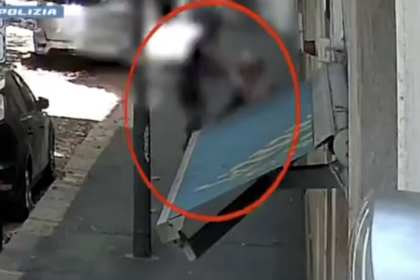

A group of officers was viciously attacked in Berlin’s neighborhood of Spandau during a check for weapons at a shisha bar, resulting in all four officers suffering injuries and two arrests. One of the perpetrators is accused of smashing a bottle over the head of one of the officers, resulting in a serious head injury.
Police consider the bar a major meeting spot for organized crime. Media reports indicated that the operation was a part of a measure to combat gun crime.
At around 10:45 p.m., officers entered “King’s Lounge,” and found approximately 24 guests there, according to news outlet BZ.
Officers indicated they were there to check for weapons. At that point, the 45-year-old owner of the business began protesting the operation. He grew so angry that he took a bottle and allegedly smashed it over an officer’s head. Then, a 28-year-old guest inside attacked the other officers.
Three officers suffered cuts from broken glass, and both suspects were injured and arrested.
All four officers were listed as unfit for duty due to their injuries.
Despite the violence, officers managed to check the 24 people in the bar. None of them had any weapons on their person or other dangerous objects.
The EU’s decision to continue freezing funds due to Hungary has resulted in a historic achievement for the Central European country of 10 million: It is now a net contributor to Brussels’ coffers, joining the illustrious ranks of countries such as Germany, France, Sweden and the Netherlands.
This has not happened since Hungary joined the EU in 2004.
By the end of October this year, reveals Nepszava, barely HUF 589 billion of EU support had flowed into the Hungarian budget, while HUF 609 billion of Hungarian taxpayers’ money had been paid into the common budget as EU membership fees.
Going into the end of the year, it is expected that this situation may change if additional funds owed are paid to Hungary. Still, 2025 would still be the year when the least EU support will be drawn.
Hungary remains one of the poorest countries in the EU and is well documented as largely dependent on EU support, or “catching up” funds.
However, due to various alleged rule of law violations, the European Commission has been withholding support; concerns voiced range from claims over a lack of judicial and prosecutorial independence and corruption to an alleged lack of competition in public procurement and disregard for EU’s open borders policies.
The Orbán government, and his supporters across Europe, claim that Brussels is simply playing politics, i.e., withholding funds over differences in political ideology, be that opposition to the EU’s extreme LGBTQ+ agenda or fervent calls to continue the war in Ukraine—both of which Hungary and Hungarians have voiced strong opinions against.
This past April, Orbán slammed Hungarian opposition MEPs for conspiring with European Union officials to damage Hungary’s economy and healthcare system. Describing it as “a dark day for Hungarian democracy,” he argued that opposition politicians were working against the interests of Hungarian citizens in an effort to undermine the ruling government’s efforts to boost the country’s economy and citizens’ wellbeing — all in an effort to finally convince voters Orbán and his Fidesz party must be ousted.
The main contender against Fidesz in next year’s parliamentary elections in Hungary is the Tisza Party, led by Péter Magyar, a former member of Fidesz and ex-husband of former Justice Minister Judit Varga.
Now a member of the EPP in the European Parliament, Tisza is being pushed by EPP leader Manfred Weber, with the understanding that Tisza will likely fall in line with all of Brussels’ demands once in power. Then, and only then, will Hungary receive the rest of its funds, or so it has been indicated.
For now, Fidesz is still in power, Orbán has made it clear he will not play ball with their demands, and funds remain frozen.
Diving into a more detailed breakdown, Nepszava explained that EU funds received by Hungary have gone from HUF 1.6 trillion in 2021 to HUF 1.4 trillion in 2022, a jump in 2023 to HUF 2.2 trillion, and then a drop in 2024 to HUF 1.3 trillion.
Meanwhile, Hungarian contributions to the EU have fluctuated between HUF 450-674 billion. In 2024, the balance of payments and disbursements, according to the portal, was HUF 668 billion compared to the usual amount of around HUF 1 trillion in previous years. This year, however, the subsidies have completely dried up, so by the end of October, only HUF 589 billion had arrived, HUF 20 billion forints less than paid in.
So, for now, Hungary can enjoy being a “net contributor,” although it is clear that the government is gunning to get the rest of its funds owed, as quickly as possible.
After a flamboyant speaker went viral at the Alternative for Germany (AfD) Youth Congress, there are questions about Alexander Eichwald. Speculation is growing about whether he is an undercover agent, a left-wing satirist, or actually just a genuine AfD supporter. Regardless of the truth, the AfD is already preparing to expel him from the party.
Social media has been asking questions about Eichwald, who sported a blue dinner jacket, after his speech at the AfD Youth Congress in Giessen over the weekend.
Even within the party, there is no clear answer about who he is.
🇩🇪🔴Many on the right are accusing this man of being an undercover agent.
After Alexander Eichwald went viral for his "Hitler-like" speech at the Alternative for Germany (AfD) Youth Congress, speculation is growing about who he actually is.
The newly elected head of the AfD’s young group “Generation Germany,” Jean-Pascal Hohm, also had no answer to questions about Eichwald.
“No matter whether you’re a left-wing provocateur, an undercover agent or simply crazy – anyone who acts like that has no place in the AfD and its youth organization,” he told the dpa news agency.
“Alexander Eichwald’s appearance once again showed how important it is to look closely at admission interviews to see who you accept into the party and who you don’t,” he added.
Eichwald’s speech, in which he used to term “party comrades” and referred to dog breeds when selecting who is allowed into Germany, drew comparisons to Hitler and his propaganda chief Joseph Goebbels.
With his speech, Eichwald applied for a position on the board of the newly founded “Generation Germany.” Eichwald clearly lost to Alexander Claus, receiving only 12 percent of votes.
When asked by the dpa whether his appearance was serious, he only responded “yes” and then left the conference hall.
Already, there is speculation about whether the speaker was an undercover agent of the powerful spy agency, the Office for the Protection of the Constitution (BfV). The BfV is known to place informants inside the parties it targets, with the AfD one of its main concerns. However, others speculated the man is a satirist, potentially from the left. Still, there is no confirmation as of yet who the man actually is.
AfD co-leader Tino Chrupalla announced an audit of the data and membership rights of Eichwald, who has only been part of the NRW-AfD in Herford since October.
As a result, Eichwald was removed from the AfD council by circular resolution on Sunday. “Accordingly, the measure was also taken to aim yesterday by circular resolution to exclude Mr. Eichwald from the party through a party expulsion procedure.“
Additionally, measures are being pursued to have him removed from the party entirely.
AfD parliamentary group leader in Herford, Michael Schneidermann spoke to Welt about Eichwad.
“He touted himself here as a political scientist and student and said he would like to take part in local politics. He did, too.“
The Herford AfD parliamentary group leader, commenting on Eichwald’s speech, said the 30-year-old man had “absolutely unmasked“ himself with his appearance.
“At the weekend in Giessen, that was behavior that I was absolutely not aware of,” said Schneidermann.
Schneidermann also speculated that Eichwald may be an undercover agent “sent from a satirical background.” Schneidermann also said that Eichwald “damaged the party and also reputation of the youth wing of the AfD, which had just been founded.”
Germany has been plagued by knife attacks for years, and new data is shining a light on just how bad the situation has become, with both injuries requiring hospitalization and deaths on a sharp rise.
Although not yet published, data from the German Society for Trauma Surgery, which handles a database of treated cases of serious injuries, the number of people requiring emergency room treatment for violently inflicted stab wounds increased by 50 percent over just four years.
This is the first time data from this registry has been filtered solely for cases where someone had intentionally stabbed another person, writes Welt, based on a report out of Der Spiegel.
“According to the report, 3,325 stab wounds related to violent crimes were recorded over the past ten years. The number of people seriously injured by violent stab wounds has risen steadily: from approximately 250 in 2019 to approximately 375 in 2023, the most recent data available. This represents an increase of 50 percent.”
Out of all the victims in this cohort, 86 percent were men and, on average, 31.3 years old. Upon arrival at a hospital, approximately 70 percent of them required emergency treatment. Another 8 percent of arrivals were so severely injured from their stab wounds that they died in the hospital.
“It’s alarming to see that knives are being used as weapons with increasing frequency in Germany,” Andreas Seekamp, who has worked for 20 years as a senior trauma surgeon at the University Hospital Schleswig-Holstein, Kiel Campus, told Der Spiegel.
German doctors have also noted that, besides a higher number of reported knife attacks, their brutality is also increasing. “We have the impression that the attacks are being carried out more deliberately,” said Dietmar Pennig, Secretary General of the German Society for Orthopedics and Trauma Surgery.
“We are definitely seeing an increase in stab wounds to the neck or chest, precisely where it is particularly dangerous.”
As Remix News previously reported, migrants are particularly overrepresented in violent crimes, including knife attacks.
“We have imported knife violence. In other cultures, the knife is a kind of status symbol. This is changing the social climate here in the country,” stated criminal attorney Udo Vetter earlier this year. He further noted that “knives have become an everyday companion for many people. And the barrier to using them is low.”
Notably, he warns that due to the rise of knives and knife crimes, it is creating a problem that is expected to only grow exponentially, with more and more people arming themselves with knives out of fear.
“Because if some people deliberately pack a knife as a murder weapon, more and more people will also resort to knives, supposedly to defend themselves,” stated Vetter.“Young people in particular have knives in their pockets just like their cell phones.”
The head of the German Police Union, Rainer Wendt, also spoke out about the knife crime problem, saying: “The threshold for violence is getting lower and lower. And the fuse is getting shorter. Knives are being drawn even for trivial reasons and seemingly harmless disputes.”
As Remix News previously reported, violent crime reached a record high in Germany last year, with foreigners responsible for nearly half of crimes. There were 29,014 cases in total involving a crime where a knife was used, of which, 15,741 were knife attacks. Serious and dangerous bodily harm with a knife increased by 10.8 percent in 2024 compared to 2023.
A 29-year-old Moroccan man who pulled a knife and threatened people at the Weimar Christmas market on Saturday evening has already been released from custody as police chiefs considered his charges to be insufficient to justify pre-trial detention.
The incident took place at the ice rink in front of the German National Theater, where families and children were skating during the first festive weekend. According to police, the man was harassing visitors when a witness confronted him. Officers say he immediately became aggressive and threatened the witness with a knife.
Bystanders stepped in, pushing him away from the rink towards a snack bar on Heinrich-Heine-Straße as the situation escalated. Police later wrote, “The 29-year-old pulled a knife in the course of [the altercation at the ice rink], creating a threatening situation. Bystanders noticed the action and pushed the man away from the Christmas market area. When the police arrived, the situation was initially confusing.”
Pepper spray was used to overpower the suspect after what officers called continued resistance. He was restrained, taken into custody, and three others were slightly injured by pepper spray during the intervention. “The 29-year-old was overwhelmed and taken to police custody,” the police statement added, as cited by Zeit.
But despite the confrontation, the knife, and the arrest, he is no longer being held. Police chief Christian Hackbart confirmed that the charges — threats, attempted assault, and violation of the event’s knife ban — were considered insufficient to justify detention.
Hackbart also said the man, who is already known to police for violence, was heavily intoxicated and has yet to be questioned.
🇩🇪🎅 Deck the halls — and move the bollards.
How Germany now prepares for Christmas, with one market in Augsburg requiring several full-time staff to repeatedly move anti-vehicle bollards back and forth to make way for trams. 🤯 pic.twitter.com/GW4wLEk447
In Bavaria, a second Christmas market faced disruption on the same weekend — this time through arson. Hours before opening day in Schorndorf, several club-run wooden huts were soaked with accelerant and set alight. As cited by Bild, Mayor Max Schmaderer said kerosene is believed to have been used. Surveillance footage reportedly recorded the perpetrators, and police are reviewing the material while appealing for witnesses.
A driver spotted the flames around 4 a.m. on Sunday and alerted emergency services. Firefighters prevented widespread destruction, though the municipality’s own booth also caught fire. Schmaderer wrote publicly: “We are all still deeply shocked,” calling the incident “a cowardly attack against volunteers and clubs, which must be condemned in the strongest terms.”
Christmas markets across Germany have had to deal with the soaring costs of terror-proofing venues after several high-profile attacks in recent years. Some towns are resorting to installing anti-tank barriers at entrances to the markets, while others have planted heavy-duty bollards to protect areas of heavy footfall from vehicle attacks.
The demonstration weekend in Giessen surrounding the founding of the new Alternative for Germany (AfD) youth organization, Generation Germany (GD), saw a number of violent scenes that have led to condemnation from Hesse Interior Minister Roman Poseck (CDU) and other officials.
According to police, demonstrations by various organizers against the AfD were “mostly peaceful.” However, in some places, there were violent clashes, and “Water cannons were used to break up road blockades.”
However, Poseck said that “without the police, the most serious acts of violence and civil war-like conditions would have occurred in Giessen.” He added that the police’s use of coercive means was “necessary and permissible,” for example, to prevent violent demonstrators from “breaking through to the AfD venue or blocking access roads and emergency routes for long periods of time.”
Poseck stated: “We must not allow individual groups in our country to enter a parallel legal world.”
He stressed that “The end does not justify the means.”
The demonstration and the founding of the AfD youth movement came right at a time when the AfD saw its best poll result so far, reaching 27 percent, making it the most popular party in the country by two points.
Managerial Class Libs: "The rise of Right-wing populism is one of the greatest mysteries of the present age."
Germans: "It's the migration."
Managerial Class Libs: "Why is AfD surging?? What dark magic is at work??"
Notably, Hessian Prime Minister Boris Rhein (CDU) referred to the events as a “left-wing low point” and criticized the “forced marches in Giessen.” He wished for the moderate left to “distance themselves from this weekend of violence in Giessen.”
Alice Weidel, the leader of the AfD, also took to X to highlight some of the violence against police she saw, writing: “Yesterday’s day has shown: This cannot go on. Media and political competitors are equally called upon to return to freedom of opinion and democracy!”
Der gestrige Tag hat gezeigt: So kann es nicht weitergehen. Medien und politische Mitbewerber sind gleichermaßen dazu aufgefordert, zurückzukehren zu Meinungsfreiheit und Demokratie! pic.twitter.com/1aZnKsOf8U
The AfD event, held in the Hessenhallen on Saturday, saw approximately 25,000 people attend, according to police. The turnout was much lower than expected, but the “Resist” alliance claimed over 50,000 people attended. The associated police operation was one of the largest in Hesse, involving up to 5,000 officers from 15 federal states acted as a barrier to the AfD event.
Police Chief Krückemeier, while noting the worst scenarios did not occur, reported that between “10 and 20 police officers were slightly injured.” Three people were arrested, but “all have left the detention center shortly afterwards.”
While data on injured demonstrators was not available, the Giessen-Marburg University Hospital treated around 15 demonstrators on Saturday afternoon.
Good Morning from Germany, where three-quarters of citizens are now dissatisfied w/Chancellor Friedrich Merz's policies. No chancellor in recent history has seen approval ratings this low, less than a year into their term. pic.twitter.com/YN5ii99gYr
The German Federation of Trade Unions (DGB) Hesse-Thuringia, which organized the largest protest claiming over 20,000 participants, emphasized that their event was “very determined and peaceful” and that cooperation with the police was good. However, chairman Michael Rudolph noted, referring to injured police officers and demonstrators, that “these incidents need to be resolved on both sides.”
Laura Wolf, spokeswoman for the “Resist” alliance, accused police officers of having “paved the way for fascists.”
Police Chief Krückemeier defended the actions of law enforcement, saying “that the rights of arrested people had been taken into account at all times,” and that there is “currently no evidence of unlawful use of coercion.”
A retirement home in Zurich-Leimbach may soon become a temporary asylum shelter for up to 300 migrants, a proposal that has sparked outrage among local residents.
As reported by NZZ, the Swiss city is facing a shortage of accommodation for asylum seekers, and says the currently vacant building, which had been earmarked to be transformed into affordable accommodation for locals, presents one of the few viable large-scale options.
Residents say the plan could overwhelm an already vulnerable district and believe having 300 male asylum seekers move into the area, which is near a local kindergarten and playground, will be a security risk.
The retirement home, owned by the city and closed in August, is scheduled for major renovation with the intention of creating new housing for seniors and families by 2030. Until work begins, officials are exploring interim uses, with the accommodation of refugees now considered the leading option.
The site contains 90 former units and stands near Leimbach’s community center, school, indoor pool, and main play park.
Locals say the scale of the proposed asylum housing is central to their objections. Neighborhood association president Christian Traber argues that Leimbach is already under social and infrastructural strain. He told the NZZ that, with around 300 asylum seekers already distributed across the district, adding another 300 would raise the proportion from four to nearly 10 percent of the population. “That’s simply too many,” he said.
A petition backed by the Leimbach neighborhood association is now being prepared, urging the city to abandon the shelter plan. The petition warns that the proposal “would lead to a significant increase in the number of asylum seekers housed in the neighborhood” and says older residents were removed from the property without “a concrete construction project or a reliable timetable for the renovation.” Its supporters argue the building should instead be refurbished promptly for seniors or used as low-cost housing for students.
Residents who spoke on the record echoed those concerns. Neighborhood association member Anja Graf, 39, says the term “interim use” is misleading, arguing that such Asylum Organization placements tend to last “5 to 10 years.” She told Blick, “Our senior citizens were evicted. The elderly had to leave, were uprooted,” adding, “Renovate the building so that our elderly can move back in.” Graf said she worries about the impact of “300 young male migrants” on public spaces and transport, and claims many locals no longer feel as safe at night as they once did.
“We’re not xenophobic,” she said. “We’re simply not stupid or naive. Because we know what would be coming our way.”
Trix Romer, 66, spent three decades working in the retirement home and says residents were “shocked and afraid” to learn they had to leave. She believes the building would be suitable for student accommodation instead. “The elderly people who created Switzerland as it is today do not deserve to be treated this way,” she said. Former resident Elisabeth Eicher, 92, recalled panic among tenants when the closure was announced. She remained until the final weeks but eventually moved out on her family’s advice.
Official figures show Leimbach has a 9 percent welfare rate, roughly double the city average, with low household incomes, a high share of foreign-language households, and an ageing housing stock. One local school reportedly saw six teachers resign last year, citing overwhelming social pressures.
The city continues to argue that supervision, training programs, and structured routines help large asylum accommodations integrate into their surroundings. A spokesperson for the social services department told the NZZ that collective shelters such as the former SRF building in Zurich-Oerlikon operate under 24-hour supervision and that residents attend work integration or education programs. The city says concerns are being taken seriously, but notes that space for refugee housing remains scarce. “Unfortunately, the city’s options are limited,” spokesperson Stefan Rüegger said.
The decision on whether the Leimbach property will become an asylum center is expected in the coming weeks, and if approved, the building would be occupied from next summer.
The brutal attack in Vienna on July 7, 2024, which left seven young men from Afghanistan seriously injured, was a case of fatal mistaken identity, according to the subsequent investigation. The incident, which saw victims stabbed—one “near his heart”—and another suffer a “minor brain hemorrhage,” was the culmination of escalating street battles and gang rivalry in the city over the summer.
The attackers, a group of dozens of youths who “partially masked their faces” and armed themselves with “knives, hammers, telescopic batons, and brass knuckles,” set off for the vicinity of Meidling train station.
There, they chased down and brutally assaulted the young, unsuspecting Afghan men. However, it turns out the Afghans were not the intended targets of the attack. Instead, the Chechens who allegedly gathered, were out to exact revenge on a group of Syrians.
Over the summer, street battles between Chechens and Syrians in Vienna had escalated, with young Syrians, as Chechens making headlines across the country for their large-scale battles and reprisals in the city.
At the time, the violence was so bad that Dominik Nepp, chairman of the Austrian Freedom Party in Vienna, called on the military to be deployed.
“The only solution left to restore order is the deployment of the military,” he said.
The small park near Meidling train station was known as a meeting place for young Syrians, which is why the armed group, including several Chechens, showed up there.
After months of investigations under Operation “Peacebringer,” a total of 24 young men, aged between 16 and 25, will face trial. The 94-page indictment, obtained by Der Standard, includes charges of intentional grievous bodily harm and aggravated assault.
The prosecution focuses on 25-year-old Chechen Abubakar D., who has multiple previous convictions. Der Standard reports he is suspected of being the alleged mastermind behind the mass stabbing and assault.
According to the indictment, Abubakar D. had developed a hostile attitude toward Syrians and publicly invited people to a so-called “conference” on Instagram just days before the attack. Prosecutors say that he plotted on the “elimination” of the Syrian group and scheduled a day for the attack to take place.
At this conference, Abubakar D. allegedly delivered a detailed plan, which was then spread through Telegram and other channels.
At the agreed meeting point, “at least 30 attackers allegedly gathered,” according to the prosecution, and Abubakar D. gave “the signal to attack.”
Abubakar D. admits the conference took place in police interrogations but claims “no calls for violence were made there,” a claim the public prosecutor’s office considers a “pure fabrication.”
Chats reportedly contradict his account. In one conversation, a defendant referred to Abubakar D. as the leader, while stating: “Our leader, I’ll say, he’s got a whistle. We’ll punch and stab until he whistles again, and then we run away.”
Abubakar D. has multiple prior convictions for similar offenses, including membership in a criminal organization and a terrorist association. He recently received a non-legally binding 10-year sentence for bank robbery and money laundering, and now faces up to 15 years in prison in this new case.
The second main perpetrator is an 18-year-old Chechen, who can be seen in a recorded video “repeatedly punching and kicking one of the victims.” He has a prior conviction for robbery but will be treated as a juvenile, halving his potential maximum sentence to five years.
The remaining 22 defendants are considered accomplices, with 18 having “no prior convictions.” A court date has not yet been set.
The gang conflict has resulted in other significant convictions: a trial related to the so-called Viennese “gang wars” ended this May. The 30-year-old first defendant, who allegedly shot a Syrian man in a Brigittenau park two days before the Meidling attacks, was sentenced to 14 years in prison for attempted murder.
While Russia is routinely portrayed as a serious military power, as the war drags on, Russia is becoming more and more reliant on Chinese drone components to survive.
Now, China’s drone component supplier Wang Dinhua has just purchased a 5 percent stake in Russia’s Rustakt, a top drone manufacturer in Russia. Rustakt is subject to sanctions imposed by both Ukraine and the European Union, reports Do Rzeczy, citing an article from FInancial TImes.
Samuel Bendett, a drone expert at the Center for Strategic and International Studies, noted the growing cooperation between the Russian and Chinese military-industrial complexes, as well as Putin’s reliance on Chinese components for Russia’s growing drone needs. However, this reliance is nothing new.
Another Russian company, Aero-HIT, has also benefitted from this partnership, reportedly producing up to 10,000 drones per month this year. It also plans to produce more advanced models.
China is generally considered the leading drone component manufacturer in the world, dominating much of the supply chain to the point that many of the components also purchased by the United States also come from China.
Ukraine has also discovered laser sensors manufactured by a South African company in Russian drones attacking its cities. It remains unclear how products intended for civilian use ended up on the kamikaze drones, the independent Russian-language website The Moscow Times reported on Friday.
Laser rangefinders from several countries, including South Africa, have been detected in long-range drones modified from the Iranian Shahed, according to Vladislav Vasilyuk, a Ukrainian official responsible for sanctions policy. Industrial lasers from South Africa’s Lightware are small and lightweight, making them suitable for installation in drones.
The supply of military equipment to countries engaged in armed conflict without the consent of the South African government is prohibited, but Lightware is not registered as a trader in ammunition or dual-use products or technologies.
A homicide investigation is underway in Guérande, Loire-Atlantique, after beloved 78-year-old municipal councilor Catherine Bailhache was found stabbed to death in her home on Wednesday afternoon.
Officers entered the property in the Achelais Park area shortly before 5 p.m. after being alerted by third parties. Bailhache was discovered on the ground floor with stab wounds. Emergency services attended but were unable to save her.
During the search of the house, a 34-year-old man emerged from a bathroom closet, armed with a knife, and attempted to attack the first responding officer. A member of the Saint-Nazaire Surveillance and Intervention Platoon (PSIG) opened fire, hitting him in the shoulder. He was taken to hospital and remains under police guard. He will be placed in custody once his condition improves.
The suspect had been living in the property for around 10 days as part of a non-profit scheme offering accommodation to young workers, according to the prosecutor’s office.
He has no previous record with the police or the courts. His role in the killing, and a possible motive, are still to be established. An autopsy will be carried out in Nantes to clarify the circumstances of Bailhache’s death.
Bailhache was a retired teacher and former school principal, serving as an opposition councilor in Guérande. She was involved in local cultural groups and known in artistic circles for her work and exhibitions.
News of her death spread quickly through the town, prompting tributes from residents and colleagues. Speaking to Ouest-France, one described the announcement as “an earthquake,” noting her presence in the Guérande Artistic Research Group and her visibility in art exhibitions. Multiple tributes were posted on Facebook following the announcement, praising the victim’s commitment to her local community.
Yannick Favennec, French MP for Mayenne, wrote on social media, “She was my teacher in secondary school. I had great admiration and respect for this woman of commitment and culture.”
Sandrine Josso, MP for Loire-Atlantique, recounted meeting Catherine at the beginning of her political career: “I had just been elected municipal councilor in Herbignac, and Catherine was already an elected official in Guérande. She took me under her wing and greatly encouraged me to get involved. She was an inspiring woman.”
The local council posted a tribute on Thursday, which read, “The City of Guérande learned with deep emotion and profound sadness of the death of Catherine Bailhache, a municipal councilor. This news has come as a shock. Our thoughts are with his family, loved ones, and all those affected by this loss.
“Committed to Guérande, particularly on heritage-related issues, Catherine Bailhache has left her mark on municipal life through her dedication. A notebook is available in the lobby of the Town Hall for those who wish to leave a message in tribute to Catherine Bailhache.”
According to Le Parisien, the Saint-Nazaire research brigade has taken charge of the case. Investigators are working to reconstruct the timeline of events inside the house and determine whether the suspect acted alone or had a prior dispute with the victim.
No further details surrounding the attack or the suspect have been released.
Taleb al-Abdulmohsen ranted at witnesses on Thursday, causing great consternation amongst victims at his historic trial after days of confusing and outrageous outbursts.
Yesterday, victims and witnesses began speaking about their ordeal at the bloody Christmas market in Magdeburg. Al-Abdulmohsen, the Saudi national who worked as a doctor in Germany for years, is accused of driving his vehicle in a zig-zag pattern through the market to kill as many people as possible.
However, he is currently trying to claim that one of his victims could have died from coronavirus instead of his car ramming attack.
Forensic physician Dr. Gerald Brenecke, Halle University Hospital, started his testimony. One day after the attack, on Dec. 21, 2024, he conducted autopsies of five victims. The first victim he autopsied was 45-year-old Nadine L.
He said the corpse “had massive injuries in the upper body area and head.”
However, the doctor noted the woman’s heart was previously damaged and that “the woman died of highly acute heart failure,” while she was trying to escape the car.
The suspect, al-Abdulmohsen, jumped on this claim to indicate the victim may have died in connection with the coronavirus, saying that people have become more susceptible to cardiac arrest since the coronavirus pandemic.
One of the lawyers of the victims reacted with rage in the courtroom.
“I complain that the victims no longer need to listen to this nonsense. Today is the first time it’s about the victims, and they have to listen to the defendant’s crap,” said the lawyer.
🇩🇪‼️ "He was a known terrorist. Nobody did anything about it."
The parents of the youngest victim killed in the Magdeburg Christmas market terror attack, 7-year-old André, have released a video condemning the government and pleading for help.
The judge angrily reacted, cutting al-Abdulmohsen off and saying that the defendant should only ask specific questions.
However, despite a motion against al-Abdulmohsen being allowed to continue his line of questioning, this has been rejected by the judges in the case.
The presiding judge said, “Even if this seems or is unbearable for the co-plaintiffs, the chamber cannot shorten the defendant’s right to ask questions. That could provide grounds for an appeal.”
He further stated: “I want to avoid at all costs that we have to repeat these proceedings. We know that these proceedings place a high burden on co-plaintiffs and their relatives.”
People not only lost their lives on that fateful day, but many victims and witnesses were left to face painful trauma from the massacre.
Co-plaintiff Anne Kathrin H. was the first person physically injured by the Saudi who testified in the trial. In court, while fighting back tears, she said: “I wanted to go to the Christmas market with my partner and was a little impatient. We left shortly after 6 p.m.”
Right after the couple ate, Anne Kathrin H. said, “Then the car hit us. Everything was black. When I woke up again, I realized that I had fallen over. The bystanders took me to the rescue workers. There, I found my husband Matthias. He cried and said happily, ‘You’re alive. You’re alive…’”
Her husband was also injured.
🇩🇪He should have "killed even more," said Saudi national Ahmad about the Christmas market terror attack in Magdeburg last year.
Ahmad said the attack was "completely ok."
Now, Ahmad is in hiding after his interview with German media outlet MDR, who reported his comments. pic.twitter.com/aoR4h2B2rs
Both victims were treated at a university hospital. Katrin H. was on sick leave until mid-February while her husband “still limps to this day.”
She said the attacker took away her family’s sense of security and happiness.
“I’m still receiving psychological treatment and also in a self-help group,” said Kathrin H.
Another witness, Mario T., along with his wife and acquaintances, provided first aid in the aftermath of the Christmas market slaughter:
“There was a small child opposite us who had to be resuscitated. We helped an injured man.” The images of the destroyed market “left their mark on the family,” according to Bild.
“My wife is still struggling with the psychological consequences today,” said Mario T.
He said his wife no longer goes into town and rarely leaves the house.
“She only goes to work and back home,” the man said.
The day also saw forensic specialists describing autopsies of the other victims in the case.
Eyewitness Eyad I. is a former Syrian doctor from Magdeburg, who worked at the Christmas market in 2024. He spoke with the help of a German interpreter.
“I had a booth at the entrance to the Christmas market. I was in my booth when I suddenly heard a noise. I didn’t know what it was.”
Then, Eyad saw a seriously injured boy: “The wound was open, I could see the boy’s bone. He grabbed me.”
He noted that “blood came out of his wounds. He screamed and didn’t let go of me.”
Eyad treated the wound, and paramedics took over from there.
🇩🇪🔥 Saudi doctor Taleb al-Abdulmohsen is now on trial for allegedly killing 6 people during a deadly car-ramming terror attack on a German Christmas market last year.
The 51-year-old suspect faces 6 counts of murder and hundreds of counts of attempted murder and bodily harm for… pic.twitter.com/HRsaqF9kE6
Throughout the trial, the defendant has screamed, rioted, and raged.
According to his own statement, al-Abdulmohsen also claimed to have been on hunger strike since the start of the trial. However, Bild journalists note that “he appears to be in great shape and speaks animatedly with his defense lawyers as the chamber enters the court and opens the day of the trial seven minutes late.”
The day before, he was brought to the ground inside his glass case after physical rioting inside. Judicial officers brought him to the ground.
He has had his microphone constantly switched off as well, including for questioning the psychological health of witnesses. The former doctor was given his medical license despite clear evidence of fraud regarding his medical experience, along with a long history of threatening to kill Germans, which was all documented on social media. In fact, in what was a complete failure of German authorities, they were even warned by a Saudi intelligence agency of the threat the man posed.
The German taxpayer is on the hook for the massive trial, but that is a drop in the pond for what Germans are paying for mass migration every year, totaling at least €50 billion for integration, housing, and social benefits. That cost does not cover increased security and police costs due to criminality from Germany’s growing foreign population, either.
Even the price of Christmas market security is soaring across the country, another burden shouldered by taxpayers and small business owners.
Investigators from Ukraine’s National Anti-Corruption Bureau (NABU) and the Specialized Anti-Corruption Prosecutor’s Office (SAP/SAPO) conducted searches of Andriy Yermak’s home on Friday morning, according to statements from both agencies and reports in Ukrainian media.
Yermak, chief of staff to President Volodymyr Zelensky and considered one of the most influential figures in government, confirmed that law enforcement officials had been granted access to his residence.
Yermak wrote on Telegram, as cited by Meduza, that the authorities were “conducting procedural actions” and added, “The investigators are not facing any obstacles. They have been given full access to the apartment, and my lawyers are on site, cooperating with law enforcement. I am providing full cooperation.” President Zelensky has not commented publicly.
The search forms part of a widening corruption probe centered on the energy sector. Earlier this month, NABU announced it had uncovered large-scale embezzlement at Energoatom, the operator of Ukraine’s nuclear power stations, involving kickback schemes worth hundreds of millions of dollars.
Authorities have named Tymur Mindich, a close associate of Zelensky, as the alleged architect and one of the primary beneficiaries. His property was searched on Nov. 10, though he reportedly left for Israel shortly before the raid, in a sign he was clearly tipped off in advance.
The investigation has prompted upheaval at senior levels of government. Energy Minister Svitlana Hrynchuk was dismissed, while Justice Minister Herman Halushchenko, who previously headed the Energy Ministry until July 2025, was suspended pending further probes. Several suspects were taken into custody, and Zelensky imposed sanctions on Mindich and businessman Alexander Tsukerman, with Tsukerman also currently located in Israel. They are now both wanted in connection with the case.
Former Deputy Prime Minister Oleksiy Chernyshov, described as close to the president, was also arrested.
Rustem Umyerov, Secretary of Ukraine’s National Security and Defense Council and a central figure in talks with the United States and Russia, has testified to investigators as a witness. Ukrainian media have reported that Mindich sought to exert influence on Umyerov during his tenure as defense minister, claims Umyerov has denied.
Bild reported that Yermak’s office was also examined as part of related proceedings. The chief of staff was recently appointed to lead Kyiv’s negotiating team with Washington regarding an eventual settlement to the war, a decision that surprised observers as the corruption investigation gathered pace.
Ukrainian press have reported internal discussions over whether Yermak should be dismissed, though at a closed meeting on Nov. 20, Zelensky signaled that he did not intend to remove him.
Notably, Zelensky attempted to take control of NABU before the massive raids on his inner circle. He only backtracked when Europe and the United States sharply criticized the move. Critics have speculated that the power grab on his part may have been a result of him becoming aware investigators were closing in on his associates.
A Swedish government review has found that thousands of people linked to gangs in Sweden have been drawing income from the country’s benefits system for years, creating what authorities describe as a reliable, legal-looking revenue stream for criminal networks.
According to findings prepared under the state’s organized crime framework, about 4,000 individuals known to police for gang affiliation have been receiving sickness benefits, sick pay, or job-seeker support. Combined payments across the group are estimated at 3.6 billion kronor (€327.5 million) over time, enough to provide what officials call a “white” income even when illicit earnings fluctuate.
It effectively means that law-abiding Swedish taxpayers are inadvertently subsidizing criminal gangs through the benefit system, providing them with a safety net income that enables them to continue operating.
Nils Öberg, head of the Social Insurance Agency, said the material reinforces the pattern authorities have been tracking. Speaking to TV4, he said the welfare system has become part of the business model: an official income on paper, and criminal income off it.
Samnytt notes that the report shows a marked overrepresentation of people with a migration background in the cohort examined. This applies to both those born abroad and those born in Sweden to two foreign-born parents.
Investigators highlight the contradiction between benefits requiring reduced work ability and the documented activity of some recipients. Case studies in the report refer to individuals formally certified as unfit for work while running gangs, traveling abroad, or coordinating violent offenses. One man listed on medical grounds after an accident was recorded visiting gyms and participating in gang operations. Another, diagnosed with limited work ability, is reported to have led a large criminal network while accumulating more than 30 convictions.
Maintenance support is also cited as a hidden revenue channel. Since many gang figures report little or no legal income, the state covers child maintenance on their behalf. In 2024, more than 3,600 such individuals were classified as unable to pay, resulting in payouts of around 118 million kronor (€10.7 million).
The review also tracked corporate links. One in three businesses that filed sickness claims on behalf of gang-connected employees are run or previously run by people with criminal links. More than four in five show clear connections to gang networks. The personal assistance sector in particular was flagged as an area with heavy infiltration, both among staff and among owners.
Social Insurance Minister Anna Tenje, as cited by Sydsvenskan, said that the situation was “astonishing” and insisted that public funds are meant for people who genuinely need them. She argued that weakening the financial lifeline to criminal networks is essential if the government wants to reduce gang influence.
Speaking to TV4, Labor Minister Johan Britz described those involved as “welfare pirates,” adding that taxpayers were effectively financing criminal lifestyles under the guise of social support.
Police estimate that around 67,500 people in Sweden have some form of gang association, of whom roughly 17,500 are considered actively involved. National Police Commissioner Petra Lundh said there is no clear indication of improvement or deterioration and warned that recruitment remains steady.
The authors of the review state that existing law was designed for honest applicants rather than organized exploitation and suggest that stronger information-sharing powers and more robust verification are required. The government says new data-access legislation will come into effect in December, with further reforms planned later in the parliamentary term.
Officials say the next step is to reassess benefit cases flagged in the review and halt payments where fraud is suspected. The agency involved says it will broaden investigations, but ministers have offered no timeline on when changes will take full effect.
After a forced conscript was beaten in his groin area to the point that he lost an “organ” following emergency surgery, Ukrainian authorities have moved to arrest the recruitment center head.
The staff of the Ukrainian State Bureau of Investigation (DBR) arrested the head of one of the district recruitment and military service preparation centers (TCK) in the Ivano-Frankivsk Oblast.
The recruiter is accused of brutally beating a conscripted man for refusing to perform a fluorographic examination during the medical aptitude test (VLK), reported by the General Prosecutor’s Office of Ukraine and the DBR, based on the announcements of Ukrainian news outlet Pravda.ua.
The DBR investigated complaints from citizens and parliamentarians that beatings, torture, and demands for money had taken place in a TCK operation in Transcarpathia. Notably, neighboring Hungary has alleged that recruits from the Transcarpathia region are targeted for recruitment at an especially high rate due to them being ethnic Hungarians.
“Investigators uncovered numerous abuses of power committed by a senior officer at the center,” the DBR communication was quoted by the source.
Based on the investigation, it was revealed that the man was sent to the hospital for a VLK examination together with other citizens. When he refused the examination, the lieutenant colonel deliberately inflicted at least five blows against the victim, targeting the groin area.
As a result, the victim suffered serious physical injuries that required the “surgical removal of an organ.”
The officer was charged with abuse of power during martial law, with serious consequences. On the motion of the prosecutors, the court ordered an arrest without the possibility of bail. Based on the source, it was also revealed that the possible involvement of other persons, including police officers, in the case is currently being investigated.
This beating is likely just the tip of the iceberg, though. As already reported by Remix News, a Hungarian citizen and entrepreneur, József Sebestyén, died in July in the Beregsász hospital after Ukrainian recruiters severely beat him with iron bars in a forest, with the incident also caught on film.
Prime Minister Viktor Orbán has forcefully condemned forced conscription in Ukraine after the beating death. Speaking on Kossuth Radio, Orbán linked the tragic incident directly to the ongoing war, asserting that a country where such events occur due to forced conscription is unfit for European Union membership.
“A country where this could happen cannot be a member of the EU,” said Orbán.
“We are talking about a Hungarian-Ukrainian dual citizen. This entitles us to avoid using cautious language. They beat a Hungarian citizen to death, that’s the situation. And this is a case that we need to investigate, as this cannot happen,” Orbán stated, emphasizing the gravity of the situation. He highlighted that while the front lines might seem distant to many Hungarians, “the war is taking place in our neighboring country. The threat is directly here.”
A video post on this topic from Remix News was immediately flagged by X and censored, meaning that EU censors may be jumping on this report due to its sensitive nature.
For years, videos of Ukrainian recruits being dragged off the streets and beaten have been circulating, making the arrest of one of these recruiters quite out of the ordinary.
A French elderly woman was dragged through the court system for 18 months, all because she expressed outrage in a social media post over the murder of Thomas Perotto in Crépol, which has been reported as an anti-White hate crime. The 70-year-old Sylvie has finally been acquitted on Nov. 20 of “hate speech” in the Paris Court of Appeal, which overturned her conviction in a lower court.
“I still find it hard to believe it, this story changed my life so much. But you shouldn’t be afraid to say what you think,” the relieved retiree told the press after her conviction was overturned.
“At no time did I call for harm. It was simply a reaction of the heart, spontaneous. I have grandchildren the age of this young man who was stabbed,” said the former nurse, whose public comments about the murder were posted on her personal profile.
The case is not only being seen as a victory for free speech, but also an example of how far zealous authorities will go to terrify Europeans complaining online about foreigner crime or mass immigration.
Sylvie was living in Cuers when she suddenly had her house raided and was arrested for alleged “hate speech” for a Facebook post she made shortly after the death of Thomas in Crépol in 2023. The youth was stabbed to death by a group of youths with a migration background, and their trials are still ongoing.
So far, nobody has been convicted of the crime, but numerous witnesses at the event reported hearing the youths scream they “wanted to kill White people” before Thomas was killed with numerous stab wounds. Another two French youths were seriously injured during the attacks.
In response to Thomas’ death, Sylvie posted “the names of the alleged perpetrators involved in Thomas’ death” and mentioned “the soldiers of Islam” in her post, according to French news outlet France Bleu.
The French authorities later targeted the woman, launching a police action on May 28, 2024. She says she was shocked to find police officers standing at her door at 6 a.m.
She was convicted in the Paris Criminal Court, where she was forced to pay a fine for €1,000 for a post “inciting hatred.” However, her conviction has now been overturned on the basis that her comment was covered under freedom of expression.
Sylvie said she is still processing the court decision, according to ICI. She expressed great emotion and a profound sense of injustice after her hellish 18-month legal ordeal.
She also spoke about the emotional toll of having the police show up at her door in an early morning raid and being treated like a criminal.
“At my age, 70 years old and sick, I must have been a danger for them to come get me and take me into custody. My life has been disrupted. I was photographed as a delinquent and they took my fingerprints. I was told I was a first-time offender. It’s been a year and a half of trauma, and I feel a deep sense of injustice. I wasn’t talking about expressing hatred at all. But freedom of expression must be protected. Because the day we lose our freedom of expression, we simply lose our freedom. And it’s very dangerous,” Sylvie stated.
The Paris Criminal Court had initially convicted the retiree for “provocation to hatred,” imposing a fine and compensation for the alleged perpetrators whose names she had shared. However, her lawyer, Maître Maxime Barnier, advised her to appeal, arguing that her freedom of expression had been infringed upon.
“My client was being prosecuted for provoking hatred and violence, an offense with an extremely vague legal outline. The Court of Appeal took up the position of the Court of Cassation, considering that the provocation should be taken as an exhortation, not a simple invitation, but an injunction to do so. Now, in this case, there was no exhortation to hate people because of their real or supposed belonging to a clearly defined community, nor was calling on citizens to protect or defend themselves an exhortation to commit violence. The Court of Appeal considered that this was part of a debate of public interest,” said the retiree’s lawyer.
More than 6,000 people turned out for a march through the French town of Romans-sur-Isère on Wednesday in memory of Thomas, a 16-year-old boy stabbed to death on Sunday by a group of youths who gatecrashed the winter ball in nearby Crépol and shouted how they "wanted to kill… pic.twitter.com/JhaIGBXHuy
“The right to express oneself is also the right to be caricatured and outrageous. I am not defending this opinion. I defend the right to be able to express this opinion within the limits provided by law. We do not beg for freedom or the right to express ourselves. We impose it, we claim it and we protect it. And as an exception, it is sanctioned if the limits set by law are crossed,” Barnier explained to ICI Provence.
The Paris Court of Appeal therefore ruled that “Sylvie had not exceeded the limits” fixed by law in this instance.
Notably, the murder of Thomas is still hotly debated and discussed in France, including earlier this month when French politician Éric Zemmour mentioned what he said were the anti-White racist motives behind the murder.
🇫🇷🔴French politician @ZemmourEric: "It’s not Russian soldiers who are killing our children. It wasn’t a Russian soldier who killed Philippe. It wasn’t a Russian soldier who killed Thomas. Those who are dying today are young French people, killed by Islamic s**m."
Two Algerian men accused of abducting and raping a woman in Toulouse in September 2022, before leaving her naked on the roadside, appeared before the Assize Court on Monday to answer for their alleged crimes.
Both men are charged with kidnapping, extortion with a weapon, and arbitrary detention with release under seven days.
As reported by Actu Toulouse, the victim, referred to as Mélanie, was returning home to the Pech-David district of the city after a date on the evening of Sept. 24, 2022, when she was approached by two strangers as she got out of her vehicle. They pointed what appeared to be a firearm at her, ordered her back into the car, and drove away with her.
The defendants, Abdelkader G. and Mohamed M., were aged 18 and 20 at the time. The weapon was later identified as a replica. Lawyers for Abdelkader G. state that the initial intent was to steal the vehicle, but that the pair continued with the abduction out of fear she would alert authorities.
The car stopped later that night on Chemin des Étroits near the Garonne River. According to investigators, Mélanie, believed to be in her 30s, was ordered to undress under threat of the gun and was forced to perform oral sex on Abdelkader G. before being abandoned by the roadside.
A passing motorcyclist found her and alerted the authorities. She was taken to hospital and prescribed ten days of medical leave.
DNA collected from a medical examination of the victim linked investigators to Abdelkader G. He was arrested days later while driving the victim’s car in Toulouse’s Saint-Michel district, and his alleged accomplice was detained shortly after.
The men face the same charges, but Abdelkader G additionally faces charges of rape at gunpoint.
The primary defendant, now 21, is known to authorities for drug trafficking offenses. He arrived in France from Algeria in 2016 at the age of 12 as an unaccompanied minor. He experienced lengthy periods in foster care and juvenile detention. His parents are in prison in Algeria.
According to French media, his lawyer confirms that he admits to the acts and acknowledges that the combination of offenses could result in a life sentence.
The German town of Külsheim is dealing with the soaring costs of terror-proofing German Christmas markets with a very festive solution: anti-tank barriers.
The German public media reporting this news does not even blink about how absurd the situation has become, but instead actually praises the “creative solution” of the anti-tank barriers. For skeptics, the anti-tank barriers may serve as a comical or tragic illustration of German Christmas markets moving beyond a mere police state and right into something resembling a militarized zone.
The Christmas market in Külsheim, which has a population of approximately 5,000 and is located in the southern state of Baden-Württemberg, has announced it is saving money by recycling anti-tank barriers for its Christmas market.
Located in the Main-Tauber district, Tageschau notes that “four disused concrete anti-tank barriers with a diameter of 1.4 meters were converted for the Christmas market.”
The barriers were painted with white and red paint, and were produced at the cost of €1,000 per anti-tank barrier when paint and working time are considered.
The city notes it saved €30,000 by repurposing the anti-tank barriers for its Christmas market.
Notably, across Germany, cities are spending millions on bollards, moveable barriers, and other security measures for Christmas markets, which is why the cost of Christmas markets is becoming more and more expensive.
According to Simone Hickl-Seitz, head of the city of Külsheim, protective bollards used to cost only €800, but he says that manufacturers now charge ten times as much.
“They know exactly that all cities need this. But the coffers are empty,” said Hickl-Seitz. The four anti-tank barriers were acquired from former Bundeswehr barracks, and each weigh several tons. Their previous purpose was to prevent the movement of tanks, presumably from invading territory in Germany.
🇩🇪🎄 German police are now confiscating pocket knives from elderly women at Christmas markets.
Exploding knife crime in Germany, which the police openly says is tied to mass immigration, has led to a security state at German Christmas markets. pic.twitter.com/nRTQRIOr2d
German public media outlet SWR also included the Külsheim measure as a “cost-effective” and “creative” solution.
Just last year, Saudi national Taleb al-Abdulmohsen allegedly drove a vehicle at high speeds into the Magdeburg Christmas market, killing six people and injuring hundreds. The former doctor, who became a doctor despite years of fraud, abuse, and threats to kill Germans, is standing trial for his crimes. However, his actions, and other Christmas market attacks, have led to a crisis, with spiraling security concerns spread across the country.
🇩🇪🔥 Saudi doctor Taleb al-Abdulmohsen is now on trial for allegedly killing 6 people during a deadly car-ramming terror attack on a German Christmas market last year.
The 51-year-old suspect faces 6 counts of murder and hundreds of counts of attempted murder and bodily harm for… pic.twitter.com/HRsaqF9kE6
In Magdeburg, there were fears that the entire market would be canceled due to the stringent and costly security measures being required of organizers.
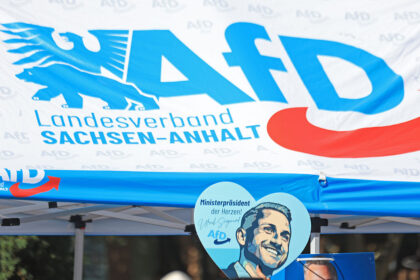
In response, Alternative for Germany (AfD) politician Ulrich Siegmund, chairman of the AfD’s parliamentary group in Saxony-Anhalt, visited the market and lamented that countries like Poland and the Czech Republic, that have so far managed to avoid mass immigration, do not have these issues.
“There was a terrible attack here a year ago. That was right here, where I’m standing right now. Of course, you have to learn from these experiences and do better. But the question must be, not how do you protect Christmas markets? But why do we need to protect Christmas markets?” he asked. “Go to the Czech Republic, go to Poland, go to other countries that have not opened their borders, that have not sold their own security for anything here. No, the CDU’s policies at state and federal level have brought us exactly to this point. We are losing our freedom bit by bit. We are giving up our way of life. And for what? That is the question.”
While the left will mock Germans for saying they want their “old” country back, the reality of a police state at swimming pools in the summer and a police state at Christmas markets in the winter, or even anti-tank barriers, is leaving many Germans longing for a previous era.
Pointing to an old picture of the market, Siegmund says, “Have a look at this, I just discovered it here. It used to be a perfect world, that’s exactly how I knew it. That’s exactly how I want it back… I want our old country back. I want every one of you here to be able to walk peacefully through a Christmas market like this and enjoy your lives. We don’t deserve this, our country doesn’t deserve this. Our children do not deserve this.”
🇩🇪🎄The German Christmas market in Magdeburg has been suspended over security concerns, sparking a nationwide debate.
The question: Why are Christmas markets in Germany being canceled while countries like 🇵🇱Poland and the 🇨🇿Czech Republic have no serious terror threats at their… pic.twitter.com/MUW5fofh5w
Although the Magdeburg Christmas market has since announced it will open, the costs for security remain sky-high and worries remain about another deadly terror attack.
Last week, Gerold Leppa, chairman of the German Federal Association for City and City Marketing (BCSD), said that the costs for organizers are exploding, rising a whopping 44 percent in the last three years. Of course, it is not just security but also personnel and even music licensing, but as Remix News noted yesterday, cities are spending millions more to ensure proper security.
While it is true that only a small handful of Christmas markets have been canceled due to security costs, such as in Overath, there is no denying that German cities — already facing major debt crises in large part due to mass immigration — are having to shoulder extremely expensive security solutions at their own Christmas markets.
Milan will not hold its traditional New Year’s Eve celebration in Piazza Duomo this year, with the city confirming that no concert or public countdown will be staged.
Mayor Giuseppe Sala attributes the decision to the upcoming 2026 Winter Olympics, noting that a significant portion of the square is already taken up with preparations for the Games due to commence on Feb. 6.
“The square is 30 percent full for the Olympics, plus there’s the Christmas tree and the Olympic timer in Piazzetta Reale, so it can’t happen this year,” Sala said, adding that the administration intends to restore the event next year.
The cancellation comes after several high-profile sexual assaults in Piazza Duomo during celebrations in recent years, which have brought the city into disrepute. There is no formal suggestion that the cancellation is due to these attacks, but it is clear that the city cannot afford any bad press in the lead-up to the Games.
New Year’s festivities in and around Piazza Duomo were overshadowed last year by sexual assaults involving groups of young migrants targeting women in the crowd, including tourists. Six Belgian students reported being sexually assaulted by up to 30 to 40 men in the city’s main square.
“We were harassed there. They touched us over our clothes, but also underneath,” one of the victims, Laura, told Belgian news site 7s7 days after the attack. “Three of us, including myself, were sexually assaulted. They put their hands in my underwear. It went way too far.”
She described the event as a “night of terror,” noting how she and her friends were surrounded by adult males waving flags of countries such as Iraq, Pakistan, and the United Arab Emirates, and how her group of friends felt “powerless in the face of so much violence.”
Another widely reported case in 2023 saw nine women attacked, with police later identifying 18 suspects, including foreigners from North Africa between the ages of 15 and 21, three of whom were minors, but also North Africans with Italian citizenship.
“We tried to fend them off, my friend hit and slapped them, but they laughed and continued to harass us, I had 15 hands on me,” one of the victims, from Mannheim, Germany, told the ANSA news agency, adding: “At some point, I fell to the ground, and they kept putting their hands on us.”
“We were surrounded by a group of people. They all spoke Arabic. We cried and screamed for help, but no one helped us. There were 30 people around us, touching us everywhere, nobody spoke Italian and unfortunately also no English when we managed to get out of there,” she added.
Although the mayor has framed this year’s cancellation as a matter of space and logistics, the absence of large-scale festivities removes the potential for any negative press only weeks before global attention turns to Milan.
Deputy Prime Minister Matteo Salvini criticized the decision, arguing that an Olympic year deserved a public celebration. He suggested that Milan should have hosted a cultural performance — such as a Filarmonica della Scala concert — rather than leaving the square unused.
“The world will look at Milan on Feb. 6 and wonder what events will be held in Piazza Duomo: whether there will be any quality events, not a concert by rapper Maranza. I don’t see any,” he said.
French lawmakers on Thursday adopted a non-binding resolution urging the government to oppose the EU-Mercosur free trade agreement in its current form.
The text, tabled by the left-wing La France Insoumise (LFI), passed by 244 votes to 1 in a near-unanimous rebuke of the deal, calling on President Macron to oppose the pact at the European Council.
Under the proposed trade agreement, finalized at the end of 2024 after decades of negotiation, the EU would benefit from expanded access for exports such as cars, machinery, wine, and other goods to Argentina, Brazil, Uruguay, and Paraguay. In return, meat, sugar, honey, poultry, and other agricultural products would enter Europe with reduced tariffs.
French farming unions have long opposed the deal, warning that cheaper imports produced under looser standards, to which European farmers are bound by, would undercut domestic producers. There have long been protests from the agricultural sector against the draft agreement, and demonstrations continued on Wednesday evening when dozens of farmers blockaded the Tancarville Bridge toll station in Normandy, according to Le Figaro.
Agriculture Minister Annie Genevard said in early November that France would not “sign an agreement” that would “condemn” its farmers, a stance she repeated while noting that several member states — including Poland, Austria, the Netherlands, Ireland, and Hungary — share Paris’s concerns. But lawmakers across party lines warned that President Emmanuel Macron, who once called the accord “unacceptable,” appears more open to it ahead of an expected European-level vote on Dec. 19.
Thursday’s debate was initiated by La France Insoumise during a day in which the opposition group took control of the parliamentary agenda. LFI rapporteur Matthias Tavel accused the French president of backtracking on his remarks.
“Less than a year ago, Emmanuel Macron called this agreement unacceptable, a bad text. And now, here he is declaring that it’s all a step in the right direction. Yet, not a single line of the agreement has been changed,” he said. Tavel went on to denounce what he called an “agricultural and health tipping point.”
Socialist MP Mélanie Thomin warned that if the deal proceeds, the government will be responsible “for the massive reintroduction of unauthorized products into food: growth hormones, antibiotics, and pesticides banned within the European Union.” National Rally deputy Julien Limongi branded the proposal “institutionalized dumping, a weapon of mass destruction against our agriculture,” calling it “a stab in the back, a betrayal.”
Julien Dive, of the center-right Les Républicains, urged Macron not to “sign the death warrant for French agriculture.” Only the governing party led by Prime Minister Gabriel Attal abstained.
Responding for the government, Minister for Europe Benjamin Haddad rejected claims of inconsistency, saying, “France’s position has always been consistent” and that “the agreement reached is not acceptable as it stands.”
He added that amendments to the agreement are being discussed in Brussels, but that improvements are still insufficient. “It’s not enough,” he said, calling for “a detailed plan” from the European Commission to address legitimate concerns.
A convicted rapist from Tegel prison in Berlin has failed to return to the facility after an unaccompanied release, with police saying the man attacked his wife with a knife, resulting in serious injuries.
The fugitive, identified as the 37-year-old Mike L., was remarkably due to be released from prison next month. The former market manager had participated in several unaccompanied releases over the past few months as part of his preparation for life after incarceration.
However, during the latest release, police believe he used it as an opportunity to stab his ex-wife.
BZ reported that there had been “no problems with these releases so far.” However, he allegedly ambushed his ex-wife in Lankwitz with a knife on Saturday. While no further details have been announced, the woman was hospitalized with serious injuries, though she has since been able to leave the clinic.
In what BZ described as a perplexing development, the authorities did not publicly disclose information about either the crime or the man being on the run from authorities.
The spokeswoman for the Berlin judicial administration “did not want to comment on this on Wednesday afternoon.”
The police reportedly recorded the knife attack as “domestic violence.” This is presumably why the public was not informed.
Police spokesman Florian Nath stated, “The colleagues are investigating dangerous bodily harm. Everything else is the subject of the investigation. The man is being searched for.”
Mike L. was convicted in 2021 and sentenced to four years and nine months in prison for aggravated rape, deprivation of liberty, coercion, possession of weapons, and bodily harm. He also received an additional two years for an arson attack.
The events leading to his imprisonment involved Helena D. (then 23, whose name has been changed), an employee at the firm where L. was a marketing manager. In 2019, he began a relationship with the colleague, who was ten years his junior. The relationship was characterized by “jealousy and violence,” leading the woman to move out and obtain an emergency restraining order against him.
On April 9, 2020, L. encountered Helena D. on the street. He forced her into his car at knifepoint and drove to the island of Usedom, which is in the state of Mecklenburg-Western Pomerania. That night, he raped her in the car.
A new poll shows that for the first time, a majority of Germans do not completely rule out voting for the Alternative for Germany (AfD), marking a major milestone for the party.
While the media and the establishment have waged a non-stop campaign against the right-wing group, this campaign appears to have failed, at least so far. The Insa polling firm found that 49 percent of Germans rule out ever voting for the AfD, while the rest could, in theory, see themselves lending it their vote.
This, however, also needs to be put into context. The AfD party is still the worst party in terms of the pool of people willing to vote for it. In other words, even though the Green Party, for instance, polls much lower than the AfD, there are still more Germans who say they could imagine voting for that party than there are Germans who say they could imagine voting for the AfD.
“Only just under one in two people fundamentally rule out voting for the AfD. This is still the worst value of all parties in the ‘negative Sunday question,‘ but the best value ever measured in this category for the AfD,” Insa chief Hermann Binkert told Bild, as reported by Tagesspiegel.
Still, the result shows major progress for the AfD, and could further complicate efforts to ban the party.
The latest poll from Insa also found that the AfD remains the number one party in the country, if by a slim margin. The AfD is polling at 26 percent, with the CDU and CSU right behind at 25.5 percent. The SPD is at 15 percent.
The fact that the AfD is not only the number one party, but also increasingly making inroads with Germans, continues to be portrayed as a catastrophe for the establishment, which is desperate to stymie the party.
Notably, the AfD has reached its first-place polling position despite ban threats and mass surveillance on its party members. At the same time, a taxpayer-funded media empire fueled by billions of euros in mandatory payments from German households has relentlessly published propaganda aimed at the party.
That means that despite billions in propaganda, Germans are inwardly becoming more receptive to the AfD’s core economic, security, and anti-immigration messages. The media and the German government can only do so much censoring and damage control.
Serbia has been plunged into an unprecedented energy crisis in recent days, as the impact of American sanctions has paralyzed the country’s oil supply almost overnight, writes Hungarian analyst Dániel Deák in a recent post. Now, Hungarian Prime Minister Viktor Orbán is offering support to his Serbian ally, President Aleksandar Vučić.
“In the chaos of war, we can count on each other,” said Orbán before heading to the Serbian city of Subotica, which has a large Hungarian community, in order to commemorate Stephen Shepherd. According to Orbán, the joint commemoration goes beyond an emotional gesture. He said he believes that a true strategic alliance now exists between Hungary and Serbia.
Shipments via the Croatian pipeline were immediately halted after NIS, Serbia’s strategic oil company, became a target of U.S. sanctions. Banks responded by freezing the company’s finances, and the Pančevo refinery, the backbone of Serbia’s fuel supply, became virtually inoperable, according to Hungarian news outlet Mandiner.
To make matters worse, more than 300 NIS-owned gas stations are not accepting credit card payments because American card companies have blocked transactions with the company. Operators say there is no supply disruption yet, but no one can guarantee that the system will not collapse in the coming days.
The Hungarian prime minister emphasized that Serbia has found itself in a difficult situation due to its sanctions policy, and there is a risk that the country’s largest oil refinery will have to be shut down. This could cause serious supply problems, even fuel shortages.
According to Viktor Orbán, Central European cooperation today is not only about political diplomacy, but also about concrete economic and energy security steps. He said that Serbia is one of Hungary’s most important partners.
Analyst Dániel Deák emphasizes that everything that Serbia is experiencing now did not happen in the case of Hungary. This is a direct result of Orbán’s meeting with President Donald Trump in Washington on Nov. 7, with Orbán walking away with an exemption from American energy sanctions.
Unlike Serbia, there are no energy supply problems in Hungary; there are no disruptions in the payment system, and the fuel market has remained stable.
The Hungarian prime minister is personally visiting Serbia today to – as Deák puts it – try to help Hungary’s strategic ally. However, it remains unclear what concrete steps Orbán’s government will take to halt the crisis in Serbia.
Poland’s government and leading opposition figures have publicly pushed back against suggestions that the European Union can compel Warsaw to recognize same-sex marriages, despite a landmark ruling from the Court of Justice of the European Union (CJEU) requiring Poland to acknowledge a marriage legally concluded in another member state.
Interior Minister Marcin Kierwiński insisted on Wednesday that this week’s judgment does not equate to Brussels overruling Polish sovereignty.
“Since yesterday, many untruths have accumulated in this matter. Interpretations are already emerging that say: the EU is imposing its legislation on us. So no – it cannot impose its legislation on us,” he said, adding that the judgment alone “cannot force a change in Polish law in this regard.”
He stated that the government will outline how the ruling will be handled only “after thorough analyses by the Ministry of Foreign Affairs, the Ministry of the Interior and the Ministry of Justice.”
The ruling — issued on Tuesday by the EU’s top court — found that Poland acted incompatibly with EU law when it refused to recognize the marriage of two Polish men who married in Berlin in 2018 and sought legal recognition upon returning home.
The CJEU held that while marriage legislation remains a national competency, a member state cannot obstruct EU citizens’ freedom to move and maintain family life across borders. The judges concluded that denying recognition “may cause serious inconvenience at administrative, professional, and private levels” and would breach both free movement rights and the right to family life, enshrined in the European treaties and human rights legislation.
The judgment stopped short of requiring Poland to legalize same-sex marriage domestically, but it does obligate Warsaw to treat foreign same-sex marriages the same way it treats opposite-sex marriages for the purpose of recognition.
Under current law, transcription of foreign marriage certificates is the sole method for acknowledgment — a system the court said must now apply equally to same-sex couples. The move opens the door to same-sex couples in Poland, knowing they can return and insist upon the same rights as heterosexual couples.
Political fallout was immediate. President Karol Nawrocki, who has repeatedly taken a hard line against perceived EU overreach and is framed as a Eurosceptic within the Polish political landscape, was publicly defended by Przemysław Czarnek, deputy chairman of the opposition Law and Justice (PiS) party, who said Poland should not be expected to accept every directive from the EU.
“When they ask us to reduce CO₂ emissions by 90 percent, we really have to say: Down with it,” Czarnek said. He argued the same stance should apply to “rulings of the Court of Justice of the EU on same-sex marriage,” adding: “We are not condemned to be in the European Union, the Union is not our homeland, Brussels is not our capital.”
Czarnek, a former education minister, said the EU was originally a peace project but has drifted toward unification that “goes beyond the original plans.” Membership still offers value, he said, but “if it destroys our Christian worldview, then we have to say NO. We have to weigh the costs and benefits.” He stressed that EU membership should last only so long as Poland can safeguard its interests.
Sabrina Decanton, municipal councillor for the Ecologistes (Green party) in Saint-Ouen, France, has announced she will be withdrawing from the municipal election scheduled for March 2026.
Among her reasons listed are the homophobic comments within her own local Ecologistes group, specifically saying that she was a “target of homophobia,” according to the text of her announcement posted on X by Fdesouche.
“My sexual orientation is mentioned as an obstacle to my candidacy and a possible victory, some believing it would be incompatible with the support of working-class neighborhoods – a position I consider stigmatizing and discriminatory,” Decanton wrote.
Of note here is that her party is presumably caving to pressure from the local population of Saint-Ouen, known to be home to many African and Middle Eastern migrants, which the French refer to as “working-class.”
In other words, minority residents, especially known to be largely Muslim migrants, will not accept a lesbian as a candidate.
Decanton also mentions facing pressure to sign an illegal and unethical document, were she to be elected, that would have relegated municipal decisions to a “restricted and secret group.”
One commenter on X noted that such agreements are known to be ”relatively common” in immigrant-heavy cities, although he had never heard of them being put in writing.
Just outside of Paris, in its northern suburbs, Saint-Ouen-sur-Seine has a population of some 47,000, 40 percent of which were foreigners, according to 2023 estimates by INSEE.
Seine-Saint-Denis, the department to which Saint-Ouen belongs, was home to 7.8 percent of immigrants from Metropolitan France, according to figures from the Ministry of the Interior in 2021.
“I deeply believe that another way of doing politics is possible, but I refuse to compromise my values and my integrity,” Decanton added to her announcement.
In a recent Instagram post, she appears to congratulate Zohran Mamdani on becoming mayor of New York City, calling him “a multicultural mayor for the global city New York.”
New figures from the Federal Employment Agency indicate a pronounced change in the composition of families receiving Bürgergeld (citizen’s benefit). As of June 2025, around 1.7 million people under 18 years old were supported through the system. Just over 875,000 were German citizens, while approximately 822,000 held foreign passports — placing the share of foreign minors at 48.4 percent.
This distribution varies strongly by region. In Bavaria, Saarland, and Baden-Württemberg, more than half of all minors receiving Bürgergeld are foreign nationals, with Bavaria reporting the highest proportion at 57.1 percent. In Berlin and Mecklenburg-Vorpommern, the share is lower, at around 39 percent and 38.3 percent, respectively.
When compared with population size, the contrast is even clearer. Citizen’s benefit was paid to an estimated 7.3 percent of German children, but to around 35 percent of foreign children nationwide — meaning that statistically, one in 14 German minors and slightly more than one in three foreign minors received support from job centers in mid-2025.
Reporting on the figures, NIUS outlined the steady shift over the past 15 years. In 2010, roughly four out of every five under-18 recipients were German. Today, the ratio of foreign minors is close to one-to-one.
In 2010, payments to foreign minors amounted to roughly €669 million. Last year, this figure was €3.6 billion. Payments for German beneficiaries have remained comparatively stable, fluctuating around the €2.5-€2.7 billion mark.
AfD social policy spokesman René Springer argues that the new data reflects structural strain on the welfare system and has called for tighter migration controls. In a written statement, he said that benefits for foreign children “have risen far faster than the system can sustain” and urged a change in policy direction, including stricter border management and enforcement of deportation orders.
Springer’s assessment is not too dissimilar to remarks made earlier this year by Chancellor Friedrich Merz, who warned that the German welfare model may no longer be sustainable in its current form due to economic headwinds, rising subsidy needs, and demographic pressure. “The welfare state as we have it today is no longer financially viable with what we are achieving economically,” he said in August.
His remarks prompted a reaction from Hungarian Prime Minister Viktor Orbán, who pointed to Hungary’s earlier shift toward a labour-priority economic model and claimed that Western welfare structures are reaching their limits.
“The Western welfare state is bankrupt, so it was right for us to switch to a labor-based economy in 2010,” Orbán said, contrasting Hungary’s “nation-building” approach with Germany’s belated “crisis management.”
Around 15 percent of Germany’s under-18s have a foreign passport, while an estimated 40 percent have some form of migration background. The Federal Employment Agency has previously reported that among working-age Bürgergeld recipients, roughly two-thirds are either immigrants or have immigrant parents.
Despite these discussions, the Bürgergeld program was still being presented as late as August by the Federal Employment Agency as available to young migrants who cannot meet basic living costs. Information sections aimed at newcomers, including English-language guidance for recent arrivals, remained publicly accessible online on the agency’s website.
Germany will not attempt to return Ukrainian refugees en masse after the end of the war, the head of Berlin’s immigration authority has said, insisting there will be no rapid or compulsory repatriation when hostilities cease.
Engelhard Mazanke, director of the Berlin Immigration Office, noted that the EU’s temporary protection regime has already been extended until March 2027. With around 1.3 million Ukrainians living in Germany, he said it is “definitely not” realistic or feasible that the country could contemplate returning everyone in a short timeframe.
Speaking to Ukrinform, Mazanke argued that, even if any political pressure emerged to do so, such a move would be impossible to implement.
The immigration chief noted that Germany had never experienced an influx of such a scale from a culturally similar country, contrasting the wave of Ukrainian refugees to those who arrived en masse from Syria and elsewhere in 2015. While the migration crisis a decade ago was dominated by men, most Ukrainian arrivals have been working-age women with children.
Looking to historical precedent, particularly the refugee movements from the Balkans, Mazanke suggested the long-term outcome may split roughly half between those who return and those who remain — but stressed that family formation, not employment or language, is the key factor in long-term settlement.
Public sentiment, however, is increasingly strained. An INSA poll commissioned by Bild last month found strong opposition among German citizens to continued financial support for Ukrainian refugees: only 17 percent of respondents supported Bürgergeld payments, while 66 percent opposed them. Data from the Federal Labor Agency indicated that by March 2025, 701,000 Ukrainians were receiving public assistance, including 502,000 of working age. The same survey found 62 percent of Germans believe Ukrainian men of conscription age should return home to Ukraine.
Across Europe, research points to limited return intentions unless Ukraine regains its territory and receives firm security guarantees — of which the former at least looks increasingly unlikely under the latest 28-point plan being discussed among the United States and the warring parties. A major study by the Ifo Institute surveyed 2,543 Ukrainian refugees in 30 European countries and concluded that only 2.7 percent would return in a pessimistic post-war scenario — one where Russia retains occupied zones, the economy deteriorates, and no peace deal or security assurances are in place.
In the most favourable scenario — restored 1991 borders, NATO membership, reduced corruption and increased income — the share rises to 46.5 percent. So, even the best case makes Mazanke’s suggestion that half could return look optimistic.
Women reported a stronger willingness to return than men and were more responsive to institutional and economic improvements. Younger refugees valued employment and EU prospects more, yet even among those aged 18 to 34, the average return probability was only 26.3 percent.
The findings suggest the long-term reconstruction of Ukraine may be hampered if return rates remain low.
A mother suffered serious stab wounds in an attack by an African migrant on Nov. 20 in the Mireuil district of La Rochelle, at rue Ernest-Meissonnier.
At 4:30 p.m., an altercation broke out between neighbors. The migrant, who comes from the Ivory Coast, reportedly has a history of psychiatric disorders.
The 43-year-old suspect attacked the 33-year-old victim with a bladed weapon, according to police, stabbing her multiple times in the chest and face.
After being transported to Poitiers Hospital, she was listed in critical condition and her life was in “serious jeopardy” according to French news outlet Inf-Info.
Police arrested the suspect at 9:00 p.m., and a case for attempted murder was opened. He has no criminal record on his file.
Women’s safety in France has been a major topic, with the French right saying that violence from foreigners represents a major threat.
Earlier this month, French MEP Marion Maréchal wrote: “83% of victims of sexual violence in Île-de-France transport are French, while 61% of those accused of these acts are foreign. The problem is not men, the problem is mass immigration.”
In addition, Astrid Mae, a spokeswoman for the French feminist group Collectif Némésis, said the left’s suggestion that women-only train cars should be implemented is nothing more than a “band-aid” for a social wound.
“There is a problem of massive, uncontrolled immigration. We know that today, 62 percent of sexual assaults on public transport in the Ile-de-France region are committed by foreigners,” she said.
A 35-year-old African man has reportedly made a full confession for beating and sexually assaulting a 53-year-old Italian woman at dawn on Nov. 21 in the city of Gallarate, according to media reports. Remarkably, this rape occurred shortly after the Remigration Summit in the city featuring speakers such as Austrian activist Martin Sellner.
Now, the mayor of the city, Andrea Cassani, said the rape is another example of why remigration must happen.
Cassani had refused to back down under pressure from the left to cancel the entire Remigration Summit. Now, he is noting that the African migrant accused of rape did not “flee war” but instead committed a vile act against a defenseless woman in his city. The mayor further pointed to statistics that show Italy’s rape crisis has been brought on by mass immigration.
The African suspect, who is originally from the Gambia, was caught on surveillance camera before and after the crime. He has lived in Italy for 11 years, is married to an Italian woman, works as a mechanic, and has three children.
🇮🇹🚨“I had an impulse."
A 35-year-old African man has made a full confession for beating and sexually assaulting a 53-year-old Italian woman at dawn in the city of Gallarate.
The African suspect:
🔺has lived in Italy for 11 years 🔺works as a mechanic 🔺has 3 children
According to Italian news network Sky Tg24, the African man reportedly targeted the older woman while she was on her way to work in the Cajello district.
Prosecutors say the man admitted to dragging the victim behind a flower bed near a car park and sexually assaulting her in the city of 55,000 people.
Italian police arrived at the suspect’s home and found the African still wearing the clothes seen on the surveillance camera. They also found the victim’s phone next to his apartment.
The suspect confessed to all the main details and crimes in the case to prosecutor Roberto Bonfanti during questioning after he was taken into custody.
Explaining the rape, he reportedly said during his confession: “I had an impulse.”
Mayor speaks out on migrant violence
The mayor of Gallarate, Andrea Cassani, addressed the attack, saying, “Yesterday, it was not yet known who the culprit was, but everyone had already understood what happened. Now, the rape against one of our fellow citizens was perpetrated by a Gambian — who evidently did not come to Gallarate to pay our pensions or because he was fleeing from some war — but to be supported by us and to rape a woman who could be our mother, our wife.”
The city recently made the news for hosting the Remigration Summit, which Andrea Cassani allowed to go through in her city despite pressure from the left.
🚨 Real warning from our founder and organizer Afonso Gonçalves:
Cassaini is noting that this type of rape is exactly what speakers at the Remigration Summit were talking about. In fact, it is the new reality facing Italy and much of Europe due to mass immigration.
“It all happened a few steps from the Condominium Theater, where a few months ago, young people from all over Europe — worried about the consequences of uncontrolled immigration and the high propensity to crime of these individuals — spoke of remigration,” he said. “It is not racism but statistics: More than 50% of violent crimes are committed by foreigners who are less than 10% of the population in Italy.”
Just yesterday, Remix News covered the topic of sexual crimes and migration in Italy, showing that foreigners, while only making up 9 percent of the population, commit nearly half of all sexual violence crimes. However, these statistics also do not take into account Italian citizens with a migration background, who may also count towards a significant percentage of “Italians” committing crimes in the data.
The mayor said: “It’s time for all citizens to open their eyes to the consequences of immigration and for politics to also put a stop to this invasion and send these criminals back to their countries.”
The female victim was treated at Sant’Antonio Abate Hospital in Gallarate, and reportedly was ordered to take 20 days to recover from the rape and assault.
The African man has been charged with assault and a range of sexual crimes.
A Swedish court has handed down prison terms to seven defendants belonging to a Somali drug gang known as the Death Patrol (Dödspatrullen) over the abduction of a 22-year-old woman and her two-year-old daughter, held for nearly four days in a rented cabin as leverage over an unpaid gang-linked drug debt.
As reported by Samnytt, the woman was abducted on the morning of April 17 in Strängnäs, on Sweden’s west coast, as she was strapping her daughter into a car seat. A car pulled up behind her, several men got out, and she was coerced into the vehicle. The kidnappers then drove her and the toddler more than 400 kilometers across the country to Gothenburg.
There, the woman was given 500 kronor (€45) to buy necessities inside a grocery store while the kidnappers held her daughter. Surveillance images later showed one of the men carrying the child around inside the shop. The victims were subsequently taken to a rented cabin in Kyrkeby outside Kungälv, where they were kept for nearly four days. During that time, the woman learned that her ex-boyfriend owed several million kronor to the migrant gang in relation to a lost drug shipment to Norway. She and her daughter were being used as leverage to force repayment.
Court reporting from Ekuriren back in October noted that at the time of the abduction, the ex-boyfriend had already travelled to Finland to begin serving a prison sentence. A photograph of the woman with tape over her mouth and someone holding her head was reportedly sent to him and other relatives, together with demands for payment. The gang members also discussed recording the woman being raped to increase pressure on the family to pay up on her ex-boyfriend’s behalf.
The child’s grandmother, back in Strängnäs, had already noticed her car parked outside her home with a door open and alerted the authorities. Investigators soon linked the disappearance to the ex-boyfriend and tracked the perpetrators to the Airbnb cabin near Kungälv.
Police located the cabin during Easter weekend. Surveillance began on the Sunday evening, and during the night into Monday, a tactical team entered the building and took several people into custody. The woman and her daughter were medically assessed after the operation and were described as physically unharmed, though in a state of shock.
The mother told investigators she cried through much of the second day, convinced she might not survive. One of the defendants, by contrast, later described the ordeal as a “road trip” — insisting that everyone “made tacos, walked outside and played cards,” and even suggesting that the victim agreed to have her mouth taped for a photograph. He denied kidnapping and maintained he was merely trying to reclaim money.
Professional footballer Exauce Bokunyungu, 22, was identified as the main perpetrator and received the longest sentence: six years and 11 months. Ali Ise, 23, and Benjamin Patay, 22, were each sentenced to five years and five months, while Diu Ngong, 20, who booked the cabin, received two years and eight months for aiding and abetting.
Three additional men — Aghyad Saad, Ahmad Sarjin, and Abrham Woldeghebriel, aged 21 to 25 — were also convicted for another kidnapping linked to the same investigation. They were given sentences ranging from three years and 11 months to four years and five months.
Money spent on organizing public events has increased by an average of 44 percent over the past three years, according to a study by Germany’s Federal Association of Cities and Municipalities Marketing.
For many cities, and especially smaller towns and private organizers, these expenses, now at a record high, have become a serious burden, writes Polish outlet Do Rzeczy.
Due to a series of attacks in recent years, beefed-up security is a must. The 2016 attack in Berlin, in which an Islamist driver drove a truck into a crowd, and last year’s deadly attack at the Magdeburg Christmas market, both hit home hard. Just this year, there was a car attack in Munich in February and another car that crashed into a crowd in Mannheim in March.
In German public media outlet NDR, they write that there are exploding cost sin many cities, including the following:
Hanover
“For example, the security concept for the Christmas market in the old town [in Hanover] is expected to cost around €530,000 more than last year. This large sum is intended to implement various measures to ensure the safety of visitors. The money comes from the general budget of the state capital, the additional costs are not passed on to the stand fees. The city did not want to specify exactly which measures would be implemented – for security reasons,” wrote the newspaper.
Dresden
According to a separate report from NDR, Dresden has purchased 180 new car barriers, costing €1.9 million. The city is also renting shipping container to block access roads.
Göttingen
In Göttingen, €400,000 extra are now being spent to secure the Christmas market with traffic barriers and concrete blocks. This comes at a time when the city has a €100 million budget deficit. Buses that pass close by to the Christmas market are also being rerouted for the first time.
Wolfsburg
Wolfsburg plans to spend nearly a million euros on security measures, including €261,000 for crossing barriers. The city also will purchase retractable bollards and “high-security furniture” which will be installed over the coming years for €938,000.
Many of Germany’s famed Christmas markets, including the “Winterwelt Potsdamer Platz Berlin” and “Berliner Weihnachtszeit,” now have massive concrete barriers and even checkpoints at the entrances.
All of these serious security measures cost money, plus CCTV, security patrols, and additional security procedures.
On top of that, such security measures do nothing to add to the “festive spirit” that are supposed to define Christmas markets in Germany.
According to “Rzeczpospolita,” the German Ministry of the Interior acknowledges that security concerns are fully justified. It points to the large number of visitors, central locations, and open-air nature of the fairs as factors increasing the risk. But there is an ongoing debate as to who is ultimately responsible for bearing the cost.
Local authorities are calling on the federal states to shoulder some of this burden, arguing that combating terrorism is beyond the capabilities of municipalities.
Chancellor Friedrich Merz has stated that the federal government does not plan to provide additional financial support, pointing out that the state police are responsible for security. The Association of German Cities and Municipalities warns that if additional funding is not provided, organizers may be forced to pass on the costs to visitors.
Some markets have already decided to charge an admission fee, such as at the Gendarmenmarkt, where people will now have to pay €2 entrance to enter.
Meanwhile, Remix News just reported a few weeks ago that another Christmas market was cancelled altogether in Overath, North Rhine-Westphalia, due to a dispute over who should bear the growing costs of counter-terrorism security.
Fewer Dutch people are embracing veganism and vegetarianism, according to new research, which could bode poorly for those pushing such diets on Europeans.
Although more people are open to eating slightly less meat, the small population group that completely abstains from meat or animal products has actually declined between 2023 and 2025. These remarkable results, which go against the overall trend of sustainability, come from the Sustainable Living Monitor survey. This is a biennial survey of over 4,000 people, conducted by the Milieu Central knowledge center in collaboration with the research agency Motivaction.
The data shows that completely abandoning meat is on the decline among the Dutch. In 2021, 2 percent of the population claimed to be vegetarian, which meant consuming no meat or fish, but dairy and eggs. That segment grew to 5 percent in 2023, but has now dropped back to 3 percent. That is nearly a 50 percent drop in those practicing such a diet in just two years.
For vegans, who consume no animal products at all, the percentage of Dutch practicing this diet went from 0.6 percent of the population in 2021 to 2 percent in 2023, and has now fallen all the way to 0.5 percent in 2025.
In just two years, the popularity of veganism has fallen 75 percent in the Netherlands.
Several popular vegan food companies have gone bankrupt in Europe in recent years, including in the Netherlands, due to softening demand.
The news comes at a time when skepticism is growing about these types of diets, especially veganism. Many people partaking in such dieting trends are lacking vital nutrients, and for children, the risks are especially great.
As noted by a study at Cambridge University: “A vegan diet can pose dangers to children, mainly due to potential deficiencies in crucial nutrients like vitamin B12, vitamin D, iron, calcium, iodine, and DHA, which are vital for growth, bone density, and cognitive development. Risks include poor growth, lower bone mineral density, anemia, and in severe cases, developmental delays. Major health organizations advise that a vegan diet for children should not be undertaken without careful planning and medical supervision.”
However, many on the left have marketed these diets, including to children, as a way to fight climate change. However, the data shows that more and more people are abandoning this ideology and eating meat and animal-based products.
That is not to argue that meat eaters are necessarily healthy by default. The Western diet has seen consumption explode higher for processed foods, processed meats, and copious amounts of sugar, simple carbs. Coupled with a lack of physical exercise, it has resulted in a health disaster.
Dutch also unwilling to give up their cars
Just like meat, many Dutch people are attached to their cars, especially those with combustion engines. Only 8 percent say they would go through life without a car. Less than 19 percent are open to giving up car ownership. However, 12 percent are willing to rent out their cars via a digital platform.
There’s something strange going on with electric driving. On the one hand, the percentage of people actually driving a plug-in car has grown from 3 percent in 2023 to 6 percent in 2025. But the group of people open to switching to electric driving has decreased in the past two years, from 51 percent to 44 percent. This is despite the fact that more affordable models are appearing on the market.
Judith Roumen, strategic behavioral researcher at Milieu Centraal, suggests that the “Musk effect” could be a possible explanation. She’s referring to the apparent aversion to Tesla cars as a result of Musk’s temporary political collaboration with President Donald Trump. She also believes that the focus on environmental issues surrounding batteries may play a role in the declining support for electric driving.
Sustainable must be made easy and cheap for mass adoption
The survey results are not all bad for those promoting a sustainable lifestyle. Dutch people appear to be willing to buy fewer new clothes, take the train instead of a plane, and improve insulation in their homes for energy efficiency.
While people often say they are willing, this does not always translate into action. There remains only a small group of people who actually make sustainable choices.
“There’s a great willingness to embrace sustainability. But we need to translate that support into action,” concludes Ika van de Pas, director of the Milieu Centraal knowledge center.
“A new government doesn’t have to be cautious about implementing new sustainability measures. There’s a great willingness to participate. We just have to ensure that the most sustainable choice is also the easiest and cheapest,” he said.
An Iraqi national has been sentenced to life imprisonment in Germany for murdering his estranged wife by chasing her across a sidewalk at 71 kilometers per hour and ramming her with his car in a suspected honor-related homicide.
The 37-year-old mother of seven died instantly in the May 12 attack in Varel, in the Friesland district of northern Germany. The verdict, delivered by the Oldenburg Regional Court, is not yet legally binding due to the possibility of appeal.
According to the court’s findings as reported by Bild, the woman had been walking along the sidewalk with headphones on when her 38-year-old husband accelerated directly toward her, striking her with such force that she was thrown several meters into the air.
Emergency responders rushed to the scene, but she died before they could provide aid.
At the start of the trial, the defendant insisted the collision had been an accident, claiming that his mobile phone had fallen and, while trying to retrieve it, he inadvertently jerked the steering wheel and pressed the accelerator, just happening to strike his estranged wife. Judges rejected this account, stating that the evidence overwhelmingly contradicted any notion of an accident.
The court ruled that he acted out of jealousy and contempt, concluding that he felt his honor had been violated because his wife wanted a divorce.
RTL reported at the time of the incident that the couple had been living separately, and a restraining order had already been issued against the defendant, prohibiting him from contacting his wife.
The couple’s seven minor children are now under the care of the local youth welfare office.
In the aftermath of the killing, a GoFundMe page was set up to provide financial security for the children.
“Seven children are left behind, not only having lost their mother but also being left without parental care,” its creator, Sarah Weeken, wrote. “The family has been torn apart in an instant. The children, aged between 5 and 16, are now struggling with immeasurable pain, loss, and uncertainty about their future,” she added.
At the time of writing, it had raised €7,700 of its €20,000 target.
Update: A final ruling from a Hungarian court has forced the Index news portal to publish a correction to their previous report claiming that they had a leaked tax package from the Tisza camp, which they also falsely claimed would constitute the party’s economic plan.
New documents, allegedly from the Hungarian opposition Tisza Party, show a plan for a radical left-wing economic policy shift, including substantial tax hikes.
Entitled “Hungary 2027–2035 Convergence Program,” the draft, which is reportedly hundreds of pages long, would collect HUF 1.3 trillion in additional revenue annually through tax and contribution increases, austerity measures, and state redistribution.
The document, “each chapter of which is authenticated by several signatures,” proposes an expansion of the role of the state, a radical redistribution of income and wealth, and a comprehensive reorganization of public burden-sharing, writes Mandiner, based on a leaked document obtained by Hungarian news portal Index. Some of the alleged proposals are listed below.
A new progressive personal income tax system would mandate a 22 percent tax rate above HUF 416,000 gross, 33 percent above HUF 1.25 million gross, and a reduction of family tax benefits by 30 percent in the middle income bracket and 50 percent in the upper one.
Some of Fidesz’s tax simplifications would be abolished or limited to micro-enterprises, while the self-employment flat-tax vehicle KATA would only be allowed for students and pensioners.
A new annual 6.5 percent wealth tax on total assets over HUF 500 million (real estate, vehicles, securities, jewelry, etc.) is purportedly also part of the Tisza plan, according to the “leaked document,” along with progressive taxation of capital income (dividends, exchange rate gains, property sales, rent) with rates of 20 percent, 30 percent and 40 percent.
“Solidarity contributions” on employers and individuals would also be instituted, allegedly to the tune of 3 percent-8 percent on pension contributions and 6 percent-8 percent on health contributions.
A new corporate tax scheme would also be progressive: SMEs 13.5 percent-18 percent, large companies 21.5 percent, and multinationals 25 percent (instead of the current flat rate of 9 percent).
According to the Index report, most corporate tax breaks would also be eliminated, and development tax breaks would be slashed.
Meanwhile, the value-added tax (VAT) rate—already unpopularly high for all goods at 27 percent—would be hiked to 32 percent for cars, alcohol, and tobacco products.
Pet owners are apparently targeted by the Tisza party, with an alleged proposal for an extra 4 percent tax on pet products (food, litter) and a “dog and cat tax” of HUF 18,000 per animal per year.
Other targeted areas are said to include the abolition of the childcare allowance (GYED), a 20 percent widow’s pension tax, a 20 percent inheritance tax on health insurance policies, and a lifestyle-based “bonus–malus” system for healthcare premiums.
In what seems especially odd for the left-leaning Tisza is the supposed call to privatize the state health insurance system, with a mandatory private pension fund and insurance system, plus the end of free healthcare for children.
Lastly, the National Tax and Customs Administration would take over payroll accounting from employers, and in one rather Orwellian note, there would be a Digital Employee Card (DMK) for real-time monitoring of employees at work.
Mandiner calls out the supposed plan for “significantly increasing the role of the state” and “putting social considerations ahead of market incentives.”
“The planned reform package would affect broad social strata, from the middle class to small businesses to investors, while raising serious questions in terms of sustainability, economic growth, and competitiveness,” they write.
It should be noted that in a previous suit against Index for “leaking” Tisza’s supposed plan for general tax hikes, the portal at the time stated that its article was simply “opinion.” Now, however, they are clearly alleging to have real, “signed” documents.
The migrant defendant suspected of killing 17-year-old Lisa from Abcoude and raping a 30-year-old woman days earlier spoke only four words during his first appearance in an Amsterdam court on Tuesday.
The suspect, known as “Chris Jude,” spoke only to confirm his personal details, and answered “no” when asked if he wished to comment on the charges, according to court reporting by De Telegraaf newspaper.
Lisa was murdered in the early hours of Aug. 20 as she returned home from central Amsterdam on her bike.
According to prosecutors, the investigative trail led them to the nearby asylum center, where the suspect had been staying for only a few weeks. CCTV footage shows a man on a distinctive bicycle — black with a white front fork — following Lisa on her route home. Cameras captured him riding behind her from Spaklerweg and remaining near the scene along Holterbergweg where she was pushed off her bike into the grass.
🇳🇱🇩🇪 Women in the Netherlands and Germany are now trying to defend themselves with "Smurf spray" after an asylum seeker raped and murdered 17-year-old Lisa.
"Since Lisa’s death, many of (self-defense) products have been sold out, including the Smurf spray."
At 4:07 a.m., the teenager called the emergency services. During the call, she cried out, “No, help me,” before the line went silent. Police arrived minutes later but found her dead. Nearby, officers located her phone, ID cards, and a gray hoodie, later found to contain both Lisa’s DNA and the suspect’s. Wet footprints and a fresh bicycle track suggested the attacker had fled quickly.
When detectives reviewed surveillance near the asylum center, the same man was seen arriving shortly after the attack and washing his face, hands, legs, and shoes at an outdoor tap. His bicycle was parked at the center, and staff identified it as his. He was arrested the next day.
A knife carrying Lisa’s DNA was found in his locker along with a bucket containing wet clothes.
Five days before the killing, a woman staying at a hotel in the Dutch capital had been violently raped along Weesperzijde. Surveillance again linked the same distinctive bicycle and showed the suspect first following the woman and then returning to the asylum center around 2 a.m. The woman suffered multiple injuries, including a broken jaw. DNA taken from the rape scene matched the suspect.
The man says he is 22 and from Nigeria, but his identity remains unconfirmed as he possessed no documents upon arriving in the Netherlands. According to prosecutors, he speaks a dialect associated with a specific region of Nigeria. Requests for assistance have been sent to Nigerian authorities. His lawyer told the court that the suspect had lived in several orphanages in Nigeria and Tunisia and that the names “Chris” and “Jude” were given to him during those years.
According to Het Parool, the suspect said he was smuggled by boat to Europe and picked up by authorities near the Italian island of Lampedusa. He traveled on to the Netherlands via several European countries and was registered at the registration center in Ter Apel on June 21, just two months before Lisa’s murder.
The defense also said the suspect reports hearing “voices” since childhood and sometimes cannot recall events. He claimed to have left the asylum center on the nights in question because “the voices got too loud,” and returned to find wounds on his hands and a knife in his possession, but did not know how it got there.
His lawyer insisted that he has not confessed or denied the allegations and will answer questions “when he is able to.” Such a defense opens up the possibility of a mental health diagnosis, which could see him rendered incapable of criminal intent.
The prosecution argued that the suspect should remain detained, describing him as a flight risk who had only been stopped because he was arrested quickly. The court agreed, ordering that he stay behind bars until the next preliminary hearing on Feb. 11.
A full psychiatric evaluation will take place at the Pieter Baan Center early next year.
A 56-year-old man has died two weeks after being stabbed at the Perrache tram station in Lyon’s 2nd arrondissement, according to French media.
The attack occurred on Friday, Nov. 14, at around 9:30 p.m. According to police and local reporting from Actu Lyon, the victim collapsed onto the tram tracks after being stabbed at least once in front of multiple witnesses.
Emergency services treated the man at the scene before taking him to Édouard-Herriot Hospital, where he remained in critical condition. Authorities confirmed over the weekend that he died from his injuries.
Witnesses described the aftermath as deeply distressing. One person told local media, “We saw a body near the tram.” Another described the situation as “a nightmare scene,” recalling the confusion as passengers and bystanders tried to understand what had happened.
A suspect was apprehended shortly after the attack through witness accounts and CCTV footage. According to the Lyon prosecutor’s office, the man — identified as a 32-year-old homeless individual originally from Guadeloupe — was placed in police custody but later transferred to a psychiatric unit after his condition was deemed medically incompatible with detention.
Following the victim’s death, he was arrested again on Monday, and the investigation was reclassified as a homicide case.
Early information indicates that the victim was stabbed in the chest with a barbecue fork in a pedestrian tunnel used by tram lines.
The exact motive behind the attack remains unknown.
Remarkably, a very similar story just occurred in Paris as well, involving a violent migrant from Guadeloupe, who slashed two victims in their faces, carving the “Joker smile” into each victim.
Young Killian and his girlfriend have spoken to French media about the terrifying incident from earlier this month.
🇫🇷🔴 "We escaped death – both of us."
This young French couple is a symbol of the New Europe.
🔺“We now avoid going out much, in order to stay safe.” 🔺“We always have this fear: Could we run into someone like him again?” 🔺“Now, I can’t sleep without crying.”
Rome police have arrested three Moroccan men accused of dragging an 18-year-old girl out of her boyfriend’s car and gang raping her while restraining her partner and forcing him to watch.
Investigators say the woman was attacked on the evening of Oct. 25 after a migrant gang surrounded the parked car where she and her 24-year-old boyfriend had stopped late at night in Tor Tre Teste park in the Italian capital.
Police believe the group may have consisted of up to five individuals and are still searching for two suspects.
According to police, the Italian couple had parked their vehicle in a secluded area of the park when the attackers broke the car windows and forced both occupants outside. Corriere della Sera reported that the men restrained the young man while one of the attackers raped the woman. Mobile phones from the couple were then stolen before the men fled on foot.
Authorities say fingerprints recovered from the windows and the vehicle link the three arrested men to the scene.
After the attackers fled, the couple contacted emergency services and provided statements that allowed detectives to identify the suspects quickly.
Two suspects were detained on Oct. 28. A third man was arrested in Venice several days later. Police have kept information limited due to the ongoing investigation, and officers continue to assess whether additional individuals were involved.
The case has prompted political commentary criticizing the limited national attention the incident initially received. Il Prima Nazionale noted that this is not the first serious sexual assault reported in the Tor Tre Teste area. Last August, a Gambian man was arrested in connection with two separate rapes committed between Via Prenestina and the park, including that of a 60-year-old woman.
Nel parco Tor Tre Teste, lo scorso agosto, venne violentata una donna di 60 anni dallo stupratore seriale gambiano Sheikh Hydara, beneficiario di protezione internazionale. pic.twitter.com/obQqfP1Mwx
Despite the seriousness of those incidents, they also did not lead to a broader national debate.
“This silence, even more than the violence, is the political crux of the matter. It reveals how rigidly selective contemporary rhetoric on women’s rights is. It provokes outrage when the perpetrator is an Italian man, recognizable. It fades when the perpetrators are illegal immigrants already marginalized,” the site wrote.
Earlier this week, Remix News reported on data from Italy’s interior ministry for 2024, showing that foreign nationals committed 44 percent of all rapes that year, despite comprising just 9 percent of the country’s resident population.
The data is even more alarming when focusing on minor suspects. In 2023, government data showed that 56 percent of all arrests of minors for sexual violence were non-Italians.
Politico tries to present itself as “objective” and on a quest to fight “disinformation” and “fake news,” but the media giant’s latest actions reveal it appears to be willing to get dirty in support of the EU establishment’s preferred candidates. Yesterday, Politico’s “Poll of Polls” aggregator showed Viktor Orbán’s Fidesz party pulling ahead of the opposition Tisza party for the first time in a year. Shockingly, Politico waited less than 24 hours to react to this “bad news” by changing the data in its own polling aggregator, which also happened to be very good for the opposition Tisza party.
Once the results were “corrected” on Politico’s polling aggregator — by removing two polling firm results and adding a new one — suddenly Fidesz dropped from a one-point lead to seven points behind Tisza in the polling average.
Before and after polling results for Hungary’s upcoming national elections in April, with Politico changing the results less than 24 hours after Fidesz’s party pulled ahead
This came after Hungarian media reported on Orbán being ahead of Magyar for the first time in a year, as Remix News published yesterday. However, screenshots had already been widely taken of the Politico polling results, showing the before and after.
Telex media outlet, by no means friendly to Orbán, reported on what Politico did next in response to Orbán gaining the polling lead.
“But what happened in the specific case? Although Politico’s graph does not indicate which research is from which company, if we compare them with the research published in the past period, it turns out that the position of Poll of Polls on Sunday was most influenced by the recent measurements of the Hungarian Social Researcher and the Center for Fundamental Rights. The former measured a Fidesz advantage of 10 percentage points, the latter 7 percentage points, and these two measurements were enough to drag the average so far that a Fidesz advantage of 1 percentage point emerged.
And here comes the twist. Around noon on Monday, Politico deleted the research of the Hungarian Social Researcher and the Center for Fundamental Rights from its summary, but added Publicus’ latest measurement, which shows a Tisza advantage of 9 percentage points. Accordingly, the overall Tisza advantage of 7 percentage points came out, so that the Tisza stands at 46 percent and Fidesz at 39 percent. (We asked Politico why the measurements of the Hungarian Social Researcher and the Center for Fundamental Rights were deleted; if they answer on the merits, we will report on it.)
By excluding the two researches from the total and by hiring Publicus, who made significant mistakes in the previous two elections, the difference between the support of the Tisza Party and Fidesz immediately jumped by 8 percentage points.”
Politco could not even wait a few days to change the data firm inputs. It immediately sprung into action, adding the Publicus poll and deleting two polls which showed Orbán in the lead.
Besides the ridiculous timing of Politico’s actions, Politico’s move is also highly dubious, considering that it removed polling firms that have a better track record than Publicus, which is known to have an extreme left-wing bias.
Notably, the firm Politico added, Publicus, is a polling institute that was remarkably wrong about the last Hungarian national election in 2022. It claimed the opposition was tied with Orbán’s Fidesz party, but this result was massively off the mark. In fact, Publicus had the worst polling result of any firm in the lead-up to the 2022 national election, amounting to an incredible 20-point failure.
As Telex writes, “With the last measurements before the 2022 election, however, Publicus made the biggest mistake, 20 percentage points in the difference between the support of Fidesz and the united opposition, slightly ahead of the 16 percentage point mistake of Republikon and Závecz (all three institutes measured the opposition above and Fidesz below).”
In addition, before the 2024 European Parliament election, Publicus overestimated the DK-MSZP-Párbeszéd list by 6.5 percent, as well as the Tisza list by 4.2 percent, even if it predicted other party results accurately.
In other words, Publicus has a very poor track record, and by some measures, the polling firm should be seen as a laughing stock with its 20-point miss. Notably, in the United States, the outrageously wrong Iowa poll from Selzer led her to quit polling completely, and that was only a 16-point miss versus the Publicus 20-point failure.
However, some could argue that the Publicus polling firm did exactly what it was supposed to do: deliver a manipulated poll that showed the opposition to Orbán with far more support than it actually had. A 20-point miss, after all, veers into the realm of a failure so great, it is difficult to explain such a miss purely by poor data science.
One of the polling firms removed by Politico, Hungarian Social Research voiced outrage over the move. An analyst from the firm, Krisztián Talabér, wrote on Facebook about Politico’s move. He noted that his firm actually had the most accurate result of the 2022 election, while Publicus had the worst result.
“So Politico removed the Hungarian Social Research Institute from its ‘Poll of Polls’ research summary, the institute that gave the most accurate election forecast in Hungary before the 2022 parliamentary election, and instead included the institute that claimed even on the eve of the election that the score was 47-47, while the opposition was more among the undecided. The domestic result was 52-36 in favor of the ruling parties. Most accurate out, most inaccurate in. Scandal,” he wrote.
Of course, the Hungarian government has jumped on this “alteration” of the polling firms included in the Politico “Poll of Polls” as well.
The political director for the Fidesz party, Balázs Orbán, took to X to write, “Less than 24 hours after I posted an analysis citing the @PoliticoEurope ‘Poll of Polls’ — which clearly showed Hungary’s patriotic government parties, Fidesz-KDNP, ahead of Péter Magyar and his Tisza Party — the pro-war Brussels elite’s in-house outlet suddenly rewrote its numbers & deleted that lead retroactively. Such blatant data tampering exposes exactly how far some are willing to go to distort Hungary’s political reality. By removing from their aggregate index every poll that didn’t align with their preferred narrative, they turned a ‘Poll of Polls’ into a one-sided construction.”
‼️ Less than 24 hours after I posted an analysis citing the @PoliticoEurope “Poll of Polls” — which clearly showed 🇭🇺 Hungary’s patriotic government parties, Fidesz–KDNP, ahead of Péter Magyar and his Tisza Party — the pro-war Brussels elite’s in-house outlet suddenly rewrote its… pic.twitter.com/U1oTu2xYsg
The timing from Politico is indeed remarkable and shows the lengths publications are willing to go to remove Orbán from power. Politico lives and dies on its access to the EU power structure, and that relationship may come at a cost. In short, this certainly looks like a “favor” that veers into outright manipulation. Of course, Politico is a media giant with more reach than any Hungarian publication, both in Hungarian and the English language. That means it can afford to take these measures, since it will receive very little heat from anyone that matters to its bottom line.
Case in point, Balázs Orbán’s post on X did not even obtain 40,000 impressions. His audience is also meaningless to Politico. They care about power first and foremost, and Orbán holds very little sway in the levers of power in Western Europe, especially in Brussels.
In fact, any move Politico makes against Orbán can only stand to be rewarded by powerful backers, with more insider access and connections to the power structure within the EU. At the same time, removing Orbán from power aligns with the fundamental ideological approach of Politico, along with many other powerful media outlets.
Expect more manipulation ahead from Brussels and its “independent” publications of choice.
A new poll indicates that Jordan Bardella, president of the National Rally (RN), would secure a victory in the second round of the 2027 French presidential election in every matchup tested. Although elections are still 18 months away, it shows a considerable shift in French public support to right-wing, conservative positions.
The new Odoxa-Mascaret poll released Tuesday, conducted for French news outlet Public Sénat and other regional press outlets, suggests a clear path for Bardella should Marine Le Pen’s potential ineligibility be confirmed.
According to the new poll, even if Le Pen fails in her appeal attempts, Bardella, seen as her successor, would comfortably lead the first round in both main scenarios examined by the pollsters.
In a polling scenario with Édouard Philippe (Centrist candidate), Bardella would take 35 percent of the first-round vote, with former Prime Minister Édouard Philippe advancing to the runoff with 17 percent. In the second round, Bardella would defeat Philippe with 53 percent to 47 percent of the vote. This marks a reversal from the same Odoxa poll conducted in April, where Philippe led the RN leader 54 percent to 46 percent.
FrenchNational Rally party president Jordan Bardella answers reporters following a meeting, after France’s prime minister Sebastien Lecornu resigned plunging the country into a deep political crisis. Monday, Oct. 6, 2025 in Paris. (AP Photo/Christophe Ena)
In a matchup against Gabriel Attal, Bardella’s first-round support increases slightly to 36 percent. Prime Minister Gabriel Attal, who polls at 11 percent, would be overtaken by both Raphaël Glucksmann (14.5 percent)and Jean-Luc Mélenchon (12 percent).
The institute also tested other potential second-round matchups, taking into account the “margins of statistical error” from the first round. Bardella would defeat Raphaël Glucksmann with 58 percent to 42 percent of the vote.
Against the secretary general of Renaissance, Gabriel Attal, Bardella would win with “56 percent against 44 percent.”
Finally, against far-left La France Insoumise leader Jean-Luc Mélenchon, Bardella would secure a decisive victory with “74 percent of the vote against 26 percent.”
Mélenchon, in particular, is known for actively supporting the Great Replacement.
🇫🇷🚨 French far left leader once again says the Great Replacement is real and good
Jean-Luc Mélenchon: "Yes, Mr. Zemmour, there is a Great Replacement. Yes, Mr. Bayrou, there is a Great Replacement."
Bardella himself has been attracting huge crowds across the country, with polling showing that more than half of France is willing to have him lead the country. During a recent stop in Brittany, he published a video of Bretons waiting for a chance to meet him, writing: "Brittany was a difficult land for the National Rally. But the Bretons have become aware of the accuracy of our diagnosis on agricultural abandonment, on security laxity, or even on mass immigration: we are here, now, in a land of strong progress for our ideas."
La Bretagne était une terre difficile pour le Rassemblement National.
Mais les Bretons ont pris conscience de la justesse de notre diagnostic sur l'abandon agricole, sur le laxisme sécuritaire ou encore sur l'immigration de masse : nous sommes ici, désormais, dans une terre de… pic.twitter.com/ikKV2C2Jfr
The survey did not include Marine Le Pen, whose candidacy is linked to her legal situation. Bardella, however, is favored by both the French public and National Rally (RN) supporters, amounting to a seven-point lead" over Le Pen, according to Odoxa.
Approval ratings saw a minor boost for the current administration: President Emmanuel Macron gained "one point in a month, reaching 21% approval, allowing him to climb out of his historic low in this poll." Prime Minister Sébastien Lecornu gained "6 points, reaching 36% approval."
The survey was conducted Nov. 19 and 20 among a representative sample of 1,300 French people age 18 and older, including 1,206 registered voters (quota sampling method). The margin of error for the voting scenarios is between 1.5 and 3.5 points. For popularity ratings, the survey was conducted among a representative sample of 1,000 French people age 18 and older (quota sampling method), with a margin of error between 2.5 and 3 points.
With artificial intelligence omnipresent, Hungary is looking to nurture its growth and utility while ensuring proper regulation and guardrails. In part, this will involve automating “monotonous tasks” and see at least a million Hungarian employees working with AI to deliver productivity growth, according to a Hungary’s government commissioner responsible for AI.
“Hungary’s AI strategy, according to the commissioner in charge, is based on using artificial intelligence to transform work by freeing people from monotonous tasks. The goal is to prepare 1 million Hungarian employees to effectively cooperate with AI to support “development, value creation and social well-being,” said László Palkovics, Hungary’s AI commissioner, in his opening message via an AI avatar at the Portfolio AI & Digital Transformation event, reports the Portfolio portal.
“A global structural revolution is underway, in which data, knowledge and algorithms represent the new economic capital,” he added.
One of the most important objectives of the Hungarian AI strategy is that “technology should not remain an isolated experiment, but be integrated into the fabric of the economy, industry, education and public administration,” the government commissioner responsible for AI told those present.
The biggest challenge of the next decade, he added, will not be the speed of production, but the ability to adapt, in which artificial intelligence plays a key role.
Palkovics explained the Hungarian AI strategy for the period between 2025 and 2030, saying that it is built on data-driven decision-making, an AI-first approach, and responsible innovation. Along these pillars, Hungary will act as both regulator and active developer, creating a balance between sovereignty and international integration, according to Palkovics.
AI is currently making significant breakthroughs in business in production and Industry 4.0, services and customer relations, and managerial decision-making. For Hungarian companies, investing in AI is not a risk, but an opportunity to increase efficiency, reduce operating costs, and reach new markets.
In terms of domestic AI development, Palkovics listed several ongoing projects: the SME Decision-Making Project to support data-based corporate decision-making, the Semantic Interoperability Project to ensure that different government and business databases speak a common language, the EESZT data asset utilization project to enable the processing of health data for research and industrial purposes, and the Hungarian linguistic and cultural model to guarantee digital sovereignty and preserve cultural heritage.
The rapid growth of AI has created new concerns related to data protection, trust, responsibility, and transparency. The Hungarian government and its partners seek to ensure a balance of security, ethics, and reliability. They ultimately want the domestic regulatory environment to help companies, not act as an obstacle.
The European Union’s top court ruled on Tuesday that Poland is legally obliged to recognize a same-sex marriage concluded in another EU member state, declaring that Warsaw’s refusal to acknowledge the marriage of two Polish men married in Berlin is incompatible with EU law.
The two citizens, who married in Germany in 2018 and wished to return to Poland “as a married couple,” sought transcription of their German marriage certificate — the only procedure Polish law provides for recognizing foreign marriages. Their request was rejected because “Polish law does not allow marriage between persons of the same sex.”
The couple appealed, prompting Poland’s Supreme Administrative Court to refer questions to the European Court of Justice of the European Union (CJEU). In a detailed judgment, the Luxembourg-based court reaffirmed that while marriage laws fall within national competence, EU free movement law imposes binding limits on how member states apply those rules. The court noted that as EU citizens, the spouses “enjoy the freedom to move and reside within the territory of the member states and the right to lead a normal family life when exercising that freedom and upon returning to their member state of origin.”
The law effectively opens up the possibility of same-sex couples, in member states where same-sex marriage is not recognised, eloping and their country of origin being forced to acknowledge the marriage upon their return.
In its written judgment on Tuesday, the court emphasized that when citizens create a family life in another member state, “in particular by virtue of marriage, they must have the certainty to be able to pursue that family life upon returning to their member state of origin.”
Luxembourg found that refusing to recognize a same-sex marriage that was lawfully concluded in another member state “may cause serious inconvenience at administrative, professional, and private levels, forcing the spouses to live as unmarried persons in their member state of origin.” Such a refusal, the court held, is “contrary to EU law” because it infringes both the freedom to move and reside, and the fundamental right to respect for private and family life.
The court also rejected arguments that recognition would undermine national identity or public policy. According to the judgment, “the obligation to recognize does not undermine the national identity or pose a threat to the public policy of the spouses’ member state of origin. It does not require that member state to provide for marriage between persons of the same sex in its national law.” Instead, the obligation stems strictly from the rights associated with EU citizenship and free movement.
Member states, the court said, retain “a margin of discretion to choose the procedures for recognizing such a marriage,” and transcription is only one possible mechanism. However, those procedures “must not render such recognition impossible or excessively difficult or discriminate against same-sex couples on account of their sexual orientation.”
Because Poland offers only a single legal avenue for recognizing foreign marriages — transcription, which effectively creates an official Polish civil-status record by copying the details from a foreign marriage certificate word-for-word into Poland’s own registry — the court concluded that Warsaw must “apply that procedure equally to marriages concluded between persons of the same sex and to those concluded between persons of the opposite sex.”
Poland’s courts must now resolve the couple’s case in accordance with the Luxembourg ruling, and the decision is binding on all national courts hearing similar disputes.
Despite years of political promises to regain control over migration, nearly one million people whose asylum applications have been formally rejected continue to live in Germany.
The new figures, released by the federal government in response to an inquiry from the AfD and obtained by Bild, show that as of Oct. 31, 2025, a total of 934,553 foreign nationals were registered in the Central Register of Foreigners as having a rejected asylum claim. In the summer of 2023, that figure stood at 896,065.
The largest groups among rejected applicants are Afghans (153,550), Turks (93,762), and Kosovars (68,261). In addition, Germany hosts around 2.4 million foreigners with recognized protection status, including more than a million Ukrainians. Others include 43,203 individuals entitled to asylum under the Basic Law, 696,985 recognized refugees covered by the Geneva Convention, and 420,358 beneficiaries of subsidiary protection.
“There have been many problems with the obligation to leave the country for years,” Professor Daniel Thym of the University of Konstanz told Bild. “Only a minority comply with the legal obligation to leave, are deported, or leave voluntarily with financial support.” He noted that many individuals receive permission to remain even when their livelihood is not secure, meaning social benefits often continue.
The legal obligation to leave takes effect once a negative asylum decision is final or when no suspensive effect applies. However, appeals and temporary suspensions often delay removals. At the end of 2024, 72,500 people who were legally required to leave had been living in Germany for over six years.
AfD lawmaker René Springer argued that the status quo signals a loss of state authority. “If rejected asylum applications have no consequences and protection instead becomes the rule, that is not humanism, but a loss of state control,” he said.
According to the Federal Ministry of the Interior, Germany carried out 19,538 deportations between January and October 2025, already surpassing the previous year’s total, but the figure remains a drop in the ocean.
The numbers have prompted harsh criticism. AfD co-leader Alice Weidel wrote on X: “One million rejected asylum seekers live in Germany, and they are not being deported: Is this the ominous ‘migration turnaround’ that Merz and the CDU promised during the election campaign?”
Conservative commentator Anabel Schunke added that the system no longer retains public legitimacy. “If it doesn’t matter whether someone is here legally or illegally, because it makes no difference anyway, then it’s no wonder that the current asylum system enjoys virtually no acceptance in society. This is absolutely insane.”
In alle Europese landen zullen politici asiel ‘op orde’ moeten krijgen. Dat kan alleen door internationale verdragen te wijzigen en ─ als dat onvoldoende is ─ op te zeggen. Regel dat, juist ter bescherming van onze rechtsstaat en democratie.https://t.co/wftWwGvgKJpic.twitter.com/ggpJT86JnS
Historian and author Dr. Rainer Zitelmann said the scale of unresolved cases is overwhelming German infrastructure, from the courts to local councils. “Nearly one million rejected asylum seekers live here, and incidentally, they are crippling the administrative courts, which now deal with related lawsuits in 50 percent of their cases. And the finances of the municipalities are imploding,” he said.
The political and social tensions surrounding migration have deepened as concerns over public safety rise. According to the latest ARD “Deutschlandtrend” poll, only half of respondents feel very or rather safe in Germany, a fall of five points since February. Some 48 percent view public spaces as rather or very unsafe. In 2017, 75 percent of Germans reported feeling safe.
Interior Ministry data released in October highlighted the scale of crime involving arrivals over the past decade. Between 2015 and 2024, Syrian suspects were linked to 135,668 criminal offenses — amounting to one every 39 minutes over ten years. Other major source countries also showed high totals, including 82,960 cases involving Afghan suspects, 69,946 involving Iraqis, 39,918 involving Moroccans, and 32,383 involving Algerians. Across the top ten countries of origin, more than 460,000 crimes were recorded in the decade.
Government data also showed that 63,977 women were victims of sexual violence in 2024, with foreigners accounting for 35 percent of perpetrators despite making up 15 percent of the population. Women were also the victims in more than 265,000 physical assaults and over 155,000 crimes against personal freedom.
More than half of Poles say they trust President Karol Nawrocki, the independent politician who was supported by the conservative Law & Justice (PiS) party in the last presidential election. This is a record score for the politician.
A new IBRiS poll commissioned by Onet indicates that President Karol Nawrocki is trusted by 51.8 percent of Poles, a 4.9 percentage point increase compared to the October survey, reports Do Rzeczy. Meanwhile, 41.9 percent of survey participants declared a lack of trust in the head of state, and 6.3 percent of respondents were neutral.
“He is just short of the all-time record set by Szymon Hołownia in January 2024, who, as a newly-appointed speaker of the Sejm, gained 54.4 percent of trust,” Onet pointed out.
Nawrocki was followed by Deputy Prime Minister and Minister of Foreign Affairs Radosław Sikorski, with 40.3 percent of Poles saying he had their trust, a drop of 3.5 percentage points. Close to half of respondents (49.8 percent) declared a lack of confidence in the foreign minister, while 9.6 percent were neutral.
The new speaker of the Sejm and head of the New Left, Włodzimierz Czarzasty, is currently trusted by 39.6 percent of respondents, a gain of 7.6 percentage points since the previous survey. Another 47 percent of respondents declare they have no confidence in this politician, and 13 percent are neutral.
Others in the top 10 (for politicians Poles trust) included Deputy Prime Minister and Minister of National Defense Władysław Kosiniak-Kamysz, who earned 37.7 percent, Prime Minister Donald Tusk, 37.4 percent, and former PM Mateusz Morawiecki with 37 percent (up 3.7 percent). Morawiecki is now number one among PiS politicians and also beat out Confederation representatives.
Data from Italy’s Interior Ministry for 2024 shows that foreigners commit nearly half of all rapes, while only representing 9 percent of the country’s resident population.
Specifically, the graph shows they are arrested in 44 percent of cases.
Sexual Violence cases, Italy, 2024
The troubling data, which was cited by Italian journalist Francesca Totolo, also shows that when it comes to gang rapes, “50 percent of perpetrators were foreigners.”
The situation is reportedly “even more of an emergency” when analyzing data concerning minors. In 2023, 56 percent of the arrests and reports for the crime of sexual violence concerned minor foreigners.
A report titled “Young People and Gender-Based Violence” by the Ministry of the Interior’s Department of Public Security analyzed data from 2020 to 2023 for the 14-34 age group. It documented the following:
59 percent of known perpetrators of “sexual violence” were “foreigners.” This is highly disproportionate, as foreigners in that age group represented only 12 percent of all residents aged 14 to 34 in Italy.
In cases of “forced or forced marriage,” which rose from eight cases in 2020 to 28 in 2023, “One hundred percent of the perpetrators of this crime are foreigners.”
For “abuse against family members and partners” between 2020 and 2023, 36 percent of perpetrators aged 14 to 34 were foreigners.
Totolo then goes into a range of cases, from just the beginning of November to Nov. 19, to illustrate the crisis in the country. For all sources, please consult Totolo’s piece, where she links to the local news stories covering each incident. It is important to remember this is only a selection that Totolo compiled and is likely omitting many incidents.
In Parma in early November, writing that a girl was followed, harassed, and groped by a group of young foreigners in the city center. She escaped into an apartment building, saying later about the incident: “They told me to stop. And then they made advances, harsh words. They were a group, they smelled of alcohol and smoke. They were touching me. I was just inches away from them, and speeding up was no use. They followed me for meters, I had them glued to my neck. Yes, I was scared.”
In Borgo Panigale in early November, a 50-year-old woman was threatened, beaten, and choked by a young foreigner who held a knife to her throat while demanding money on a bike path. The victim stated: “I couldn’t breathe. I had to free myself with all my strength.”
Prato (Nov. 1): A 48-year-old Chinese man attacked his Chinese wife with a cleaver, nearly amputating her hand.
Bitonto (Nov. 1): A woman was followed and harassed by a foreigner, described as “mulatto, tall and thin,” who exposed himself to her. The victim lamented: “I love my Bitonto and I want to feel safe being able to return home without feeling violated by the sight of a horrid and vulgar spectacle.”
Padua (Nov. 2): A woman was surrounded by three young North Africans who attempted to steal her dog and spat on her. She said: “I no longer go out alone, and if there’s no one to accompany me, I put absorbent mats on the floor at home.”
Arcore (Nov. 2): Brazilian model Stephanie Amaral was attacked and beaten on a regional train by Balde Abdulaye, a 26-year-old Gambian illegal immigrant with a deportation order and a criminal record. After seeing his photo, another woman, 25-year-old Ilaria Fancellu, said she was subjected to persecution by the same man, stating: “In a year, I filed four or five complaints, not counting those of my family members, and I always found myself faced with him. I wonder if things can only be resolved when a case becomes media news.”
Milan (Nov. 2): A young woman was attacked by an African man she had reprimanded for urinating on a church wall.
🇮🇹✝️An Italian woman found a migrant outside her house urinating on a church in Milan.
She told him, "The church is not a bathroom!"
At that point, he pulled down his pants and began chasing her. He told her he also "pisses on the police."
San Fermo della Battaglia (Nov. 4): A 49-year-old Iraqi illegal immigrant groped two nurses’ private parts and harassed them with explicit gestures and words at the hospital. He locked one victim in an office before she escaped.
Terranuova Bracciolini (Nov. 4): A 42-year-old Tunisian man with a criminal record attacked, beat, and stabbed a female acquaintance in the face after breaking into her home. He then attempted to stab responding Carabinieri officers.
Cremona (Nov. 5): A foreigner beat and threatened his partner with a knife.
Lucca (Nov. 5): A female driver was threatened, attacked, and spat on by a gang of North African minors who tried to board her bus with alcohol bottles. One gang member yelled: “Bitch, if you were in Tunisia, I would have already slit your throat.”
Cremona (Nov. 5): A 28-year-old Salvadoran illegal immigrant was arrested on suspicion of domestic abuse against his partner and children, as well as sexual assault against the woman.
Perugia (Nov. 6): An African man harassed passengers on a bus with sexually oriented behavior, including touching his genitals and approaching young girls. After being confronted by university students, he displayed a knife and later stalked one of the harassed girls, who was forced to take refuge in the minimetrò as the man could not pass the turnstiles without a ticket.
Rome (Nov. 7): A 37-year-old woman was groped by a 42-year-old Albanian man while having breakfast at a café.
Florence (Between Nov. 7 and 8): A 35-year-old Panamanian tourist was raped by a 26-year-old Egyptian man and a 32-year-old Moroccan man, both with criminal records.
Cantù (Nov. 9): A 23-year-old sales assistant was attacked by a foreigner who attempted to undress and rape her as she arrived to open her store; colleagues intervened and saved her.
Bressanone (Nov 10): An illegal immigrant previously reported for attempting to solicit 10-year-old children was discovered during a check and ordered to be expelled to a repatriation center.
Turin (Nov. 12): A 23-year-old student was sexually assaulted and groped by a 30-year-old Bangladeshi man while walking downtown. He attempted to kiss her and pulled her hair.
On a Bus (Nov. 14): A 22-year-old Pakistani asylum seeker, who landed illegally in Lampedusa in 2024, harassed and groped a minor student.
Milan (Nov. 16): At the San Siro stadium during the Italy-Norway match, a 24-year-old Norwegian woman was harassed and groped in the restrooms by a 20-year-old Egyptian cleaner.
Lecce (Nov. 18): A 24-year-old Moroccan man was arrested, accused of stalking, solicitation, and aggravated sexual assault against a 16-year-old girl in Anzio over a month.
Rieti (Nov. 19): A 34-year-old Nigerian serial molester was arrested after allegedly harassing a woman and then a student.
The piece concludes by stating that Italy “is a country that is sacrificing thousands of women on the altar of open ports and a multicultural society.”
A 22-year-old Tunisian national living in Italy was arrested on Thursday after punching the father of a one-year-old girl and attempting to walk away with the stroller containing the baby.
The incident occurred in Piazzale Stazione in Padua. According to police reports and local media, the child’s father, a 21-year-old Romanian citizen, was with his daughter outside the train station when the attacker approached him without warning and struck him in the face.
The man immediately seized the stroller and tried to flee toward Viale della Pace. The child, who had been asleep, remained strapped into the seat.
The father followed the suspect at a distance and stayed in contact with the police, describing the attacker’s movements. When officers arrived, they found the 22-year-old standing beside the stroller and the child frightened but unharmed. He was detained and taken to police headquarters.
During transport, the suspect resisted arrest, kicking and punching an officer, who later required medical treatment. Police say the man continued his aggressive behavior inside the patrol vehicle, attempting to cling to the interior to prevent officers from removing him.
As reported by Padova Oggi, the Tunisian citizen, resident in the province of Padua and in Italy for about a year, was arrested for resisting and injuring public officials. He was also charged with assaulting the child’s father and attempting to kidnap the girl.
His arrest was validated in a summary hearing on Friday, and he was placed under a precautionary order requiring him to remain in his municipality of residence.
Citing the seriousness of the case, Padua’s Police Commissioner Marco Odorisio has ordered the initiation of procedures to revoke the man’s residence permit, according to the official police report. An instruction for a mandatory expulsion order from the municipality has also been issued.
The attempted kidnapping is the latest in a spate of similar incidents in recent months.
In a separate incident on Oct. 19 in Bologna, police arrested a 17-year-old Gambian minor after he allegedly attempted to remove a newborn baby from a stroller near the city’s train station. According to reports, the suspect reached into the stroller in the presence of both parents. They intervened immediately, and nearby witnesses helped prevent the abduction.
The baby was unharmed. Police located the suspect minutes later in a nearby park and arrested him after a brief chase. The minor, who lives in a community center for unaccompanied youths, was charged with attempted kidnapping and resisting a public official.
Also in October, Catalan police investigated an attempted kidnapping of an 11-year-old girl in the town of Torelló, north of Barcelona, after four North African men attempted to bundle her into a vehicle as she returned home from her local supermarket.
Yesterday, Yad Vashem, the World Holocaust Remembrance Center in Israel, reignited the feud between Israel and Poland over the involvement of sovereign Poland in the Jewish genocide, a point of contention between the two countries for years now.
“Poland was the first country where Jews were forced to wear a distinctive badge in order to isolate them from the surrounding population. #OTD 23 November 1939 Hans Frank, the governor of the Generalgouvernement issued an order that all Jews aged 10 and above must wear a white cloth armband 10 cm wide marked with a blue Star of David on their right arm,” the Israeli institute posted.
In response, Polish Foreign Minister Radoslaw Sikorski replied in brief: “Please specify that it was ‚German-occupied’ Poland, @yadvashem.”
Yad Vashem’s also got tagged with a community note, clarifying that Hans Frank was German, not Polish. “Hans Frank is a German war criminal sentenced to death by hanging by the International Military Tribunal in Nuremberg (1946).”
“Poland was the first victim of the Second World War, not a perpetrator of crimes. The Holocaust was a German crime – a fact that is not open to negotiation or “reinterpretation.” @yadvashem should stand guard over the truth, not obscure it. And today, in the German Embassy, they are surely opening champagne,” posted Polish MEP (ECR) Arkadiusz Mularczyk.
Poland’s Institute of National Remembrance, formerly headed up by President Karol Nawrocki, also waded in, calling Yad Vashem’s post “unacceptable.”
An unacceptable statement by the Yad Vashem Institute.
A lack of knowledge about the German regulations imposed on Polish society enslaved by the German Reich (including Jews), or ignoring them, is unbecoming of institutions such as Yad Vashem.
— Institute of National Remembrance (@ipngovpl_eng) November 23, 2025
“A lack of knowledge about the German regulations imposed on Polish society enslaved by the German Reich (including Jews), or ignoring them, is unbecoming of institutions such as Yad Vashem,” they posted.
After a brief history lesson in four points, highlighting the massive aid provided to Jews by Poles and the fact that helping Jews was punishable by death, the Institute of National Remembrance closed by clarifying who exactly was in charge during the anti-Jewish policies in Poland: Germans. “
“The obligation to wear the Star of David, various forms of identification, and the penalties for failing to comply were elements of German racial policy, implemented by the administrative and terror apparatus created by Germany.”
An unacceptable statement by the Yad Vashem Institute.
A lack of knowledge about the German regulations imposed on Polish society enslaved by the German Reich (including Jews), or ignoring them, is unbecoming of institutions such as Yad Vashem.
— Institute of National Remembrance (@ipngovpl_eng) November 23, 2025
This is not the first time Poland has had to respond to Israeli inaccuracies. In just two examples, former PM Morawiecki slammed historian Barbara Engelking for claiming that Poles were co-responsible for the Holocaust back in 2023.
And in 2020, Yad Vashem had to apologize for not mentioning the crimes of the Soviet Union during the Second World War during the World Holocaust Forum, such as the mass execution of 20,000 Polish officers during the Katyn massacre.
The institute then also refused a speaking slot to Poland, despite allowing Russian President Vladimir Putin to speak at the commemoration of the liberation of Auschwitz, leading then President Duda to not attend.
French authorities have dismantled a large methamphetamine laboratory operating in Le Val, a small village in the Var region and home to just 4,300 people.
The site was concealed inside ordinary garage boxes and was linked to the Mexican Sinaloa cartel.
According to investigators cited by CNEWS, five chemists affiliated with the cartel arrived in Le Val a little over two years ago to establish the laboratory. They trained around 15 people on site before returning to Mexico.
When police raided the premises, the laboratory was running at full capacity. Fifteen individuals were arrested at the site.
The mayor, Jérémy Giuliano, told the French broadcaster that there had been no outward signs of activity: “I passed by every day. They are garage boxes like you can find in several villages,” he said, adding that the setup generated no nuisance and was intentionally designed to avoid attracting attention.
🇫🇷 Marseilles. France
The French port city is now a major narcotics hub for Europe.
Last year, a 15-year-old was stabbed 50 times and burned alive in the drug violence as murders hit record highs.
Police estimate that approximately 400 kilograms of methamphetamine were produced. The drugs were distributed locally and exported abroad, including to New Zealand. Investigators value the profits at more than €11 million.
Residents interviewed said the laboratory was eventually detected after information leaked and neighbors noticed repeated van movements in and out of the site.
French investigators and Europol documents indicate that the Le Val laboratory is not an isolated case. In a separate case from Marseille in May, French gendarmes and Belgian authorities, supported by Europol, dismantled a criminal network involved in the production and trafficking of synthetic drugs that had “strong ties to the Mexican Sinaloa cartel.”
An action day that spanned both France and Belgium was initiated following the June 2024 seizure of 216 kilograms of crystal methamphetamine, which led investigators to the unraveling of the criminal network.
The 2025 threat assessment by France’s Anti-Narcotics Office (Ofast) concluded that foreign cartels are now active alongside French networks. Le Monde’s reporting on the document noted that after the interception of multiple drug “mules” in Los Angeles bound for French Polynesia, and the seizure of a container routed towards Papeete, the authorities documented the “implication in France of the Sinaloa cartel.”
It described France as both a major consumer market and a transit hub and lists Sinaloa among several international organizations operating on French-linked routes.
French anti-drug officials warn that such cases illustrate how Sinaloa’s presence in France is structured: not through a large visible armed presence, but via technical experts sent to set up laboratories, cooperation with local and European gangs for logistics and distribution, and use of French or French-linked financial channels for laundering and reinvestment.
Serious unrest has broken out again at a notorious asylum center in Utrecht, the Netherlands, where a group of unaccompanied minors was responsible for hundreds of reported incidents last year.
Police were called to the Soestdijk Palace estate in Baarn last weekend to break up fights, and two young residents were arrested. The Dutch central asylum agency (COA), however, maintains that additional security is unnecessary and says the shelter has been calmer since several disruptive residents were transferred last summer.
De Gooi-en Eemlander reported how, with only around 90 asylum seekers in Baarn last year, the center recorded 309 incidents in 2024. Roughly 100 cases involved physical or verbal violence. The location, which mainly houses unaccompanied minors, has been under scrutiny since revelations that a small group of teenage residents had turned the shelter into a “breeding ground” of intimidation, threats, coercion, and organized theft.
The situation escalated again in August, after an NRC report revealed that vulnerable minors were being beaten, threatened, and forced to shoplift for older boys who dominated the shelter. According to the Dutch newspaper, those who refused were assaulted in the woods behind Soestdijk Palace. Staff had known about the exploitation for more than a year, but neither the municipality nor the police had been told.
The municipality accused the COA of withholding essential information and described itself as having been “cheated” by the agency’s lack of reporting. Several council members even argued that the COA’s permit should be revoked. In September, Baarn issued a formal notice of default and warned that continued non-compliance could lead to closure of the site. A strongly worded letter has since been drafted and sent to both the COA and the ministry.
Alderman Steven de Vries says the COA has been more communicative since the scandal broke, and stresses that the shelter is not facing imminent shutdown. According to him, the agency can be held accountable for failing to meet its obligations, but “not for every incident.” He maintains that the COA is now following agreements more reliably.
Before last week’s incidents, the COA insisted that calm had largely returned since several “troublemakers” were removed from the center earlier this year. The organization confirmed that two disturbances took place last weekend but declined to comment on whether tensions between Syrian and Eritrean residents were involved. Police were called to both incidents, and two young men were briefly detained.
NRC’s earlier reporting described a 17-year-old Syrian who allegedly led the intimidation network, demanding stolen goods from other minors and ordering them to steal in nearby cities. He has since received a residence permit and moved to another location.
Counselors, however, say he continues to influence minors connected to Baarn. None of the victims filed reports with police, fearing retaliation.
Police have admitted they were unaware of the extent of the criminal exploitation until recently. “Unfortunately, the rumors didn’t reach us sooner,” a spokesperson said. Officers are now conducting further investigations with municipal and COA staff.
A Syrian migrant is on trial for a number of crimes, including separate rapes and a child pornography charge, in the German city of Dresden. The 22-year-old Omar Y. has been in custody for six months, with the public prosecutor charging him with two rapes, including one of his pregnant wife, who married him under “Islamic law.”
The rape trial is running in the Dresden Regional Court, with the first charge relating to the rape of a 17-year-old woman.
Prosecutor Bettina Ball stated that Omar Y. arranged to meet the victim at Dresden’s Albertplatz, but the teenager did not want to go inside a building with the man.
“Out of annoyance, he decided to meet her in a secluded place,” Ball said.
Omar Y. allegedly arranged to meet the woman on the banks of the Elbe River, near the Albert Bridge. He is accused of raping the young woman on a park bench.
He is also accused of raping his pregnant wife, whom he married on May 2, 2025, under “Islamic law.”
Omar Y. allegedly repeatedly abused and raped the woman, who was an acquaintance of the first 17-year-old victim. He is said to have raped her while she was sleeping and also in the shower.
The wife, who was pregnant, later wanted to remove items from their apartment, at which point, he violently beat her, according to Prosecutor Ball.
The man was later arrested and charged with child pornography that was found on his iPhone 5.
Bild, which covered the story, learned that the man was also accused of illegally filming sexual acts in a separate case. His phone was also reviewed for evidence in that case.
In October, the number of apartment rental inquiries dropped by as much as 40 percent compared to September, and year-over-year demand decreased by approximately 18 percent, based on data from “Rzeczpospolita.”
The weakening is due, among other things, to the end of the academic season and a shift in the tenant mix.
Meanwhile, supply remains high. Last month, there were over 58,000 active rental listings on portals. Studios and two-bedroom apartments continue to be the most popular, while larger units remain empty the longest.
The decline in demand is directly impacting rental prices, falling by 2-4 percent in many major cities from the previous month.
According to “Rzeczpospolita,” landlords are increasingly reducing prices, offering discounts of up to several hundred złoty (c. €120-€180), or even offering properties for sale simultaneously. These reductions also apply to new, higher-end apartments, which previously rented out much faster.
The profitability of apartment rentals is also declining slightly. Investing in apartment rentals is becoming more difficult due to rising maintenance costs, regulatory risks, and competition from institutional rental companies.
According to “Rzeczpospolita,” increased interest in renting can be expected towards the end of the year, as some people will want to secure an apartment for themselves, fearing possible price increases starting in January. However, analysts emphasize that the market is heading towards a “soft landing” rather than a sharp price correction.
Politico’s Poll of Polls, an aggregate of polls from across Europe that gives a better idea of the general trend in voter intentions, now shows Hungarian Prime Minister Viktor Orbán’s party, Fidesz, leading the opposition party Tisza.
Late December 2024, Fidesz had dipped below Tisza, at 39 percent and 40 percent, respectively, with the party led by Péter Magyar maintaining a comfortable lead all year of a few and even several percentage points.
The gap had narrowed over the last month, with Fidesz now at 44 percent and Tisza at 43 percent.
Clearly, as the war has dragged on and corruption scandals surround Ukrainian President Zelensky, many may be questioning why so much EU money has gone to the war, especially as EU funds continue to be kept from Hungary.
However, within hours of posting this article with the graph above, Politico switched it for one showing Tisza still clearly in the lead with 46 percent versus 39 percent for Fidesz.
Sources are saying Politico pulled two polls from institutes known to be government-friendly.
A 2024 Századvég Foundation poll, taken when EU leaders were seriously considering more military involvement, including troops on the ground in Ukraine, noted that 86 percent of Hungarians did not support either European or NATO military involvement in the war. Another 80 percent of Hungarians said they did not think Russia would attack Hungary even if Ukraine were defeated, and 79 percent said they did not think Russia would attack NATO.
Another factor that may be pushing voters back to Fidesz is the basket of economic measures the party has implemented and continues to expand.
This includes a lifetime personal income tax exemption that is now being extended to mothers with even just two children (starting this January), as well as an income tax exemption for all Hungarians under the age of 25.
Fidesz faction leader Máté Kocsis has also additionally highlighted the measures Fidesz has taken for Hungarian citizens, especially for those under 25, noting the comparative advantage over youth from older generations.
“Especially someone who graduated from an industrial engineering school and wanted to start working at the age of 17-18, if they had been told that you wouldn’t have to pay taxes for the next 7-8 years, until you were 25, they wouldn’t have believed their ears,” the politician said, reported Magyar Nemzet.
The portal lists the various policies put in place by Fidesz, including the reinstatement of maternity leave, which allows mothers to stay at home with their unborn child for three years. The Orbán government also introduced the maternity allowance, which now represents the full gross salary.
This means that anyone who goes on maternity leave will receive more money after the birth of their child than their previous salary. Also, grandparents can receive pay for taking care of their grandkids while parents work.
In other family-friendly moves, working mothers can now also receive childcare in addition to her salary, childcare payments are also now tax-free, large families (3+ kids) can receive a HUF 2.5 million subsidy to buy a car, and the government has is expanding the number of places in nursery schools.
Furthermore, a worker’s loan for young people makes it easier for them to start their lives and repay student loans.
The government additionally has an entire loan scheme for families with children, which has been extremely popular, as well as an interest-free loan of up to HUF 11 million for those about to start a family. Plus, just this year, the government launched its Otthon start program, a 3 percent home loan program. The course for Hungarians getting their driver’s license is also now free for those in high school.
Benefits extend to the elderly as well. In addition to the reinstatement of the 13th month pension, the government under Fidesz has provided food vouchers and VAT discounts to retirees and is now considering a 14th month pension as well.
Lastly, the Women 40 program allows women to retire early as long as they have worked for 40 years.
Moroccan migrant Redouan El H. is now on trial for attempted murder in Germany for severely beating a 47-year-old victim with a bicycle lock at the Hanover train station in May earlier this year.
The 34-year-old Moroccan migrant has a long criminal record for theft, coercion, assault, drug trafficking, and predatory extortion, totaling 19 entries on his record. He entered Germany in February 2015 and has gone on a 10-year crime spree in the country. He had his asylum application rejected when he first entered, but all attempts to deport him have failed.
With the aid of 11 false names and a lack of cooperation from Morocco, he was able to avoid deportation.
On May 27, 2025, authorities tried to deport him once again, which was unsuccessful, because he needed to stand trial for new crimes. He currently faces charges for attempted murder and robbery.
Redouan El H. allegedly assaulted the 47-year-old man, an acquaintance of his, with a bicycle lock in a vicious attempted murder attack at a train station in Hanover. He also kicked the victim in the head, causing severe injuries.
The assault was caught on surveillance camera.
Two days later, he then robbed a man at the Steintor in Hanover of his cell phone.
Redouan now faces a long prison sentence if convicted, with a verdict due in December. A deportation is also unlikely after his potential sentence, as Morocco refuses to issue documents.
He reportedly entered Germany 10 years ago with no identification papers, claiming he was from Algeria in an effort to conceal his identity. In Germany, he has continuously changed his name and gone under a number of aliases.
Redouan El H. said that he was acting in self-defense and that the 47-year-old hit him first. However, the surveillance video shows the suspect viciously attacking the victim.
A witness said: “He hit blindly with anger. He stamped his foot on the man’s skull. He was breathing heavily, I saw a pool of blood on his head.”
A 29-year-old asylum seeker from Afghanistan is on trial at the Stuttgart Regional Court for attempted murder after a young woman was stabbed repeatedly and seemingly at random in Kirchheim unter Teck earlier this year.
Prosecutors allege the attacker ambushed his 27-year-old victim from behind on March 14, putting her in a chokehold before stabbing her six times in the arm, shoulder, and thigh.
According to the indictment, the woman had finished work and was walking toward the town center when she was attacked without warning on a narrow footpath between Senefelderstrasse and Henriettenstrasse. Bleeding heavily, she managed to cry for help as the assailant fled. Emergency responders were dispatched, and she was rushed to the hospital.
As reported by Esslinger Zeitung, the authorities were initially unable to identify the perpetrator. Police patrols and an extensive helicopter search produced no immediate leads. It was only weeks later that investigators arrested the suspect, who was already in custody for two burglaries at a local bank. The forensics taken at the time of his arrest matched those on the database acquired from the attack.
Authorities say the man had broken into the same savings bank branch twice, on Feb. 20 and again on April 14. He was released after the first burglary but detained following the second. His DNA was found both on the knife used in the stabbing and on the victim’s jacket.
Despite this, the defendant denies the charges. Through his lawyer, he told the court, “It wasn’t me,” claiming he cannot explain how his DNA was found on the weapon and suggesting other residents of his accommodation may have used the knife.
As Bild reported, during a psychiatric evaluation, the defendant expressed his frustration over his asylum situation. He had applied for asylum in France but was rejected on two occasions before submitting two further applications in Germany. He told the expert he wanted to return to Afghanistan but lacked a passport, and that acquaintances advised him to commit crimes so he could be deported. He allegedly admitted carrying out the bank burglaries for this purpose.
The victim is understood to be suffering both physically and psychologically months after the attack. “I can no longer leave the house alone, I have no stamina, and my mobility is limited,” she said, adding, “My life has been turned upside down.”
The trial, which began last week, continues on Monday, with a verdict expected early next month.
Hungary’s Office for the Protection of Sovereignty has revealed new details regarding the Telex news portal and the funding it has received from the United States, including USAID.
Telex has claimed that it does not depend on foreign funding, but year after year, according to an analysis by the Office, it has received money from foreign governments, including the U.S., and Brussels, reports the Mandiner news portal.
Of note is that Telex received $10,000 through the Internews EPIC applications implemented within the framework of USAID’s activities in Hungary.
USAID and its activities have since been terminated by the Trump administration.
According to the office, headed by Tamás Lanczi, the president of the Office for the Protection of Sovereignty, Telex received the money from the machine controlled as a political weapon by the democratic American government through the “Independent Media Center.”
The Office for Sovereignty Protection has already identified the Internews Foundation in previous reports as a key player in the media manipulation machine that the American deep state has been operating for more than four decades.
Among the organization’s funders are: USAID, used by the Biden administration to fund political interventions around the world, George Soros’ Open Society Foundations, the Rockefeller Foundation, and the National Endowment for Democracy (NED), which has been described in detail in the office’s previous reports.
NED, Mandiner notes, played a major role in the illegal foreign campaign financing of the opposition coalition in the 2022 parliamentary elections.
Internews provides media outlets not only with money, but also with technology and content suitable for spreading narratives, which must represent given values and messages and produce activity on designated topics.
The condition for the support, the Office emphasized, is the creation of narratives that allow the American progressive elite to put pressure on the governments and decision-makers of the given countries, and to influence the citizens of the given country.
The organization is highly active in the Central European region, primarily in Hungary and Poland. Its joint media development programs with USAID have played a role in the operation of certain Hungarian media outlets since 2010 in the form of tenders, professional training, and infrastructure support.
The Office’s investigations revealed that, in exchange for money, Internews expects the media outlets to make the topics it determines part of the public discourse, to frame narratives that are contrary to the interests of the client as disinformation, and to provide the funded editorial offices with mandatory content.
As Tamás Lánczi wrote previously, “Telex.hu journalists received almost HUF 200 million of U.S. government money.”
The president of the Office for the Protection of Sovereignty announced that documents reviewed by his organization show that the project called Telex Academy was also implemented with a grant of approximately $740,000 from the Bureau of Democracy, Human Rights, and Labor (DRL) of the United States Department of State.
The vast majority of the money was paid to Telex journalists.
A 19-year-old Syrian man is on trial in Berlin, accused of slitting the throat of a Spanish tourist in what prosecutors say was an anti-Semitic attempted murder at the city’s Holocaust Memorial earlier this year.
Prosecutors allege that the defendant, Wassim Al M., was driven by jihadist ideology and a belief that he had a “religious mandate” to kill.
The defendant, who arrived in Germany as an unaccompanied minor and applied for asylum in 2023, was charged with attempted murder, aggravated assault, and attempted membership in a foreign terrorist organization.
According to prosecutors cited by Welt, the Syrian bought a curved 16-centimeter knife shortly before the attack and travelled from Leipzig to Berlin with the intention of killing a Jew. On Feb. 21, he allegedly approached 30-year-old Spanish tourist Iker B. M. from behind and slashed his throat at the Memorial to the Murdered Jews of Europe. The victim suffered a 14-centimeter wound to the neck, as well as deep cuts to his cheek and hand while trying to escape. Witnesses reported hearing the migrant teen shout “Allahu Akbar” as he pursued his victim through the memorial.
Chief Public Prosecutor Michael Neuhaus told the court that the defendant had embraced the “Salafist-jihadist ideology” of ISIS and wanted to contribute to what he believed was a global “holy war.” Neuhaus said Wassim Al M. blamed Jews for the world’s suffering and deliberately chose the Holocaust Memorial because he expected to encounter Jewish visitors there.
Prosecutors argue that the Gaza war acted as the trigger for the attack, motivating him to carry out what they described as a “message against the free society in which we live.”
The victim’s lawyer, Sebastian Sevenich, said his client survived only thanks to rapid intervention by passersby and emergency responders. The Spanish national continues to suffer from nerve damage and PTSD, leaving him unable to work. “He was very seriously injured, critically injured,” Sevenich said, describing “a brutal, massive attack” from which his client is still recovering.
Police officers who responded to the scene testified on the first day of the trial, recalling the collapsed victim and chaotic attempts to track the attacker. The suspect was arrested shortly after the attack with blood-smeared hands and clothes.
The defendant has chosen not to comment on the charges. Proceedings are being translated for him in Arabic, and he remains in pretrial detention at a Berlin juvenile facility.
The trial is ongoing with a verdict expected in January.
Hungary is experiencing a hepatitis A epidemic, with nearly 1,600 cases registered so far this year, 15 times the annual average for 2019-2023.
Hepatitis caused by the virus is rare in developed countries, with 2014 being the last year a comparable wave occurred in Hungary, according to 24.hu.
Hungary’s Public Health and Pharmacy (NNGYK) says that by the beginning of November 2025, some 1,600 cases of hepatitis A had been reported for the year.
For comparison, the annual average for the period 2019–2023 was 102. The authority last gave a situation assessment in March and then in June.
According to the NNGYK at the time, the number of reported cases in the first five months of 2025 was seven times higher than in the same period of the previous year. The geographical distribution is uneven: in addition to Budapest, the most infections were registered in Pest, Fejér, and Komárom-Esztergom counties, but reports came from all regions of the country.
The age groups between 3 and 59 years were affected by the virus in almost the same proportion.
Experts say many affected people are asymptomatic to the virus, while others may experience fatigue, weakness, nausea, diarrhea, lower abdominal pain, and other symptoms.
The infection can be prevented by vaccination, while hand hygiene is also important, especially for those who are not vaccinated, because the pathogen is mostly spread through food or drinking water contaminated with feces.
Infected people can also transmit the virus through close contact, and less commonly through blood or sexual contact.
Hepatitis A is usually mild, with symptoms resolving within weeks, although a more severe, long-lasting form may occur. Unlike other types of hepatitis, chronic liver disease does not develop.
Remix News just reported on Poland issuing a travel warning about going to the Czech Republic due to a Hepatitis A outbreak there that has seen cases quadruple. No similar warning has gone out for Hungary.
Back in June, the European Center for Disease Prevention and Control (ECDC) issued a multi-country warning for Hep A. “Between January and May 2025, Austria, Czechia, Hungary, and Slovakia reported a higher-than-expected number of hepatitis A virus (HAV) subgenotype IB cases,” the agency site wrote. It added, “This rise in HAV infections is primarily affecting adults experiencing homelessness, individuals who use or inject drugs, and those living in poor sanitary conditions. Additionally, cases have been reported among members of the Roma communities in both Czechia and Slovakia.”
Dr. István Kiss, director of the Institute of Medical Public Health at the Faculty of Medicine of the University of Pécs, noted the ease with which the disease can spread from one area to another. The main triggers for Hep A, he said, are poor hygienic conditions and unsafe drinking water, and the introduction by a traveler from a developing country.
He emphasized that similar outbreaks appear from time to time, and in the absence of proper hygiene, an infected person can pass the virus on to up to 8 to 10 people, who then spread it further.
However, Dr. Kiss noted that there is no need to worry about a nationwide, widespread epidemic, because cases are typically concentrated in a few, well-defined areas, and the necessary tools are available to curb the spread.
Hungarian officials are sharply criticizing what they describe as a dangerous escalation in European war rhetoric after France’s top general warned the public to prepare for the possibility of losing “its children” and enduring economic hardship in the event of a future conflict with Russia.
In a post on X, Balázs Orbán, a Hungarian MP and political director to Prime Minister Viktor Orbán, accused Paris of normalizing the prospect of war. “When Emmanuel Macron’s top general says Europe must be ready to accept losing its children and suffer economically for war, something is deeply wrong. Hungary rejects this logic — we work for peace, not for sending our children into war,” he wrote.
His criticism followed remarks by Fabien Mandon, the Chief of Staff of the French Armed Forces, who delivered a stark warning about Europe’s readiness. In a speech on Nov. 18, Mandon told an audience that Western European countries “must be ready for a possible clash with Russia within three to four years, and this cannot be kept secret from the public any longer.”
When 🇫🇷 @EmmanuelMacron's top general says Europe must be ready to accept losing its children and suffer economically for war, something is deeply wrong. 🇭🇺 #Hungary rejects this logic — we work for peace, not for sending our children into war. pic.twitter.com/C2Xs3aXBJ9
The general argued that deterring Moscow would require mobilizing national resources and societal resolve. “All knowledge, all economic and demographic power must be directed to deter the Moscow regime from trying any further,” he said.
Mandon stressed that young soldiers already serving, who are “between 18 and 27 years old,” rely on public backing. “They persevere in their mission if they feel that the country is with them,” he said. But he warned that France could be endangered if it hesitates in the face of potential suffering. “If our country backs down because it refuses to accept losing its children, or if it has to endure economic hardship because priorities are directed, for example, to defense production, then we are in danger.”
The comments sparked immediate backlash in Budapest, where officials argued that France’s top military leadership is preparing society for large-scale conflict instead of seeking de-escalation.
Budapest described the statements as evidence of “war psychosis” taking hold in Western Europe, reaffirming Hungary’s stance that peace negotiations should guide Europe’s approach.
Hungary has long been an advocate for a peace deal facilitated by U.S. President Donald Trump and has refused to provide ammunition to the frontline.
Earlier this week, Prime Minister Viktor Orbán accused the European Commission of “astonishing” irresponsibility after receiving a letter from Commission President Ursula von der Leyen urging member states to provide additional financial support to Ukraine.
Orbán said the request came “at a time when it has become clear that a war mafia is siphoning off European taxpayers’ money,” claiming Brussels was asking for more cash rather than demanding oversight or suspending payments. He was referring to the recently exposed corruption scandal enveloping the country.
Footage is circulating on social media, appearing to show that Russian forces have taken the key city of Pokrovsk, or the ruins of what was Pokrovsk.
Kyiv has yet to confirm defeat, but the Russian Defense Ministry also released a video on Thursday, according to Reuters, showing its soldiers moving freely and patrolling the city’s streets, with no Ukrainian forces visible anywhere.
Russian forces walking around Pokrovsk.
Note the heavy fog still present as well as very little auditable fighting in the city. pic.twitter.com/n8sIe3nZRu
This would mean the end of Moscow’s year-long effort to surround Pokrovsk, which serves as a major logistics hub for supply lines for Ukrainian forces.
Russian maps now show the city under Russian control, although Ukrainian maps still mark Pokrovsk as a neutral zone, not under the control of either side.
Noted as the “gateway to Donetsk,” taking Pokrovsk would allow Putin to advance his forces north toward the two largest cities in the Donetsk region still under Ukrainian control, Kramatorsk and Slovyansk.
“Seizing Pokrovsk would put Vladimir Putin a step closer to his goal of occupying the entire Donbas,” a BBC analysis stated a couple weeks back, when it emerged that Russia was close to total control.
As Remix News reported at that time, the city is of significance because it serves as the logistics hob for the eastern Ukrainian theater of operations, the city and its surroundings are home to a railway distribution hub with huge storage capacities, while the H-32 highway is the most important east-west transport axis, he says. This is used by the Ukrainian army to transport supplies, fuel and combat equipment in Donetsk. Two north-south roads also run through it, on which maneuvering troops move.
Ukrainian President Volodymyr Zelensky had already acknowledged that Ukraine’s situation in Pokrovsk was extremely difficult, and that Russians have infiltrated the town, but he has also repeatedly denied that the city had fallen into Russian hands.
Now, with a new U.S.-Russian peace deal in the works and Zelensky in the middle of a massive corruption scandal, Ukraine now appears to be in full retreat,
A Dutch father from South Limburg, who had a minor daughter through surrogacy with his ex-husband, is currently trial. He now faces up to four-year prison sentence for allegedly abusing her in the bathtub on two occasions.
The 40-year-old admitted that “boundaries have been crossed,” but insisted that he “never did it with bad intentions.” According to him, the actions happened more by accident and the initiative came from the child herself.
In court, he stated: “The first time she touched my genitals with her mouth, I should have talked to her more so it wouldn’t happen again.”
The Tongeren prosecutor also claims the man took over 200 nude photos of the girl and her visiting friends, according to a report from Dutch newspaper De Telegraaf.
The man appeared before the Tongeren criminal court on Thursday morning, charged with voyeurism, the production and distribution of child pornography images, the rape of his daughter, and the assault on the moral integrity of the girl.
The man’s lawyer, Master Ysbert Drees, asks for the acquittal for all charges, outside of the photos taken. According to Drees, the other children were aware that photos were being made of them and even gave the man permission to take them. According to him, it was only recently that a law stipulates that victims need to give consent when taking voyeruistic photos, and that the law did not apply at the time of this event.
“Merely taking the photos is not punishable. The legislator has not provided that in the event of facts of voyeurism a minor cannot give consent. It also happened in a family context.” According to him, moreover, his client did not take the photos for sexual purposes nor in a sexual context.
As for the rape of the daughter in the bath, the man also pleads not guilty. “It was a penetration, but with the crime of rape you need a setup. That seems far from the case here. It happened accidentally.”
The alleged abuse came to light after the gay couple separated and the father began a new relationship with a woman. She eventually went to the police on August 16, 2023, after her daughter-in-law mentioned that she had performed sexual acts with her father in the past.
The girl testified that she took her father’s genitals in her mouth while they were taking a bath together. This allegedly occurred once when she was three years old and a second time when she was six years old.
When the man’s new partner decided to leave him following the abuse allegations, she discovered a collection of photo albums. The albums contained “nude photos of the girl and some friends who came to play and stay with the man.” Investigation showed the man had taken “more than 200 images of the children in the bath or while they went to the toilet.”
It was also noted that one of the children is said to have “slept in the man’s bed during a sleepover.”
The Tongeren prosecutor argued that “the facts have all been proven” and demanded a prison sentence of four years, partially suspended to allow the man to receive treatment. The prosecutor added: “I don’t think there is any insight into guilt.”
The victim’s other father, the man’s ex-husband, is asking for €5,000 in compensation. His lawyer, Tom Van Overbeke, read an emotional letter in court, stating: “My best friend gave us the most beautiful gift and you abused it in a disgusting way.”
The surrogate mother herself is also demanding €3,500, stating: “All this has left me with a huge wound that will never heal. I also felt extremely guilty because it felt like I was partly responsible for what was done to her because I gave birth to her. I am so angry and terribly sad.”
The daughter’s ad hoc guardian, Christophe Daerden, is asking for damages of €10,000 for the girl herself. Parents of other victims identified in the nude images and the ex-girlfriend who discovered the facts are asking for damages between €1,500 and €3,500.
Judgment in the case will be delivered on Dec. 11.
The Syrian migrant convicted for his involvement in the death of 20-year-old Philipos as he accompanied his sister to a graduation ball in the German town of Bad Oeynhausen last year, is demanding €25,000 in damages from police union vice-chairman and author Manuel Ostermann, accusing him of unlawful statements in his recent book entitled “Germany Is No Longer Safe.”
Philipos was badly beaten in June 2024, so much so that he fell into a coma and died two days later in the hospital. The 18-year-old suspect, Mwafak al-S., was arrested and ultimately convicted of attempted manslaughter. He was sentenced to nine years in juvenile detention.
His lawyer, Burkhard Benecken, is now contesting statements made in Ostermann’s book related to the attack, noting that the sentence is not yet legally binding because of an ongoing appeal to the Federal Court of Justice.
Benecken argues that Ostermann misrepresented the legal status of the case by writing that the migrant “beat Philipos Tsanis to death,” even though the sentencing court ultimately convicted al-S. of attempted manslaughter due to unresolved questions over which of two skull fractures caused the fatal injury.
Benecken also challenges references to alleged prior violent offenses and what he describes as unsubstantiated implications that the attack may have been religiously motivated. In court, evidence pointed instead to a dispute over drugs shortly before the violence broke out.
Ostermann, who is First Deputy Federal Chairman of the German Federal Police Union, rejects the accusations and calls the legal threat an attempt to score publicity. He maintains that his book reflects broader concerns about violent crime and argues that the Syrian offender had already been known to police for previous offenses. While this is true — the migrant teen had been convicted of grand theft and grand robbery and had been sentenced to community service — Ostermann said he had also committed aggravated assault and attempted rape, offenses for which he had not been convicted of in a court of law.
Ostermann also notes that Philipos’ mother has publicly expressed support for him.
The regional court in Essen will now determine whether Ostermann’s statements crossed the line between political commentary and legally actionable claims, and whether the author must pay damages and issue corrections.
The police union chief and author spoke to Welt about the proceedings, calling them “absurd” and “ridiculous.” “To me, it simply reeks of an attempt to gain media attention and possibly a bit of money. I can’t explain it any other way,” he told the outlet.
Benecken, however, accused the author of committing an “incomprehensible blunder” and suggested he had a responsibility to report the facts as a police officer who “should stand for the rule of law, such as the presumption of innocence and fair reporting.”
Germany’s cities are on the verge of a massive financial crisis, with the mayor of Essen warning that the data shows that almost every single city in the country is nearly bankrupt.
Currently, the total deficit for all German cities in 2025 is €30 billion, which jumped from last year’s deficit of €24 billion.
Essen’s Mayor Thomas Kufen (CDU), who is also a member of the CDU federal executive board, is sounding the alarm: “Almost every German city is now on the verge of bankruptcy.”
In North Rhine-Westphalia alone, only 10 out of 396 cities and municipalities can present a balanced budget, and these alarming figures from Germany’s largest federal state can be applied to the “entire country,” he said.
Mayor Kufen stressed that the crisis is universal, affecting municipalities regardless of their location: “What’s new is that all cities have their backs against the wall,” he told Bild newspaper.
He warned that “budget freezes would now have to be imposed everywhere,” including in many cities previously considered wealthy.
Kufen emphasized the need for a national discussion on affordability: “We have to talk about what we can do so that our welfare state itself does not become a social case. This means: What do we want to afford and what else can we afford?”
However, he noted that cities cannot make these crucial decisions themselves; only the federal government can
Kufen illustrated the crisis with figures from his own city, Essen, which has a population of nearly 600,000. The city had planned a balanced budget for 2025. “But instead of a slight increase of €1.7 million, we currently have a deficit of €123 million,” he calculated.
Once again, refugee accommodation and integration are near the top of the list for reasons why the city is seeing a budget shortfall. Far from being a solution to Germany’s budget and pension crisis, they have become a massive financial burden for the country, costing at least €50 billion a year in social integration, housing, and benefits.
WATCH: 🇩🇪🇪🇺 Mass immigration is fueling the West's housing crisis.
Here's how it's happening in Germany.
In a powerful speech in the German Bundestag, @AfD politician Carolin Bachmann slams the ruling government for allowing 2 million migrants into the country while families… pic.twitter.com/DMEqiV316S
Kufen points to education and social spending as burdens on his city as well, and in many ways, foreigners here also account for huge costs.
For example, official statistics from Essen indicate there are approximately 22,730 primary school students enrolled in Essen, and out of these, about 5,565 are classified as “Not German,” making up roughly 24.5 percent of primary school students in the city. If this definition is expanded to those with an “immigration background,” then the figure increases to 35 percent.
As with states and cities across the country, the non-German student population has, in general, been a massive budget burden, as these students need extra integration courses and more money per student to compensate for educational deficits.
In regard to Essen, there are also increased personnel costs due to a public sector tariff increase.
As a consequence, Kufen had to impose “restrictive household management” in Essen. This means the city is essentially only paying what is legally required, such as social assistance and wages. For all other expenses over €5,000, “you need an extra permit from the treasurer.”
Summarizing the situation, Kufen said, “There’s not much left.”
Addressing the federal government’s gigantic debt package intended to help cities, Kufen explained that Essen will receive €335 million over the next 12 years, equating to “just 28 million per year.”
He argued this is insufficient because the funding is primarily intended to finance construction projects. In Essen, that would “with luck be enough for two and a half schools,” Kufen said, noting that “costs have exploded, especially when it comes to construction.”
Kufen made it clear he doesn’t want to sound “ungrateful.”
“We’re happy to take the money. But if someone thinks that Berlin or Düsseldorf will solve all my problems, all I can say is: It will help alleviate them, but we still have a lot to struggle with.”
The mayor stressed that what cities truly need is “not just the money for investments, but simply less bureaucracy, easier awards, fewer requirements so that I can end up doing more with the little money.”
He also warned that if the state cannot function, then democracy is under threat, saying: “Because that’s where citizens find out whether the state works. Whether I can get a daycare place or whether the street lamps come on at night. If you can no longer do all of this, the people who pay taxes get the impression that politicians are not dealing with it properly. And that’s dangerous.”
It is not just the government either, with data showing that residents in Essen are taking on more and more personal debt due to rising rents, electricity, and even food prices, which have risen further in recent months.
The number of people who have taken on so much debt that they cannot pay it back has risen for the first time in six years as well, reaching 5.7 million people who are defined as “over-indebted.” The report also warns that this trend is expected to worsen due to rising unemployment.
Polish Foreign Minister Radoslaw Sikorski has decided that Poland will send $100 million this year to help bridge its funding gap, but already some Polish politicians are pointing out that Poland is running a serious deficit. Budget shortfalls are costing Poles big time, including a lack of funding for hospitals.
Sikorski is well known for his extreme pro-war positions and unrelenting support for Ukraine.
“From the budget I have at the Ministry of Foreign Affairs, I intend to transfer $100 million before the end of the year for military aid to Ukraine under the PURL program, which we use to purchase American weapons,” Sikorski said in Brussels on Thursday, ahead of a meeting of the EU Foreign Affairs Council, writes Do Rzeczy.
Right-wing Confederation politicians are calling on Sikorski to reverse this decision. Sławomir Menzten, the co-chairman of the Confederation and the president of New Hope, slammed Sikorski for funding a corrupt Ukraine while Poles don’t have proper medical care.
“Zelensky’s closest associates stole $100 million, and right after that Sikorski wants to donate $100 million to Ukraine. Maybe Ukrainians should just stop stealing? Then we won’t have to help them. Polish taxpayers’ money should be spent on the needs of Poles, not on being stolen in Ukraine. Poland has no money for Polish hospitals, but can we afford to finance Ukraine?” Menzten said, as cited by Do Rzeczy.
Ewa Zajączkowska-Hernik, a member of the European Parliament for Confederation, also weighed in.
“About a dozen days ago, one of the biggest corruption scandals in Ukraine broke out. President Zelensky’s closest associates and friends are involved, and one of them even fled to Israel through Poland. The scandal reaches the highest levels of government, which is capable of embezzling significant funds from the aid provided to them, and a few months ago, Zelensky himself signed a law (later withdrawn) eliminating the independence of anti-corruption services. One big cesspool,” the MEP wrote on X.
“That’s why I appealed for this reason, and for Poland’s record budget deficit, to suspend financial aid to Ukraine from Polish taxpayers’ money, including ending this absurd interest payment on the Ukrainian loan that runs until 2068!” the Confederation MEP continued.
“The entire Confederation submitted such a draft resolution to the Sejm of the Republic of Poland. And what did the government do? They are pumping millions more into Ukraine, without any guarantees, no conditions, nothing!” Zajączkowska-Hernik pointed out.
Notably, the latest tranche in funding from Poland that Sikorski is citing, $100 million, is exactly the same figure reportedly robbed by Zelensky’s corrupt cronies in Ukraine.
“Will we ever come to our senses in this complete and unbridled submission to giving everything and receiving nothing in return? We have given them aid worth several percent of GDP, well over 100 billion złoty (€24 billion), enormous military, humanitarian, logistical aid, everything. Maybe it’s high time we started pursuing an assertive transactional policy based on Polish national interests? Let’s stop being suckers! Either we start respecting each other, or no one will respect us,” she concludes.
The Priority Ukraine Requirements List (PURL) program aims to help European leaders purchase American weapons and ammunition for Ukraine in a war with Russia. Since Trump took office, Washington has changed its support for Kyiv by ceasing direct funding for some weapons and military equipment.
Europe has once again been pushed to the margins of a major international peace effort after reports that background negotiations are underway between Washington and Moscow on ending the war in Ukraine, Zoltán Kiszelly, director of political analysis at Hungary’s Századvég think tank, has claimed.
Speaking to Magyar Nemzet, Kiszelly said Brussels has only itself to blame, arguing that the EU’s “pro-war policy” has left the bloc watching from the sidelines while others shape the outcome.
The latest concern in European capitals followed a sudden breakdown in planned talks between Ukraine’s president and Steve Witkoff, Donald Trump’s special envoy. Witkoff reportedly cancelled his meeting after President Zelensky rejected American ideas and instead pushed a proposal he had developed with several European partners, according to Interfax-Ukraine.
Meanwhile, media outlets, including NBC, report that Trump has already approved a 28-point draft peace plan drawn up by Witkoff, Vice President JD Vance, Secretary of State Marco Rubio, and Jared Kushner. Sources told U.S. networks that the plan includes multiple concessions: Ukraine would have to surrender the Donetsk region as a precondition for peace; Kyiv would legally retain ownership of the territory but allow Russia de facto control in exchange for an undisclosed rental fee. Additional provisions reportedly include halving the size of Ukraine’s armed forces and banning long-range missiles.
While this deal takes shape between Washington and Moscow, Europe is “once again a bystander in the geopolitical game taking place on its own continent,” Kiszelly said. He argued the EU has “failed twice,” first by encouraging the United States to stay the course militarily, and second by allowing what he describes as Brussels’ “arrogance” to push European diplomacy out of the room, despite attempts by Hungarian Prime Minister Viktor Orbán to encourage Brussels to change tack.
“Trump looks after America’s interests, Moscow represents Russian interests, and Ukrainians are happy if someone helps them,” he said, while Brussels has excluded itself by pursuing “ideological and desire-driven policies” rather than pragmatism. Despite setbacks, he said ceasefire discussions are still advancing and claimed Trump has “put the parties on a roller-coaster ride, but the negotiations did not break down.”
The Hungarian perspective is shaped by Prime Minister Viktor Orbán’s long-standing insistence that Europe must restore direct contact with Moscow to avoid precisely this situation. Kiszelly said the current moment “proves Orbán right,” arguing that without a revived Russian-European dialogue, the EU has no meaningful role.
Trump’s draft plan has already sparked outrage across Europe. Member state government officials speaking to Axios, the Financial Times, and the Telegraph said the widespread territorial concessions demanded of Kyiv are unacceptable.
EU foreign policy chief Kaja Kallas insisted any agreement must involve both European countries and Ukraine itself. Polish foreign minister Radosław Sikorski said it would be unacceptable to impose restrictions on a victim’s right to self-defense. France’s foreign minister Jean-Noël Barrot said Ukrainians want peace, “but peace cannot be a capitulation,” and Spain’s foreign minister, José Manuel Albares, echoed that view, stating that no peace plan is legitimate without both Ukraine and the European Union fully included.
Rubio has not denied the reported details of the plan’s content. He wrote on X that Washington would continue to develop “serious and realistic ideas” and that a durable peace would require “difficult but necessary concessions” from both sides.
Sejm Speaker Włodzimierz Czarzasty announced yesterday that he had signed an order banning the sale of alcoholic beverages in buildings and areas managed by the Chancellery of the Sejm.
“It is difficult to inform society about the need to ban (the sale of alcohol) at petrol stations, about the need to ban the sale of alcohol at night, without setting an example from the parliament, i.e., from those who will pass such a law,” he explained, according to Do Rzeczy.
The order will come into effect on Monday, Nov. 24, right in time for Christmas festivities.
PiS leader Jarosław Kaczyński agreed with the Speaker, although he said this was merely his personal opinion. He also warned that the so-called “tonic without a cap” could return.
“Just remember that there is a risk that the so-called tonic without the cap will come back,” said the PiS MP.
“When we came to the parliament, at least the sale of vodka (…) was banned by (Wojciech) Jaruzelski, because those supposed members of parliament from those communist parties drank terribly,” he recalled.
Kaczyński explained that parliamentarians then tried to circumvent the ban by ordering a bottle of tonic without its cap, i.e., vodka in a tonic bottle.
“There was some social engineering on the part of the representatives of communist formations to make friends with the people from the NSZZ ‘Solidarność’ trade union, who came in, sat down at the tables and immediately ordered the so-called tonic without a cap from the waitresses, to start with vodka,” he said, adding that he believed the Speaker today would somehow prevent this from happening.
Kaczyński also agreed with the changes to MPs’ mileage allowances that the new Speaker of the Sejm plans to introduce, expected to come into force this January.
Czarzasty stated that he does not agree that anything in this matter should be unclear in the public’s opinion and emphasized that each MP has the potential to spend PLN 3,000 (€700) per month on mileage allowances.
“People have questions about what this money was spent on,“ he added, and Polish society has the right to transparency.
A 90-year-old man in a Borås nursing home has been charged with inciting hatred after allegedly telling staff that all Muslims should leave Sweden, comments witnesses say he made after drinking a couple of shots of schnapps with his lunch.
The incident took place in August in the home’s cafeteria, where the man routinely has two shots of schnapps during meals to help with pain relief. According to witness accounts provided to police as cited by Samnytt, he grew irritated with the staff — many of whom are Muslim — and muttered that he was “fucking tired of this place” and that “these Muslims shouldn’t be allowed to stay.”
He then allegedly directed the remarks at a Syrian staff member wearing a headscarf, telling her that all Muslims must leave the country and that she “shouldn’t stay here.”
According to Sveriges Radio, staff reported that the atmosphere in the lunchroom became tense after the remarks and that they ultimately contacted the authorities. The case is now proceeding to court.
Three colleagues, two of them also Muslim, told investigators they heard the comments clearly. The woman targeted told police she became distressed, cried, developed a headache, and had to go home because she was unable to continue working. She later said the incident felt deeply violating and has since expressed her intention to seek compensation.
During questioning, the 90-year-old said staff later told him he had been loud and behaved inappropriately, for which he apologized, but he insisted he has no memory of making any remarks about anyone’s religion.
“I’m just blank about this incident,” he told police, saying he could neither admit nor deny the accusation, according to Swedish media reports.
Police investigated the case as a suspected crime against democracy, reviewing his internet and social media activity for any relevant material, but found nothing. The man has no criminal history.
Prosecutors argue that around 30 people were present in the dining room when the comments were made, meaning the statements were spread broadly enough to meet the legal threshold for incitement.
They are also seeking a conviction for molestation as an alternative charge.
A suspect is on the run after stabbing a 14-year-old girl in her thigh in downtown Rosenheim in Bavaria, according to police.
The man, approximately 30 years old and speaking German with an Eastern European accent, possibly Russian, asked the young girl for money and cigarettes in the downtown area early yesterday evening. She refused him and began to walk away, only for the man to pursue her from behind.
The man quickly caught up with her, pushed her to the ground, and held his knee to her throat.
The teen began resisting him, at which point he plunged a 10-centimeter kitchen knife into the girl’s thigh. He then fled the scene, according to a report from PNP.de.
When police arrived, the knife was still embedded in her thigh. She was transported to the hospital with serious but non-life-threatening injuries.
Police are currently hunting for the suspect on suspicion of dangerous bodily harm. He is described as having thin, shoulder-length black hair, a pink T-shirt, a black leather jacket, and sweatpants.
The young woman said his breath smelled strongly of alcohol.
Just one post on social media network X, involving the word “parasite,” has led to a major police operation against a German citizen, who is known only by the first initial of his last name, M.
Berlin police searched the man’s home, seized his phone, fingerprinted him, and used identification measures usually reserved for serious crimes. At one point, an officer reportedly to him: Think about what you post in the future, you must understand that you are now under observation.”
The case involving M. is being presented as the latest example of Germany’s descent into a police state, where a single post seemingly covered by freedom of expression can result in the most intrusive and oppressive police actions.
The man’s lawyer, who is involved with a range of freedom of speech cases, says the police actions feature a “new quality.”
M., a 45-year-old self-described “libertarian” healthcare worker from the Göppingen area, told Welt newspaper that state security officers arrived at his home around 6 a.m. on Nov. 13, 2025. They presented a search warrant, dated Nov. 11, 2025, authorizing a search to find evidence such as cell phones or computers based on an investigation into incitement to hatred.
M. wants to remain anonymous “for fear of social disadvantages.”
The reason for the search, as M. describes it, was a post on the X platform from Sept. 29, 2025:
“No, every person who is financed by the state pays no net taxes, they live on taxes. Every civil servant, every politician, every employee in a state-owned company, everyone who is subsidized and financed by the state. Not a single parasite pays any net taxes.”
Upon request, the Ulm police headquarters “confirmed the operation ‘in the Göppingen area on suspicion of sedition,'” but declined to confirm the exact wording of M.’s statement “due to the ongoing investigation.”
The Ulm public prosecutor’s office also refused to comment on the content, stating that “information about the content or even the wording of the statement will not be provided in an ongoing investigation,” according to press spokesman Philip Haslach. The involvement of state reporting offices like “Hesse against agitation” or “So Done” was not confirmed.
M. noted that he has experienced anxiety since the operation, waking up with panic about another police visit.
The German man, whose post reportedly only reached hundreds of people and featured nearly no engagement, was faced with a terrifying situation at 6 a.m. on Nov. 13.
M. described the officers showing up at his door and giving him a choice: “Hand over his cell phone PIN and cell phone – or they would turn the apartment upside down.”
He complied, stating: “I saw no other option than to give the police the PIN. Otherwise, they would have taken everything with them, computer, tablet, even an old cell phone. Then I wouldn’t have been able to communicate at all.”
He disputes the police’s statement that he went to the station voluntarily, quoting the officers as saying: “You’re coming to the station now.” During the trip, one officer reportedly told M. he was “now under surveillance” and that the problem with his statement was the word “parasite,” arguing: “In doing so, you are attacking people personally.”
Notably, M. did not specifically target any individual with his speech.
At the Göppingen police station, M. was subjected to identification measures: “Fingerprints and criminal photos. To do this, I had to expose my upper body so that a scar from an appendectomy could also be photographed.”
M. also remembers: “I was also asked for a blood sample to secure DNA. I refused that too.” The blood sample was not taken.
M. refused to testify during the subsequent interrogation and claims he “didn’t get a search or interrogation record from the police.” He was then driven back home.
M.’s lawyer, Marcus Pretzell, is alarmed by the case, which he says is the first time he has “experienced identification measures in these cases” among his approximately 100 clients for opinion crimes.
Pretzell states he has not yet received file access, but calls the police actions “nonsensical and clearly illegal,” arguing that “The search measures for opinion crimes are almost never proportionate. This is especially true in this case. The investigation itself is obviously illegal because the statement is covered by freedom of expression.”
Pretzell also suggests the search warrant may not “meet the formal requirements for a search warrant” because the specific accusation, the post on X, is allegedly missing from the document M. received.
The extreme methods used against M. raise the question of why many of these cases are being handled in the most draconian manner possible, involving early morning police raids, seizure of electronic devices, and the collection of biometric data. Often, such methods are utilized for the most serious crimes, such as murder, assault, rape, or organized crime or terror.
M. vehemently rejects any association with National Socialism, where the word “parasite” was historically used to denigrate Jews. He states: “I despise violence. I despise extremism. I despise Nazism, socialism and communism.” He notes that his use of the word refers to the vocabulary of politicians like Argentine President Javier Milei, who repeatedly described Argentina’s political elite as “parasites.”
As Welt newspaper notes, the word has also been used in German politics: Bavaria’s Prime Minister Markus Söder (CSU), for example, said in early 2024: “The AfD is a parasitic party.” And in 2005, then-Federal Labor Minister Wolfgang Clement (SPD) used the word to describe unemployed people working illegally.
The case has also garnered international attention, with political commentators like Paul Joseph Watson covering the house search.
The user is also an active poster on X and has been commenting on his case as well as retweeting the extensive coverage his case has received in Germany.
“With most posts, I also took great care to consider exactly what I write. With a few, I was also angry and emotionally charged at times, and that surely seeped into the posts as well. In my opinion, that’s human and happens to almost everyone,” he writes.
Bei den meisten Post, habe ich mir auch sehr genau überlegt was ich schreibe. Bei wenigen war ich auch mal wütend und emotional aufgeladen und das ist sicher auch in den Post mit rein geflossen. Das ist meiner Meinung nach menschlich und geht nahezu jedem so.
German authorities using house searches as a weapon against dissent
The police raid on M. comes shortly after Berlin police raided journalist and commentator Norbert Bolz last month over a sarcastic tweet ridiculing the title of a newspaper article, with prosecutors alleging he used a banned Nazi slogan.
Bolz described the incident as a “joke” that had been grossly misunderstood.
Bolz told Bild after the house search that “the sad, despotic reality that I have only ever described in recent years has caught up with me. Scary.“
Bolz has been regularly interviewed and quoted as an expert by Bild.
BREAKING: A German man, Paul S., was hit with a €5,000 fine for calling a judge "obviously mentally disturbed."
The judge issued no jail time to a 30-year-old Syrian migrant who raped a 15-year-old German girl while she was walking home in Osnabrück. The migrant, who was drunk… pic.twitter.com/82ADHKL4Ox
The Berlin public prosecutor’s office launched an investigation, accusing Bolz of using symbols of unconstitutional organizations. The charge stems from a post in January in which he wrote, “Good translation of woke: Germany awaken!” The tweet was a play on words referencing an article published in the left-wing newspaper Taz, originally titled “AfD ban and Höcke petition: Germany awakens.” The headline was later changed.
Prosecutors argue that “Germany Awake” was a slogan used by the Nazi Party, making its use a potential criminal offense. However, the search warrant reportedly attached little weight to the context.
Last year, a German man who described a judge as “obviously mentally disturbed” — after the judge issued a light sentence to a Syrian who raped a 15-year-old girl — was slapped with a €5,000 fine for “insulting” the judge. This fine was almost double the fine given to the Syrian rapist for the sexual assault.
These instances have been ongoing for years, with Remix News reporting back in March 2022 how over 100 people had seen their homes raided across Germany for “insulting” politicians, as police had been instructed to conduct a nationwide crackdown on what they called “hate mail” targeting those in public office.
In an interview with Nius, defense lawyer Udo Vetter criticized the German system, revealing that Germany faces over 140,000 open arrest warrants for insults against politicians.
“Crime is getting out of hand and everything is going down the drain, and we have to spend so many, countless hours of work with such things — wasting our time,” he added.
Germany’s industrial workforce has shrunk significantly over the past year, with the automotive sector facing the most severe losses, according to new data released by the Federal Statistical Office (Destatis) on Thursday.
At the end of the third quarter of 2025, the automotive industry employed more than 48,700 fewer people than a year earlier, a decline of 6.3 percent — the steepest drop among all major industrial sectors with more than 200,000 employees.
With 721,400 people employed, the sector’s headcount has fallen to its lowest level since the second quarter of 2011, when it stood at 718,000. Despite the contraction, the automotive industry remains Germany’s second-largest industrial employer, behind mechanical engineering, which counted roughly 934,200 employees at the end of the third quarter.
Across the manufacturing sector as a whole, around 5.43 million people were employed — a year-over-year decrease of 120,300, or 2.2 percent.
Suppliers have suffered the deepest cuts within the automotive sector. Vehicle and engine manufacturers employed 446,800 people, down 3.8 percent from the previous year. Employment in the body and trailer manufacturing segment fell by 4 percent to 39,200. The sharpest contraction occurred among producers of parts and accessories for motor vehicles, where employment declined by 11.1 percent to just under 235,400.
Job cuts have also spread across most other major industrial sectors. Metal production and processing recorded a 5.4 percent decline, leaving 215,400 employees at the end of the third quarter. Employment in the manufacture of data processing, electronic, and optical equipment fell 3 percent to 310,300. The plastics industry saw a 2.6 percent contraction to 321,400, while manufacturers of metal products recorded a 2.5 percent drop to 491,500.
Mechanical engineering experienced a decline in line with the industry average, with employment falling 2.2 percent to around 934,200. Some sectors saw milder cuts: The chemical industry contracted by 1.2 percent to 323,600 employees, and employment in the manufacture of electrical equipment dipped 0.4 percent to 387,500.
The food industry stands out as the only major industrial sector to register job growth. Employment rose by 8,800, or 1.8 percent, reaching 510,500 workers at the end of the third quarter.
Destatis notes that while the automotive sector remains a cornerstone of German industry, the scale of recent job losses marks its weakest employment level in 14 years.
In recent years, the overall picture for the German economy has been one of stagnation. Over the past eight quarters, four have seen contractions, including zero growth in Q3 and -0.2 percent in Q2 of 2025.
Although the country is not technically in recession currently — this requires two consecutive quarters of growth contraction — business leaders have sounded the alarm and called for radical measures from the CDU-led coalition government to arrest the crisis.
In August, Germany’s Chamber of Commerce and Industry (DIHK) sent a serious warning to Chancellor Friedrich Merz, arguing that “things cannot go on like this.”
“The German economy is deeper into the crisis than many people want to see,” CEO Helena Melnikov wrote.
“As before, it cannot go on. It is crucial that productivity and economic performance grow faster than social spending,” she warned.
According to her, “this cannot be achieved through tax increases, but only through structural reforms. In a situation where billions in loans are already being taken out, the tax increase is a completely wrong signal.”
Germany faces a looming energy crisis as the surge in demand from massive new data centers, driven by the artificial intelligence (AI) boom, is quickly outstripping the capacity of its existing electricity grid. This is the urgent warning from seasoned energy manager Andreas Schierenbeck, CEO of Hitachi Energy, in a recent interview conducted with Welt newspaper.
Schierenbeck, who has held leadership roles at Siemens, ThyssenKrupp Elevator, and Uniper, stresses that Germany’s current energy plans are insufficient to cope with the unprecedented energy appetite of modern data centers.
“We must not overlook the coming boom in data centers,” Schierenbeck warns. “Just two or three additional data centers can massively increase energy demand – and Germany is not yet prepared for this.”
The scale of new data centers is fundamentally changing energy planning for the German state, which has moved away from reliable nuclear power and fossil fuels. Schierenbeck points out that standard data centers used to require 10 to 20 megawatts (MW). Today, facilities are being planned for 200, 500 MW, or even more than one gigawatt (GW)—”i.e., the size of a large coal-fired power plant.”
This rising consumption threatens to widen Germany’s existing energy deficit. After the nuclear phase-out and the scaling back of coal, Germany has transitioned from being a net exporter to a net importer of electrical energy.
“Germany is in a power gap – and it is threatening to grow,” Schierenbeck says.
Schierenbeck emphasizes that a reliable electricity grid, when using renewables like wind and solar, can only achieve a “maximum of 70 to 80 percent stability.” Beyond that, a secondary, stable energy source is required. While France uses nuclear power and Norway uses hydropower, he suggests the German approach of planning gas power plants for peak loads and during so-called dark lulls “is entirely sensible.”
However, even with the right energy mix, the network itself is becoming a severe bottleneck. The penalty for slow grid expansion is steep: “If our electricity network is not powerful enough, no industry will settle there.”
Data centers are already reaching their limits because “there are hardly any locations with an available network connection,” a critical point for planning, he stated.
Adding to the capacity issue are bureaucratic hurdles, particularly concerning grid connection approvals. Schierenbeck criticizes the current “first-come, first-served principle” for connection applications, which he calls the “greyhound principle.”
“Due to the greyhound principle in permits, many connection points are actually blocked – for example by battery storage projects that are three times oversubscribed. This often doesn’t make technical sense, but whoever comes first will be served first,” he explains, adding, “To be clear, there is no prioritization today. Today we are working through.”
Schierenbeck proposes that the regulatory process must evolve to consider the broader public benefit. He advocates for prioritization based on investment criteria, suggesting it should matter “how much is invested in the location for the grid connection, how many jobs are created and how grid-friendly the project is.”
Beyond grid capacity and regulation, the energy transition faces a tangible manufacturing challenge: a global shortage of transformers. Without a reservation, the waiting time for a transformer in Germany can be up to four years.
“The shortage is a fact. It will continue for several more years. Transformers have become the bottleneck of the energy transition,” he states.
The issue stems from a lack of investment security, as “For a long time, demand was difficult to predict; many customers were unwilling to reserve capacity or enter into framework agreements.” Now, with customers planning and reserving long-term, companies like Hitachi Energy are gaining the security to invest in new manufacturing capacity, such as at their Bad Honnef plant.
Furthermore, he suggests that production speed is hindered because “Today, almost every transformer is unique.” To speed things up, Schierenbeck suggests a move “away from one-off manufacturing and towards more standardized solutions.”
Other bottlenecks include materials, like electrical sheet, of which Europe produces only about 35 percent of its own requirements, and the scarcity of specialist companies needed to build the massive, high-capacity transformer plants.
Comparing Germany to the U.S., where Hitachi Energy operates a large market, Schierenbeck notes that the U.S. benefits from faster decisions and implementation:
“Data centers are built quickly and network connections are allocated quickly.”
He concludes that catching up with countries like China in manufacturing capacity will be a monumental task, likely taking “not just years, probably decades.”
Poland’s Ministry of Foreign Affairs has urged citizens to avoid all travel to the Czech Republic amid the country’s worst hepatitis A epidemic in nearly half a century. The warning follows a surge in infections that has already reached more than four times last year’s total.
According to the Czech State Institute of Public Health, 2,597 cases have been recorded since January, compared with just 636 in all of 2024. By Wednesday, iDNES reported that the number had climbed to 2,640, confirming that this year’s epidemic is the largest in 46 years.
The virus is spreading across all age groups, though people aged 30 to 45 and children aged five to nine are most commonly affected. Prague remains the epicenter, with 1,108 confirmed cases, followed by the Central Bohemia region with 418. Hospitals have admitted most of those infected, but at least 322 patients could not be hospitalized due to a shortage of beds.
Since the start of the year, 29 people have died, mostly men with pre-existing health problems such as chronic liver disease, alcoholism, or drug addiction. Doctors say infections in the capital have now moved well beyond traditional risk groups and are circulating widely in the general population.
As reported by the Polish Press Agency (PAP), Poland’s foreign ministry has warned travelers to exercise strict hygiene, avoid food from unknown sources, drink only bottled water, and ideally postpone any travel to the Czech Republic until conditions improve. Officials say the scale of the outbreak and the pressure on Czech hospitals justify the unusually strong advice.
The outbreak has triggered a national scramble for vaccines. Many clinics report that they have completely run out of standard hepatitis A vaccines, with only limited supplies of combined hepatitis A and B vaccines remaining. These combined doses are more expensive and take longer to provide effective protection.
Some patients, including those preparing for medical procedures, say they have been told they may have to wait until early next year. Several general practices and hospitals confirm vaccine shortages, noting they are reserving remaining doses for those directed to be vaccinated by health authorities.
The Ministry of Health says it has secured emergency shipments from abroad, with more than 30,000 doses arriving this week and a further 65,000 expected in the coming weeks.
Demand for antibody testing has also risen sharply. SYNLAB laboratories told iDNES it had tested more than 24,500 blood samples this year, a 37 percent increase on last year and 63 percent more than in 2023. Around one-third of those tested show long-term immunity, mostly older adults, while children under 10 have the lowest rates of protective antibodies.
The epidemic, which first appeared in the Ostrava region last April, has since spread nationwide. Schools and workplaces have imposed quarantines, and some hospitals have temporarily reduced canteen services as catering staff have been placed under isolation.
Polish media have revealed the names of two Ukrainians who allegedly committed acts of explosive sabotage on Polish railways on behalf of Russia.
“The terrorists acting on behalf of Russia, who committed an act of sabotage on the railway and fled to Belarus, are Yevhenii Ivanov and Oleksandr Kononov. Both are of Ukrainian nationality. Yevhenii Ivanov is 41 years old and Oleksandr Kononov is 39,” Onet portal unofficially reported on Thursday.
The website reports that the two were the “masterminds” of a sabotage operation on the Polish railway and were in Poland for only a few hours.
“Ivanov, according to Ukrainian media, was allegedly involved in an attempt to blow up the Atlon Avia plant in Lviv in 2024. He previously lived in Russia and was involved in smuggling people across borders. He comes from the Kharkiv Oblast,” the report reads.
The prosecutor’s office on the saboteurs: They fled to Belarus
“On Monday, we initiated an investigation and received evidence indicating that the perpetrators are two Ukrainian citizens: Oleksandr K. and Yevhenii I., who are currently residing in Belarus. The prosecutor’s office has decided to charge them with carrying out acts of sabotage of a terrorist nature at the request of the Russian Federation,” announced Przemysław Nowak, spokesman for the National Prosecutor’s Office, on Wednesday.
The men face life imprisonment. Prosecutor Nowak said the Ukrainian suspects had not been detained and it had not been possible to conduct legal proceedings against them.
“The investigation has only been going on for two days, but it is treated as an absolute priority. We are working on it in cooperation with the Internal Security Agency and the Central Bureau of Investigation of the Police,” he noted.
It is known that other people have been detained in the case, but no charges have been filed.
“We are cooperating with the Ukrainian side and have a lot of information about the suspects. I can only say that they have no criminal records in Poland. There is no request for pre-trial detention yet, so we are unable to issue an arrest warrant,” said the PK spokesman.
Both incidents, near Garwolin and Puławy, were recorded and transmitted by electronic devices found on site.
All over Europe, farm shops often feature an “honor system” where customers can enjoy self-service. The system mostly works, but in recent years, certain individuals have been taking advantage of the system more and more.
In one case in Kinttelfeld, a farmer’s shop was robbed for the third time, with the operator now publishing photos of the suspects. The robbery has prompted German commentator and journalist Anabel Schunke to lament that the high-trust societies seen throughout Europe are now turning into multicultural low-trust societies.
The family farm, run by Garbiele Eberhardt and her husband Benedikt, wanted to offer the self-service option to its “loyal customers,” but it has been targeted by a number of robberies in the last weeks.
Described as a “small, lovingly run farm shop” by the Austrian newspaper Heute, the shop sells homemade products twice a week, but because customers want to shop outside those hours, the Eberhardt family offered a freely accessible refrigerator with access to their products.
“This works well, but unfortunately, there have been several recent thefts,” an annoyed Eberhardt told Kleine Zeitung.
In the videos, the clearly foreign suspects, who are not speaking German, can be seen laughing as they rob the small farm store.
Remarkably, the thefts are a family affair, with the family publishing videos of the theft on their Facebook page. It shows a young man with two children showing up and emptying out the fridge in seconds while the children hold a bag to fill with loot. The fact that the farm shop was clearly labeled with signs that showed there were CCTV cameras did not appear to deter the thieves.
“It’s now the third time in a short space of time that they’ve completely cleared out the fridge for us,” said the farmers. After the first thefts, they even put up photos of the suspects next to their products, which means they saw that they were being filmed, but still kept robbing the hard-working farmers.
Gabriele Eberhardt wrote on Facebook: “How outrageous you have to be to go on thieving sprees like this with children.”
The police have been informed of the crime and are currently searching for the suspects. However, Garbiele wants to continue the self-service corner: “We won’t let something like that get us down.”
“The robberies have also sparked condemnation on X. German commentator and journalist Anabel Schunke wrote about the thefts, stating:
Small farm shops that also offer goods outside of their actual opening hours in a freely accessible refrigerator for their customers, who then leave money there, function exclusively in so-called high-trust societies.
High-trust societies are characterized, as the name already indicates, by a high degree of mutual trust. This is especially the case in ethnically homogeneous societies whose people share common values, views, and beliefs.
Multicultural societies are all low trust societies, especially since we are experiencing immigration predominantly from cultures that are diametrically opposed to ours, from people who mostly possess low education and high moral flexibility. A look at the children here reveals everything I need to know. That’s just the price for multikulti, here as in Austria and everywhere.”
Kleine Bauernläden, die auch außerhalb der eigentlichen Öffnungszeiten Waren in einem frei zugänglichen Kühlschrank für ihre Kundschaft anbieten, die dann Geld da lassen, funktionieren ausschließlich in sogenannten High Trust Societies.
Farmers are not only having to deal with small-scale robberies such as this one. Crimes against farmers in Germany have been on the rise, with half of farmers saying that they have to deal with the issue of theft, including farm equipment, livestock feed, and even animals such as sheep.
As a result, more and more farmers are turning to surveillance methods, including placing GPS chips in machinery or installing more surveillance cameras. There are no exact figures that Remix News was able to discover about the proportion of foreign suspects involved in crimes against farmers, although foreigners, especially those from Africa and the Middle East, are vastly overrepresented in serious crimes in Germany and Austria
However, many of the suspects are believed to be organized gangs from Eastern Europe, especially regarding some of the more high-profile thefts in the east of Germany.
A documentary from NDR highlights the many issues facing farmers when it comes to theft, and also the issue that in Germany, the perpetrators’ faces are not permitted to be published, even if a farmer captures them on surveillance camera.
The letter sent by European Commission head Ursula von der Leyen to EU leaders urging swift action on Ukraine’s “pressing financing needs” for 2026-2027 has now been leaked for all to view.
Calling its financial gap “significant,” the EU commission leader calls for rapid, flexible and sustainable financing, with the first payments to be available “by the beginning of the second quarter of 2026.”
“There should be fair burden sharing with international partners,” the letter, leaked by Politico, adds.
Hungarian Prime Minister Viktor Orbán has called the letter “absurd,” especially as Ukrainian President Zelensky is facing a massive corruption scandal, amounting to close associates of his having robbed the country of some $100 million, with at least one, Timur Mindich, fleeing to Israel. Other top ministers have been implicated, including the country’s justice minister, who has been suspected from his role.
Zelensky’s polling numbers have reportedly fallen to below 20 percent, there are calls for the entire government to resign, and even ardent supporter Poland is seeing MPs draft resolutions for Ukrainian aid to end.
Meanwhile, Brussels is expecting EU member states to pony up more cash, fast.
Von der Leyen gave three possible solutions to do this: non-repayable grants from member states, a preferential loan from EU credit market sources, and a “compensation loan” linked to frozen Russian assets.
She especially emphasizes that the security of all of Europe is linked to that of Ukraine.
“The bottom line is that Europe needs a sufficiently strong defense posture to credibly deter its adversaries, as well as respond to any aggressions. An essential and inevitable pillar of this defense posture is the security and the strength of Ukraine,” she said.
According to the EU commission, Kyiv expects a total financial deficit of €135.7 billion over the next two years, on top of the aid already promised. However, even before the latest bombshell scandal, EU and German authorities were pointing out rampant corruption across Ukraine, with even polling from Ukraine itself showing the vast majority of Ukrainians blame Zelensky for the corruption issues facing the wartime country.
According to IMF forecasts, the Ukrainian economy will need significant external resources even if the war ends in 2026.
The commission describes in detail the three financing options: direct support from EU member states would require “€45 billion per year, i.e. at least €90 billion;” the EU credit market facility would require mandatory member state guarantees; and the model based on frozen Russian assets would risk contagion of financial and legal risks, especially if it were interpreted as “confiscation” by third parties.
The letter also discusses using all three options separately or in combination, as long as Ukraine gets what it needs when it needs it.
Von der Leyen closes her letter with a call to “rapidly reach a clear commitment on how to ensure that the necessary financing for Ukraine will be agreed at the next European Council meeting in December.”
Orbán had a terse response to all three options and the letter in general, which he posted on X. Calling the “magic trick” of joint borrowing “absurd,” he dismissed money tied to Russian assets as a path filled with “lengthy legal wrangling, a flood of lawsuits and the collapse of the euro.”
€135 billion. That's how much money the head of the Brusselian bureaucracy, President @vonderleyen, wants to scrape together for Ukraine. This is the price of prolonging the war.
The President has one problem: she doesn't have this money. What she does have are 3 proposals on… pic.twitter.com/XFic4Fsgmr
As to member states offering up funds, the Hungarian prime minister laughed it off: “As if they had nothing better to do.”
“So let’s choose common sense. Let’s stop funding a war that cannot be won, alongside the corrupt Ukrainian war mafia, and focus our strength on establishing peace,” he concluded.
A 45-year-old Ivorian migrant who enforced an extreme, isolating form of Islam on four women and nearly 30 children in France has been sentenced to 30 years in prison for raping his partners and violently abusing the children in his control.
Held in pretrial detention since 2022, the man was convicted of 21 charges, including spousal rape, violence against minors, and acts of torture or barbarity. Jurors at the Assize Court in Gers found that he created a climate of “widespread violence” inside a secluded house where the women and children lived in near-total isolation under his authority. Some 28 of the 29 children were identified as victims.
Throughout the trial, the defendant remained silent and even ordered his court-appointed lawyer not to defend him, Le Progres reported. He denied all wrongdoing and disputed being the father of almost all the children, though investigators said the children themselves consistently described him as their father or as a father figure. No DNA testing was carried out because he refused, and no civil party to the proceedings formally requested it.
Prosecutors described a household ruled by coercion under the threat of violence. The man was said to have stripped the home of furniture, sealed windows “to prevent the devil from entering,” and imposed a rigid religious routine.
Court documents cited by AFP detailed beatings with hands, feet, and objects such as a metal pipe seized from the home. Two very young children were subjected to treatment classified as torture: They were allegedly lifted by their ears until they bled and forcibly submerged in water to silence them.
The abuse spanned more than a decade. According to La Dépêche du Midi, the indictment outlined several periods: the torture of two minors from 2020 to 2021, rapes of partners from 2008 to 2022, and violence against children in 2020-2021. The women and children lived in complete isolation for years, allowed outside only for school runs to Nogaro each morning in two minivans.
The situation came to light in early 2022 when one of the women managed to flee and alert the authorities. The man was arrested in April that year, and 27 minor children were placed into care before later being reunited with their mothers.
Three former partners, who had also been accused of violence against minors or failing to report crimes, were acquitted. Around 30 witnesses, including psychologists and social workers, testified in a seven-day hearing described by prosecutors as one of the most intense cases the court has faced in years.
The defendant, born in the Ivory Coast and living in France since the age of 16, maintained his silence throughout. His 30-year sentence, with a two-thirds security period, is among the heaviest available short of life imprisonment.
A report out of the International Energy Agency reveals that the Hungarian capital of Budapest had the lowest electricity prices in the EU in October. Meanwhile, the German capital of Berlin ranked as having the most expensive rate in Europe.
German households paid more than four times higher electricity prices on average than Hungarian households in the second half of 2024, reports Magyar Nemzet, based on the IEA study.
In one section of its report, the agency noted the importance of investments in renewables and efforts to make electricity affordable, adding that prices can vary greatly between countries.
Világgazdaság recently wrote on the latest Eurostat figures from October, which show that Germany had the highest household electricity unit price of 41.08 euro cents, while Hungary’s was 9.34 euro cents per kilowatt hour. The EU and slightly lower European averages were about 2.8 times higher than the Budapest tariff, based on a report by the Finnish VaasaETT analysis company. In addition to Germany, electricity was more expensive than 30 euro cents in eight other capitals.
Hungary has maintained such a low level due to its government’s policy of keeping a cap on utility prices. The Hungarian price regulation has been two-tiered since August 2022: The “classic” reduced utility price (36 forints per kilowatt-hour) is valid up to 2,523 kWh of electricity per year, after which a higher, but still reduced, and non-market-based, official price comes into effect. This 70.10 forint tariff was 10.76 euro cents in October, which is the second lowest among the capitals examined.
It is also worth comparing how much the tariffs, whether low or high in absolute terms, burden households. Based on the October figures, the Hungarian Energy and Public Utilities Regulatory Office calculated that the average amount of electricity and gas consumed by a two-earner household with an average income among the capitals examined.
Among the households modeled in this way, a Budapest resident spent 1.7 percent of their income on utilities, while a Brussels resident spent 2.2 percent. Lisbon had the worst figure at 6.1 percent. Berlin came in seventh place with 2.5 percent.
An earlier Eurostat calculation from October showed that in the first half of 2025, the Czech Republic had the highest electricity prices (39.16) in classical purchasing power parity (PPS), followed by Poland (34.96) and Italy (34.40). Hungary once again performed excellently in this comparison with a value of 15.01, which put it in second place after Malta (13.68).
Opposition parties in Hungary have repeatedly called for the Hungarian caps to be cancelled, arguing that the cost is too great.
Brussels has also shown little sympathy for Hungary’s reliance on Russian gas. The EU has called for the government to drop this energy, but if Hungary were to stop importing Russian gas, heating prices for Hungarians would spike, as the caps would no longer be sustainable.
Despite the United States exempting Hungary from its own ban on Russian energy, EU commission head Ursula von der Leyen has been clear that Brussels still expects Budapest to submit a plan to divest itself of Russian energy sources.
Government calculations show that if Hungary were forced by the EU to forego Russian natural gas and oil, tariffs would increase threefold, directly hurting Hungarian citizens. In addition, the price of energy used by businesses would also rise, which, even if they survived, would be passed on to consumers.
The question may arise as to why Brussels has an interest in weakening the economy of a member state and worsening the financial situation of its population, and why politicians who want to take over the government of Hungary support these efforts, Magyar Nemzet asks.
The French government is facing accusations of orchestrating a stealth tax grab after deciding to quietly revise the data used to calculate property taxes for tens of millions of homes.
According to an exclusive in Le Parisien, the Ministry of Economy plans to update amenity records for 32 million dwellings, a move that will automatically raise tax bills for a large share of homeowners.
The revision centers on so-called “comfort elements” — features such as running water, electricity, toilets, sinks, showers, bathtubs, and heating or air conditioning. Each of these adds a fixed number of square feet to a home’s taxable surface area for the purposes of determining the amount paid in property tax.
The rules date back more than five decades, but the underlying records have barely been updated since they were first created.
Internal documents from the Directorate General of Public Finances (DGFiP) show that in 7.4 million homes across France, at least one of these amenities is missing from the official data. The tax authority now assumes that such omissions simply reflect outdated paperwork, not the actual condition of the property. Missing items will therefore be added automatically, without owners being asked to verify or amend the information themselves. The result will be an increase in property tax for millions of homes, based purely on assumptions without any formal assessment.
Only households experiencing the most significant adjustments will receive a notification of the changes, and revised tax notices will commence in August.
The vast majority of houses won’t be reassessed. While 60 percent of homes in the Haute-Corse region are earmarked for inspection, a minority in each other major French regions will be checked to ensure the tax increase is justified. In Paris, just one quarter of homes will be inspected, while the share drops to around 10 percent in more rural regions like Indre-et-Loire and Isère.
According to the French newspaper, the DGFiP expects an average increase in property tax of €63 for 7.4 million homes, raking in over €460 million.
“This is simply a matter of generalizing a rule that should have already been generalized before,” a government spokesperson, as cited by Money Vox, insisted, but the decision has been heavily criticized by political leaders.
Jordan Bardella, president of the National Rally, claimed that property owners had “become the cash cows” of the government, which, according to him, had “tried to surreptitiously impose this measure behind the backs of the National Assembly.” He further called on the government to reverse its decision and stop “stabbing French property owners in the back.”
On the political left, Mathilde Panot, leader of the La France Insoumise deputies, said, “We are totally opposed to this new scheme which aims once again to take money from the pockets of French men and women and to refuse to make the richest in this country contribute.”
Even among the centrists, the plan was criticized. Former Prime Minister Gabriel Attal, who served under President Macron, said that he would never have allowed such a move had he still been in office, and suggested that the policies affecting real estate and housing in recent years have, “objectively, been a failure.”
The plan has also drawn strong criticism from unions. “The government is speculating on convenience features without any proof,” Frédéric Scalbert, general secretary of the CGT public finance union told the newspaper. He warned that many older or rural homes still lack full heating or bathroom facilities, meaning low-income households could be hit hardest by a reclassification that assumes amenities they do not actually have.
Property-owner organizations also object to the lack of verification. “I don’t see how the tax authority can move ahead like this. It will trigger countless disputes,” said Sylvain Grataloup, president of the National Union of Property Owners (UNPI).
Property-tax bills have already grown at twice the pace of inflation over the past decade, averaging €1,072 for houses and €851 for apartments last year.
With European cities, suburbs, and even rural settings increasingly home to asylum centers, which are often fiercely rejected by residents, there appears to be little that can be done to stop this sea change. However, one wealthy neighborhood in Berlin, known for its left-wing politics, has found a potential solution.
Yesterday, Pankow won an injunction against building an asylum center for 420 migrants, with the court citing the “environmental impact,” which would disrupt a colony of bats at the site, along with other bird species.
Never underestimate wealthy, Green-voting White people dead set against diversity in their own neighborhood. Lawfare suddenly becomes a weapon in their favor, especially when it has a nice, environmentally friendly veneer that can appeal to left-wing locals and a judiciary worried about looking racist.
The planned refugee shelter was supposed to be built in a green courtyard in Berlin-Pankow near Kavalierstrasse and Ossietzkystrasse. Protests against the refugee center and the various legal battles challenging its construction have long been the subject of newspaper and television reports.
Now, the asylum home has been temporarily blocked once again by an administrative court over species concerns for bats and birds. The court ruled that an exemption issued by the district in the case, which would have allowed the construction, was unlawful, since it was “not sufficiently specific” regarding the species that would be affected by the project.
Not only were many local residents against the project, but nature conservation groups also came out against the project.
Despite the ruling, the Berlin Senate and the housing association are still planning to move forward with construction, according to Stern. An appeal can now be sent to the Higher Administrative Court of Berlin-Brandenburg.
This NIMBYism seen in Pankow is on full display across the Western world, with often wealthy left-wing White people screeching whenever the diversity gets too close to their own neighborhoods. Then, suddenly bat populations, precious insects, and tree species must be protected, not to mention the “unique character” of the neighborhood or some historical building, or some zoning code.
Yet, the residents of these neighborhoods overwhelmingly vote for the left, in many, many cases.
In a separate Remix News article report published today about migrant violence targeting youths growing up in Pankow and neighboring Penzalaer Berg, Remix News notes that Pankow features a high proportion of White left-wing, pro-migration voters. In the 2025 Bundestag elections, the left parties (SPD, Greens, and the Left Party) all took home close to 54 percent of Pankow’s vote.
So, a tip for those communities dealing with the construction of new asylum centers in Europe: Create bat-friendly habitats, invite in rare insects, plant endangered tree species, and so on. It might just be the key to landing a court victory to “protect the environment.”
Obviously, the premise of this article is tongue-in-cheek, but in theory, neighborhoods cannot simply say they do not want an asylum home. They must come up with novel solutions, and in many cases, courts and governments do not care in the end. They need to put the millions of foreigners who have come to Europe somewhere, and your neighborhood seems like it could use some diversity anyway.
In the case of Pankow, it probably helped that they have a lot of wealthy lawyers concerned about conserving their property values. Notice that tiny rural villages outside of Berlin, often lacking the resources, lawyers, and activists in a locale like Pankow, are not nearly as successful at fighting the construction of asylum accommodations. Still, bats also like rural settings, so bats might be a legal long shot worth a try.
There are, of course, also real benefits that come with more bats, more species diversity, and a nicer green space. Berlin, in particular, still features plenty of green spaces and parks, but in many instances, the immigration-fueled building boom has already eroded much of the “open” character of the city. This unfortunate development is already far further along in many other cities across the Western world, including Paris, London and New York.
Germany’s interior ministry has confirmed that just 62 Afghans have accepted a government offer of several thousand euros to voluntarily withdraw from resettlement programs and waive a government pledge to fund their relocation to Europe.
In total, 90 percent of those approached have not taken up the offer.
According to ministry spokesperson Elena Singer, cited by Welt, about 1,900 Afghans in Pakistan have been promised asylum by Germany. Of these, 650 people were offered financial incentives. “So far, 10 percent of those contacted, which corresponds to 62 people, have declared their willingness to accept the offer,” Singer said. The large majority declined, and officials remain in contact with others still deciding, although the official deadline to accept the offer expired on Tuesday.
The payments were aimed at Afghans whose legal position the government considers weakest and whose admission approvals could still be revoked after lengthy reviews. As the interior ministry previously told the media, those eligible for the scheme were those who “cannot expect to be accepted in Germany.” The offer consisted of several thousand euros, medical support, psychological care, plus logistical support in exchange for dropping out of the schemes.
The CDU-led coalition government in Berlin halted the resettlement program for particularly vulnerable Afghans in May, although the German courts have continued to rule that the government is obliged to honor commitments made to Afghan nationals by the previous administration.
Eva Beyer, spokeswoman for the aid group Kabul Airlift, previously told Focus that only “a maximum of five families” had agreed to drop out of the program in exchange for taxpayer cash. She said those who did accept did so only after securing visas for other countries.
More than 2,000 Afghan nationals remain stranded in Afghanistan and Pakistan awaiting relocation under various protection schemes launched after the Taliban takeover in 2021. Although the CDU/CSU-SPD coalition suspended admissions in May, some flights have continued due to binding court rulings.
In a landmark case earlier this year, the Berlin Administrative Court ruled that an admission granted to an Afghan woman and her 13 family members was legally binding and could not be revoked, ordering the foreign ministry to act immediately. The government later withdrew its appeal, finalizing the judgment.
Officials say the suspension was triggered by “security and procedural concerns,” following reports that only one in eight Afghans admitted under special programs had undergone full security vetting before arrival, and that more than 31,000 Afghans entered Germany without complete background checks.
The federal police union DPolG previously called for a full halt to flights, citing identity-verification failures and terrorism concerns. “The current procedure, in which travel documents are issued despite identities not being fully verified, is highly risky and irresponsible,” its chairman, Heiko Teggatz, said in March.
Hungary’s National Assembly has adopted a multi-point package of tax-cutting measures for businesses, passing the proposal with 167 votes in favor and none against or abstaining.
The plan, developed jointly by the government and the Hungarian Chamber of Commerce and Industry, aims to ease the burden on sole traders and small, medium, and large enterprises through changes to VAT rules, expense allowances, social security contributions, and reporting thresholds.
As reported by Magyar Nemzet, the package introduces a tiered rise in the individual VAT exemption threshold, which will increase to HUF 24 million (€62,480) by 2028. The threshold will first rise to HUF 20 million on Jan. 1, 2026, then to HUF 22 million in 2027, and finally to HUF 24 million in 2028. Flat-rate entrepreneurs — essentially self-employed individuals who choose a simplified tax system where their taxable income is calculated using a fixed, automatic expense deduction instead of documenting their real costs — will also benefit from an increasing general expense deduction, rising to 45 percent in 2026 and 50 percent in 2027.
The government says the plan will reduce the minimum social contribution base for full-time sole traders by abolishing the 112.5 percent multiplier currently used to calculate the social contribution tax base. Officials say this will reduce the tax burden for around 140,000 entrepreneurs. The small business tax scheme will be widened to allow an additional 4,000 to 5,000 entrepreneurs to enter the more favorable regime. Retail tax brackets will be shifted upward, which officials say will improve conditions for around 350,000 businesses.
The proposal will also see excise fuel tax increases postponed for six months, with the possibility of further delay. The corporation tax threshold will rise sharply from HUF 5 million (c. €13,000) to HUF 20 million (€52,000), and the simplified reporting limit for micro-enterprises will increase from HUF 150 million (c. €390,000) to HUF 180 million (€470,000).
“While Brussels pushes a war economy, Hungary keeps its focus where it belongs: on national interests, not on funding a conflict that isn’t ours,” Orbán said. “Today, we announced an 11-point action plan to strengthen Hungarian entrepreneurs. Our commitment is to peace, stability, and an economy that benefits our people.”
Business groups broadly praised the package, particularly the rising VAT-exemption threshold and the administrative reductions affecting around 80,000 sole traders.
The move is no doubt also aimed at winning over businesses ahead of April’s election, widely considered to be Orbán’s toughest electoral test during his time in office. Budget deficit reduction targets have taken a back seat — being raised to 5 percent for this year — as announcements of tax cuts and higher government spending have been timed to coincide with the upcoming vote.
A brutal attack against three young victims on a Berlin playground sparked headlines this week due to the brutality of the assault. Now, local residents are saying the perpetrators are a youth gang, either of Arab or Afghan origin, which has been causing trouble in the area of wealthy, left-wing Pankow for months. As Remix News outlines in the second half of this report, the targeting of youths in Pankow by foreigners has been a long-running issue for the last few years.
Residents described the group already causing trouble over the summer, with a group of six to eight young people of Arab or Afghan origin roaming in Paule Park and causing trouble with loud shouting and aggressive behavior.
Now, the situation reportedly escalated, with residents saying the gang is responsible for the attack.
On Saturday, at around 8:00 p.m., the “youth gang” targeted three children on a Berlin playground, leaving two 13-year-old victims with severe fractures across their bodies.
The five youths targeted the group of victims without warning. The 13-year-olds were beaten several times, while the 11-year-old, who managed to escape, ran and got help. When two adults tried to intervene, the attackers escaped and allegedly kidnapped one of the 13-year-old boys.
The first 13-year-old was transported to the hospital with a broken nose. The other 13-year-old, who had been dragged from the scene, was found by police at Schönholz S-Bahn station with severe injuries and was also transported to the hospital. This victim had severe fractures to his face and a broken hand.
The perpetrators stole a cell phone and a debit card.
While residents are saying the suspects were Arab or Afghan, police said they have not identified the suspects, and they all remain on the run. Police have also not released any description of the suspects.
Pankow, a wealthy leftist enclave
Pankow is notably one of the wealthier neighborhoods in Berlin, and as typical of such locales, it features a high proportion of White left-wing, pro-migration voters. In the 2025 Bundestag elections, the left parties (SPD, Greens, and the Left Party) all took home close to 54 percent of Pankow’s vote.
Pankow also recently made headlines in Berlin for its opposition to an asylum home, which saw strong protests from local residents.
Just yesterday, authorities halted the plans to build the asylum home, which was justified to protect a bat population that would have been “disturbed” by the construction. Critics called it another example of the wealthy pushing “diversity for thee, not for me.”
The wealthy neighborhoods of Prenzlauer Berg and Pankow belong to the same district, which is also called Pankow. They have seen German youths terrorized in robberies and violence, often by suspects with a foreign migration background.
“What happened to her is now everyday life in Prenzlauer Berg. Young people rob young people. Sometimes without weapons, sometimes with them — every weekend, more often than anywhere else in the capital,” reads a report from Tagesspiegel, published last year.
“In no other district of Berlin have the authorities registered as many cases of so-called ‘youth group violence’ in the past three years as in Prenzlauer Berg, with 183 cases such as robbery, threats and bodily harm having been recorded here since 2020. Other corners of Berlin, like Hohenschönhausen or Neukölln, follow far behind,” the article states.
The report further states that many of these robberies involve “stripping” the victims of all their clothes, which can have lasting and “enormous” psychological consequences for the victims, according to police chief Anja Rode.
The report notes that many of the perpetrators are not from the neighborhood, but instead from the multicultural Wedding neighborhood, known for its high proportion of Arab and Muslim residents.
Tagesspiegel notes that even though many of the perpetrators have a migration background, there is reluctance to talk about it in the highly left-wing neighborhood.
“The cliché of the young person with a migrant background who comes from Wedding to Prenzlauer Berg to target ‘rich kids’ is something of a taboo topic for some, especially in Prenzlauer Berg, where the Greens regularly just miss an absolute majority in individual polling stations,” reads the report.
However, a mother, Anke Weber, wants to openly talk about the issue to Tagesspiegel.
The teacher and mother of two had her 16-year-old daughter robbed by three male teenagers last year, close to the Eberswalder Street metro station.
“They held a machete to her neck,” said Weber.
The 16-year-old was traveling in a group of four, and all of them had money, headphones and other belongings taken. At least one robber was identified, but it remains unclear if he suffered any legal consequences.
The mother also describes other youths battling with each other, sometimes with knives, in her neighborhoods, including in other robberies that she witnessed. She called the police but lamented that the problem is not going away.
“My impression is that the perpetrators come from neighboring districts, especially from Wedding. The majority of them are boys with a migrant background,” the teacher said. She said the young robbers “systematically run through and rip off people.”
Remarkably, the teacher is concerned that her son might have growing “prejudices” because foreigners are systematically robbing and threatening young people while they are trying to enjoy public spaces.
Tagesspiegel writes, “Especially with her son, she notices how prejudices are slowly growing.”
“I’m working against it, but he’s had repeated bad experiences,” she said.
In an illustration of a nationwide phenomenon — or perhaps a European-wide phenomenon — it is of paramount importance that victims of migrant crime do not become prejudiced, with leftist women “working against it” everywhere, regardless of the consequences.
An 18-year-old man with both Swedish and Syrian citizenship has admitted in a Stockholm court to planning a terrorist attack on the city’s major summer cultural festival in the name of the Islamic State, according to statements made in court on Tuesday.
Prosecutors say the teen repeatedly pledged allegiance to ISIS, acquired instructions on building explosives, and began assembling bombs intended for use during the Stockholm Culture Festival held across central locations in August.
His lawyer, Johan Åkermark, told AFP that his client pleaded guilty to “preparing a terrorist crime” and “preparing serious crimes (using) flammable and explosive materials,” and also admitted to “training for terrorism,” which concerns the receipt of bomb-making instructions.
The defendant “is also accused, along with a 17-year-old teenager, of attempted murder in Germany in August 2024, an accusation he denies,” Åkermark told AFP. That allegation, prosecutors say, relates to an incident in Eppstein, though information on the incident remains limited.
Swedish prosecutors, cited by Kristianstads Bladet, told the court that preparations for the planned attack took place between August 2024 and February 2025. Investigators placed the suspect under surveillance in the second half of 2024, a move that prosecutor Henrik Olin has previously said “helped prevent a serious terrorist attack in Sweden.” Authorities allege the defendant intended to use weapons or explosives and had purchased a body-worn camera to film the assault. He also recorded what prosecutors described as a “martyr video” intended for later release.
In court, prosecutor Carl Mellberg said the planned act aimed “to instill serious fear in the name of the Islamic State among a population or part of the population in Sweden that does not share the IS ideology.”
According to the Swedish newspaper, much of the prosecution’s evidence comes from an undercover police officer who communicated extensively with the defendant about his plans. Earlier in the trial, the young man admitted to participating in a terrorist organization, in line with the indictment’s claim that he had sworn allegiance to ISIS.
After the guilty pleas were entered on Tuesday, the court moved the hearing behind closed doors. TT news agency reported that Åkermark declined to comment further following the decision.
The 18-year-old has been held in custody since his arrest on Feb. 11. A preliminary psychiatric assessment has suggested he may suffer from a serious mental disorder.
After a sabotage attack on a vital Poilsh rail line used to supply Ukraine with weapons, Deputy Prime Minister and Minister of National Defense Władysław Kosiniak-Kamysz announced that over 400 Polish Territorial Defense Force soldiers, together with Poland’s Railway Protection Service, are now patrolling 80 key sections of railway infrastructure.
“The soldiers utilize all necessary equipment, including drones, and a helicopter is also at their disposal. Joint operations with the RPG will be conducted for as long as necessary. If the need arises, the forces will be increased,” he posted on X.
The move comes in the wake of two acts of sabotage that occurred on the Warsaw-Lublin railway route. In Mika (Garwolin County, Masovian Voivodeship), an explosive device destroyed a railway track, and near the Gołąb railway station (Puławy County, Lublin Voivodeship), a train carrying 475 passengers had to suddenly brake due to a damaged railway line.
The defense minister also announced yesterday that new military exercises were taking place in Finland.
“Our soldiers have begun important maneuvers in Lapland: relocation of equipment over long distances, cooperation with soldiers of allied forces, and provision of fire support during operations. These are the main tasks of the Northern Strike 25-2 exercises, which are being carried out on the training ground in Finland,” he posted.
The prosecutor’s office has launched an investigation into acts of terrorist sabotage directed against railway infrastructure and committed on behalf of a foreign intelligence agency, reports the Do Rzeczy news portal.
Minister of Justice, Attorney General Waldemar Żurek has established a special investigative team to investigate the sabotage on railway lines. The team will consist of prosecutors from the Masovian branch of the National Prosecutor’s Office, as well as officers from the Internal Security Agency and the Central Bureau of Investigation of the Police.
Meanwhile, others are warning that Europe should be pursuing peace, not preparing for war.
János Zila, an analyst at the Center for Fundamental Rights, has openly criticized “the globalist elite in Brussels” for pushing the war, continuously funding it, and even making moves to escalate it. This is why we are “currently seeing a huge arms race,” he told Magyar Nemzet.
He said that is why Germany is accelerating the expansion of conscription and why it is arming itself with such an enormous force. According to the analyst, there is an obvious need to defend Europe, but there is no need to deliberately seek conflict with Russia.
Zila underlined the importance of next year’s Hungarian election, as it will decide whether Hungary continues to push for peace or joins the mainstream in Brussels and is dragged into war.
Poland has been a long-time supporter of Ukraine, but it now has one party calling for a stop to all funding as evidence grows that much of that money has reportedly been siphoned away by alleged criminals.
The Confederation party has announced a draft resolution in the Polish parliament, the Sejm, calling on the Council of Ministers “to suspend financing Ukraine from Polish taxpayers’ money” due to the ongoing corruption scandals.
The party has specifically requested that Poland stop paying interest for Ukraine on its EU loans.
“The Sejm of the Republic of Poland is outraged by reports of corruption scandals in Ukraine and notes the discussion on the scale of corruption in Ukraine and attempts to limit the independence of anti-corruption services,” the draft resolution reads, as cited by Do Rzeczy.
Last week, the National Anti-Corruption Bureau of Ukraine (NABU) uncovered a network of criminals who had created a corruption scheme aimed at influencing strategic public sector enterprises, particularly the energy company Enerhoatom.
The lead suspect who allegedly masterminded the scheme, Timur Mindich, is a close associate of Ukrainian President Volodymyr Zelensky. Mindich fled to Israel last week just before his home was raided and police recovered stacks of cash, still with barcodes from U.S. banks. Also discovered in his apartment was a golden toilet, which has become a new symbol of the cronyism and corruption of the Zelensky regime.
Zelensky and Mindich were previously business partners, according to the Times of Israel, and the latter’s influence grew substantially ever since Zelensky took office in 2019.
According to investigators, the suspects allegedly collected bribes from the company’s contractors, amounting to 10 to 15 percent of the contract value.
The total amount of bribes paid is estimated to be approximately $100 million. Currently, seven suspects are under investigation, and five have already been detained.
Meanwhile, support for Zelensky has reportedly fallen below 20 percent, and at least one ally may be starting to break.
“The Sejm of the Republic of Poland, taking into account the huge corruption scandal in Ukraine, calls on the Council of Ministers to suspend financing of Ukraine from Polish taxpayers’ money, in particular to suspend the payment of interest by the Ministry of Finance for Ukrainian loans, which is based on the agreement concluded by the Polish government with the European Commission in May 2023,” the authors of Confederation’s draft resolution stated.
Last month, Confederation MP Grzegorz Płaczek requested clarification on what exactly Polish taxpayers are paying in relation to loans made by the European Commission to Ukraine.
The Polish Ministry of Finance informed him that in 2025, Poland plans to repay Ukrainian interest totaling over PLN 110 million, and in the following years, 2026-2027, Poland will continue to repay “similar amounts” on an annual basis.
“So, in a situation where our budget deficit and public debt have skyrocketed, we – Polish taxpayers – will be contributing to the repayment of Ukrainian debt for years? Has someone gone mad in this country? This is clearly anti-Polish action!” Płaczek said at the time.
“According to data from the Ministry of Finance, the cost of interest on the Ukrainian loans exceeds 100 million złoty (€24 million) annually and is expected to be borne for many years. We call for a halt to these expenses, especially when Poland itself is facing drastic budget problems,” they explained.
“The Sejm calls on the Ukrainian authorities to effectively fight corruption, carry out the necessary reforms and punish all those guilty of corruption crimes,” it added.
In another horrifying case involving a foreigner allegedly raping an elderly victim, a 24-year-old Algerian man is on trial for breaking into a disabled elderly woman’s apartment in Stendal and brutally raping her — all while filming.
The case, dating back to February 2025, involves the Algerian man breaking into the 66-year-old woman’s apartment, where he then threatened her with a knife. He then began raping the woman while filming much of the rape on his smartphone. The rape reportedly lasted for hours, and because the woman has a mobility impairment, there was little she could do.
Remarkably, the trial for the man in Stendal Regional Court on Wednesday last week was postponed because the judge arrived at the trial drunk. He was given a breathalyzer, which revealed his blood alcohol content was 2.7 per mille. He has now been fined, and the trial has been rescheduled with a different judge, according to German news outlet MDR.
Remix News has long covered the trend of foreigners committing egregious rapes of elderly victims in Europe. In one of the most shocking cases, just last month, a son watched an Afghan caregiver rape his 82-year-old Austrian mother during a livestream in the woman’s Vienna apartment.
Somali-born Baasim Yusuf was sentenced to eight years in prison earlier this year for brutal sexual assaults on elderly women in his care, but due to holding Swedish citizenship since 2018, he cannot be deported despite the severity of his crimes.
Exploding violence in Germany has long been tied to mass immigration, as the statistics clearly show, and German train stations are becoming another perfect illustration of this worrying trend.
The number of violent crimes at Berlin central station in 2024 has tripled compared to 2019, which was the last year before the coronavirus crisis. In Cologne, violent crime has grown 70 percent in the same timeframe, according to Welt newspaper.
Those are just two cities, but the same trend is seen everywhere.
“Look at a main train station, in Duisburg, in Hamburg, in Frankfurt. Neglect, drug dealers, young men, mostly with a migrant background, mostly from Eastern Europe or Arab-Muslim cultural areas. This also has to do with irregular migration, as it looks in our inner cities, in the marketplaces“, said Jens Spahn, the CDU parliamentary group leader, in a BILD interview. Remarkably, his own party is massively responsible for Germany’s incredible demographic transformation and crime crisis.
As the left promotes public transport as a big part of the solution to climate change, the reality is that taking public transport is becoming more and more dangerous.
According to police data, the total number of violent crimes at train stations rose from 25,640 in 2023 to 27,160 last year. Meanwhile, women are more and more at risk. Sexual crimes increased from 1,898 to 2,262 within a year, while property damage jumped from 30,961 to 32,671.
According to a statement, Alternative for Germany (AfD) MP Martin Hess warned: “Train stations, once places of mobility and peaceful encounters, are increasingly becoming no-go areas.“
“In many areas of crime, foreigners are disproportionately represented among the suspects,” he added.
Saxony, which has far fewer foreigners, sees huge crime increase
Even in German states with far fewer migrants, foreigners are contributing to a massive rise in crime and sexual assaults. In Saxony, for instance, crime has jumped massively in just one year at German train stations.
“The sharp rise in crime (total offenses: 11,065 in the first half of 2025) at Saxon train stations is alarming. Whether property crimes, vandalism, or violent offenses: virtually all forms of crime show massive increases. Violent offenses at Saxon train stations rose by a good 42 percent, sexual offenses by over 15 percent, and weapons offenses by almost 87 percent. At some individual Saxon train stations, there were enormous increases in crime. For example, the number of offenses at Dresden Central Station rose by 24.6 percent, at Leipzig Central Station by 57.2 percent, and at Bischofswerda Station by 100 percent,” he said.
Rentzsch points out an especially shocking statistic in one German city: “The Chemnitz Central Station is the unfortunate leader, with an increase of 212.5 percent.”
As with every single German state, migration is the biggest driver of this crime surge.
“The uncontrolled mass immigration, largely driven by the CDU/CSU and SPD, is clearly having an effect: almost Foreign nationals account for 50 percent of all crimes committed at Saxon train stations, and there is a significantly above-average proportion of foreign suspects in violent, property, sexual, and drug-related offenses,” he said.
Notably, in Saxony, only 8 percent of the population is made up of foreigners, yet they are responsible for 50 percent of all crimes in train stations. Another 5 percent or so of the population are German citizens with a migration background.
Government avoids talk of mass deportation, focuses on mass surveillance
Due to the drastic increase in acts of violence around the train stations, Federal Interior Minister Dobrindt (CSU) says he wants to take action, even as the police union speaks of “intolerable“ conditions.
Knives also play an increasingly large role in train stations. During just one year, the number of weapons offenses rose from 589 to 808, and property damage from 16,786 to 17,595. As Welt notes, “Foreign nationals are overrepresented across all crime groups.”
Meanwhile, German police unions are calling train stations across the country “crime hotspots.”
The fact that public space is closing to Germans is becoming more and more apparent, as young men from foreign lands, along with Germans with a migration background, increasingly dominate these vital areas. As with the case of swimming pools and Christmas markets, the solution is more surveillance that increasingly relies on artificial intelligence and a large police state presence.
As Welt notes, “Cameras are now running in many train stations, which are also intended to detect abnormalities at an early stage with AI support and can help emergency services assess the situation. According to Dobrindt, 200 cameras are now in use in Munich alone, which ‘contributes to de-escalation.’ The interior minister announced an expansion of video surveillance – technology has tripled the number of suspects identified in recent years.”
Remarkably, even as these technologies increase more suspects, crime keeps rising. In part, suspects are likely given light or no criminal sentence at all, and many of those who are caught are never deported.
The government admits itself it is not partaking in a mass deportation drive, but instead more “control” and “surveillance” to police the imported population.
“Control, surveillance, motivated emergency services. This is our model against crime and our model for an increasing sense of security in Germany,“ said Dobrindt to describe his campaign.
Slovak Prime Minister Robert Fico used a party event in Nitra on Monday evening to call for reform of Slovakia’s political system, arguing that the current party landscape undermines stable governance.
Speaking at a gathering titled “November 17 – Day of Respect for Other Opinions,” he said the country could not be effectively governed with dozens of parties competing in elections and governments formed through “broad coalitions” that ultimately see policies outlined in manifestos significantly watered down.
“Thirty-one parties cannot run, and we cannot form a government based on broad coalitions that are unable to function. This form of democracy is harmful to the Slovak Republic,” Fico told the audience at the Agrokomplex. Democracy, he said, should be “a democratic competition between the best for the best ideas,” but in Slovakia it had become “a sea for a ship of fools,” TASR reported.
Nov. 17 is marked in Slovakia as the anniversary of the 1989 Velvet Revolution, a national day commemorating the fall of communist rule and the restoration of democratic freedoms. Against that backdrop, Fico warned that the country had strayed from the principles secured after 1989, urging Slovaks not to forget life before the transition. He claimed that “people worked, created values, and then someone privatized and stole them.” He insisted that his Smer-SD party had “never adopted a law against democracy or restricting human rights” while in power. “We have not abused power, we have not used the police, we have not interfered in the affairs of other countries,” he added.
Veronika Remišová of the opposition For the People party sharply rejected his remarks, accusing Fico of misusing an anniversary devoted to democracy and freedom. “While all of Slovakia celebrated democracy and freedom yesterday, Robert Fico decided to commemorate the legacy of November ’89 in a way that only he knows how — by spreading conspiracy delusions and contemplating how to solidify his own power, while openly calling for a limit on the number of political parties,” she said, as cited by Pravda. Remišová urged the prime minister to stop undermining democratic norms. “If you are disturbed by the competition of many political parties and if you consider totalitarian regimes to be a model of perfect governance of the country, leave public life as soon as possible,” she said.
Deputy National Council chairman Tibor Gašpar echoed Fico’s message, arguing that opposition parties and activists do not respect democracy. He said many of the hopes of the Velvet Revolution had not been met and that societal tensions had worsened. Gašpar pointed to the shooting of the prime minister in May of last year as “the culmination of the hatred that prevails in society,” saying it targeted “first of all the person Robert Fico for having a different opinion, for having dared to say what values he professes.”
He called on the opposition to accept the results of the 2023 election. “I ask myself, what are you protesting against? In 2023, there were free elections, which resulted in a government headed by Robert Fico. Respect these results,” he said.
Even President Peter Pellegrini intervened, warning that Fico’s hardened political style was heightening tensions. “I do not think that the tough style of politics that he has been demonstrating in recent months is the right policy and the right type of politics that Slovakia needs,” he said. “On the contrary, it seems to me that the tension in society is becoming even more pronounced, and the prime minister must also realize that he is not just the prime minister of his party’s voters. He is the prime minister of the Slovak Republic.”
The severed hands found on the A45 motorway in North Rhine-Westphalia, Germany, on Monday have been identified as belonging to a 32-year-old Eritrean woman registered at an asylum seeker accommodation center in Bonn, according to Hagen police.
The discovery triggered an extensive search for the woman and raised unanswered questions about how her remains ended up on a motorway far from where she was living.
The case began shortly after 3 a.m. on Monday when a female driver reported seeing unfamiliar objects on the roadway between the Olpe-Süd interchange and the Freudenberg exit. Highway patrol officers who responded found two severed human hands lying on the road. The motorway was closed while officers searched the surrounding area, but they found no crash site, no vehicle, and no additional body parts.
As WDR reported, fingerprint analysis allowed investigators to identify the hands as belonging to a 32-year-old woman of Eritrean nationality who is registered at a Bonn asylum seeker center with her three-month-old child. She had not been reported missing prior to the discovery. Police searched her accommodation but found no evidence of violence or any indication of what may have happened to her.
In a written statement, Hagen police said: “The Hagen police’s homicide unit has determined that the remains belong to a 32-year-old woman of Eritrean nationality. The woman, along with her three-month-old child, is registered as living in an asylum seeker accommodation center in Bonn. The infant is currently in official custody.
“Extensive searches for the 32-year-old woman have so far been unsuccessful, and the circumstances surrounding the crime remain unclear.”
No further details surrounding the woman, such as how long she had resided in Germany or whether she had any acquaintances of interest within the shelter or beyond, have been disclosed.
Forensic specialists are examining how the hands were severed, while investigators work to determine where the incident occurred and whether the remains may have been transported by vehicle. The location of the discovery has not yet produced any additional clues, and detectives say they currently have no confirmed crime scene.
Berlin experienced “Wild West scenes” over the weekend as multiple shootings occurred across the capital in quick succession, leaving several people seriously injured. The motives behind the attacks remain unclear, and in most instances, the perpetrators are still at large, but they underline growing insecurity in Berlin and Germany as a whole.
The wave of shootings comes after Berlin already experienced a record number of shootings in 2023 and again in 2024. This year, 2025, is also on track to be even more violent in terms of gun crimes.
Berlin is also the most violent state in all of Germany when it comes to gun crime. The BKA situation report on gun crime in 2024 revealed that nowhere else in Germany are more shots fired than in Berlin. With a frequency of 9.9 cases per 100,000 inhabitants, the capital is well ahead of Saarland (8.8) and Hamburg (8.3).
The rash of gun violence began on Friday evening in Lichtenberg, where shots were fired outside a snack bar on Franz-Jacob-Straße. Two men, aged 29 and 28, were struck. The public prosecutor’s office confirmed that the older man “remains in critical condition in the hospital.”
The following night, on Saturday evening, a 34-year-old man was shot in Kreuzberg’s Böcklerpark. An unknown assailant approached him, “fired several shots, and fled.” The victim was hospitalized, and the 6th Homicide Division assumed control of the investigation.
Finally, on Sunday night, unknown assailants opened fire on an apartment building in Tegel. Although residents alerted the police, the perpetrators “escaped in a car.” In that case, no one was injured, though it is currently unclear whether this incident is related to a similar shooting that took place in Spandau a week prior.
These weekend incidents form part of a worrying pattern of shootings in recent weeks across the city, including attacks in Staaken, Mariendorf, Zehlendorf, and another incident in Kreuzberg. In most cases, no arrests have been made.
Investigators suspect that the violence is fueled by feuds between different, sometimes organized, “migrant gangs.” The underlying conflicts are often believed to revolve around “drug trafficking, turf wars, and scores to settle.”
In response, the police plan to intensify their efforts. Police Chief Barbara Slowik and Senator for the Interior Iris Spranger (SPD) have “announced a more decisive approach.” Up to 100 special forces officers are slated for deployment to confiscate weapons, dismantle criminal networks, and quickly detect armed confrontations.
Hudhaifa Al-Mashhadani, the head of the German-Arab school in Berlin and a prominent critic of radical Islam, says he is “still shocked” after a man attempted to push him in front of an oncoming subway train late on Friday morning.
Shortly after 11 a.m., Al-Mashhadani had left Neukölln town hall and descended into the station when he felt himself shoved towards the platform edge. “The man then hit me on the head with his hand. It was over in a few seconds.” He said he managed to fight back as the train approached.
According to his account, the subway driver, once the train had fully stopped, shut the doors behind him, giving Al-Mashhadani a clear view of the assailant. He described the man as appearing to be of “southern European descent,” wearing glasses and a red-and-white Palestinian keffiyeh. Al-Mashhadani said the attacker then mimed a knife across his throat with two fingers and pointed two fingers at his own eyes. “That’s how it was, it didn’t work this time, but we’re keeping an eye on you,” Al-Mashhadani recalled in a comment to Focus magazine.
A police spokesperson told the German news outlet that state security investigators are reviewing surveillance footage and interviewing witnesses. “The State Security Service has taken over the investigation. Video footage from the platform has been secured,” they told the Berliner Zeitung.
Al-Mashhadani is a public critic of Islamist mosque associations in Neukölln and plays a leading role in the German-Arab Council, a coalition of 36 liberal and secular organizations that cooperates with Jews and Israelis in Berlin. He has been supportive of the district’s integration commissioner, Güner Balci, after she warned of an “infiltration” of parts of the Berlin Social Democratic Party (SPD) by Islamist actors.
“Güner Balci is right, the power of mosque associations and Koranic schools has grown ever larger, they bring the ideology of the Muslim Brotherhood and other extremists into the country, and especially to the children,” he told Focus.
Al-Mashhadani believes he was deliberately targeted, saying: “The Islamists want to take revenge on me and kill me.” He said he suspects those responsible are former activists linked to the now-banned Hamas support group Samidoun, as well as left-wing radicals in Neukölln.
Al-Mashhadani is the dean of the German-Arabic language school “Ibn Khaldun” on Karl-Marx-Straße in Neukölln. The school is currently under police protection after becoming a target for radical anti-Israel activists.
The governing mayor, Kai Wegener, issued a statement denouncing the incident. “Berlin belongs to those who build bridges – not to those who spread hatred. My solidarity goes to Prof. Dr. Al-Mashhadani. Berlin stands firmly by his side,” he said.
A detailed study by the prestigious polling service Ifop shows that hardline views are growing amongst Muslims in France, including an emphasis on the laws of Islam being placed over those of the state, particularly among young Muslims. At the same time, Christianity is collapsing in France.
Among Muslims in general, 44 percent polled say they “respect the rules of Islam” as being more important “than respect for French laws.” For those aged 15-24, 57 percent believe the rules of Islam are more important than “respect for French laws.”
These numbers are truly astounding, and show that despite claims from the left, there are millions of Muslims in France who do not respect the laws of the country and have a more hardline vision of Islam.
When it comes to Sharia law, fewer Muslims are supportive of this concept, but the overall numbers are still concerning.
Slightly less than one in six Muslims (15%) interviewed in France are convinced that “Sharia law must be applied in its entirety, regardless of the country in which one lives.” Considering there are approximately 6 million Muslims in France, that amounts to 1 million people.
Once again, 15-24 year olds are more radical than average, with 21 percent agreeing that Sharia law should be applied in France.
At the same time, Catholics are disappearing from the country. The poll shows the proportion of respondents who identify as Catholic has collapsed from 83 percent in 1985 to 43 percent today. They are falling into the category of those “without religion,” which increased from 13 percent in 1985 to 37 percent in 2025.
Compared to the entire French population, the proportion of respondents who declared themselves Muslim increased sevenfold between 1985 and 2025, from 1 percent to 7 percent, confirming that “Islam remains in the minority in our country.”
As Le Point writes while reporting on the polling results, the data “provides an inventory of the relationship French residents have with religion and Muslims. The findings confirm trends from previous surveys: The Muslim community is living its beliefs with increasing intensity, particularly among young people. In the event of a conflict between faith and law, young Muslims would mainly prioritize Islam over the laws of the Republic and over science.”
France, which styles itself as a secular country, also features a growing religious fundamentalist group. The 15-24 age group for Muslims is particularly concerning, with 81 percent placing the Quran above science in explaining the origins of the world, according to Ifop. Overall, 65 percent of Muslims hold this view compared to only 19 percent for followers of other religions, who believe their religions better explain the origins of the world than science.
In many ways, the polling shows that Muslims in France are even becoming more conservative, despite claims that integration would only improve with time.
The study resonates as an observation of “painful integration failure.” Muslims whose fathers were born in France are much more often Islamist sympathizers on at least part of the program (51 percent) than those whose father was born in the Maghreb (32 percent). Similarly, French people by birth adhere to the Brotherhood twice as much as French people by acquisition, amounting to 35 percent compared to 18 percent.
Some 38 percent of French Muslims approve of all or part of Islamist positions, doubling the figure of 19 percent in 1998, underlines Ifop.
Correspondingly, the share of Muslims who want Islam to modernize has fallen from 48 percent in 1998 to 21 percent today. When Ifop requested respondents to choose between the Civil Code and Sharia law on “an important subject in your family, such as ritual slaughter, marriage or inheritance,” 49 percent of Muslims chose to respect French laws, down from 62 percent in 1995. The consumption of alcohol among Muslim men has also fallen sharply, from 46 percent in 1989 to only 26 percent today.
Today, 33 percent of Muslims residing in France — French citizens or foreign nationals — feel sympathy for one of the Islamist movements, a figure that rises to 42 percent among young people. Within this population, 3 percent have sympathy for the most radical and bloody ideology, jihadism.
There are two ways of looking at this result, with Le Point noting that optimists will say this only represents 0.21 percent of the French population, while pessimists will say this represents a recruiting pool of 142,000 supporters in France.
Notably, given the potential security concerns around jihadism, it is also possible this result is underreported, due to the “shy polling” effect, where polling respondents are afraid to voice support or opposition to different polling questions out of fear.
When it comes to groups like the Muslim Brotherhood, 23 percent of French Muslims voice sympathy for the group.
The Ifop study for the journal Screen Saver was carried out by telephone from Aug. 8 to Sept. 2, 2025, using a sample of 1,005 people of the Muslim religion, drawn from a nationally representative sample of 14,244 people aged 15 and over residing in mainland France.
After Ukrainian President Volodymyr Zelensky’s close associate, Timur Mindich, fled to Israel after allegedly masterminding a €100 million corruption scheme, it appears the Ukrainian public is turning on their leader — at least according to polls cited by a Ukrainian member of parliament.
“According to the polls I’ve seen, Zelensky’s popularity has fallen below 20 percent,” said Ukrainian parliament member Yaroslav Zheleznyak.
The GOlden toilet found in Mindich’s apartment.
Zheleznyak’s comments came from a video on the Strana media outlet’s Telegram channel, cited by Hirado,
On Nov. 10, the National Anti-Corruption Bureau of Ukraine (NABU) and the Special Anti-Corruption Prosecutor’s Office (SAPO), which are independent of Zelensky’s office, announced an investigation into a major corruption case related to the energy sector, dubbed Operation Midas. The salacious details saw police raid 70 locations and recover stacks of cash, still with barcodes from U.S. banks, in Mindich’s apartment, along with a golden toilet.
Mindich has reportedly fled to Israel amid a probe of his growing influence within the country’s lucrative industries, and fears that his access was facilitated by his ties to Ukrainian President Volodymyr Zelensky. The two were once business partners, and Mindich’s influence had expanded since Zelensky was elected in 2019.
Mindich was a co-owner of Zelensky’s production company Kvartal 95, named for the comedy troupe that helped catapult the Ukrainian president to fame as a comedian before he entered politics. Zelensky transferred his stake in the company to his partners after he was elected.
Despite expanding his business portfolio since Zelensky’s election, Mindich maintained ties to the entertainment world. Until the corruption probe was exposed this week, he was a producer of the comedy show “Stadium Family” on YouTube. In light of the scandal and his tarnished reputation, the show’s owners shut it down this week.
He is also a relative of Leonid Mindich, who was arrested by Ukraine’s anti-corruption watchdogs in June when he was trying to flee the country, according to local reports; he was charged with embezzling $16 million from an electric power company.
The corruption scandal has shocked the entire global community. Notably, key media outlets are hammering Zelensky with the story, with Fox News even featuring it as their number one news item.
Other outlets like the Financial Times are also hitting Zelensky hard. Even Ukrainian outlets, Ukrainska Pravda, have been running headlines like “How the president’s friends robbed the country in wartime,” which contain salacious details about just how deep Zelensky’s ties go with the corrupt cronies he has long worked with, and who helped fuel his rise to power.
From golden boy of Western media to golden toilet scandal: "Bags of cash and a gold toilet: the corruption crisis engulfing Zelenskyy’s government. Zelenskyy and his closest aides had tried this summer to neuter independent anti-corruption agencies as they were finalising a… pic.twitter.com/PNc7EYSLQv
As Ukrainska Pravda notes that another key target in the investigation is also in Israel.
Sources in law enforcement say NABU and SAPO have information that SAPO Deputy Head Andrii Syniuk may have leaked information to some of the participants in the scheme. At that time, however, Mindich’s name was not in the electronic materials.
Following this leak, Mindich’s chief financier Oleksandr Tsukerman, aka “Sugarman”, fled the country.
Tsukerman flew to Israel with Mindich on 29 October to attend a friend’s celebration.
Mindich returned to Ukraine on 4 November, while Tsukerman remained in Israel.
There are already rumors swirling that Zelensky himself may have known about the massive corruption scheme targeting his inner circle, which would explain why he tried to take over NABU earlier this year before he backed off due to international pressure.
NABU’s X account has posted the news: “#NABU and #SAP have sent to court the case of the former Deputy Minister of Energy, who is accused of receiving an undue benefit in the amount of 500 thousand USD for granting permission to export mining equipment from a frontline area.”
According to TASS, investigators searched the Energoatom company, as well as the apartments of oligarch and Zelensky associate Mindich and the currently suspended Justice Minister German Galushchenko, who had been serving as energy minister at the time of the events.
NABU also released recordings from the apartment of Mindich, known as the Ukrainian president’s “treasurer,” which revealed discussions about corrupt practices.
With the evidence, charges were brought against Mindich, Igor Mironyuk, former advisor to the Minister of Energy, Dmitry Basov, security director of Energoatom, as well as businessmen Alexander Zukerman and Igor Fursenko, and Lesya Ustymenko and Lyudmila Zorina.
The defendants also include former Deputy Prime Minister Alexei Chernyshov, who is considered a member of Zelensky’s inner circle.
Mindich fled the country a few hours before the house searches began, which means he was almost certainly tipped off by someone with close connections to the case.
A new report from French newspaper Le Monde details the gruesome and corrupt business of “body hunting” in Ukraine, which involves the “funeral Mafia” using corrupt tactics to locate and collect dead soldiers and civilians for profit.
“We hunt for bodies,” is how one person involved in the trade put it in the Le Monde report. The new report indicates that corruption in Ukraine reportedly extends even to the dead, with the French paper exposing the massive mafia-controlled funeral business in Zelensky’s Ukraine.
The report indicates that the whole process starts with fierce competition for the dead.
One employee of market leader Anubis says that multiple parties offering their services will rush to a bombing site, often fighting amongst themselves in front of grieving families.
“Competition is fierce. To be first, funeral companies have to make informal agreements with police, hospitals, and morgues. These organizations and authorities are the first to notify us if a death occurs, in exchange for financial compensation,” he says, adding, “This is not corruption, but the purchase of information,” Magyar Nemzet reports.
“It’s a chaotic market where everyone grabs what they can. If I don’t adopt these methods, my plate will be empty. The funeral business is like prostitution, drug dealing, and gambling, but no one talks about it openly.”
With an annual turnover of more than 2.1 billion hryvnia (€43 million), more than 3,000 enterprises, mostly private, are competing to bury the dead.
Employees are paid on a commission basis. The general market trend is for the mediator to receive 11 percent of the amount paid by the families for each funeral. The average monthly income in the industry ranges between $1,000 and $1,500.
Funerals are also more expensive.
Before February 2022, a funeral cost an average of $200, according to official figures. At Anubis, the employee who spoke to Le Monde said a funeral today costs $500-$1,000, but the price of a coffin can rise to $2,500, and the most expensive ones to $10,000.
In Ukraine, people want funerals to be as short as possible due to their fear of bombings. Previously, the coffin was taken to the church to say goodbye there. Now, it is taken directly to the cemetery.
In the Kyiv region, the liberated areas are still cluttered with mines, so many people choose cremation. In the Kherson and Zaporizhia regions, people are asking deminers to clear the space reserved for coffins in the cemetery.
According to a paramedic working in Odessa, each reported death brings in between “70 and 120 dollars” for the paramedic who notifies the funeral home, although that figure may have been before they were forced to first contact their employer, who would then call the funeral home themselves to take a cut.
The families of dead soldiers are also often forced to choose private funeral companies with which local authorities, who bear the costs, have agreements.
Mykola Storozsuk, deputy head of the Odessa-based Veterans Hub, an NGO that helps veterans and their relatives, said: “Corruption cases continue to occur across Ukraine, in which local government officials pressure soldiers’ families to choose certain private businesses.”
Muhaylo Serebryakov, head of the NGO Ensemble contre la corruption (Together against Corruption), is well aware of these practices, which were widespread throughout the country even before the Russian invasion in February 2022, but no one talked about them.
“Employees of funeral homes receive a notification for money and arrive at the scene before the ambulance or police,” explains the anti-corruption activist, emphasizing that the war further exacerbated these abuses, creating “fertile ground for all kinds of corruption.”
According to Le Monde’s reporting, the Ukrainian Ministry of Communities and Territorial Development has stated that “corruption and abuse in the field of funeral services remain one of the most important and complex problems for the development of territorial communities.”
This anti-corruption action plan highlights that secret agreements between companies and members of law enforcement forces and medical personnel are “frequent,” which “violate the rights of families” and “provide an unjustified advantage to certain market players.”
The document also reveals several other abuses, such as “morgue staff sometimes performing unnecessary autopsies solely to force families to pay for a mandatory service. In contrast, some families are forced to pay to avoid an autopsy.”
The war brought no changes to such practices. Companies also charge random prices. “The more affluent they look, the higher the price,” says Serebryakov.
The ministry’s action plan was supposed to tighten legislation to combat abuses in the funeral industry, but the bill has gone nowhere. Meanwhile, these practices seem to go unnoticed and unmentioned in discussions about corruption in Ukraine.
“The law was not passed because this black market benefits many people,” says Oleksandr Skorik, deputy director of the state funeral company Spetskombinat.
Global supplies of yttrium are starting to run low, and with China restricting its own exports, prices are skyrocketing for key rare earths like yttrium oxide.
Yttrium is critical to numerous industries, including aerospace, energy, and semiconductors. It is used in specialized alloys for aircraft engines and coatings that protect against extremely high temperatures. Dwindling supplies are raising fears of serious shortages, while prices have already seen significant increases.
China is home to some 70 percent of global production and as much as 90 percent of the processing of these key materials, according to a Reuters report cited by the Do Rzeczy news portal.
Thin copper oxide wires are applied to crystalline yttrium barium to test conductivity. (Photo by Corbis/VCG via Getty Images)
Despite negotiations with the U.S. leading to an easing of some Chinese restrictions, yttrium exports still require a special license, which is difficult and time-consuming to obtain.
“So far, licenses issued only cover small shipments, and material deliveries are still significantly delayed,” says Ellie Saklatvli, an analyst at Argus.
European prices for yttrium oxide, used to produce thermal insulation coatings, have risen 4,400% since January, reaching $270 per kilogram. In China, yttrium costs just $7 per kilogram, but even there, prices have risen 16 percent, although they have started to decline slightly in recent weeks.
The American Aerospace Industries Association (AIA) is warning that yttrium is a vital element in the production of cutting-edge jet engines.
“Our supply chain is heavily dependent on imports from China. This dependence is driving up costs in the face of growing shortages,” says Dak Hardwick, AIA’s vice president of international affairs.
For semiconductors, yttrium acts as a protective coating and insulator, with one industry source rating the “threat level at nine out of 10.” While mass outages are currently unlikely, companies face extended production times, rising costs, and declining equipment performance, says Richard Thurston, president of Great Lakes Semiconductor.
Coatings containing yttrium are also used in the energy sector, including for gas-fired power plants, where they protect turbine blades from extremely high temperatures. Reuters says that despite there being no current disruption to supply, industry players are closely monitoring the market situation.
Romania has announced new defense cooperation with Germany’s Rheinmetall.
Rheinmetall CEO Armin Papperger and senior Romanian officials, including Economy Minister Radu Miruță and Defense Minister Ionuț Moșteanu, have agreed on the purchase of 300 Lynx infantry fighting vehicles from the German defense company Rheinmetall. An important element of the new cooperation is that some of the production will take place on the ground in Romania, to benefit local producers and the domestic economy as well.
The Romanian government has been clear in its intentions to expand its defense capabilities, including via the purchase of high-tech equipment, notes reported Portfolio.hu, citing information from Defence Blog.
Parliamentary approval of the final phase of Romania’s infantry fighting vehicle program is required before any domestic production can begin. The program will take advantage of Rheinmetall’s existing presence in Romania, through its factory in Mediaș.
The facility “manufactures and modernizes specialized vehicles and trucks for both civilian and military markets” and will now also support production of the Lynx IFVs.
Rheinmetall will also invest €500 million to build “the world’s most modern gunpowder factory” in Victoria, Brasov County, which will “create hundreds of jobs and strengthen the country’s defense industry.””
Hungarian Prime Minister Viktor Orbán has accused the European Commission of “astonishing” irresponsibility after receiving a letter from Commission President Ursula von der Leyen urging member states to provide additional financial support to Ukraine.
In a post on X, Orbán said the request came “at a time when it has become clear that a war mafia is siphoning off European taxpayers’ money,” claiming Brussels was asking for more cash rather than demanding oversight or suspending payments.
“This whole matter is a bit like trying to help an alcoholic by sending them another crate of vodka. Hungary has not lost its common sense,” he wrote.
I received a letter today from President @vonderleyen. She writes that Ukraine’s financing gap is significant and asks member states to send more money. It's astonishing. At a time when it has become clear that a war mafia is siphoning off European taxpayers’ money, instead of…
In a separate video posted on Facebook, he added: “I’m trying to suppress my first reflexes to write a polite letter, because it’s quite shocking when it turns out that a war mafia in Ukraine is putting European people’s money away, God knows exactly where, and instead of ordering an audit or perhaps suspending further payments, the president of the Commission is suggesting that we send even more money.”
His remarks came shortly after the European Commission released details of proposed amendments to the EU’s 2026 budget, which include substantial new allocations for Kyiv. The Commission said €3.9 billion in grants and €7.2 billion in loans would be made available under the Ukraine Facility, alongside €2 billion for defense-related programs. Of that defense package, €1 billion is earmarked for capability development under the European Defence Fund, €621.3 million for the new European Defence Industry Programme — including its Ukraine Support Instrument — and €261.3 million for Military Mobility.
According to Hungarian newspaper Magyar Nemzet, which cited the Commission president’s letter, Brussels expects Ukraine to require at least €71 billion more even if the war ends by late 2026. The letter warns that Ukraine could run out of funds by the end of the first quarter of 2026 and reiterates that the EU is still exploring ways to use frozen Russian assets to support Kyiv. Belgium, which holds the largest share of those assets, continues to raise legal objections, and Moscow has repeatedly threatened retaliation that could inflict significant economic damage on EU member states.
Orbán’s intervention follows a corruption scandal in Ukraine that has dominated global headlines. Last week, Welt reported that a close associate of President Volodymyr Zelensky, Timur Mindich — often referred to as Zelensky’s “cash wallet” — had fled Ukraine shortly before a police raid. During searches conducted by the National Anti-Corruption Bureau (NABU), investigators reportedly found bundles of U.S. dollars still sealed with bank tags and a gold-plated toilet. The scandal has led to the suspension of Justice Minister Herman Halushchenko, and NABU and the Special Anti-Corruption Prosecutor’s Office have carried out raids at 70 locations linked to Energoatom, Ukraine’s state-owned nuclear energy company.
Welt described the affair as “the biggest corruption scandal in Ukraine since the start of the war,” reporting allegations of improper procurement, embezzlement, parallel management structures in state-owned companies, and undeclared accounting. The total suspected financial damage is estimated at around $100 million. The paper noted that corruption of this scale during wartime, when hundreds of thousands of Ukrainians have been killed or wounded, and millions more forced to flee, their homes destroyed, has provoked particular outrage within the country.
The revelations have fuelled skepticism among governments opposed to unconditional funding increases for Kyiv, with Orbán insisting the EU must demand audits and accountability before offering more money. His comments also come as several pro-Ukraine member states continue to push for opening EU accession negotiations with Kyiv, arguing that Ukraine meets the formal criteria to begin the process despite the ongoing conflict.
Labour is preparing to move to the right on asylum policy as Home Secretary Shabana Mahmood sets out what she calls the biggest reforms to Britain’s asylum system since the Second World War.
In a statement to the House of Commons on Monday, Mahmood proposed switching the U.K. to a Denmark-style system of temporary status, with all refugee protection subject to regular review and revoked once a person’s home country is deemed safe.
The current five-year route to indefinite leave to remain, introduced by Labour in 2005, would be replaced with a 20-year qualification period — the longest anywhere in Europe. Those who arrive through legal routes could shorten that period by entering specific work or study programs. “The more you contribute, you can bring forward that period,” Mahmood told the House.
Ministers will also seek legislation to tighten the interpretation of Article 8 of the European Convention on Human Rights (ECHR) — the right to a family life — in asylum appeals. However, while parliament can influence how domestic judges apply Article 8, final appeals to the Strasbourg court would still override U.K. rulings, limiting the practical impact of any change. Social conservatives, such as former Conservative home secretary Suella Braverman and ex-immigration minister Robert Jenrick, have consistently said that only by leaving the ECHR can Britain limit the disproportionate effect human rights laws have on asylum policy.
The Labour government will also end the statutory duty to provide accommodation and weekly support for asylum seekers, meaning housing and allowances will no longer be guaranteed. Those with permission to work could be denied access to benefits. Failed asylum seekers will be restricted to one appeal against removal, replacing the current ability to mount multiple challenges on different grounds. Officials would also gain powers to confiscate valuables from migrants to offset state-funded accommodation costs, in a measure resembling Denmark’s so-called “jewellery law.”
In an op-ed published in The Guardian ahead of her speech, Mahmood wrote, “The pressure placed on local communities has been profound. The burden borne by taxpayers has been unfair. More than 100,000 people now live in asylum accommodation, funded by the taxpayer. Unless we act, we risk losing popular consent for having an asylum system at all. In a country that is seeing division stirred up on our streets, we will not bring unity unless we restore order to our borders.”
To reduce small-boat crossings, Labour plans to open new capped legal routes for people “genuinely fleeing war or persecution,” and local communities will be permitted to sponsor arrivals under a model similar to the Ukraine scheme. Ministers say the aim is to cut demand for journeys controlled by smuggling gangs, but concern will mount over the omission to provide a figure for the cap. Former Reform UK chairman Zia Yusuf went as far as claiming the refusal to quantify the cap effectively means there isn’t one, writing on X, “This whole announcement was about flooding the zone and trojan-horsing in a new asylum program with *no cap*!”
🚨This whole announcement was about flooding the zone and trojan-horsing in a new asylum program with *no cap*! pic.twitter.com/gP6ztbER8S
The shift has drawn notable reactions on the political right. Independent MP Rupert Lowe said, “This will be unpopular to some, but I want Mahmood to succeed. I don’t give a toss about who kicks out the illegals, I just want them gone. And for now, there is one group of people who can deliver that: the Labour Government.” He added that if robust reforms lead to “far more illegals getting sent home, then I will support it,” arguing that the debate has shifted and that “progress is being made here.” He urged supporters to “keep the pressure on, to make them go far faster and far further.”
This will be unpopular to some, but I want Mahmood to succeed. I don't give a toss about who kicks out the illegals, I just want them gone.
And for now, there is one group of people who can deliver that.
Reform UK leader Nigel Farage wrote, “The Home Secretary sounds like a Reform supporter. It’s a shame that the Human Rights Act, the ECHR, and her own backbenchers mean that this will never happen.”
The last comment could be significant. Government proposals would still need to be passed in the Commons, and the majority of the Labour parliamentary party are typically pro-refugee and pro-immigration.
In response to Mahmood’s statement to the House, for instance, Labour MP Nadia Whittome gave a flavor of how the plans were going down on the government’s own backbenches.
“How can we be adopting such obviously cruel policies? Is the government proud to have sunk to such depths that it’s now being praised by [nationalist activist] Tommy Robinson?” she asked.
It remains to be seen whether enough lawmakers in the party can foresee the threat that Reform poses at the next election and vote accordingly in what would be significant reforms to nullify the populist party, at least on this issue.
Does anyone buy what Shabana Mahmood is selling today?
The Conservative Party took aim at Mahmood’s integrity ahead of her speech, reminding her of the fact that while she talks tough on asylum now, as a backbench MP (a lawmaker not in the government), she called for a general amnesty on all illegal migrants currently living in Britain.
“I do support a general amnesty for all people who are already in the country so that they can regularize their status and start playing a full part in British society,” she said previously.
The Ertzaintza, the autonomous police force of Spain’s Basque Country, has published its first report ever on the origin of detainees, with the data showing that 64 percent are foreigners, despite foreigners only making up approximately 14.1 percent of the population.
The statistics, which cover January 2025 to September 2025, are in many ways groundbreaking for Spain. It is the first time that the geographical origin of those arrested and under investigation is included in police data.
There were 80,111 crimes between January and September 2024, with 64.21 percent of those arrested being foreign nationals and 35 percent identified as Spanish.
For serious crimes like intentional homicide or murder, foreigners committed 53.8 percent of all such crimes. A total of 13 people were arrested and three were investigated. Six of those arrested were Spanish (either Basque or from other regions of Spain), and seven were foreigners. Two were from Maghreb and five from Latin America.
For sexual assault, foreigners were responsible for 68 percent of all cases.
For robbery with force, foreigners were responsible for 68.6 percent of cases.
For robbery with violence or intimated, they committed 81.9 percent of all cases.
Foreigners committed 71.1 percent of fraud, 64.3 percent of all motor vehicle thefts, while for “other property offenses,” they were responsible for 77.5 percent of all cases.
For driving under the influence of alcohol or drugs, foreigners were responsible for 84.9 percent of cases.
A graph shows a breakdown of these crimes and many more, which was posted on X.
Me tomé la libertad de añadir una fila al inicio de la gráfica con el porcentaje de población autoctona y extranjera. El porcentaje más aproximado de extranjeros en Vascongadas en 14.9%. Yo he redondeado al 15%. pic.twitter.com/1ZiSWDZS2I
In the Basque region of Spain, the foreign-born population has doubled in the last decade, jumping to 316,942 people, representing 14 percent of the total population. Ten years ago, this number was only 137,397.
Reporting on foreign origin
The Ertzaintza (Basque Police) implemented a significant change in its crime reporting policy in mid-October, now including the geographical area of origin of individuals arrested and investigated. This decision, which was followed by the publication of the first detailed statistical report this Wednesday, has been a direct response to political pressure.
The Security Department’s decision to disclose the origins of those arrested followed demands from the PP and Vox parties, according to El Confidential.
Amaia Martínez, the sole Vox member of parliament in the Basque Country, has made this issue a central focus.
Last October, Santiago Abascal, the leader of Vox, boasted on social media of having successfully pressured the Ertzaintza to change its communication policy. He argued: “Thanks to Vox, we know the origin of criminals, something that governments and many media outlets have been hiding for years. The reality is that the most serious crimes have multiplied due to the open borders of the PSOE, PP, and their permanent separatist partners.”
Shift in Basque Nationalist Rhetoric
In recent months, the governing PNV (Basque Nationalist Party) has also taken a tougher stance on crime, even though the party was often known for its left-wing positions in the past.
The mayor of San Sebastián, Jon Insausti, argued that repeat offenders “should face prison or deportation.”
His counterpart in Bilbao, Juan Mari Aburto, has previously linked the use of bladed weapons to “cultures where the value of life is different.”
Similarly, Zupiria has connected the use of knives or razors in certain crimes to “foreigners without roots in the community.”
Faced with this change in police policy and rhetoric, the coalition EH Bildu has become the primary critic. The coalition harshly criticized the Department of Security, accusing the minister of capitulating to Vox. Parliamentarian Eraitz Saez de Egilaz declared last October: “The fascist far right is influencing him.”
President Petr Pavel said he would not appoint ANO leader Andrej Babiš as prime minister unless Babiš publicly explains how he plans to resolve his conflict of interest linked to ownership of the Agrofert holding.
Speaking on Národní třída to Radiožurnál, Pavel said that if Babiš failed to present a satisfactory solution, appointing him would “create an illegal situation,” something he could not take part in. In that case, Pavel said it would be appropriate for ANO, as the winner of the election, to put forward another candidate for prime minister.
As reported by Echo24, Babiš said on Thursday that he would announce his solution immediately before the president appoints him, and that he would disclose it publicly if Pavel wished. ANO deputy chair Alena Schillerová said on Sunday that Babiš would take irreversible steps to address the conflict but would not sell Agrofert.
Agrofert is a huge Czech conglomerate involved in agriculture, chemicals, food production, and media. Czech and EU conflict-of-interest rules say a prime minister cannot control companies that receive state or EU subsidies because he would be in a position to influence decisions that financially benefit his own business.
Pavel said he would prefer clarity in advance. “I would like to believe what Alena Schillerová and Andrej Babiš say, but I also think we should be wiser by now and not buy a pig in a poke,” he said. He argued that transparency is necessary, noting that conflict-of-interest issues surrounded Babiš during his previous premiership between 2017 and 2021. Back then, Babiš put Agrofert into trust funds before taking office, but courts and EU audits later concluded he still effectively controlled it.
“Based on the Constitutional Court’s ruling, I am obliged to ask Andrej Babiš how he will resolve this conflict of interest so that we do not have to deal with legal disputes for the next four years,” he said.
Pavel said that Babiš outlined several possible solutions at their meeting on Oct. 5, including selling Agrofert, transferring ownership to a family member, or placing it in a fund. “I told him these options would eliminate the conflict of interest. Andrej Babiš now interprets this as agreement, but he did not tell me which option he would choose. Therefore, I cannot say whether I am satisfied with it or not,” Pavel said.
He added that Babiš should state publicly which option he intends to pursue, as there is no reason for secrecy. Pavel emphasised that he does not require Babiš to resolve the conflict before the appointment, only to disclose the chosen method so the public can assess it. “If Andrej Babiš were unable to satisfactorily resolve his conflict of interest, then by appointing him, I would be participating in the creation of an illegal situation. The public does not expect that from me, and the constitution certainly does not expect it,” Pavel said.
When asked whether this meant he would not appoint Babiš without a public statement, Pavel replied: “Yes, that’s right.” According to the president’s office, failure to eliminate the conflict could expose the Czech Republic to reduced or suspended EU subsidies, as well as prevent Agrofert companies from receiving state contracts or subsidy support.
A 24-year-old Syrian man living in Germany, previously sentenced to five and a half years in juvenile detention for marrying, raping, and violently abusing a 12-year-old girl, has returned to the Essen Regional Court to face new allegations involving a second child marriage.
Prosecutors say the earlier case, for which he was convicted last summer, was not the first such marriage he entered into.
According to the new indictment, as reported by WAZ, the defendant married a 13-year-old girl in December 2019 in a religious ceremony held in an apartment on Frohnhauser Straße. The child’s parents are alleged to have received €2,000 as payment. The prosecution states that after the celebration, a wedding night was expected to take place and that both families waited outside the bedroom door. The girl is described as having been terrified. She allegedly tried to resist the defendant, who then beat her.
Investigators believe that a family meeting was convened shortly afterward, during which the girl was confronted, and that it was decided that the wedding ritual would be repeated the following night, as the girl had resisted its consummation. The prosecution alleges that the first rape occurred then.
Prosecutors say he sent a photograph to a family WhatsApp group after the second wedding night, allegedly showing a bloodstain on a carpet as proof that she had been “deflowered.”
Attempts at further sexual contact were reportedly unsuccessful, and the girl was returned to her parents.
The indictment states that the defendant remarked, “If we can’t sleep with her – what are we supposed to do with her?” or words to similar effect. The defendant later married the 12-year-old girl, the case for which he has already been convicted.
At the opening of the new trial, the defendant did not comment on the charges. Also on trial are his older brother and the brother’s wife, who are accused of financing and facilitating the two marriages.
Further hearings are scheduled to take place in January.
The Left Party’s (Die Linke) newly-chosen lead candidate for next year’s state election has called to extend voting rights to all migrants living in the capital, including those who do not hold German citizenship.
Elif Eralp’s remarks were delivered during a party strategy meeting on Saturday, where 163 delegates met ahead of the September 2026 Berlin House of Representatives election.
The 44-year-old told delegates, “Let’s make history,” after being elected as the party’s top candidate. Every Berliner aged 16 and older is eligible to vote in the 2026 election under the current legal framework, but German constitutional law restricts voting in federal and state elections to citizens. Her proposal would therefore require fundamental legal change.
The Left Party had already promoted Eralp as its preferred figurehead in October, describing her as “courageous, determined, and an advocate for all those who keep things running here.” One of her main policies has been expanding rights for migrants. She said that people with a migration background constitute almost half of Berlin’s population and are “not just part of the cityscape.” Referring to both economic migrants and asylum seekers, she said these groups “contribute to shaping this city and this country every day.”
Eralp argued that this contribution should entitle non-citizens to a right to vote. She stated: “Of course, they should also have the right to vote, regardless of whether they hold a German passport,” calling this a “democratic given.” She also criticised the CDU, accusing the party of pandering to the AfD and creating divisions in the capital.
An Insa poll published at the end of October placed the Left Party at 17 percent in Berlin, behind the CDU, and ahead of the SPD and the Greens, which currently occupy third and fifth place respectively. On those numbers, the Left Party could form a coalition with the SPD and the Greens after the 2026 election. As the largest party of the three, Eralp could feasibly become the next Berlin mayor.
Eralp has served as deputy chair of the Berlin Left Party since May 2025. She has been a member of the Berlin House of Representatives since 2021, where she acts as deputy parliamentary group chair and spokesperson for migration and anti-discrimination.
She also linked her campaign to developments abroad, referring to the recent election of Zohran Mamdani as mayor of New York. “Millions of people cast their votes for a good life for all and for a city that everyone can afford,” she said. “If a leftist can win in New York, then they can just as easily win in Berlin.” She said Mamdani represents a policy that rejects the idea that a city should work only for wealthy residents, adding: “Whether in New York or Berlin, in Marzahn or Manhattan – we all want a good life.”
Berliners are scheduled to vote on Sept. 20, 2026.
Conservative influencer Eva Vlaardingerbroek has had her shadow ban on X lifted, but Brussels surveillance and censorship machine may just be getting started. While Vlaardingerbroek is a huge name, and X owner Elon Musk may have personally intervened to lift her shadow ban, similar help may not be coming for many other dissident and alternative media accounts across Europe.
Last week, Vlaardingerbroe had posted a video on X about her ban, saying it was only in the European Union that her account was being censored due to the EU’s Digital Services Act (DSA).
Now, presumably at the request of Elon Musk, her account is again fully visible across the EU. Vlaardingerbroek wrote on X: “Great news: It seems that the shadow ban has been lifted. I’m almost glad this happened though, because at least now everyone got to see the EU and their lust for censorship in action. Thank you @elonmusk for your unwavering commitment to free speech.”
My content is being restricted in the EU under the Digital Services Act – the very censorship act I’ve been warning about for years.
Under the guise of "online safety" they put a search ban on my account and flagged my posts as sensitive/age restricted content.
Previously, users in the EU could not search for Vlaardingerbroek’s posts and her content was marked as “sensitive” and hit with an age restriction.
She has approximately 1.2 million followers and quickly went viral for pointing out the restrictions her account was facing.
Vlaardingerbroek says the move by the EU came after she had criticized Brussels policies and its bureaucrats, specifically warning Europeans that the DSA would be used to silence political dissent.
“My content is being restricted in the EU under the Digital Services Act – the very censorship act I’ve been warning about for years. Under the guise of “online safety” they put a search ban on my account and flagged my posts as sensitive/age restricted content. The EU hates free speech because it threatens their power.”
Just found out I’m shadowbanned on X.
I searched my account on someone else’s phone and it did not appear in the search results. Only fakes.
When I finally found it, it said: “This account possibly contains sensitive content” and she couldn’t follow me.
Her father also commented on her shadow ban, stating that von der Leyen already had a history of pursuing censorship when she was a German politician 15 years ago.
“‘A fox may lose its fur, but it never loses its tricks.’ Ursula von der Leyen cannot suppress her authoritarian tendencies. In 2009, she attempted to censor the internet in Germany, introducing a law that she said was intended to combat the spread of child pornography. In truth, she wanted to ban all politically dissident voices. She failed miserably, there was simply too much resistance at many levels. Now, 15 years later, Ursula von der Leyen is trying again at a European level, with the Digital Services Act. Again the objectives of the law are presented as noble, but in truth this is a Digital Suppression Act. Let us all ensure that she fails miserably again and that Europe does not become the dictatorship von der Leyen envisions. Fight for our freedom of speech!”
As reported in a new article from UnHerd, the EU has stepped up its censorship efforts, all under the guise of “protecting democracy.” Thomas Fazi writes:
As part of the Democracy Shield, the Commission proposes the creation of a Monitoring Centre that would identify and remove “false content” and “disinformation” from the internet. As Henna Virkkunen, Executive Vice President for Security and Democracy, stated, the Shield will enable Europe to “respond faster and more effectively to information manipulation and hybrid threats”. The EU’s High Representative for Foreign and Security Policy, Kaja Kallas, made no secret of the anti-Russian nature of the initiative: “we are seeing campaigns, including from Russia, specifically designed to polarize our citizens, undermine trust in our institutions and pollute politics in our countries.
The term “independent” appears repeatedly in the press release. A new “independent European network of fact-checkers” will be set up in all official EU languages, while the European Digital Media Observatory (EDMO), the EU’s flagship “fact-checking” network, financed to the tune of almost €30 million, will gain new “independent” analytical powers to monitor elections and crisis situations. But, remember, independence in Brussels translates to financial dependence on the Commission. Indeed, to guarantee this “independence”, the Commission promises generous funding to “independent” NGOs and media outlets.
The Democracy Shield builds upon the recent Digital Services Act (DSA), the most sweeping internet regulation ever implemented in Europe. In theory, these initiatives are meant to protect democracy; in practice, they do the opposite. Their aim isn’t to “fight disinformation”, as claimed, but rather to control the narrative at a time when Europe’s political elites are facing unprecedented levels of public distrust, by centralising control over the flow of information and imposing a single “truth” defined by Brussels. In short, the European Commission is building a continent-wide censorship machine.
Notably, the story Remix News ran about young Killian having his face carved open by a Caribbean migrant while on a night out in Paris with his girlfriend is not “false” or “fake news” or “disinformation.” The victim, his girlfriend, and the French media have widely reported on all the details of the case. In fact, Remix News was only running interviews translated from France. However, the entire story is widely censored across social media, presumably through the EU DSA, because it does not fit the narrative Brussels wants to promote.
Censoring stories such as this one reveals the totalitarian nature of the EU project’s censorship drive. It was never about “protecting” democracy but instead about obfuscating and stifling dissident voices as well as the victims of establishment regime policies, such as Killian in Paris.
At stake is power. European right-wing parties such as National Rally and the Alternative for Germany (AfD) increasingly represent a threat to the parties that have long controlled these key national governments and the levers of power in Brussels. The European public is growing more and more fed up with faltering economies, growing inequality, and mass immigration. In response, the EU is pulling out all the stops to ensure these right-leaning parties, known for their skepticism of the EU as well as support for strong borders, do not gain any further support among the public.
Expect more and more stories of migrant crimes, political oppression, and even stories about censorship itself to be censored across Europe. As Remix News wrote, these stories are not going away, and the European establishment’s only response will be more censorship.